

In my official job as Associate Public Relations Director, Human and Animal, I stay close to home on the grounds around here. That doesn't mean I don't know what's going on in the neighborhood.
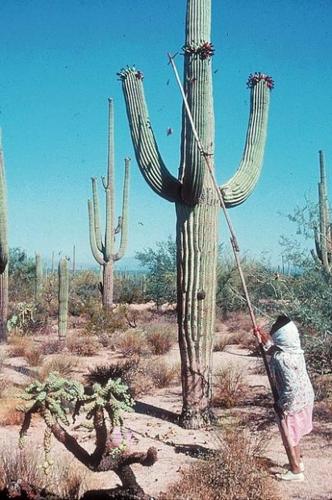
One of my informants is an observant vulture who spends a great deal of time circling over the nearby desert. He recently stopped by to report he'd seen some students leaving the Arizona-Sonora Desert Museum carrying long poles and buckets, then moving out in the desert to push those poles at the tops of saguaro cactus growing there.
"Who on earth goes out in the summer's heat to poke the tops of saguaros?" he asked.
I informed him that these students were learning about and, in some ways, following an ancient tradition of the Sonoran Desert's Tohono O'odham in collecting and processing the ripe saguaro fruit.
This Native American group lived very successfully in the desert environment for several thousands of years by careful use of the desert's resources, including saguaro fruit.
People are also reading…
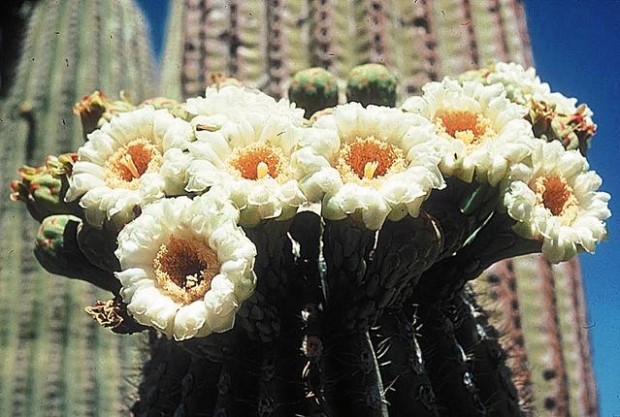
In April, May and June white flowers appear near the tips of the saguaros' trunks and branches. The fruit produced ripens by mid-June and into early July.
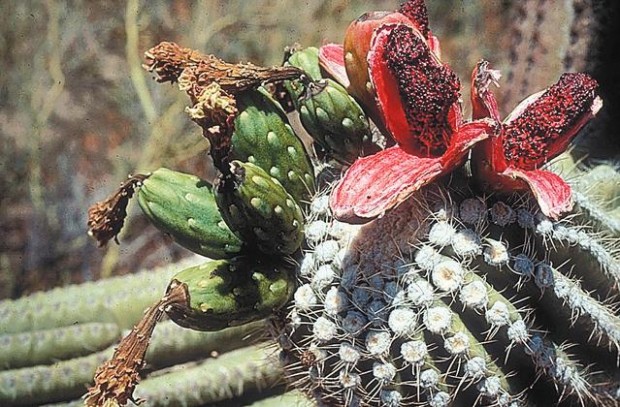
The outer covering of the fruit splits open into three or four lobes, revealing a bright red lining and a center mass of approximately 2,000 tiny black seeds embedded in red pulp.
Traditionally the Tohono O'odham set up camps in the saguaro forests, collected the fruit by pushing it loose from the cactus using a long pole composed of saguaro ribs, discarded the outer "rind" and cooked the fruit, processing it in a variety of ways to produce syrup, dried fruit, jam, vinegar, pinole, atole, oil, flour, wine and other products.
The saguaro fruit ripened at a time of year when winter stores of food had been exhausted and summer rains had not yet started to support new growth of food plants. The approximate time of year that today we call May was known by the O'odham as "Painful Month," a reference to the lack of food. Our June was designated "Saguaro Harvest Moon," the time when the people moved into their cactus camps. July was "Giant Cactus Ripe Month" during which the harvest was vigorously conducted.
Harvesting of the saguaro fruit was important not only as a physical survival measure, but was of prime importance in the Tohono O'odham's religious practices. Once the fruit had been harvested, part of the syrup was used to produce wine. This was drunk during special ceremonies that lasted several days and were known as the nawai't or saguaro wine feast. Through this observance the people sought to "bring down the clouds," or "sing down the rain," thus insuring the arrival of summer rains for their plantings of corn, beans and squash.
Once the Tohono O'odham families or groups arrived in the saguaro forests on foot, horseback, or in wagons and remained in camp for several weeks.
Today, far fewer people collect and process the fruit, they arrive in cars or pickups for a day, and seldom camp.
My vulture friend volunteered to carry out a reconnaissance and when he returned I was pleased to learn that there was at least one small Tohono O'odham group staying in a traditional camp in the nearby saguaro forest, processing this sweet, red gift of the giant cactus.
Clip 'n' save
Enjoy cool Summer Saturday Evenings at the Desert Museum. The museum will be open on Saturdays until 10 p.m. through the end of August. Special events will be scheduled each of those Saturday evenings.
A reduced admission of $5 for adults and $2 for children will be available for visitors arriving after 5 p.m.
July 22: Animal enrichment Night, 6 to 9 p.m. on Museum grounds. Storyteller Girard Tsonakwa, 7:30 to 8:30 p.m. in the Gallery.
July 29: Sonoran Sea Aquarium and Monterrey Bay Aquarium "Sustainable Seafood Night," 6 to 10 p.m. in the Gallery and on Museum grounds.
Aug. 5: Teacher Appreciation Night, 6 to 9 p.m. in the Gallery
Aug. 12: Wolf Awareness, 6 to 9 p.m. at the Mountain Habitat. Family Astronomy, 6 to 9 p.m. in the Gallery and on grounds.
Aug. 19: Storyteller Girard Tsonakwa, 7:30 to 8:30 p.m. in the Amphitheater. Live and "sort of" on the Loose, 7 to 8 p.m. in the Gallery.
Aug. 26: "All About Bats" 7 p.m. and 8 p.m. in the Gallery.