A José Canchola le pareció una tontería cuando le dieron solamente unos cuantos meses de vida despues que fue diagnosticado con cáncer en febrero del 2005.
Todavía le faltaba mucho por hacer.
El domingo, una enfermera le aseguró al negociante y filántropo que él ya había cumplido su función.
"Todo lo que Dios te ha pedido, tu lo has hecho", le dijo la enfermera, según Lupita Murillo, amiga de la familia. "Has alimentado a los pobres. Has vestido a los pobres".
El débil hombre de 76 años de edad abrió sus ojos y respondió: "Nunca lo pensé de esa manera", contó Murillo, quien es reportera para KVOA.
Canchola, quien estaba bajo cuidado en su casa en el área central de Tucsón por el último año, murió el 7 de enero rodeado de familiares, dijo su hijo mayor Anthony.
People are also reading…
Mientras la noticia de su muerte se extendía, miembros de la comunidad se les dificultaba encontrar las palabras para describir a Canchola.
"Él era un tesoro", dijo Nelba Chávez, quien conoció a Canchola por casi 30 años. "Él era un defensor para mucha gente".
Dianne Janis, quien trabajó en el área de mercadotecnia para Canchola, dijo que a ella le impresionó su entusiasmo por mejorar la vida de los niños.
Él realizó fiestas de Navidad y coordinó recaudaciones de ropa para niños necesitados del Sur de Arizona y Sonora, México. Siendo fan de beisbol, Canchola recompensaba a los estudiantes que no faltaban clases con llevarlos a los juegos de los Diamondbacks.
"No se trataba de calificaciones, sino del esfuerzo", comentó Janis. "Él era muy firme en cuanto a lo que él quería, y lo que él quería siempre era lo correcto. Él fue uno de los hombres más extraordinarios que he llegado a conocer".
Canchola fue uno de 11 hijos de inmigrantes mexicanos nacidos en Parsons, Kansas. Se mudó a Chicago cuando tenía 6 años para ser criado por sus abuelos.
Segun él, fue allí donde se le inculcó su ética de trabajo, su deber de ayudar a otros, así como su ambición.
Su carrera en inversiones bancarias- la cual duró 22 años- comenzó cuando era un distribuidor de periódicos en el distrito financiero de Chicago, donde interactuaba con banqueros y consultores económicos. Se convirtió en el primer miembro hispano del New York Stock Exchange en la década de 1950.
En los setentas Canchola aceptó un puesto gubernamental en Washington, D.C. durante las administraciones de Nixon y Ford, trabajando en un programa que ayudaba a encontrar oportunidades de empleo para minorías.
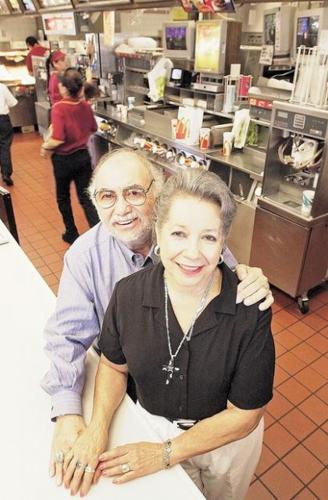
Se aventuró en el área de negocios de comida rápida en 1976 con un McDonald's en Nogales, Arizona, a una cuadra de la frontera internacional. Enventualmente se encargó de más de siete restaurantes, dos en Nogales y cinco en Tucsón.
El mes pasado la familia de Canchola vendió las tres franquisias en Nogales. Su hijo, Roger, maneja los cinco negocios en Tucsón.
En Nogales, la familia hizo una fiesta de Navidad por 30 años para niños de Nogales, Sonora.
La semana pasada, luego de escuchar la noticia de la venta del restaurante y del decline de la salud de Canchola, gente del Sur de Arizona cooperó para realizar una fiesta de Año Nuevo y una bienvenida a los nuevos propietarios y preservar la tradición familiar.
Los intereses de Canchola iban mucha más allá de las papitas y hamburguesas.
Fue alcalde de Nogales, Arizona de 1993 a 1994 y se convirtió en co-propietario de los Diamondbacks en 1993.
En el 2004, Canchola fue director honorario del Tucson-Pima Public Library Foundation y su recaudación llamada Campaign 21st Century.
También co-fundó el Ronald McDonald House de Tucsón, creó becas para estudiantes de periodismo y negocios de University of Arizona, y formó parte de varias mesas directivas, incluyendo las de Tucson Airport Authority y Tucson Electric Power Co.
Recibió el premio Crystal Apple Lifetime Achievement Award por su trabajo en la educación; el Lifetime Achievement Award de Hispanic Magazine y un nombramiento del Presidente Bush en el 2002 al National Commission on Educational Excellence for Hispanic Americans.
En el 2002 fue uno de los 49 héroes locales escogidos para cargar la llama olímpica a través de Tucsón.
El obispo de Tucsón Gerald F. Kicanas dijo que al llegar a la ciudad en el 2001, inició una amistad con Canchola, también fan de los Chicago White Sox.
"Él era un hombre con un gran corazón y una profunda compasión por los niños pobres", comentó Kicanas. "Y él era un luchador, aún durante su enfermedad".
El obispo paso tiempo con Canchola en su casa en los meses recientes para consolar a la familia y para rezar.
"Mientras sufría, el fue un hombre de profunda fe", Kicanas dijo. "Él era muy consciente de lo difícil que era para su familia cuidarlo y él era muy apreciativo".
A Canchola le sobreviven su esposa de 56 años, Carmen, y seis hijos, 12 nietos y un bisnieto.
Se realizará un velorio de 6 a 9 esta noche en St. Augustine Cathedral, localizada en 192 S. Stone Ave. Se rezará un rosario a las 7 p.m.
La misa funeraria será el sábado 12 de enero a la 1 p.m. en la catedral, y se segirá con el entierro en Holy Hope Cemetery, localizado en 3555 N. Oracle Road.
En vez de flores, la familia pide donaciones en nombre de José Canchola para el National Hispanic Scholarship Fund, 55 Second St.; Suite 1500; San Francisco, California 94105.
Given only a few months to live after his February 2005 cancer diagnosis, José Canchola dismissed the prognosis as nonsense.
He still had a lot of business to take care of.
On Sunday, a hospice nurse assured the Southern Arizona businessman and philanthropist that he had fulfilled his duties.
"Everything that the Lord has asked you to do, you have done," the nun told him, according to family friend, Lupita Murillo. "You have fed the poor. You have clothed the poor."
The frail 76-year-old opened his eyes, said Murillo, a KVOA reporter, and he replied: "I never thought of it that way."
Canchola, who was in hospice care at his central Tucson home for the past year, died early Monday, surrounded by family and friends, his oldest son Anthony said.
As word of his death spread, community members struggled to find the right adjective to describe Canchola.
"He was such a treasure," said Nelba Chavez, who knew Canchola for almost 30 years. "He was a champion for so many people."
Dianne Janis, who at one time did marketing work for Canchola, said she was impressed with his zeal to better the lives of children.
He hosted Christmas parties and coordinated clothing drives for needy children in Southern Arizona and Sonora, Mexico. And the die-hard baseball fan rewarded students with perfect school attendance by treating them to Diamondbacks baseball games.
"It wasn't about the grades, but the effort," Janis said. "He was very firm in what he wanted and what he wanted was always the right thing. He was one of the most remarkable men I have ever met."
One of 11 children born in Parsons, Kan., to immigrant parents from Mexico, Canchola moved to Chicago when he was 6 to be raised by his grandparents.
It was there, he often said, that his hard-work ethic and sense of duty to help others was instilled in him. So was his ambition.
His career in investment banking — that went on to last 22 years — began when he was a paperboy in Chicago's financial district, hobnobbing with bankers and brokers. He became the first Hispanic member of the New York Stock Exchange in the 1950s.
In the 1970s, Canchola accepted a government job in Washington, D.C., during the Nixon and Ford administrations, working in a federally funded program that helped find employment opportunities for minorities.
He ventured into the fast-food business in 1976 and broke ground on a McDonald's restaurant in Nogales, Ariz., a block from the international border. He eventually took over seven more restaurants, two in Nogales and five in Tucson.
Last month, Canchola's family sold the three franchises in Nogales. His son, Roger, runs the five Tucson operations.
In Nogales, the family hosted a Christmas Day party for children from neighboring Nogales, Sonora, for 30 years.
Last week, after hearing the news of the restaurant's sale and Canchola's failing health, people from across Southern Arizona rallied to pull together a party on New Year's Day to both welcome the new owners and honor the family's tradition.
Canchola's interests and passions went far beyond burgers and fries.
He served as the mayor of Nogales in 1993-1994 and became part owner of the Arizona Diamondbacks in 1993.
In 2004, Canchola was honorary chairman of the Tucson-Pima Public Library Foundation and its fund-raising drive, Campaign 21st Century. He co-founded the Ronald McDonald House in Tucson, created scholarships for journalism and business students at the University of Arizona and sat on numerous boards, including the Tucson Airport Authority and Tucson Electric Power Co.
He received the Crystal Apple Lifetime Achievement Award for his work in education; the Lifetime Achievement Award from Hispanic Magazine and an appointment from President Bush in 2002 to the National Commission on Educational Excellence for Hispanic Americans.
In 2002, he was one of 49 local heroes chosen to carry the Olympic flame through Tucson.
Tucson Bishop Gerald F. Kicanas said upon his arrival to Tucson in 2001, that he bonded with Canchola, a fellow Chicago White Sox fan.
"He was a man with a big heart and deep compassion for poor kids," Kicanas said. "And he was a fighter, even in his illness."
The bishop spent time with Canchola at his home in recent months to comfort his family and pray.
"While suffering, he was a man of deep faith," Kicanas said. "He was very sensitive to how difficult it was for his family to care for him and he was so appreciative."
Canchola is survived by his wife of 56 years, Carmen; six children, 12 grandchildren and one great-grandchild.
Visitation will be from 6 to 9 p.m. Friday at St. Augustine Cathedral, 192 S. Stone. A rosary will be said at 7 p.m.
The funeral Mass is Saturday at 1 p.m. at the cathedral with interment to follow at Holy Hope Cemetery, 3555 N. Oracle Road.
In lieu of flowers, the family asks that donations be made in José Canchola's name to the National Hispanic Scholarship Fund, 55 Second St.; Suite 1500; San Francisco, Calif. 94105