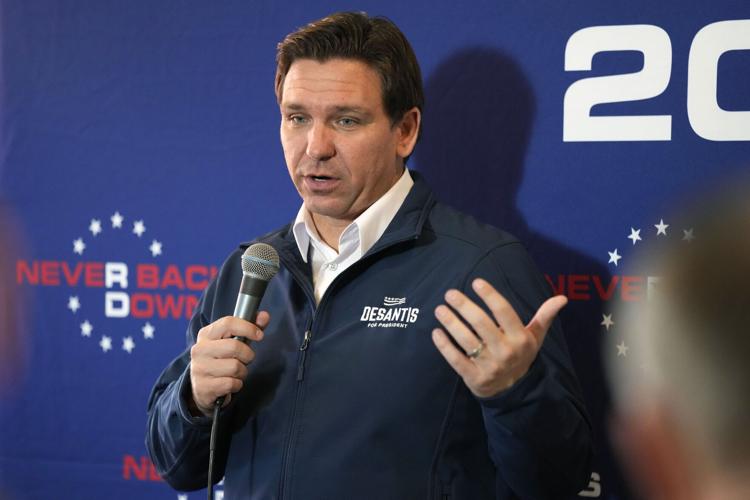
TALLAHASSEE, Fla. — A Florida governor wins reelection by record numbers and later finds himself running as a party conservative in a crowded presidential primary. In New Hampshire, he tip-toes around the explosive abortion rights issue, discusses ongoing Israeli military operations, promises he’ll secure the Mexican border and warns that the current administration’s fiscal insanity will cause more inflation, not reduce it.
While it sounds like Republican Gov. Ron DeSantis in 2023, this was former Florida Democratic Gov. Reubin Askew in 1984. Askew dropped out of the race after finishing eighth in New Hampshire. DeSantis is looking to avoid a similar fate as he prepares for the third GOP debate this week in his home state.

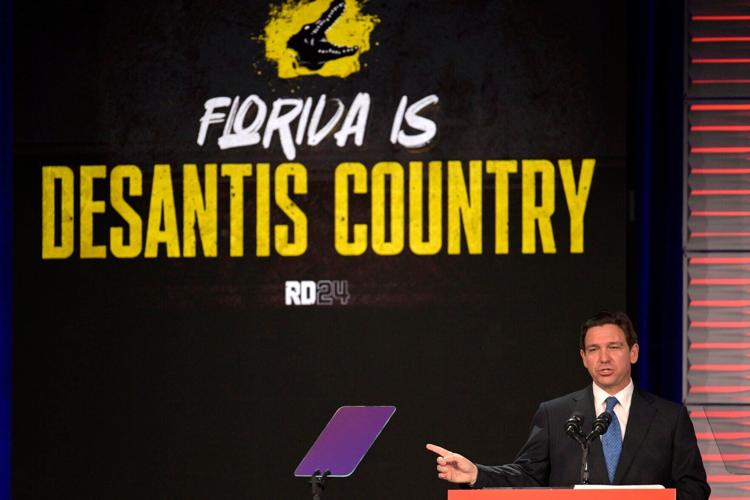
Republican presidential candidate Florida Gov. Ron DeSantis addresses attendees Saturday at the Republican Party of Florida Freedom Summit in Kissimmee, Fla.
If DeSantis or former President Donald Trump eventually is elected president next year, it would be the first time Americans have chosen a Floridian to lead them. Trump was a New York snowbird with a second home in Palm Beach when he was first elected, but he later lost as a full-time Floridian.
People are also reading…
So while Florida is home to Disney World’s Hall of Presidents, that’s not the place to look for representation from the nation’s third-largest state. And even if home court advantage gives DeSantis an opening to talk about his accomplishments in the Sunshine State, there’s no historical evidence to suggest it will help him in the race itself.
“I really have no idea why this is the case,” said former Gov. Jeb Bush, who was considered the frontrunner for the 2016 Republican presidential primary before Donald Trump’s ascent reshaped the party.
Florida has long been influential in national politics — never more so than in 2000 when there were five weeks of recounts and court challenges before George W. Bush carried the state and won the presidency, by 537 votes. And more and more Floridians have sought the presidency as its population has exploded and Republicans chased Democrats out of power in Tallahassee.

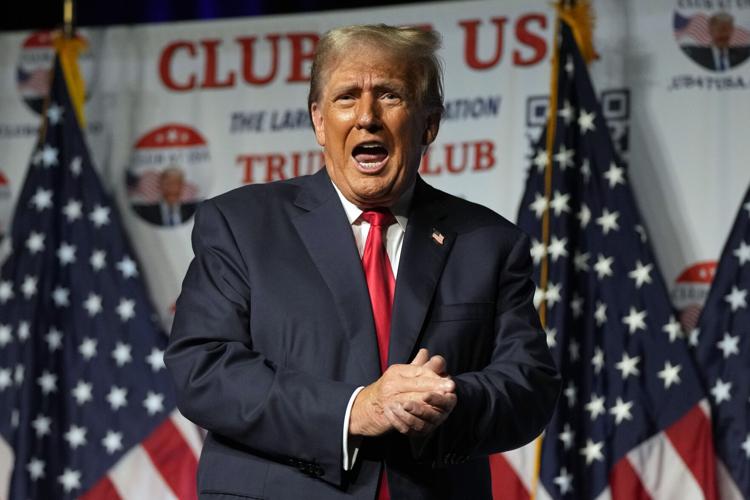
Former President Donald Trump acknowledges attendees before speaking Saturday at the Republican Party of Florida Freedom Summit in Kissimmee, Fla.
Early in the 2016 presidential cycle, many political observers thought former Gov. Bush or Sen. Marco Rubio would win the Republican nomination to challenge Democrat Hillary Clinton. Trump at first wasn’t taken seriously by either campaign — until he blasted both of the Floridians with insults as he rose to the top of the GOP pile.
It wasn’t the moment for either. Bush would have been the third member of his family to become president, and Trump’s nickname of “Low Energy Jeb” seemed to stick at a time when voters were in no mood for an establishment candidate with a whiff of inevitability, maybe even entitlement.
Rubio brought youthful energy to the campaign, but he never found his footing against a brawling candidate who specialized in branding and dubbed him “Little Marco.” Rubio tried to match Trump with branding of his own, taunting Trump about the size of his hands at one point, but the shift in strategy only seemed to diminish him further — and by then Trump was well on his way to the GOP nomination.

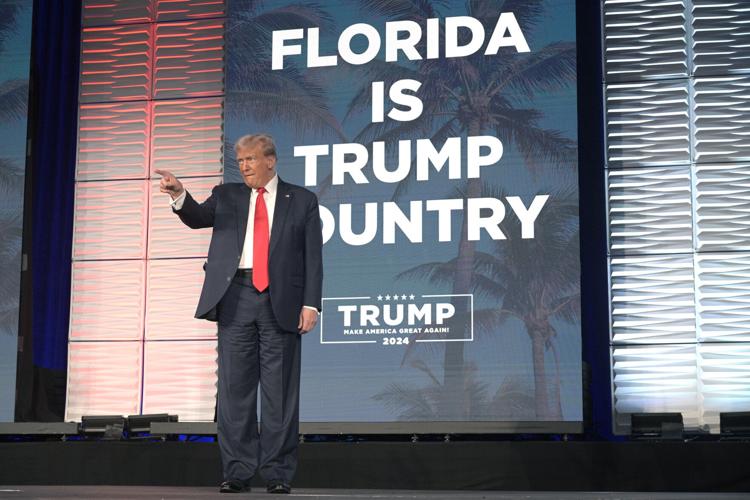
Republican presidential candidate and former President Donald Trump gestures Oct. 11 after speaking at the Palm Beach County Convention Center in West Palm Beach, Fla. Trump carried Florida in 2020 but lost to President Joe Biden in the Rust Belt.
By 2020, Trump had become a Floridian himself, changing his residence and voter registration to Florida, a state he desperately needed to win to earn a second term in the White House. He did carry the state but lost to President Joe Biden in the Rust Belt, thus adding his name to the list of Floridians who lost a presidential bid. That list keeps growing but includes Askew, Bush, Rubio, and former Sen. Bob Graham.
There is another notable asterisk: President Andrew Jackson was the first territorial governor of Florida in 1821, but it was a short stint to keep him busy as he tried to retire. It’s described as “a troublesome few months” before he returned home to Tennessee and eventually ran for the White House from the Volunteer State.
“If you track Jackson’s progress towards being a presidential candidate, Florida has very, very little to do with it,” said Daniel Feller, a Jackson historian and professor emeritus at the University of Tennessee. “Florida didn’t do much damage to his national reputation, but it certainly didn’t help it any.”
Politics were decidedly different then anyway. Jackson basically took the job as a favor to President James Monroe after the U.S. took over the territory from Spain.

Republican presidential candidate Florida Gov. Ron DeSantis speaks during a meet and greet Friday in Denison, Iowa.
Florida had a sparse population when it became a state in 1845. The federal census five years earlier counted fewer than 55,000 people, nearly half of whom were African American slaves. It wasn’t until air conditioning became more affordable and effective in the middle of the 20th century that the state’s population started to grow.
That changed in a hurry, though. It more than doubled from fewer than 2 million in 1940 to more than 5 million in 1960 and hasn’t stopped growing.
As the population has changed, the state’s politics have shifted. What had been the key swing state in 2000 has been reliably Republican in the past two presidential contests.
Trump is once again leading in Florida polls. While he won’t participate in Wednesday’s debate in Miami, he is holding a rally nearby in a city that’s 95% Hispanic or Latino, a signal he’s seeking to boost support with the state’s Hispanic voters.
The one sure bet is that Floridians will keep trying to win the White House. If neither DeSantis nor Trump win in 2024, there’s always 2028 and the possibility Rubio and DeSantis run again, perhaps joined by former governor and current Sen. Rick Scott, who has long been speculated to have presidential ambitions.
A look at some of the 2024 presidential candidates
Here’s a closer look at some of the Republican and Democratic candidates running for the nomination for president in 2024.

In April of 2023, Robert F. Kennedy Jr. announced he is running for the Democratic nominee for President of the United States in the 2024 elec…

Self-help author Marianne Williamson, whose 2020 White House campaign featured more quirky calls for spiritual healing than actual voter suppo…

President Joe Biden is running for reelection in 2024, asking voters to give him more time to “finish this job” and extend the run of America’…

When former Arkansas Gov. Asa Hutchinson kicked off his 2024 bid in April, he did so from his hometown of Bentonville, on the same steps where…

North Dakota Gov. Doug Burgum touted his small-town roots and business experience as he announced his candidacy for the 2024 Republican presid…

Former Texas Republican Representative Will Hurd is running for President of the United States. Hurd is a critic of former President Donald Tr…

Former New Jersey Gov. Chris Christie is running for president of the United States once again. Christie ran before in 2016 as he faced-off ag…

Former Republican South Carolina Gov. Nikki Haley is running for President of the United States in the 2024 election. Haley is the daughter of…

Republican presidential hopeful Vivek Ramaswamy is a wealthy biotech entrepreneur and investor and the author of “Woke, Inc.," initially launc…

South Carolina Sen. Tim Scott has launched his presidential campaign offering an optimistic and compassionate message he's hoping can serve as…

Florida Gov. Ron DeSantis has formally entered the Republican presidential primary contest. As of now, he is considered former President Donal…

Former Vice President Mike Pence joins many candidates running for the Republican nomination for president in 2024, and is the first vice pres…

Former President Donald J. Trump is running for office once again. He was defeated by sitting President Joe Biden in the 2020 election. When t…