
MEKELE, Ethiopia — In a scrubby garden at an elementary school stand 12 wooden posts, one for each student killed on a summer afternoon eight years ago, when a warplane from neighboring Eritrea dropped a pair of cluster bombs.
In all, 47 people died in the schoolyard that day — the deadliest for civilians during a war between Ethiopia and Eritrea that has cost 70,000 lives but failed to resolve the root of the conflict: ownership of a few shards of land along the countries' mountainous border.
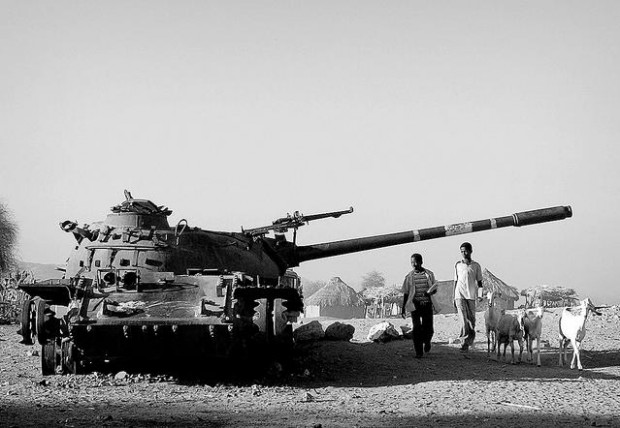
Today, in the jagged terrain north of Mekele, the countries have amassed at least 200,000 troops on either side of the border. Their presence has raised fears of a new war that analysts said would kill thousands more and plunge the Horn of Africa, including ever-volatile Sudan and Somalia, deeper into crisis.
A team of senior U.S. diplomats, led by Assistant Secretary of State for African Affairs Jendayi Frazer, is due to arrive this week for talks to try to defuse the tension in a region that's important in the war against terror. Ethiopia hosts U.S. troops along its eastern border with Somalia, a potential outpost of groups allied with al-Qaida.
People are also reading…
Few observers are optimistic about Washington's chances to break the deadlock between two impoverished countries for which the fate of a handful of dry frontier towns is a matter of the deep national pride.
"I hope the Americans have something creative up their sleeve," said Kinfe Abraham, head of the Ethiopian International Institute for Peace and Development, a policy research group allied with the Ethiopian government.
Crisis stems from 2000
In recent months, Eritrea has so restricted the operations of U.N. peacekeeping forces placed along the border to monitor the cease-fire that U.N. Secretary-General Kofi Annan has raised the possibility that the mission could withdraw.
The U.N. Security Council recently postponed talks on the fate of the peacekeeping mission to give the U.S. envoys a chance to work.
The deadlock stems from 2000, when the warring countries agreed to a truce that allowed an independent commission to draw up a boundary.
Two years later, the commission awarded the village of Badme, which Ethiopian troops held during the war, to Eritrea.
Ethiopia was incensed at losing land to its tiny northern neighbor, which once had been an Ethiopian province. It refused to give up Badme. Eritrea has refused to discuss any other issue with Ethiopia until that happens, and Eritrea's president, Isaias Afwerki, has kept his country on a war footing, with a military that accounts for 10 percent of the population.
Analysts and diplomats agree that neither side can afford a war. The threat of a new conflict sharply intensified in October, when Eritrea suddenly banned U.N. helicopter flights within its airspace.
The move has made it impossible for peacekeepers to monitor remote parts of the disputed area, and last week Annan reported that several hundred armed Eritreans had been spotted at various locations within a demilitarized zone along the border. The chances of a military miscalculation are high, analysts said.
Tensions have diminished slightly in recent weeks. Ethiopia complied with a U.N. directive to pull eight divisions back from the border, and this week U.N. military officials said they had seen no tanks or other offensive deployments by Eritrean forces.
But in northern Ethiopia, where the sting of the last war is still felt, people are fearful. Hundreds of Ethiopian troops are said to be based in the hills surrounding Mekele, an important commercial center where residents have ties on both sides.