KHARKIV, Ukraine — There is activity at the Kharkiv Institute of Physics and Technology, but it’s not what scientists at its cutting-edge nuclear laboratory trained for.
Staff at the U.S.-funded atomic research lab in northeastern Ukraine spend their days patching up the facility, which has been badly damaged by repeated Russian strikes.

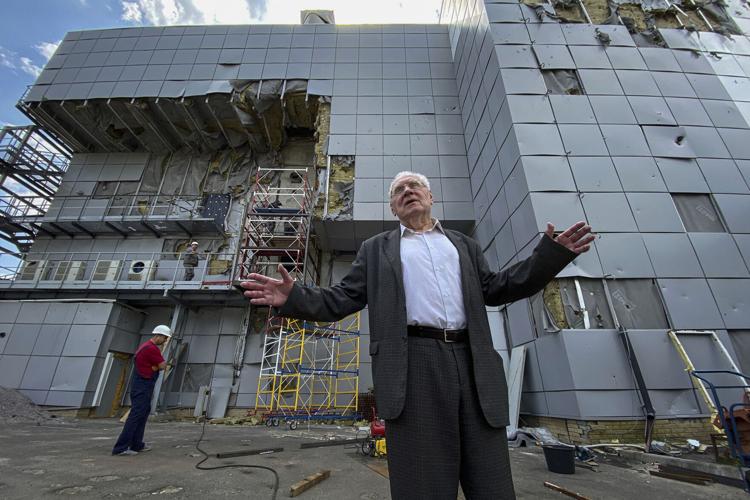
Mykola Shulga, general director of the Kharkiv Institute of Physics and Technology, shows damage to the nuclear laboratory building May 18 in Kharkiv, Ukraine.
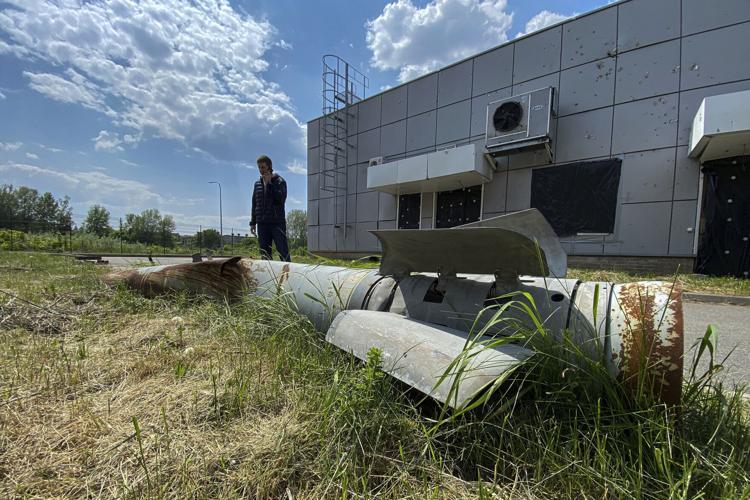
More than a year after missiles first hit, the wind batters boarded-up windows and exposed insulation flaps. When the Associated Press visited last month, debris was heaped in piles, and rocket parts sat near craters up to 8 feet deep.
Staff said the site was struck some 100 times with rockets and bombs during the first months of the war, and attack remains a constant threat. Kharkiv, near the war’s front line and the Russian border, is shelled almost daily from the neighboring Belgorod region of Russia.
People are also reading…
Before Russia’s invasion, the institute was a jewel in the crown of Ukraine’s highly developed nuclear research sector. Its experimental reactor had opened only six months earlier, designed to offer training and research facilities and to make medical isotopes used in cancer treatment.
While those fearing a nuclear accident focused their attention on Ukraine’s huge Zaporizhzhia Nuclear Power Plant, which is under Russian control, the Kharkiv lab’s small reactor also poses a risk, though so far there have been no leaks.
Mykola Shulga, general director of the institute’s National Science Center, said the damage is “significant — but we are doing repairs on our own.”
“The strikes on this installation were intentional,” Shulga said, in front of a modern gray building whose panels have been ripped off or are pocked with shrapnel holes. “This wall here was hit with seven missiles.”
The International Atomic Energy Agency also accused Russia of “sustained targeting” of the research lab. A delegation from the agency visited in November and found almost all buildings on the site were damaged, “many of them probably beyond repair.” IAEA chief Rafael Mariano Grossi called the extent of the damage “shocking” and worse than expected.
The one positive note, IAEA inspectors said, was that there was no release of radiation from the lab’s small experimental reactor.
Ukraine’s nuclear inspectorate said shelling last year damaged the facility’s heating, cooling and ventilation systems. An electrical substation and diesel generators were destroyed, leaving the site without electricity for a time.
The Prosecutor’s Office and the Security Service of Ukraine opened criminal cases for alleged war crimes and “ecocide” — one of several proceedings accusing Russia of environmental destruction.

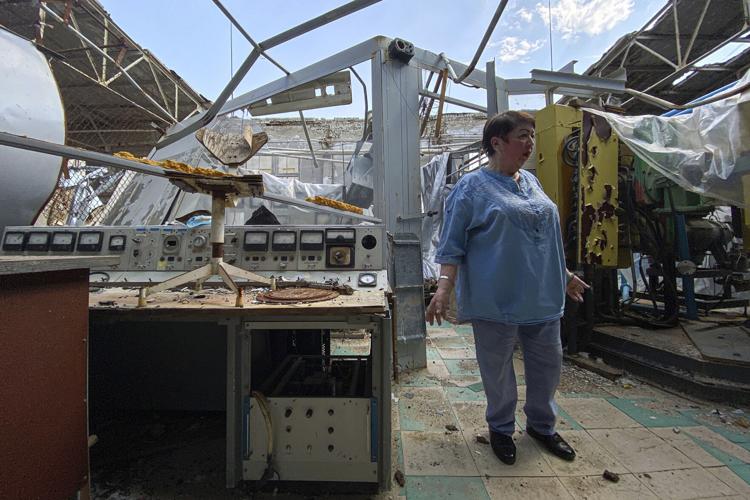
Galyna Tolstolutska, head of the department of radiation damage and radiation materials science of the Kharkiv Institute of Physics and Technology, shows damage to her department May 18 in Kharkiv, Ukraine.
“Here, you see. It used to be control panel. Most certainly it’s of no use anymore,” said Galyna Tolstolutska, head of the department of radiation damage and radiation materials science, looking around a room of equipment wrecked when the ceiling was shattered by a bomb. “This entire place was exposed to rain, snow, anything.”
In communist times, the Kharkiv facility’s research helped develop nuclear weapons, making it a Soviet equivalent of Los Alamos in the United States. After the collapse of the Soviet Union in the early 1990s, the U.S. agreed to fund Ukrainian nuclear research in exchange for Ukraine getting rid of its stockpiles of nuclear bomb-making material.
The U.S. government says the Kharkiv nuclear facility, built in collaboration with the Argonne National Laboratory near Chicago, is the first of its kind in the world, “designed to produce medical isotopes, train nuclear professionals, support the Ukrainian nuclear industry and provide experimental capabilities for performing reactor physics, materials, and basic science research.” It started operation in August 2021.
Russia’s invasion reawakened Europe’s fear of nuclear war, and nuclear accident. Fighting has erupted intermittently around Zaporizhzhia, Europe’s largest nuclear power plant, sparking fears of a catastrophic radiation leak like the disaster at Chernobyl in northern Ukraine, where a reactor exploded in 1986, sending radiation over a vast area.

Andrii Savchenko, head of the department for ensuring the operation of engineering of the Kharkiv Institute of Physics and Technology, speaks by phone in front of a fragment of a Russian rocket May 18 in Kharkiv, Ukraine.
Kharkiv does not pose the same level of risk. The Kharkiv reactor was put into a “deep subcritical state” — essentially sent into hibernation — on the first day of the war, and it contains far less nuclear fuel than a power plant.
Paddy Regan, professor of nuclear physics at the University of Surrey, said research reactors are typically 100 times smaller than civilian nuclear power reactors.
“These accelerator-driven systems are nothing like civilian nuclear reactors,” Regan said. “They’re futuristic design ideas” aimed at creating “an inherently safe reactor system” without the potential for meltdowns of existing power reactors.
“There’s much more danger from the bombs than from any radiation material,” Regan said.
Still, the State Nuclear Regulatory Inspectorate of Ukraine warned of potential “severe radiation consequences and contamination of the surrounding territories,” should the reactor be damaged. Institute staff say radiation could spread for 6 miles, covering an area home to 640,000 people.
Timeline: A look at key moments in a year of war between Russia and Ukraine
A month-by-month timeline of the war in Ukraine
The war in Ukraine that began a year ago has killed thousands, forced millions to flee their homes, reduced entire cities to rubble and has fueled fears the confrontation could slide into an open conflict between Russia and NATO.
A look at some of the main events in the conflict.
Feb. 24, 2022: Russia invades Ukraine

On Feb. 24, Russian President Vladimir Putin launches an invasion of Ukraine from the north, east and south. He says the "special military operation" is aimed at "demilitarization" and "denazification" of the country to protect ethnic Russians, prevent Kyiv's NATO membership and to keep it in Russia's "sphere of influence." Ukraine and the West say it's an illegal act of aggression against a country with a democratically elected government and a Jewish president whose relatives were killed in the Holocaust.
Russian troops quickly reach Kyiv's outskirts, but their attempts to capture the capital and other cities in the northeast meet stiff resistance. Ukrainian President Volodymyr Zelenskyy records a video outside his headquarters to show he is staying and remains in charge.
About the photo: Traffic jams are seen as people leave the city of Kyiv, Ukraine, Thursday, Feb. 24, 2022.
March 2, 2022: Russia takes Kherson, gets stuck near Kyiv

On March 2, Russia claims control of the southern city of Kherson. In the opening days of March, Russian forces also seize the rest of the Kherson region and occupy a large part of the neighboring Zaporizhzhia region, including the Zaporizhzhia Nuclear Power Plant, Europe's largest.
The Russian army soon gets stuck near Kyiv, and its convoys — stretching along highways leading to the Ukrainian capital — become easy prey for Ukrainian artillery and drones.
About the photo: Russian's army tanks move down a street on the outskirts of Mariupol, Ukraine, Friday, March 11, 2022.
March 29, 2022: Russia withdraws from Kyiv, shifts focus east

Moscow announces the withdrawal of forces from Kyiv and other areas March 29, saying it will focus on the eastern industrial heartland of the Donbas, where Russia-backed separatists have fought Ukrainian forces since 2014 following the illegal annexation of Crimea.
About the photo: People with Ukrainian flags walk toward Russian army trucks during a rally against the Russian occupation in Kherson, Ukraine, on March 20, 2022. As Russian forces sought to tighten their hold on Melitopol, hundreds of residents took to the streets to demand the mayor's release.
April 2022: Mass graves discovered in Bucha

The Russian pullback from Kyiv reveals hundreds of bodies of civilians in mass graves or left in the streets of the town of Bucha, many of them bearing signs of torture in scenes that prompt world leaders to say Russia should be held accountable for possible war crimes.
About the photo: Police work to identify civilians who were killed during the Russian occupation in Bucha, Ukraine, on the outskirts of Kyiv, before sending the bodies to the morgue, Wednesday, April 6, 2022.
April 9, 2022: Russia strikes train station, killing 52 civilians

On April 9, a Russian missile strike on a train station in the eastern city of Kramatorsk kills 52 civilians and wounds over 100.
Intense battles rage for the strategic port of Mariupol on the Sea of Azov, and Russian air strikes and artillery bombardment reduce much of it to ruins.
About the photo: People board buses during their evacuation, with a Soviet MiG-17 fighter jet monument in the background, in Kramatorsk, Ukraine, Saturday, April 9, 2022. After the bombing of the train station, residents continued their attempts to leave the city on buses and other transports.
April 13, 2022: Ukraine sinks Russian missile cruiser

On April 13, the missile cruiser Moskva, the flagship of the Russian Black Sea Fleet, is hit by Ukrainian missiles and sinks the next day, damaging national pride.
About the photo: The Russian missile cruiser Moskva, the flagship of Russia's Black Sea Fleet is seen anchored in the Black Sea port of Sevastopol, on Sept. 11, 2008.
May 16, 2022: Ukraine defenders surrender key steel mill

On May 16, Ukrainian defenders of the giant Azovstal steel mill, the last remaining Ukrainian stronghold in Mariupol, agree to surrender to Russian forces after a nearly three-month siege. Mariupol's fall cuts Ukraine off from the Azov coast and secures a land corridor from the Russian border to Crimea.
About this photo: In this photo provided by Azov Special Forces Regiment of the Ukrainian National Guard Press Office, a Ukrainian soldier stands inside the ruined Azovstal steel plant prior to surrender to the Russian forces in Mariupol, Ukraine, May 16, 2022.
May 18, 2022: Finland, Sweden apply for NATO membership

On May 18, Finland and Sweden submit their applications to join NATO in a major blow to Moscow over the expansion of the military alliance.
About the photo: NATO Secretary-General Jens Stoltenberg displays documents as Sweden and Finland applied for membership in Brussels, Belgium, May 18, 2022.
June 2022: Western weapons flow into Ukraine

More Western weapons flow into Ukraine, including U.S.-supplied HIMARS multiple rocket launchers.
About the photo: Ukrainian soldiers fire at Russian positions from a U.S.-supplied M777 howitzer in Ukraine's eastern Donetsk region June 18, 2022.
June 30, 2022: Russian troops pull back from Snake Island

On June 30, Russian troops pull back from Snake Island, located off the Black Sea port of Odesa and seized in the opening days of the invasion.
About the photo: In this photo provided by the Ukrainian Defense Ministry Press Office on Thursday, July 7, 2022, Ukrainian soldiers install the state flag on Snake island, in the Black Sea.
July 22, 2022: Deal struck on grain exports

On July 22, Russia and Ukraine, with mediation by Turkey and the United Nations, agree on a deal to unblock supplies of grain stuck in Ukraine's Black Sea ports, ending a standoff that threatened global food security.
About the photo: Turkish President Recep Tayyip Erdogan, right, and U.N. Secretary General, Antonio Guterres, sit as Sergei Shoigu, Russia's Defense Minister, and Hulusi Akar, Turkey's Defense Minister, shake hands during a signing ceremony at Dolmabahce Palace in Istanbul, Turkey, July 22, 2022.
July 29, 2022: 53 killed in missile strike on prison

On July 29, a missile strike hits a prison in the Russia-controlled eastern town of Olenivka where Ukrainian soldiers captured in Mariupol were held, killing at least 53. Ukraine and Russia trade blame for the attack.
About the photo: In this photo taken from video a view of a destroyed barrack at a prison in Olenivka, in an area controlled by Russian-backed separatist forces, eastern Ukraine, Friday, July 29, 2022.
Aug. 9, 2022: Ukraine strikes air base in Crimea

On Aug. 9, powerful explosions strike an air base in Crimea. More blasts hit a power substation and ammunition depots there a week later. signaling the vulnerability of the Moscow-annexed Black Sea peninsula that Russia has used as a major supply hub for the war. Ukraine's top military officer later acknowledges that the attacks on Crimea were launched by Kyiv's forces.
About the photo: Rising smoke can be seen from the beach at Saky after explosions were heard from the direction of a Russian military airbase near Novofedorivka, Crimea, Aug. 9, 2022.
Aug. 20, 2022: Daughter of Russian ideologist killed in car bombing

On Aug. 20, Darya Dugina, the daughter of Russian nationalist ideologist Alexander Dugin, dies in a car bomb explosion outside Moscow that the Russian authorities blame on Ukraine.
About the photo: Philosopher Alexander Dugin speaks during the final farewell ceremony for his daughter Daria Dugina in Moscow, Russia, Tuesday, Aug. 23, 2022.
Sept. 6, 2022: Ukraine counteroffensive retakes parts of Kharkiv region

On Sept. 6, the Ukrainian forces launch a surprise counteroffensive in the northeastern Kharkiv region, quickly forcing Russia to pull back from broad areas held for months.
About the photo: A Ukrainian national guard serviceman stands atop a destroyed Russian tank in an area near the border with Russia, in Kharkiv region, Ukraine, Sept. 19, 2022.
Sept. 21, 2022: Putin orders mobilization of reservists, stages illegal "referendums"

On Sept. 21, Putin orders mobilization of 300,000 reservists, an unpopular move that prompts hundreds of thousands of Russian men to flee to neighboring countries to avoid recruitment. At the same time, Russia hastily stages illegal "referendums" in Ukraine's Donetsk, Luhansk, Kherson and Zaporizhzhia regions on whether to become part of Russia. The votes are widely dismissed as a sham by Ukraine and the West.
About the photo: Riot police block a street during a protest against mobilization in Moscow, Russia, Wednesday, Sept. 21, 2022.
Sept. 30, 2022: Putin claims annexation of 4 regions

On Sept. 30, Putin signs documents to annex the four regions at a Kremlin ceremony.
About the photo: From left, Moscow-appointed head of Kherson Region Vladimir Saldo, Moscow-appointed head of Zaporizhzhia region Yevgeny Balitsky, Russian President Vladimir Putin, Denis Pushilin, leader of self-proclaimed of the Donetsk People's Republic and Leonid Pasechnik, leader of self-proclaimed Luhansk People's Republic pose for a photo during a ceremony to sign the treaties for four regions of Ukraine to join Russia, at the Kremlin in Moscow, Friday, Sept. 30, 2022.
October 2022: Bridge linking Crimea and Russia attacked

On Oct. 8, a truck laden with explosives blows up on the bridge linking Crimea to Russia's mainland in an attack that Putin blames on Ukraine. Russia responds with missile strikes on Ukraine's power plants and other key infrastructure.
After the first wave of attacks on Oct. 10, the barrage continues on a regular basis in the months that follow, resulting in blackouts and power rationing across the country.
About the photo: Flame and smoke rise from the Crimean Bridge connecting Russian mainland and the Crimean peninsula over the Kerch Strait, in Kerch, Crimea, Oct. 8, 2022.
November 2022: Russia retreats from Kherson

On Nov. 9, Russia announces a pullback from the city of Kherson under a Ukrainian counteroffensive, abandoning the only regional center Moscow captured, in a humiliating retreat for the Kremlin.
About the photo: Ukrainian servicemen check the trenches dug by Russian soldiers in a retaken area in Kherson region, Ukraine, Wednesday, Oct. 12, 2022.
Dec. 5, 2022: Ukraine uses drones to hit Russian targets

On Dec. 5, the Russian military says Ukraine used drones to target two bases for long-range bombers deep inside Russian territory. Another strike takes places later in the month, underlining Ukraine's readiness to up the ante and revealing gaps in Russian defenses.
About the photo: Ukrainian soldiers watch a drone feed from an underground command center in Bakhmut, Donetsk region, Ukraine, Sunday, Dec. 25, 2022.
Dec. 21, 2022: Zelenskyy visits US

On Dec. 21, Zelenskyy visits the United States on his first trip abroad since the war began, meeting with President Joe Biden to secure Patriot air defense missile systems and other weapons and addressing Congress.
About the photo: Vice President Kamala Harris and House Speaker Nancy Pelosi of Calif., right, react as Ukrainian President Volodymyr Zelenskyy presents lawmakers with a Ukrainian flag autographed by front-line troops in Bakhmut, in Ukraine's contested Donetsk province, as he addresses a joint meeting of Congress on Capitol Hill in Washington, Wednesday, Dec. 21, 2022.
Jan. 1, 2023: Ukraine kills scores of freshly mobilized Russian soldiers

On Jan. 1, just moments into the New Year, scores of freshly mobilized Russian soldiers are killed by a Ukrainian missile strike on the city of Makiivka. Russia's Defense Ministry says 89 troops were killed, while Ukrainian officials put the death toll in the hundreds.
About the photo: Workers clean rubbles after Ukrainian rocket strike in Makiivka, in Russian-controlled Donetsk region, eastern Ukraine, Tuesday, Jan. 3, 2023.
Jan. 12, 2023: Russia claims capture of Soledar

After months of ferocious fighting, Russia declares the capture of the salt-mining town of Soledar on Jan. 12, although Kyiv does not acknowledge it until days later. Moscow also presses its offensive to seize the Ukrainian stronghold of Bakhmut.
About the photo: Ukrainian servicemen fire a 120mm mortar towards Russian positions at the frontline near Bakhmut, Donetsk region, Ukraine, Wednesday, Jan. 11, 2023.
Jan. 14, 2023: Russian strike kills 45 in apartment building

On Jan. 14, when Russia launches another wave of strikes on Ukraine's energy facilities, a Russian missile hits an apartment building in the city of Dnipro, killing 45.
About the photo: Emergency workers clear the rubble after a Russian rocket hit a multistory building leaving many people under debris in the southeastern city of Dnipro, Ukraine, Saturday, Jan. 14, 2023.
Feb. 20, 2023: Biden makes surprise visit to Kyiv

On Feb. 20, U.S. President Joe Biden makes a surprise visit to Kyiv where he meets with the Ukrainian president in a remarkable and defiant display of solidarity.
About the photo: US President Joe Biden, center, meets with Ukrainian President Volodymyr Zelenskyy, right, and Olena Zelenska, left, spouse of President Zelenskyy, at Mariinsky Palace during an unannounced visit in Kyiv, Ukraine, Monday, Feb. 20, 2023.