If your image of nuclear power is giant, cylindrical concrete cooling towers pouring out steam on a site that takes up hundreds of acres of land, soon there will be an alternative: tiny nuclear reactors that produce only one-hundredth the electricity and can even be delivered on a truck.
Relatively small but meaningful amounts of electricity — almost enough to run a small campus, a hospital or a military complex, for example — will pulse from a new generation of micronuclear reactors. Some universities are taking interest.

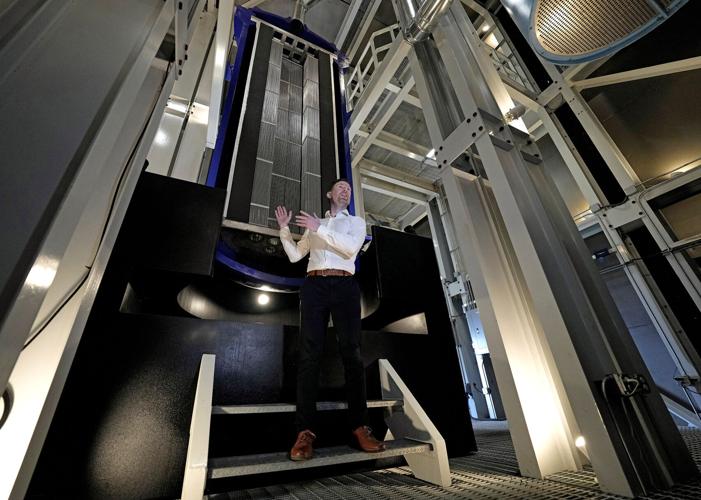
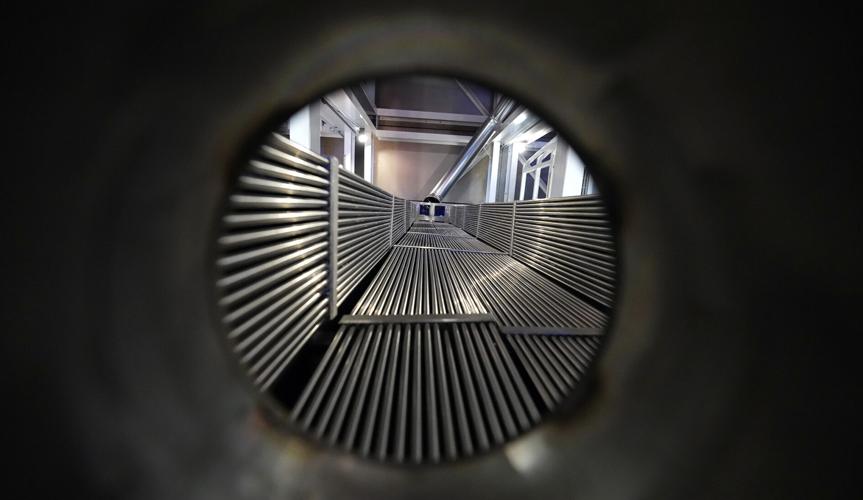
A cross-section of a prototype reactor is shown inside Last Energy’s microreactor demonstration unit Jan. 17 in Brookshire, Texas.
“What we see is these advanced reactor technologies having a real future in decarbonizing the energy landscape in the U.S. and around the world,” said Caleb Brooks, a nuclear engineering professor at the University of Illinois at Urbana-Champaign.
The tiny reactors carry some of the same challenges as large-scale nuclear, such as how to dispose of radioactive waste and how to make sure they are secure. Supporters say those issues can be managed and the benefits outweigh any risks.
People are also reading…
Universities are interested in the technology not just to power their buildings but to see how far it can go in replacing the coal and gas-fired energy that causes climate change.
The University of Illinois hopes to advance the technology as part of a clean energy future, Brooks said. The school plans to apply for a construction permit for a high-temperature, gas-cooled reactor developed by the Ultra Safe Nuclear Corporation, and aims to start operating it by early 2028. Brooks is the project lead.
Microreactors will be “transformative” because they can be built in factories and hooked up on site in a plug-and-play way, said Jacopo Buongiorno, professor of nuclear science and engineering at the Massachusetts Institute of Technology. Buongiorno studies the role of nuclear energy in a clean energy world.
“That’s what we want to see, nuclear energy on demand as a product, not as a big mega project,” he said.
Both Buongiorno and Marc Nichol, senior director for new reactors at the Nuclear Energy Institute, view the interest by schools as the start of a trend.

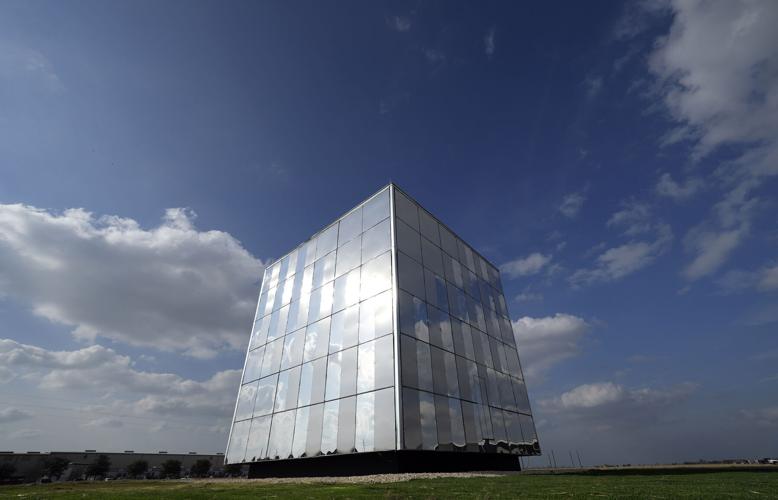
Last Energy’s demonstration unit is shown Jan. 17 in Brookshire, Texas.
Last year, Penn State University signed a memorandum of understanding with Westinghouse to collaborate on microreactor technology. Mike Shaqqo, the company’s senior vice president for advanced reactor programs, said universities are going to be “one of our key early adopters for this technology.”
Penn State wants to prove the technology so Appalachian industries, such as steel and cement manufacturers, may be able to use it, said Professor Jean Paul Allain, head of the nuclear engineering department. Those two industries tend to burn dirty fuels and have very high emissions.
Using a microreactor also could be one of several options to help the university use less natural gas and achieve its long-term carbon emissions goals, he said.
“I do feel that microreactors can be a game-changer and revolutionize the way we think about energy,” Allain said.
For Allain, microreactors can complement renewable energy by providing a large amount of power without taking up much land. A 10-megawatt microreactor could go on less than an acre, whereas windmills or a solar farm would need far more space to produce 10 megawatts, he said. The goal is to have one at Penn State by the end of the decade.
Purdue University in Indiana is working with Duke Energy on the feasibility of using advanced nuclear energy to meet its long-term energy needs.
Nuclear reactors that are used for research are nothing new on campus. About two dozen U.S. universities have them. But using them as an energy source is new.
One company that is building microreactors that the public can get a look at today is Last Energy, based in Washington, D.C. It built a model reactor in Brookshire, Texas that’s housed in an edgy cube covered in reflective metal.

Last Energy CEO Bret Kugelmass explains how power could be produced from a nuclear microreactor during a Jan. 17 tour inside the company’s demonstration unit in Brookshire, Texas.
It’s taking the unit apart to test how to transport it. A caravan of trucks will take it to Austin, where company founder Bret Kugelmass is scheduled to speak next month at the South by Southwest conference and festival.
Kugelmass, a technology entrepreneur and mechanical engineer, is talking with some universities, but his primary focus is on industrial customers. He’s working with licensing authorities in the United Kingdom, Poland and Romania to try to get his first reactor running in Europe in 2025.
The urgency of the climate crisis means zero-carbon nuclear energy must be scaled up soon, he said.
“It has to be a small, manufactured product as opposed to a large, bespoke construction project,” he said.
But not everyone shares the enthusiasm. Edwin Lyman, director of nuclear power safety at the Union of Concerned Scientists, called it “completely unjustified.”
Microreactors in general will require much more uranium to be mined and enriched per unit of electricity generated than conventional reactors do, he said. He said he also expects fuel costs to be substantially higher and that more depleted uranium waste could be generated compared to conventional reactors.
“I think those who are hoping that microreactors are going to be the silver bullet for solving the climate change crisis are simply betting on the wrong horse,” he said.