

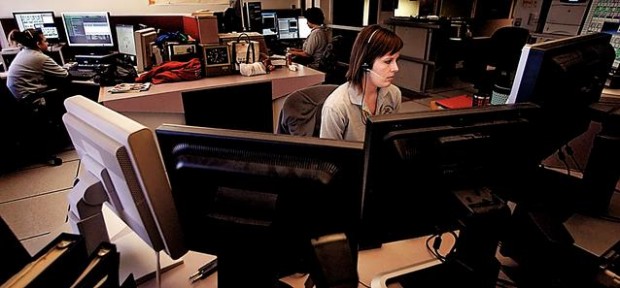
A new radio system that will let every police officer, sheriff's deputy and firefighter in Pima County talk to one another is about to take a big step toward reality, even though there isn't enough money to pay for it and the users haven't agreed on how to share the cost of running it.
The $104 million Pima County Wireless Integrated Network — dubbed PCWIN — has been in the works for seven years, likely won't be running until 2012 and still needs about $4.5 million in funding.
Details about how the system's operating costs will be shared among the region's police departments and fire districts still need to be worked out.
But the project will take a key step early next month when the Board of Supervisors votes on a $47 million contract with Motorola for the radio system infrastructure.
"Today, most of the agencies operate on their own systems and their own frequencies. The foremost reason for the project is the future capability for interoperability," said PCWIN project administrator Capt. Paul Wilson of the Pima County Sheriff's Department. "The bond election came on the heels of 9/11, and in that attack, we saw what happens when you have interoperability and when you don't, when you compare the problems they had in New York City and the response at the Pentagon."
People are also reading…
While the likelihood of such a major terrorist attack in Pima County might be slim, both the Sheriff's Department and the Tucson Police Department are using 25-year-old radio systems whose makers won't continue to support them much longer.
If the systems had to be replaced anyway, it just made sense to develop a regional system that would let responders from different agencies talk to one another.
Voters approved $92 million in bonds for the project in 2004, the single largest question in that bond package after open space. The county obtained another $8 million in state and federal grants, leaving about $4.5 million in unfunded-project costs — a gap Wilson said the county hopes to fill with additional grant money.
The deficit would have been larger, but the agencies decided not to include mobile data units promised in the bond question.
The Federal Communications Commission took away some of the channels that were to have been used for data transmission and reserved them for a commercial vendor who was to develop a data system for public safety, leaving the status of those channels uncertain.
In the meantime, many agencies bought their own mobile data units and vehicle locator systems using other funds, and investment in research for new systems stalled because the channels were not available.
That meant spending bond money on mobile data units wouldn't have resulted in a better system.
The radio system selected by the committee overseeing the project will be designed to meet Phase 2 standards developed by the Association of Public- Safety Communications Officials, meaning the equipment should be compatible with radios made by any vendor, allowing flexibility for future purchases.
The project has three basic components — the radio system, the equipping of radio towers throughout the county to allow interconnectivity, and the renovation of a former call center at 3434 E. 22nd St. into a centralized communications center. The building currently is the county's election headquarters.
Design work for the renovation already is under way, and construction is expected to start early next year.
Why is the project so expensive?
Partly because of the technology. Each radio unit will cost between $3,000 and $4,000, and the project could include anywhere from 5,000 to 7,700 units. And that doesn't include the computer equipment that will go into the central communications center.
Also, the communications center must be built to high design standards to withstand a wide range of emergencies.
Ongoing operating expenses for the system will be paid through monthly subscriber fees, not bond funds.
Of the 32 regional agencies, 18 have agreed in principle to pay the fees, though exactly how much they will pay hasn't been determined. However, those agencies represent 90 percent of the usage.
Estimates last year put the monthly fee at $96 per unit, and Wilson said he suspects it will be less than that.
The contract would allow city and county public works departments to sign on to the system as well, which could bring down the per-unit cost even further.
Wilson said smaller agencies may decide to join later, though they would face more upfront costs compared with piggybacking on the bond project now.
"All of the issues that drive us toward interoperability will drive other agencies to want to participate," Wilson said. "The question is how they will fund their share."


