

WASHINGTON — Robert Hanssen, a former FBI agent who took more than $1.4 million in cash and diamonds to trade secrets with Moscow in one of the most notorious spying cases in American history, died in prison Monday.
Hanssen, 79, was found unresponsive in his cell at a federal prison in Florence, Colorado, and later pronounced dead, prison officials said. He is believed to have died of natural causes, a person familiar with the matter told The Associated Press. The person was not authorized to publicly discuss details of Hanssen's death and spoke to the AP on condition of anonymity.

U.S. Attorney Randy Bellows, right, addresses the court during the sentencing of convicted spy Robert Hanssen, center, seen with his attorney Plato Cacheris, at the federal courthouse in Alexandria, Va., on May 10, 2002.
He had been serving a sentence of life in prison without possibility of parole since 2002, after pleading guilty to 15 counts of espionage and other charges.
Hanssen had divulged a wealth of information about American intelligence-gathering, including extensive detail about how U.S. officials had tapped into Russian spy operations, since at least 1985.
People are also reading…
He was believed to have been partly responsible for the deaths of at least three Soviet officers who were working for U.S. intelligence and executed after being exposed.
He got more than $1.4 million in cash, bank funds, diamonds and Rolex watches in exchange for providing highly classified national security information to the Soviet Union and later Russia.
He didn't adopt an obviously lavish lifestyle, instead living in a modest suburban home in Virginia with his family of six children and driving a Taurus and minivan.
Hanssen would later say he was motivated by money rather than ideology, but a letter written to his Soviet handlers in 1985 explains a large payoff could have caused complications because he could not spend it without setting off warning bells.
Using the alias “Ramon Garcia,” he passed some 6,000 documents and 26 computer disks to his handlers, authorities said. They detailed eavesdropping techniques, helped to confirm the identity of Russian double agents, and spilled other secrets. Officials also believed he tipped off Moscow to a secret tunnel the Americans built under the Soviet Embassy in Washington for eavesdropping.
He went undetected for years, but later investigations found missed red flags. After he became the focus of a hunt for a Russian mole, Hanssen was caught taping a garbage bag full of secrets to the underside of a footbridge in a park in a “dead drop” for Russian handlers.
The story was made into a movie titled “Breach” in 2007, staring Chris Cooper as Hanssen and Ryan Phillippe as a young bureau operative who helps bring him down.
The FBI has been notified of Hanssen’s death, according to the Bureau of Prisons.
What's GRU? A look at Russia's shadowy military spies
The agency

FILE - This Tuesday, July 31, 2018 file photo, shows the building of the Russian military intelligence service, located at 22 Kirova Street, Khimki, which was named in an indictment announced by a U.S. federal grand jury as part of a probe into alleged Russian involvement in the 2016 U.S. presidential election, in Khimki outside Moscow, Russia. Russia's military intelligence service GRU is attracting increasing attention as allegations mount of devious and deadly operations on and off the field of battle. (AP Photo/Alexander Zemlianichenko, File)
Formally named the Main Directorate of the General Staff of the Armed Forces, the agency is almost universally referred to by its former acronym GRU.
It is the most shadowy of Russia's secret services. When its previous director Igor Sergun died in 2016, the Kremlin announcement was so terse that it gave neither the date, cause or place of death.
The agency has an apparently broad mandate. According to the Defense Ministry website, it is tasked not only with "ensuring conditions conducive to the successful implementation of the Russian Federation's defense and security policy" but with providing officials intelligence "that they need to make decisions in the political, economic, defense, scientific, technical and environmental areas."
Allegations
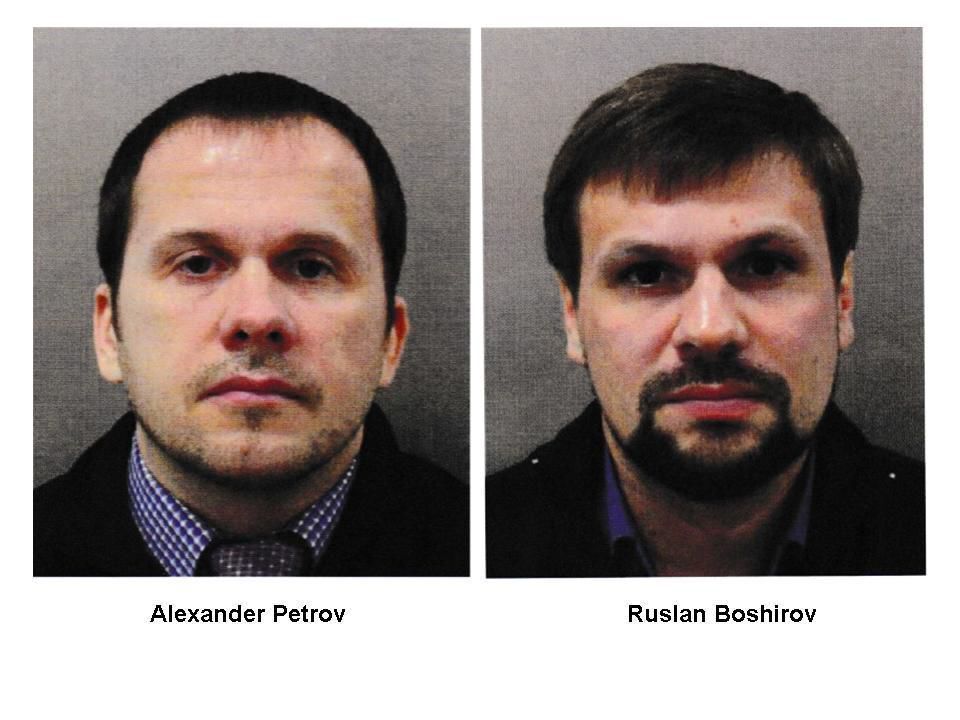
This combination photo made available by the Metropolitan Police on Wednesday Sept. 5, 2018, shows Alexander Petrov, left, and Ruslan Boshirov. British prosecutors have charged two Russian men, Alexander Petrov and Ruslan Boshirov, with the nerve agent poisoning of ex-spy Sergei Skripal and his daughter Yulia in the English city of Salisbury. They are charged in absentia with conspiracy to murder, attempted murder and use of the nerve agent Novichok. (Metropolitan Police via AP)
Britain claims that two GRU agents carried out this spring's attack with the nerve agent Novichok on Sergei Skripal, a former GRU officer who became a British double agent, and his daughter. Both survived the poisoning in the city of Salisbury, but three months later two area residents were sickened by the same nerve agent, one of them fatally — it is believed they found the discarded bottle that had carried the Skripals' poison.
This week's claim came less than two months after the U.S. indicted 12 alleged GRU agents for hacking into the Hillary Clinton presidential campaign and the Democratic Party and releasing tens of thousands of private communications, part of a sweeping conspiracy by the Kremlin to meddle in the 2016 U.S. election.

This still taken from CCTV and issued by the Metropolitan Police in London on Wednesday Sept. 5, 2018, shows Ruslan Boshirov and Alexander Petrov on Fisherton Road, Salisbury, England on March 4, 2018. British prosecutors have charged two Russian men, Alexander Petrov and Ruslan Boshirov, with the nerve agent poisoning of ex-spy Sergei Skripal and his daughter Yulia in the English city of Salisbury. They are charged in absentia with conspiracy to murder, attempted murder and use of the nerve agent Novichok. (Metropolitan Police via AP)
Also this year, the investigative group Bellingcat reported that a GRU officer was in charge of operations in eastern Ukraine, where Russia-backed separatists were fighting Ukrainian forces, in July 2014 when a Malaysian passenger airliner was shot down, killing all 298 people aboard. International investigators say the plane was shot down by a mobile missile launcher brought in from Russia. The GRU officer named by Bellingcat reportedly was responsible for weapons transfers.
Russia's RBC news service reported this year that the GRU oversees Russian mercenaries in Syria, fighting there as a so-called shadow army.
Russian authorities generally deny allegations against the GRU and refuse to discuss its activities. They said they didn't recognize the suspects Britain named Wednesday in the Salisbury poisoning.
Other agencies

FILE - In this Friday, Feb. 23, 2018 file photo, Russian President Vladimir Putin, right, listens to the Defense Minister as he arrives to attend a wreath-laying ceremony at the Tomb of the Unknown Soldier in Moscow, Russia. The GRU is one arm of Russia's extensive security and intelligence apparatus, which also includes the Foreign Intelligence Service, known as the SVR, and the Federal Security Service, or FSB, which conducts domestic intelligence and counterintelligence. (AP Photo/Alexander Zemlianichenko, File)
The GRU is one arm of Russia's extensive security and intelligence apparatus, which also includes the Foreign Intelligence Service, known as the SVR, and the Federal Security Service, or FSB, which conducts domestic intelligence and counterintelligence. The SVR and FSB were spun off from the KGB after the collapse of the Soviet Union. A former KGB agent, Vladimir Putin ran the FSB before ascending to the presidency.
And as president, Putin names the top brass in the GRU. Of all the agencies, the FSB looms largest in Russians' minds because it hunts domestic threats. The GRU, created under Soviet founder Vladimir Lenin, has a more ruthless reputation, but focuses its energies on foreign threats.
The agencies' operations appear to both compete and cooperate.

FILE - This Tuesday, May 14, 2013 file photo shows the main building of the Russian Federal Security Services, FSB, reflected in a shop's glass door on Lubyanka Square in Moscow, Russia. The GRU is one arm of Russia's extensive security and intelligence apparatus, which also includes the Foreign Intelligence Service, known as the SVR, and the Federal Security Service, or FSB, which conducts domestic intelligence and counterintelligence. (AP Photo/Ivan Sekretarev, File)
Pavel Felgenhauer, an independent Moscow-based military analyst, told The Associated Press that if "the SVR runs into military intelligence, they have to share it with the GRU; that means they try not to run into military intelligence and tell their agents not to report anything military even if they know it. The other way around, military or GRU assets are asked never to report anything political."
But in the case of the alleged U.S. election-related hacking, he said, "I believe that was an inter-service operation, because it's not military but they gained some kind of hacking access and then they shared it with the FSB and the SVR."
___
Kate de Pury contributed.


