

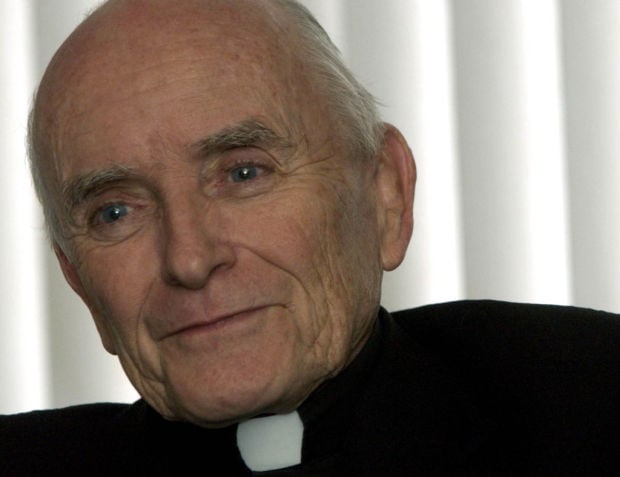
CHICAGO - The Rev. Andrew Greeley, the outspoken Roman Catholic priest, best-selling novelist and sociologist known for his deeply researched academic appraisals and sometimes scathing critiques of his church, died Wednesday night, several years after fracturing his skull in a freakish fall.
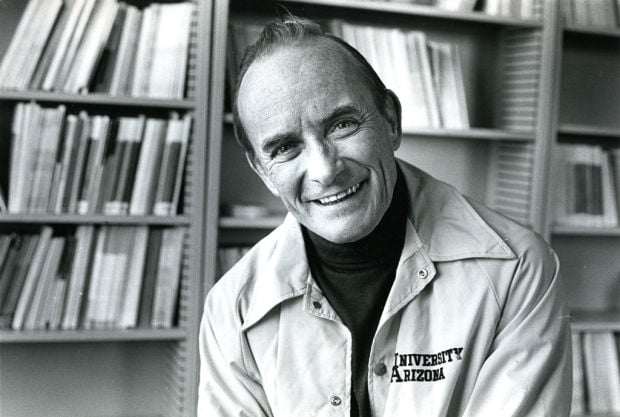
Greeley had lived part-time in Tucson for many years, while teaching at the University of Arizona.
He died in his sleep at his apartment at the John Hancock Center in Chicago, according to his spokeswoman, June Rosner. He was 85.
Rosner said Greeley had been in poor health since an accident on Nov. 7, 2008. He was at Advocate Lutheran General Medical Center when a piece of his clothing apparently got caught in the door of a departing taxi and he was thrown to the pavement.
A highly regarded sociologist, preternaturally prolific author and unabashedly liberal Chicago priest, Greeley regularly took his church to task in both his fiction and his scholarly work. His nonfiction books covered topics from Catholic education to Irish history to Jesus' relationships with women.
People are also reading…
Greeley authored some 50 best-selling novels and more than 100 works of nonfiction that were translated into 12 languages.
His racy novels and detective stories, which often closely paralleled real events, aired out Catholic controversies and hummed with detailed bedroom romps that kept readers rapt and coming back for more. Best-sellers like "The Cardinal Sins" in 1981 earned him millions of dollars, much of which he donated to the church and charities.
Greeley filled many of his books with the results of work he did at the National Opinion Research Center at the University of Chicago, where he'd done work since his days as a doctoral candidate in the early 1960s.
He also taught sociology at the University of Arizona.
But, Greeley said his immense body of research and writing was merely a reflection of his calling to be a priest.
"I'm a priest, pure and simple," Greeley told the Chicago Tribune in 1992. "The other things I do - sociological research, my newspaper columns, the novels I write - are just my way of being a priest. I decided I wanted to be one when I was a kid growing up on the West Side. I've never wavered or wanted to be anything but."
Greeley criticized the church hierarchy over issues including its teaching on contraception and the way bishops handled the sexual abuse crisis. His blunt criticism set him apart from other Catholic sociologists, said Martin Marty, professor emeritus at the University of Chicago Divinity School.
"Some sociologists are cautious," Marty said. "He took risks all the time. But he was extremely careful to be sure he had the data."
Much of his more recent research on Catholicism included calls for the Church to respond to the needs of contemporary Catholics.
In his 2004 book, "The Catholic Revolution: New Wine, Old Wineskins, and the Second Vatican Council," Greeley wrote that the Vatican II reforms caused a rift between leadership and laity that resulted in a new generation of Catholics who have redefined the faith in their own terms.
These Catholics, Greeley wrote, hold onto core doctrines and traditions even as they disagree with the rules in such areas as sexual behavior.
Robert McClory, associate professor emeritus at Northwestern University and a former priest, said Greeley was one of the few Catholic scholars who was able to critique the Catholic Church without himself becoming a dissident.
"He was able to be critical of the hierarchical church while balancing that criticism with the sound sociological data that he had been working on for more than 40 years," McClory said.
"It's not as if he was dissenting. He would say, 'The figures are there, you can look at them and the church needs to decide what to do about that.' "
McClory said Greeley also had the gift of making his data clear and interesting to the general public.
"He was not a scholarly sociologist," he said. "He had a popular approach to his writing which interested people on issues that they would not normally be interested in."
Greeley possessed an unpredictable, sometimes volatile temperament which resulted in people following his columns to find out what he would say. He lashed out at the Bush administration in a series of essays that became a book entitled, "A Stupid, Unjust, And Criminal War: Iraq 2001-2007." Before the 2008 election, Greeley wrote a column predicting Barack Obama would lose because racism would defeat him.
"He was gutsy. He was not afraid to take on the religious and political establishments," McClory said.
TUCSON ANGLE
While living part-time in Tucson for many years, Father Andrew Greeley often gave public talks and lectures at churches, particularly Our Mother of Sorrows, and at the University of Arizona, where he taught sociology. His columns appeared periodically on the Arizona Daily Star's op-ed pages.
In one of his many local interviews, Greeley told the Star's Stephanie Innes in 2007 that "If Jesus were alive today, he'd be a radical feminist." "It means that he would endorse the complete equality of women," Greeley wrote to reporter Innes in an email. "But since I'm not his press spokesman, I can't say where he would stand on (specific) issues that did not exist in his day."
Greeley's cousin, Tucson literary agent Andrew T. "Andy" Greeley, used to work at Borders and Barnes & Noble stores in Tucson. He remembers that the priest/author collaborated with him by attending many book signings there that drew hundreds of fans. Some of those events headlined by the author with the sparkling Irish eyes were held on St. Patrick's Days, he recalls.
"It's sad. But it's time. It was time for him," Tucson's Andy Greeley said Thursday of his cousin's death.
After all of Father Greeley's disappointments in the church, especially his grief over the pedophilia scandal, his cousin added, "He'll get to see the church from another view, from where he is now."
Arizona Daily Star


