
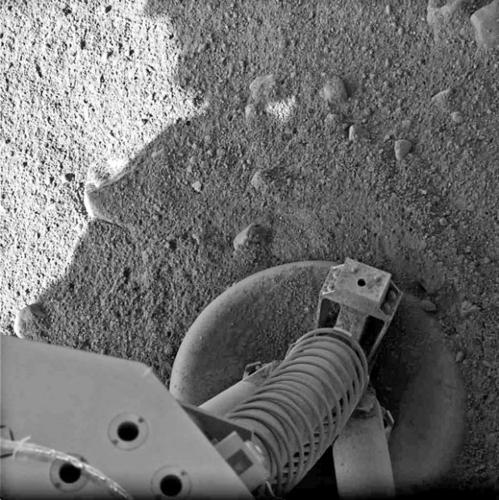
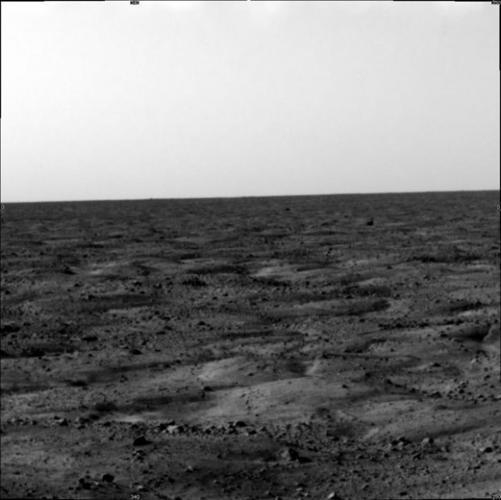
The first images from the successful Phoenix Mars Lander show views of Mars like nothing scientists have ever seen before from the red planet's surface, team leaders at UA said this evening.
The images show patterned displays in the ground, and a lack of large rocks.
They began arriving at the mission's Science Operations Center in Tucson shortly before 7 tonight, Tucson time.
"There it is, we've got a picture," a UA team leader could be heard saying as the first one arrived, and clapping erupted at the center in Tucson.
The first image shows the lander's solar array and other equipment, and scientists said they immediately confirmed that the solar array and the bio-barrier around the robotic arm deployed properly.
The first landscape picture shows small rocks but a mostly flat terrain.
People are also reading…
Not only did the Mars lander touch down safely, but it is sitting at the planet's northern pole "in an almost perfect position," says Peter Smith, UA's lead investigator on the mission, speaking from NASA's Jet Propulsion Laboratory.
"I was right to be optimistic," said Smith, who had correctly predicted that the final descent — dubbed "Seven Minutes of Terror" — would turn into "Seven Minutes of Joy."
"This team performed perfectly. They couldn't have done a better job," Smith said.
Greeting the UA team back in Tucson, which he could see on a monitor from the JPL in Pasadena, Calif., Smith added: "We're bringing that mission back to the UA tomorrow."
"I think they're ready. Don't they look ready?" he said jubilantly.
In Tucson, Smith's wife joined a group of celebrants who popped champagne corks in the UA's Science Operations Center, which will lead the mission's science.
A thousand people gathered on the UA Mall for the landing.
A packed, standing-room-only crowd of 300-plus, including key mission scientist William Boynton of UA, celebrated in the UA's Kuiper Space Sciences Building.
The landing went so well, scientists never lost radio contact with the lander during its descent.
Confirmation came at 4:53 p.m. that the UA-led Phoenix Mars Mission touched down on the red planet, prompting a rush of happiness and relief among the scientists and engineers who have spent years working on the project.
"She's talking to us and she looks great," thrilled UA mission engineer Pat Woida said of the lander. "I will take whatever Mars throws at me now."
Assessing the success of the overall landing and solar-array deployment, NASA Deputy Project Manager Dave Spencer said, "We never expected that it would be this perfect. We didn't have any hiccups."
Phoenix, launched in September, travelled 422 million miles before overcoming a complex final stage that saw it launch a parachute, free fall and, finally, ignite small jets to softly land in Mars’ northern arctic region.
The landing is a relief for NASA since Mars has a reputation of swallowing spacecraft. More than half of all nations’ attempts to land on Mars have failed.
This mission, led by the University of Arizona, will analyze the ice beneath Mars’ rusty surface to determine whether the planet ever had a climate suitable for life.
After flying through space for several months, the lander sped through Mars’ atmosphere at speeds up to 12,500 mph before touching down.
Given the distance between Earth and Mars, it takes about 15 minutes for signals from the lander to be relayed to researchers in California and Tucson. That means Phoenix had already landed by the time the first data sent during the spacecraft’s descent reached mission planners.
Next, the lander unfurled its solar panels — a critical step to ensuring Phoenix has a renewable power supply — and took those first few pictures of its surroundings.
Check back for more updates.