

JEFFERSON CITY • Gov. Jay Nixon, a Democrat, likes to portray his relationship with the Republican-dominated Legislature as one where they work toward common goals.
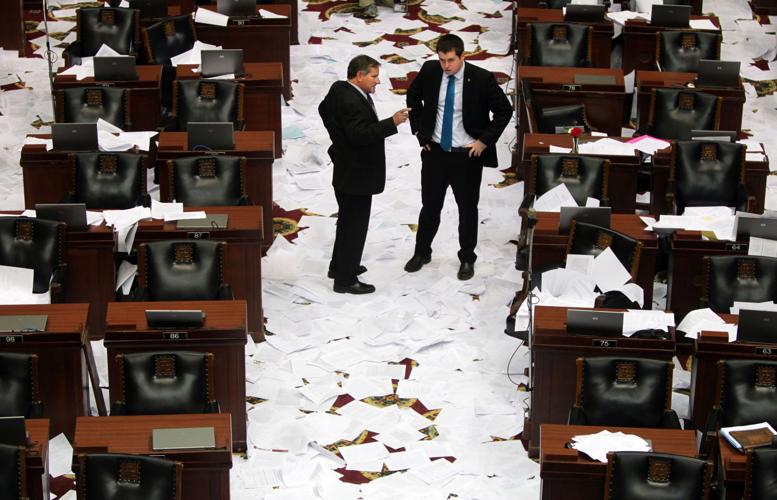
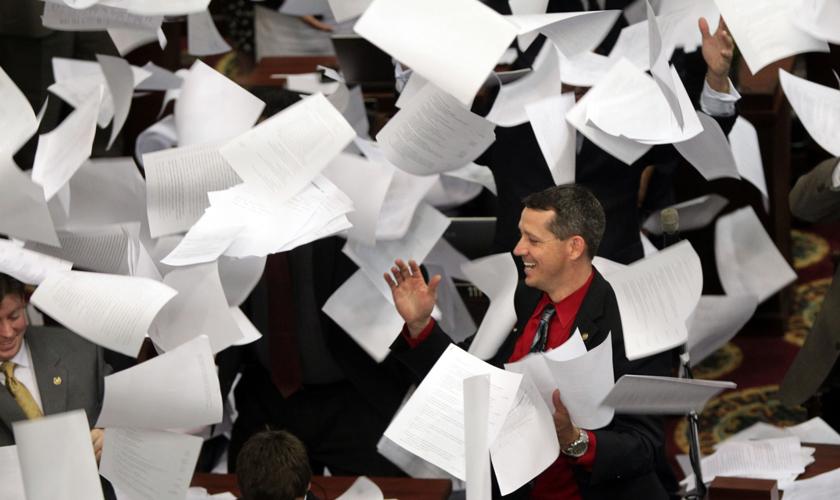
But Friday’s conclusion of the Legislature’s four-and-a-half month session magnified their differences and is likely to result in more vetoes than usual.
Nixon has signaled that he is likely to veto a $700 million corporate and personal income tax cut that Republicans called one of their biggest accomplishments. The governor said Friday that the plan’s price tag raises “red flags” for the state budget.
At a post-session news conference, he expressed reservations about a bill declaring federal gun laws unenforceable and one capping punitive damages that injured people could win for exposure to lead contamination in St. Francois County.
People are also reading…
The governor also made note of two bills that he called “unnecessary.” One would nullify court rulings based on foreign laws and another would bar the implementation of Agenda 21, a nonbinding United Nations action plan that promotes sustainable development.
Other bills that could tempt his veto pen include one making it harder for some public employee unions to deduct members’ dues from their paychecks and one creating restrictions on the use of abortion-inducing drugs.
Nixon declined to speculate on the number of bills he would veto, but he said: “I’m sure I’ll find some that either I don’t think is the right policy for the state or mistakes were made.”
George Connor, head of the political science department at Missouri State University in Springfield, said both political parties try to emphasize issues that appeal to their supporters.
“Ultimately, it’s about being able to go back home and say, ‘We have further restricted abortion rights’ or ‘prevented President Obama from taking away your guns.’ It seems to me the electoral priorities are coming to overtake the policy needs of the state,” he said.
A large number of vetoes could lead legislators to test their new veto-proof majorities. Republicans hold two-thirds of the seats in both the House and Senate, enough to override vetoes if they stick together. The veto session takes place in September.
Senate President Pro Tem Tom Dempsey, R-St. Charles, said the tax cut has enough votes to override a veto in the Senate, though the House would be tighter, because Republicans will hold the minimum needed there if they lose one member to a congressional election this summer.
Dempsey called the tax cut a modest, carefully crafted plan that won’t bust the state budget because the cuts are phased in slowly over time, and only if state revenue grows by at least $100 million a year.
Sen. Joe Keaveny, D-St. Louis, opposed the tax cut.
“Why, when we finally get to the point where we’ve got a surplus, why a tax cut? Why not restore some cuts” in mental health programs? “People don’t realize the toll” the last few years’ cuts have taken, he said.
CAMPAIGN LIMITS
In his first term as governor, Nixon’s vetoes were overridden twice: on a congressional redistricting plan in 2011 and a bill letting employers and insurance companies opt out of providing contraception coverage in 2012.
Asked if he expects more activity at this year’s veto session, Nixon predicted that legislators will “have some things on the docket other than the social activities that occur.”
The governor also said he will make good on the promise he made in his State of the State speech in January that if legislators didn’t reinstate campaign contribution limits, he would help lead an initiative petition drive to put such a proposal on the November 2014 ballot.
Missouri remains one of only four states with no limits on campaign contributions. The state also has no limits on what lobbyists can legally give to lawmakers.
House Minority Leader Jake Hummel, D-St. Louis, said Nixon would have plenty of help on the ethics petition drive from Democratic groups.
“We’re going to work with the governor’s office and outside groups to try to get that on the ballot. We think that’s the right thing to do for Missouri,” Hummel said.
Overall, Nixon declined to give the legislative session a grade. As the Democratic governor in an increasingly Republican state, he continued the tightrope walk that has prompted state voters to vote for a divided government.
“I will continue … to try to find that sweet spot where we can get together and move forward,” Nixon said.
But polarized politics dominated the legislative session this year much more than during Nixon’s first term.
His top goal, Medicaid expansion, flopped.
Under the federal Affordable Care Act, the state would have been able to add an estimated 260,000 Missourians to its Medicaid rolls, and the federal government would have covered most of the costs.
Nixon staked significant political capital on the issue — making more than three dozen trips across the state to advocate in favor of the expansion and meeting privately with Republican lawmakers to try to win them over.
Nixon was backed by a coalition of health care advocates, groups that lobby for the poor and business leaders, many of whom often side with the GOP on other issues at the Capitol.
Rep. Jay Barnes, R-Jefferson City, attempted to work out a compromise that would have allowed the state to use the federal dollars to springboard several reforms that Republicans have tried to inject into the Medicaid program for several years.
His proposal was meant to make the program resemble the private sector, with provisions to encourage efficiencies, add personal responsibility on behalf of recipients and curb fraud.
But Barnes’ proposal never gained enough traction to pass. Instead, lawmakers approved a bill to create a state task force that will examine options for improving Medicaid.
DRIVERS LICENSE FLAP
Republicans spent a lot of time this session investigating the Department of Revenue’s policy of scanning personal documents submitted for drivers licenses. They ultimately passed legislation that bars the practice.
Republican lawmakers deemed the electronic copying a privacy issue, while Revenue officials, in countless hearings at the Capitol, defended the practice as a way to make licenses more secure.
Some high-profile Republicans, including House Speaker Tim Jones of Eureka and Senate Appropriations Chair Kurt Schaefer of Columbia, fought against the new procedure, which — until last month — included the scanning of concealed weapons permits. Their criticisms only grew when officials admitted that the Missouri Highway Patrol had twice handed over a list of concealed-carry permit holders to the federal government.
In the wake of the controversy, Nixon’s administration announced that the Revenue Department would no longer scan concealed gun permits, and the department’s director, Brian Long, resigned after just four months on the job.
The questions surrounding the new license system spawned television and radio commercials and Internet campaigns targeting Nixon. The practice also led to at least one lawsuit over privacy concerns.
Jones, who has created a committee to look into the department, said the House will continue investigating until he is satisfied that it has found “truth and solutions.”
“Whether it’s hard questions that still need to be answered on the federal level about the Benghazi scandal or President Obama’s IRS or down here in the state with Gov. Nixon’s (Revenue Department), Missourians and citizens across this country are tired of government overreach, tired of government abuse, tired of government going beyond the scope of the law,” Jones said.
Dave Robertson, a political science professor at the University of Missouri-St. Louis, said Republicans pressed the issue to fire up their base.
“They’re trying to find scandals to put the other side on the defensive,” he said. “This is as close to Benghazi as we have in Missouri, so that’s what you see happening.”
In one of the universally praised bright spots of the session, both the Republican leadership and Nixon highlighted a bill that could solve financial problems with a fund for disabled workers that has been withholding payments from more than 1,200 injured workers because of a multimillion-dollar shortfall.
But Republicans failed to convert their historic majorities into success on some top goals.
Economic development legislation collapsed for the fifth time in four years. It would have shifted incentives to several new incentive programs and limited real estate development subsidies.
Internal party disputes also killed GOP leaders’ priority bills on teacher evaluations, a sales tax hike for highway construction, a bond issue for state building projects and medical malpractice caps.
The Legislature passed a bill that puts restrictions on the use of RU-487, an abortion-inducing drug. Early in the session, anti-abortion activists labeled the bill as their top priority for Missouri lawmakers in 2013.
The bill would require that a doctor be present when a woman takes any abortion-inducing medication.
Abortion rights supporters arguing against it say medication-based abortions have few side effects and shouldn’t require a doctor’s presence for the second pill in the two-step process.
“This is nothing more than a scare tactic,” Rep. Genise Montecillo, D-St. Louis, said on the floor during a debate on the bill.
But Rep. Jeanne Riddle, R-Mokane, questioned the drug’s safety and compared the abortion pill to fen-phen, an anti-obesity drug that was eventually pulled because of dangerous side effects.
“This is about women’s health,” Riddle said. “It is about looking out for the women in the state.”
The Legislature passed several pro-gun bills this session, including one that attempts to nullify federal gun laws. Others will allow state employees to keep guns in their cars on state property and move the issuing of concealed gun permits from the Department of Revenue to local sheriffs.
Some have questioned whether the so-called “Second Amendment Preservation Act” is constitutional, but Jones said he isn’t worried.
“The ultimate constitutional muster on this is the Second Amendment,” he said “Congress is not some sort of ultimate arbiter. The Constitution is.”
Rep. Chris Kelly, D-Columbia, said the gun law was “void on its face. It will never be enforced. This is about nullification. It is about secession and only about secession.”
Virginia Young is the Jefferson City bureau chief of the Post-Dispatch. Follow her on twitter at @virginiayoung.