

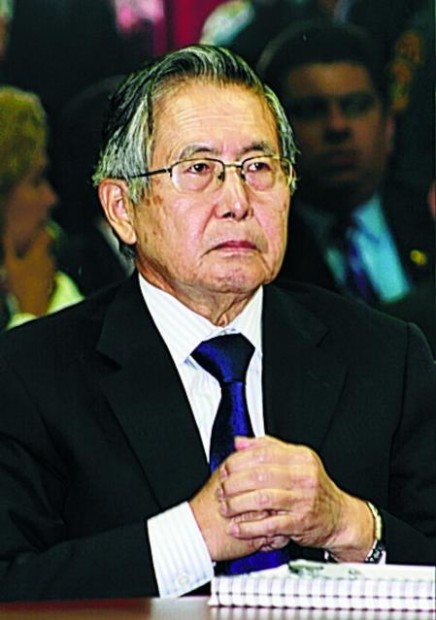
LIMA, Peru — Former Peruvian President Alberto Fujimori was convicted and sentenced to 25 years in prison Tuesday for death squad killings and kidnappings as his autocratic government battled the Shining Path insurgency in the 1990s.
Outside court, pro- and anti-Fujimori activists fought with fists, sticks and rocks. Several dozen people chanted "Fujimori killer!" and several hundred chanted "Fujimori innocent!" before police separated them.
The court convicted the 70-year-old former leader, who remains popular for rescuing Peru from the brink of economic and political collapse, of "crimes against humanity," including 25 murders by the military hit squad. None of the victims, the three-judge court found, were connected to any insurgency.
Presiding judge Cesar San Martin said there was no question Fujimori authorized the creation of the Colina unit, which the court said killed at least 50 people as his government battled Shining Path terror with a "parallel terror apparatus" of its own.
People are also reading…
Victims' family members nodded with satisfaction and shed tears in the courtroom as the verdict was read.
"For the first time, the memory of our relatives is dignified in a ruling that says none of the victims were linked to any terrorist group," said Gisela Ortiz, whose brother was killed.
Fujimori, who proclaimed his innocence in a roar when the 15-month televised trial began, barely looked up, uttering only four words — "I move to nullify" — before turning, smiling and walking out of the courtroom at the Lima police base where he has been held and tried since his 2007 extradition from Chile.
His children shook their heads in disgust and groaned in exasperation. Fujimori's daughter Keiko, a 33-year-old congresswoman, called the conviction foreordained and "full of hate and vengeance."
She said it would only strengthen her candidacy for the 2011 presidential race. She has vowed to pardon her father if elected.
Although none of the trial's 80 witnesses directly accused Fujimori of ordering killings, kidnappings or disappearances, the court said the former mathematics professor and son of Japanese immigrants bore responsibility by allowing the Colina group to be formed.
It said Fujimori's disgraced intelligence chief and close confidant, Vladimiro Montesinos, was in direct control of the unit.
And it noted that Fujimori freed jailed Colina members with a blanket 1995 amnesty for soldiers while state security agencies engaged in a "very complete and extensive" cover-up of the group's deeds.


 Faculty concerned about changes to U of A admissions policy


