MEXICO CITY — With Sinaloa cartel boss Joaquín “El Chapo” Guzmán serving a life sentence, his sons steered the family business into fentanyl, establishing a network of labs churning out massive quantities of the cheap, deadly drug that they smuggled into the U.S., prosecutors revealed in a recent indictment.

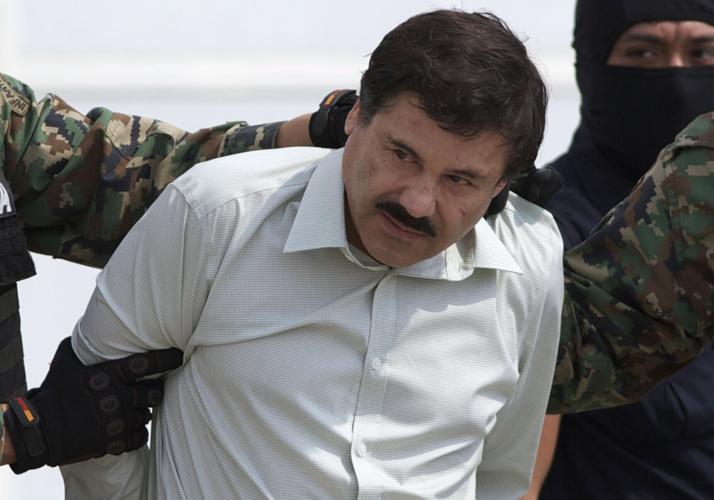
This Feb. 22, 2014, photo shows Joaquin “El Chapo” Guzman, the head of Mexico’s Sinaloa Cartel, being escorted to a helicopter in Mexico City following his capture overnight in the beach resort town of Mazatlan, Mexico.
Although Guzmán’s trial revolved around cocaine shipments, the case against his sons exposes the inner workings of a cartel undergoing a generational shift as it worked “to manufacture the most potent fentanyl and to sell it in the United States at the lowest price,” according to the indictment unsealed April 14 in Manhattan.
Synthetic opioids — mostly fentanyl — now kill more Americans every year than died in the Vietnam, Iraq and Afghanistan wars combined, feeding an argument among some politicians that the cartels should be branded terrorist organizations and prompting once-unthinkable calls for U.S. military intervention across the border.
People are also reading…

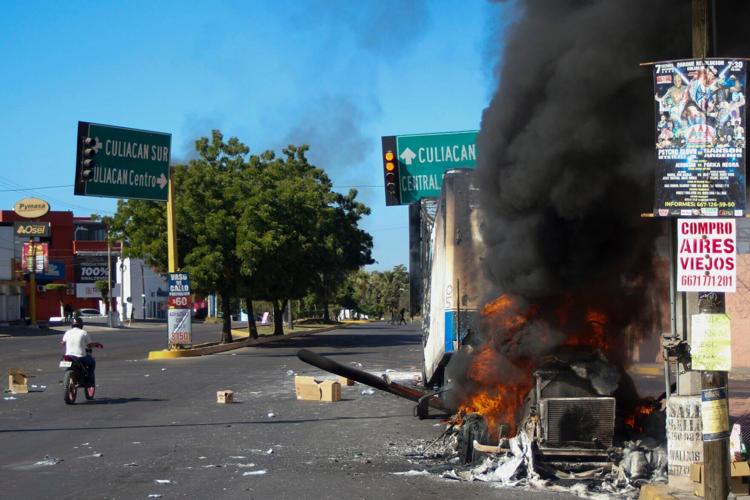
A truck burns after being set on fire Jan. 5 in Culiacan, Sinaloa state, Mexico. That was the day the government detained Ovidio Guzman, the son of imprisoned drug lord Joaquin “El Chapo” Guzman, which unleashed deadly firefights between the military and suspected members of the Sinaloa drug cartel.
“The problem with fentanyl, as some people at the State Department told me, has to be repositioned. It’s not a drug problem; it’s a poisoning problem,” said Alejandro Hope, a security analyst in Mexico, who died Friday. “Very few people go out deliberately looking for fentanyl.”
Hope predicted fentanyl would probably become an issue in next year’s U.S. elections, but he opposed any threat of U.S. intervention, saying “I don’t think that would be a very good way of addressing a public health issue.”
The groundwork for the U.S. fentanyl epidemic was laid more than 20 years ago, with aggressive over-prescribing of the synthetic opioid oxycodone. As U.S. authorities clamped down on its prescription, users moved to heroin, which the Sinaloa cartel happily supplied.
But making its own fentanyl — far more potent and versatile than heroin — in small, easily concealed labs was a game changer. The cartel went from its first makeshift fentanyl lab to a network of labs concentrated in the northern state of Sinaloa in less than a decade.
“These are not super labs, because they give people the illusion that they’re like pharmaceutical labs, you know, very sophisticated,” said Mike Vigil, former head of international operations for the U.S. Drug Enforcement Administration. “These are nothing more than metal tubs and they use wooden paddles — even shovels — to mix the chemicals.”
A single cartel “cook” can press fentanyl into 100,000 counterfeit pills every day to fool Americans into thinking they’re taking Xanax, Percocet or oxycodone. The pills are smuggled over the border to supply what son Iván Archivaldo Guzmán Salazar said are “streets of junkies,” the indictment said.
Fentanyl is so cheap to make that the cartel reaps massive profits even wholesaling the drug at 50 cents per pill, prosecutors said.
The drug’s potency makes it particularly dangerous. The narcotic dose of fentanyl is so close to the lethal dose that a pill meant to ensure a high for a habituated user can easily kill a less experienced person taking something they didn’t know was fentanyl.
Between August 2021 and August of last year, more than 107,000 Americans died from drug overdoses, most from synthetic opioids. Last year, the DEA seized more than 57 million fentanyl-laced counterfeit prescription pills, according to the New York indictment.
To protect and expand that business, the “Chapitos,” as the sons are known, have turned to grotesque violence, prosecutors said.

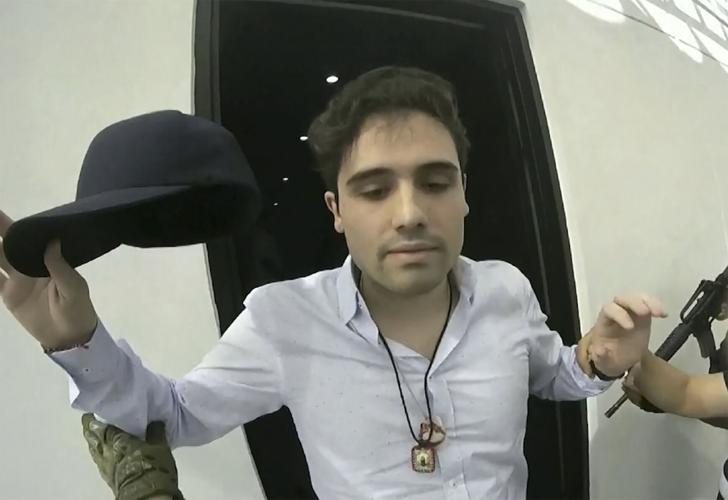
This frame grab from video, provided by the Mexican government, shows Ovidio Guzman Lopez being detained Oct. 17, 2019, in Culiacan, Mexico.
Enforcers Ivan Archivaldo Guzmán Salazar and Jesus Alfredo Guzmán Salazar are the lead defendants among 23 associates charged in the New York indictment. Ovidio Guzmán López, alias “the Mouse,” who allegedly pushed the cartel into fentanyl, is charged in another indictment in the same district. Mexico arrested him in January and the U.S. government has requested extradition. Joaquín Guzmán López is charged in the Northern District of Illinois
According to the Guzmán Salazar indictment, the cartel does some lab testing on its product but conducts more grisly human testing on kidnapped rivals or addicts who are injected until they overdose.
The purity of the cartel’s fentanyl “varies greatly depending on the method and skill of the particular manufacturer,” prosecutors noted. After a user overdosed on one batch, it was still shipped to the U.S.

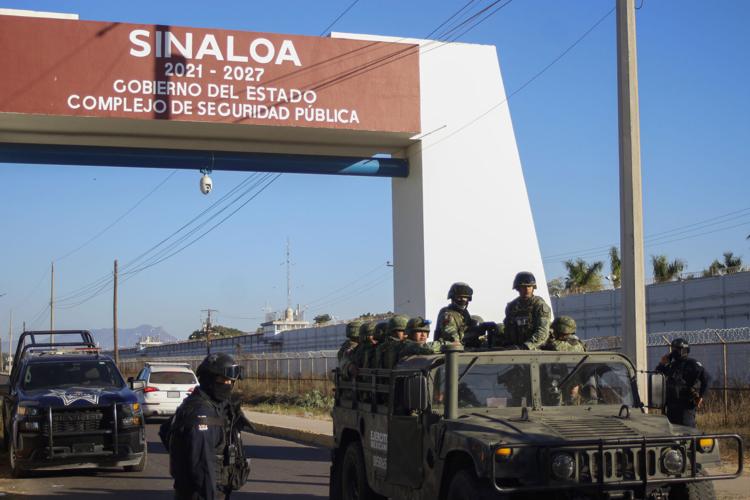
Police and military patrol Culiacan, Sinaloa state, Mexico, on Jan. 6, the day after the government detained Ovidio Guzman, the son of imprisoned drug lord Joaquin “El Chapo” Guzman.
When the elder Guzmán and Ismael “El Mayo” Zambada led the Sinaloa cartel, it operated with a certain degree of restraint. But with Guzmán serving a life sentence and Zambada believed to be suffering from health issues, the Chapitos moved aggressively to avoid a power vacuum that could fragment the cartel.
“What was really a unique advantage of the Sinaloa cartel and El Chapo was the ability to calibrate violence,” said Vanda Felbab-Brown, a senior fellow in the Strobe Talbott Center for Security, Strategy, and Technology at the Brookings Institute.
The wide-ranging New York indictment against the Guzmán Salazar brothers details their penchant for feeding enemies to their pet tigers and describes how they tortured two Mexican federal agents, ripping through one’s muscles with a corkscrew then stuffing the holes with chile peppers before shooting him.
The indictment also provides context to some recent violence in Mexico.
In August 2022, gunmen shot up Ciudad Juarez across from El Paso, Texas. Two prison inmates and nine civilians in the city were killed. U.S. prosecutors say the Chapitos’ security arm ordered their local gang associates to commit the violence, targeting a rival cartel’s businesses.
“This is not their father’s Sinaloa cartel,” Felbab-Brown said. “These guys just operate in very different mindsets than their father.”
Photos: Once-standout DEA agent says war on drugs is 'unwinnable'

Jose Irizarry, a once-standout DEA agent sentenced to more than 12 years in federal prison for conspiring to launder money with a Colombian cartel, speaks during an interview the night before going to a federal detention center, in San Juan, Puerto Rico, Wednesday, Jan. 5, 2022. “You can’t win an unwinnable war. DEA knows this and the agents know this,” Irizarry says. “There’s so much dope leaving Colombia. And there’s so much money. We know we’re not making a difference.” (AP Photo/Carlos Giusti)

This photo provided by the U.S. Drug Enforcement Administration shows U.S. currency confiscated in "Operation White Wash" in 2016. The long-running overseas investigation resulted in more than 100 arrests and the seizure of more than $100 million and more than a ton of cocaine. (DEA via AP)

Jose Irizarry, a once-standout DEA agent sentenced to more than 12 years in federal prison for conspiring to launder money with a Colombian cartel, speaks during an interview the night before going to a federal detention center, in San Juan, Puerto Rico, Wednesday, Jan. 5, 2022. After years of portraying Irizarry as a rogue agent who acted alone, U.S. Justice Department investigators have made an abrupt shift, following his confessional roadmap to question as many as two-dozen current and former DEA agents and prosecutors accused of turning a blind eye to his flagrant abuses and sometimes joining in. (AP Photo/Carlos Giusti)

Jose Irizarry, a once-standout DEA agent sentenced to more than 12 years in federal prison for conspiring to launder money with a Colombian cartel, speaks during an interview the night before going to a federal detention center, in San Juan, Puerto Rico, Wednesday, Jan. 5, 2022. Irizarry says dozens of other federal agents, prosecutors, informants and in some cases cartel smugglers themselves were all in on the three-continent joyride known as “Team America” that chose cities for money laundering pick-ups mostly for party purposes or to coincide with Real Madrid soccer or Rafael Nadal tennis matches. (AP Photo/Carlos Giusti)

Jose Irizarry, a once-standout DEA agent sentenced to more than 12 years in federal prison for conspiring to launder money with a Colombian cartel, sits during an interview the night before going to a federal detention center, in San Juan, Puerto Rico, Wednesday, Jan. 5, 2022. (AP Photo/Carlos Giusti)

Jose Irizarry, a once-standout DEA agent sentenced to more than 12 years in federal prison for conspiring to launder money with a Colombian cartel, pauses during an interview the night before going to a federal detention center, in San Juan, Puerto Rico, Wednesday, Jan. 5, 2022. He was betrayed by one of his closest confidants, a Venezuelan-American informant who confessed to diverting funds from the undercover stings and making cash payments to his longtime handler. (AP Photo/Carlos Giusti)

Jose Irizarry, a once-standout DEA agent sentenced to more than 12 years in federal prison for conspiring to launder money with a Colombian cartel, stands for a portrait during an interview the night before going to a federal detention center, in San Juan, Puerto Rico, Wednesday, Jan. 5, 2022. Irizarry’s downfall was as sudden as it was inevitable — the outgrowth of a lavish lifestyle that raised too many eyebrows, even among colleagues willing to bend the rules themselves. (AP Photo/Carlos Giusti)

Jose Irizarry, a once-standout DEA agent sentenced to more than 12 years in federal prison for conspiring to launder money with a Colombian cartel, speaks during an interview the night before going to a federal detention center, in San Juan, Puerto Rico, Wednesday, Jan. 5, 2022. Irizarry’s downfall was as sudden as it was inevitable — the outgrowth of a lavish lifestyle that raised too many eyebrows, even among colleagues willing to bend the rules themselves. (AP Photo/Carlos Giusti)

FILE - Former DEA agent Jose Irizarry arrives at the United States Courthouse in Tampa, Fla., on Thursday, Nov. 18, 2021. Federal Judge Charlene Honeywell who sentenced Irizarry said he was “the one who got caught but it is apparent to this court that there are others.” (AP Photo/Chris O'Meara, File)

This booking photo provided by the Pinellas County Sheriff's Office in August 2022 shows Michael Zoumberos. Zoumberos is the brother of one of Jose Irizarry’s former partners who partied and traveled around the world with DEA agents. He was jailed in March after refusing to testify to a federal grand jury investigating misconduct in the DEA. "I didn’t do anything wrong, but I’m not going to talk about my brother,” Zoumberos told AP. (Pinellas County Sheriff's Office via AP)