

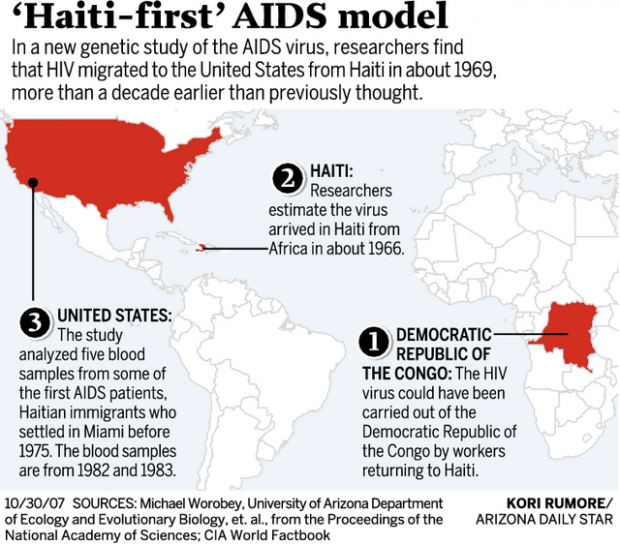
The AIDS virus arrived in the United States via Haiti in about 1969, a decade earlier than previously believed, and likely infected hundreds of thousands of people before it was first detected, according to a UA biologist.
A new study, published this week in Proceedings of the National Academy of Sciences, used DNA analysis to pinpoint for the first time how the HIV-1 virus entered this country.
The study's lead author, Michael Worobey, says the research shows most HIV/AIDS cases in the country descended from a single common ancestor long before the disease was identified in 1981.
"You don't normally think about the first moon landing and the arrival of HIV, but our results suggest it was pretty much about the same time," said Worobey, an assistant professor of ecology and evolutionary biology at the UA. "The virus had been under our noses without us knowing about it for the better part of 12 years. It's chilling."
People are also reading…
Worobey and a team of researchers in the United States and Europe analyzed archived blood samples taken from early patients, including five of the first AIDS patients identified in the United States. All were Haitian immigrants treated at a Miami hospital.
The researchers also analyzed blood samples from 117 other AIDS patients from around the world.
"Haiti was the stepping stone the virus took when it left central Africa and started its sweep around the world," said Worobey. "Once the virus got to the U.S., then it just moved explosively around the world."
The study finds AIDS was spreading many years before it was contracted by the so-called "Patient Zero," a gay French-Canadian flight attendant.
"Our results show quite clearly that person was farther along in the chain, and there's no reason to think that individual was the first," Worobey said. "What we've done here is trace back to the real index case, and although we can't identify an individual, we can make inferences about when that person started the chain of infection."
Haiti appears to have the oldest HIV/AIDS epidemic outside sub-Saharan Africa, and the most genetically diverse subtype of the virus. Researchers estimate the virus arrived in Haiti from Africa in the mid 1960s, which suggests it was carried by workers who had gone to the Democratic Republic of the Congo after it gained independence in 1960.
Future research will attempt to trace the genetic makeup of various strains of HIV even further back.
On StarNet: For more health stories online, visit azstarnet.com/health


