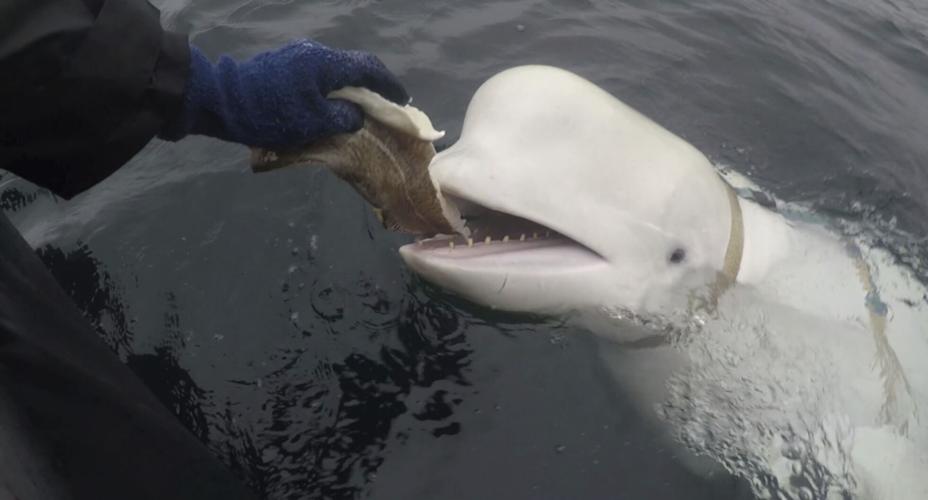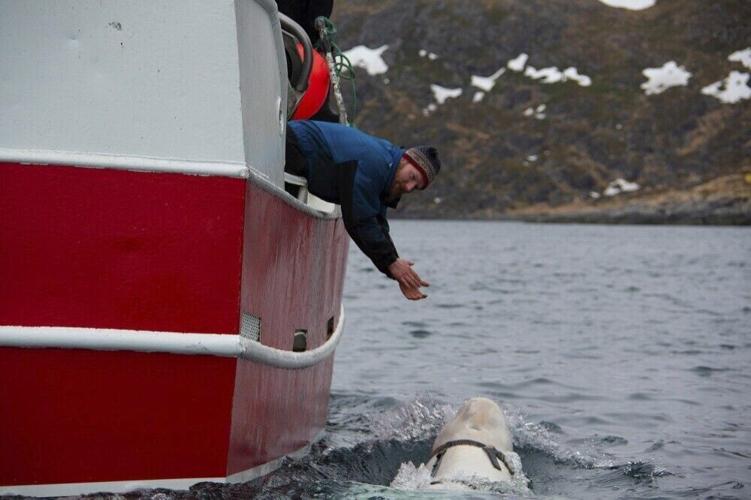
COPENHAGEN, Denmark — Norwegian authorities said Tuesday that a beluga whale, which was first spotted in Arctic Norway four years ago with an apparent Russian-made harness and alleged to have come from a Russian military facility, has been seen off Sweden’s coast nearly 1,250 miles to the south.
“During the last few weeks, it has moved quickly and swam several hundred kilometers” before reaching waters off Sweden’s west coast, Olav Lekve of the Norwegian Directorate of Fisheries said.

A beluga whale found in Arctic Norway feeds in 2019. Norwegian authorities say the whale, first spotted in Arctic Norway in 2019 with an apparent Russian-made harness and alleged to have come from a Russian military facility, is now off Sweden’s west coast.
He said it has been reported off Lysekill, which sits north of Goteborg, Sweden’s second-largest city. There was no immediate comment from Swedish authorities.
Last week, the white mammal was spotted in the inner Oslo fjord where the directorate urged people to avoid contact with the animal to ensure its safety and wellbeing. Whale-watchers in Norway have nicknamed it Hvaldimir, combining the Norwegian word for whale — hval — and the Russian first name Vladimir.
People are also reading…
The directorate pointed out that there was a risk of injury for Hvaldimir when more recreational boats than usual gathered in the fjord as people sought to catch a glimpse of a huge U.S. aircraft carrier, the USS Gerald R. Ford, which briefly visited the Norwegian capital.
“We have not received any reports from the inner Oslo fjord that give cause for concern,” Lekve said in an email to The Associated Press.
As to its origins, Norwegian authorities don’t want to speculate on it either, Lekve said.

“He is a little lonely whale who hopes to find other white whales that he can hang out with,” said Sebastian Strand, a marine biologist with Onewhale, a nonprofit organization created solely for protecting the health and welfare of Hvaldimir.
“There are few beluga whales along the Norwegian coast and in Sweden. He probably wants to have a family but has swum a little wrong,” he told Swedish broadcaster TV4.

A beluga whale found in Arctic Norway swims next to a vessel in 2019.
Carl Bildt, Sweden’s former foreign minister, jokingly suggested to TV4 that Hvaldimir should be granted political asylum in Sweden, saying “it is possible that it is a refugee protesting against (Russian President Vladimir) Putin’s war” in Ukraine.
Lekve said that, when in Norwegian waters, the beluga whale was considered a protected wild marine mammal, and authorities in Norway have “rejected all inquiries and plans to capture the whale.”
In 2019, the enigmatic whale was found frolicking in a frigid harbor near Norway’s northernmost point, where it became a local attraction. The whale, which is no longer wearing the harness, is so comfortable with people that it swims to the dock and retrieves plastic rings thrown into the sea.
What's GRU? A look at Russia's shadowy military spies
The agency

FILE - This Tuesday, July 31, 2018 file photo, shows the building of the Russian military intelligence service, located at 22 Kirova Street, Khimki, which was named in an indictment announced by a U.S. federal grand jury as part of a probe into alleged Russian involvement in the 2016 U.S. presidential election, in Khimki outside Moscow, Russia. Russia's military intelligence service GRU is attracting increasing attention as allegations mount of devious and deadly operations on and off the field of battle. (AP Photo/Alexander Zemlianichenko, File)
Formally named the Main Directorate of the General Staff of the Armed Forces, the agency is almost universally referred to by its former acronym GRU.
It is the most shadowy of Russia's secret services. When its previous director Igor Sergun died in 2016, the Kremlin announcement was so terse that it gave neither the date, cause or place of death.
The agency has an apparently broad mandate. According to the Defense Ministry website, it is tasked not only with "ensuring conditions conducive to the successful implementation of the Russian Federation's defense and security policy" but with providing officials intelligence "that they need to make decisions in the political, economic, defense, scientific, technical and environmental areas."
Allegations
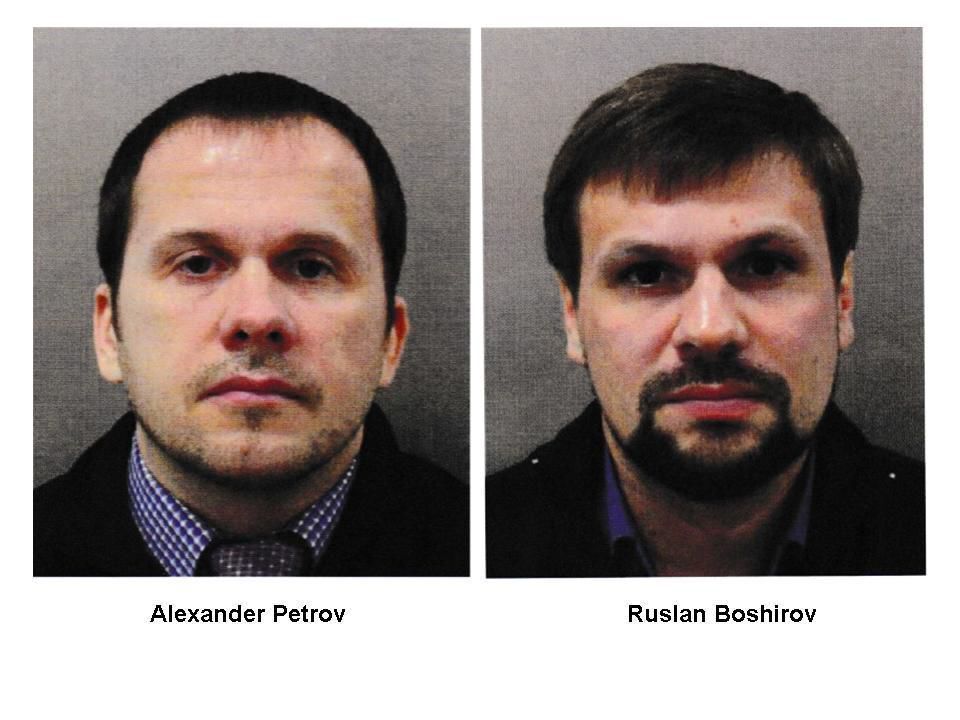
This combination photo made available by the Metropolitan Police on Wednesday Sept. 5, 2018, shows Alexander Petrov, left, and Ruslan Boshirov. British prosecutors have charged two Russian men, Alexander Petrov and Ruslan Boshirov, with the nerve agent poisoning of ex-spy Sergei Skripal and his daughter Yulia in the English city of Salisbury. They are charged in absentia with conspiracy to murder, attempted murder and use of the nerve agent Novichok. (Metropolitan Police via AP)
Britain claims that two GRU agents carried out this spring's attack with the nerve agent Novichok on Sergei Skripal, a former GRU officer who became a British double agent, and his daughter. Both survived the poisoning in the city of Salisbury, but three months later two area residents were sickened by the same nerve agent, one of them fatally — it is believed they found the discarded bottle that had carried the Skripals' poison.
This week's claim came less than two months after the U.S. indicted 12 alleged GRU agents for hacking into the Hillary Clinton presidential campaign and the Democratic Party and releasing tens of thousands of private communications, part of a sweeping conspiracy by the Kremlin to meddle in the 2016 U.S. election.

This still taken from CCTV and issued by the Metropolitan Police in London on Wednesday Sept. 5, 2018, shows Ruslan Boshirov and Alexander Petrov on Fisherton Road, Salisbury, England on March 4, 2018. British prosecutors have charged two Russian men, Alexander Petrov and Ruslan Boshirov, with the nerve agent poisoning of ex-spy Sergei Skripal and his daughter Yulia in the English city of Salisbury. They are charged in absentia with conspiracy to murder, attempted murder and use of the nerve agent Novichok. (Metropolitan Police via AP)
Also this year, the investigative group Bellingcat reported that a GRU officer was in charge of operations in eastern Ukraine, where Russia-backed separatists were fighting Ukrainian forces, in July 2014 when a Malaysian passenger airliner was shot down, killing all 298 people aboard. International investigators say the plane was shot down by a mobile missile launcher brought in from Russia. The GRU officer named by Bellingcat reportedly was responsible for weapons transfers.
Russia's RBC news service reported this year that the GRU oversees Russian mercenaries in Syria, fighting there as a so-called shadow army.
Russian authorities generally deny allegations against the GRU and refuse to discuss its activities. They said they didn't recognize the suspects Britain named Wednesday in the Salisbury poisoning.
Other agencies

FILE - In this Friday, Feb. 23, 2018 file photo, Russian President Vladimir Putin, right, listens to the Defense Minister as he arrives to attend a wreath-laying ceremony at the Tomb of the Unknown Soldier in Moscow, Russia. The GRU is one arm of Russia's extensive security and intelligence apparatus, which also includes the Foreign Intelligence Service, known as the SVR, and the Federal Security Service, or FSB, which conducts domestic intelligence and counterintelligence. (AP Photo/Alexander Zemlianichenko, File)
The GRU is one arm of Russia's extensive security and intelligence apparatus, which also includes the Foreign Intelligence Service, known as the SVR, and the Federal Security Service, or FSB, which conducts domestic intelligence and counterintelligence. The SVR and FSB were spun off from the KGB after the collapse of the Soviet Union. A former KGB agent, Vladimir Putin ran the FSB before ascending to the presidency.
And as president, Putin names the top brass in the GRU. Of all the agencies, the FSB looms largest in Russians' minds because it hunts domestic threats. The GRU, created under Soviet founder Vladimir Lenin, has a more ruthless reputation, but focuses its energies on foreign threats.
The agencies' operations appear to both compete and cooperate.

FILE - This Tuesday, May 14, 2013 file photo shows the main building of the Russian Federal Security Services, FSB, reflected in a shop's glass door on Lubyanka Square in Moscow, Russia. The GRU is one arm of Russia's extensive security and intelligence apparatus, which also includes the Foreign Intelligence Service, known as the SVR, and the Federal Security Service, or FSB, which conducts domestic intelligence and counterintelligence. (AP Photo/Ivan Sekretarev, File)
Pavel Felgenhauer, an independent Moscow-based military analyst, told The Associated Press that if "the SVR runs into military intelligence, they have to share it with the GRU; that means they try not to run into military intelligence and tell their agents not to report anything military even if they know it. The other way around, military or GRU assets are asked never to report anything political."
But in the case of the alleged U.S. election-related hacking, he said, "I believe that was an inter-service operation, because it's not military but they gained some kind of hacking access and then they shared it with the FSB and the SVR."
___
Kate de Pury contributed.



 Historic bank vault now new Tucson speakeasy