It’s among the world’s busiest container shipping routes — a stream of vessels packed with furniture, automobiles, clothing and other goods, traversing the Pacific between Los Angeles and Shanghai.
If plans succeed, this corridor will become a showcase for slashing planet-warming carbon emissions from the shipping industry, which produces nearly 3% of the world’s total. That’s less than from cars, trucks, rail or aviation but still a lot — and it’s rising.
The International Maritime Organization, which regulates commercial shipping, wants to halve its greenhouse gas releases by midcentury and may seek deeper cuts this year.
Meeting agency targets will require significant vessel and infrastructure changes. That’s inspiring plans for “green shipping corridors” along major routes where new technologies and methods could be fast-tracked and scaled up.
People are also reading…
More than 20 of these partnerships have been proposed. The goal: uniting marine fuel producers, vessel owners and operators, cargo owners and ports in a common effort.

Gene Seroka, executive director of the Port of Los Angeles, speaks during an event June 10, 2021, celebrating the port becoming the first in the Western Hemisphere to process 10 million container units in a 12-month period.
Los Angeles and Shanghai formed their partnership last year.
“The vision is that a container will leave a factory on a zero-emissions truck (in China),” said Gene Seroka, executive director of the Port of Los Angeles.
“It will arrive at the port of Shanghai, be loaded onto a ship by a zero-emissions cargo handling equipment unit, and move across the Pacific Ocean on a vessel that emits zero carbon,” Seroka said, with carbon-free handling and distribution after it gets to Los Angeles.
Los Angeles entered a second agreement in April with nearby Long Beach and Singapore. Others in the works include the Great Lakes-St. Lawrence River; a Chilean network; and numerous corridors in Asia, North America and Europe.
Roughly 90% of traded goods move on water, some in behemoths longer than four football fields, each holding thousands of containers with consumer products. About 58,000 commercial ships ply the seas.
Their emissions are less noticeable than onshore haulers such as trucks, although noxious fumes from ships draw complaints in port communities.

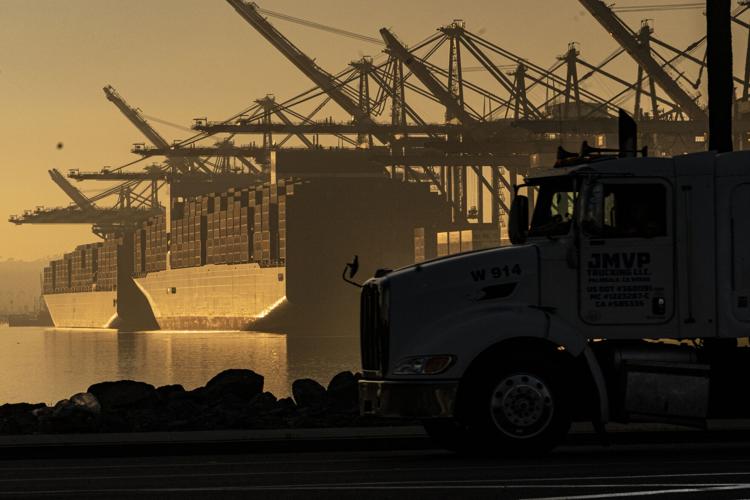
A truck arrives to pick up a shipping container Nov. 30, 2021, near vessels at the Port of Los Angeles.
Maritime trade volumes are expected to triple by 2050, according to the Organization for Economic Cooperation and Development. Studies predict the industry’s share of greenhouse gas emissions could reach 15%.
Yet the 2015 Paris climate accord exempts maritime shipping, partly because vessels do business worldwide, while the agreement covers nation-by-nation goals.
“No one wants to take responsibility,” said Allyson Browne of advocacy group Pacific Environment. “A ship may be flagged in China, but who takes ownership of emissions from that ship when it’s transporting goods to the U.S.?”
The IMO responded to mounting pressure with a 2018 plan for a 50% emissions reduction by midcentury from 2008 levels. An update scheduled for July may set more ambitious targets.
The Biden administration wants a zero-emission goal, a State Department official told The Associated Press.
Fewer than half of large shipping companies pledged to meet international carbon objectives.
Proposals range from slowing vessels down to charging them for emissions, as the European Union did last year.

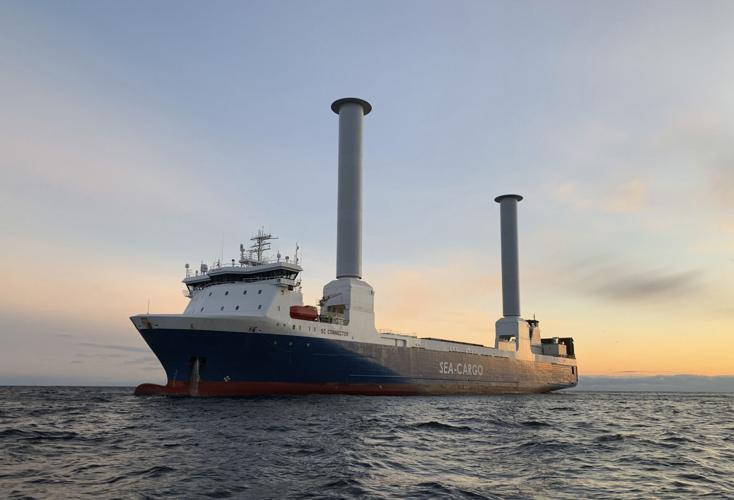
The SC Connector, a freight hauler equipped with two rotor sails that spin in the wind and help propel the vessel manufactured by Finland-based Norsepower, sails in 2021 on the North Sea off the coast of Norway.
Mechanical sails, batteries and low- or zero-carbon liquid fuels and among propulsion methods touted as replacements for “bunker fuel” — thick residue from oil refining — that powers most commercial ships. It spews greenhouse gases and pollutants that endanger human health: sulfur dioxide, nitrogen oxide, soot.
Finding alternatives will be a priority for green shipping corridors.
Worldwide, liquid natural gas is used by 923 of 1,349 commercial vessels not powered by conventional fuels, according to a study last year by DNV, a Norway-based maritime accreditation society. Vessels with batteries or hybrid systems placed a distant second.
Many environmentalists oppose LNG because it emits methane, a potent greenhouse gas. Defenders say it’s the quickest and most cost-effective bunker fuel substitute.
Of 1,046 alternative-energy ships on order, 534 are powered by LNG while 417 are battery-hybrids, DNV reported. Thirty-five others will use methanol, which analysts consider an up-and-coming cleaner alternative.

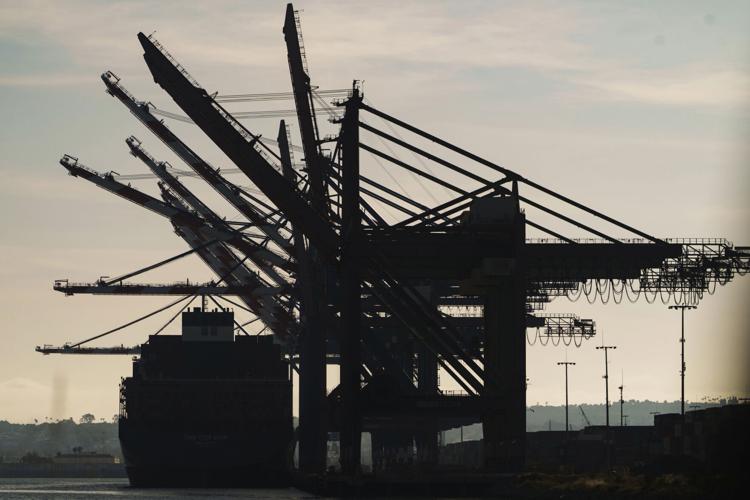
A docked container ship April 28 at the Port of Los Angeles.
Moller-Maersk plans to launch 12 cargo vessels next year that will use “green methanol” produced with renewable sources such as plant waste. A biodiesel from used cooking oil fuels some of its ships. The company is collaborating on research that may lead to ammonia- or hydrogen-powered vessels by the mid-2030s.
Norsepower offers a new twist on an ancient technology: wind. The Finnish company developed “rotor sails” — composite cylinders about 33 yards tall are fitted on ship decks and spin in the breeze. Air pressure differences on opposite sides of the whirring devices help push a vessel forward.
An independent analysis found rotor sails installed on a Maersk oil tanker in 2018 produced an 8.2% fuel savings in a year. Norsepower CEO Tuomas Riski said others saved 5% to 25%, depending on wind conditions, ship type and other factors.
Fleetzero contends electric ships are best suited to wean the industry off carbon. The company was founded two years ago in Alabama to build cargo vessels with rechargeable battery packs.
CEO Steven Henderson says it envisions fleets of smaller, nimbler ships than the huge container vessels. They would call at ports that have freshly charged batteries to swap for ones running low. Fleetzero’s prototype ship is slated to begin delivering cargo later this year.
An organization called Cargo Owners for Zero Emission Vessels pledges to use only zero-emission shipping companies by 2040. Among 19 signatories are Amazon, Michelin and Target.

 Lake Mead's drops raise prospect of unaffordable Hoover Dam electricity