

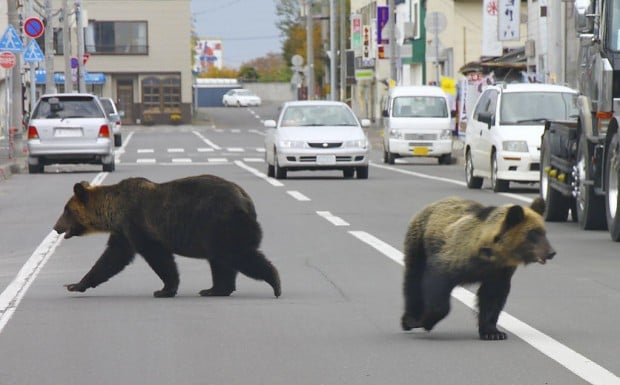
TOKYO - Many experts have agreed that this year's dearth of acorns - on which bears feed - explains why dozens of the animals have come out of forests and into towns and cities across Japan in recent months.
These bears have wandered into human settlements this year to look for food before going into hibernation, they said.
"This year, oak trees didn't grow enough buds due to unusually low temperatures in spring," an official of the Nagano prefectural government's wildlife problem section said. "And then the scorching weather in summer made the acorns fall from the trees before they had grown to full size."
A mature black bear usually weighs about 220 pounds. But a mature bear captured in Nagaoka, Niigata Prefecture, on Oct. 10 weighed only 99 pounds.
Kazuhiko Maita, head of the Institute for Asian Black Bear Research and Preservation, a nonprofit organization based in Hatsukaichi, Hiroshima Prefecture, believes a baby boom three years ago is partly to blame for the spate of bear sightings.
People are also reading…
"In autumn 2007, acorns were plentiful and bears were healthy and gave birth to many cubs," Maita said.
He said there was an abundance of acorns the following autumn, too.
Some experts have suggested changes in forests and farmland are also behind the spate of bear encounters.
Forests in mountainous areas were once maintained by forestry workers, but this work has been increasingly neglected in recent years as people drift away from these areas.
More and more farmland is being left unattended, and plants have grown among the abandoned crops. These plots are often close to residential areas and provide bears with food with cover from prying eyes.
Iwate University professor Toshiki Aoi, a researcher of wild animal controls, said bears are no longer afraid of people.
"With fewer hunters around, bears are no longer afraid to approach people. The current situation is basically an open invitation to bears to come into areas where people live," Aoi said.


