
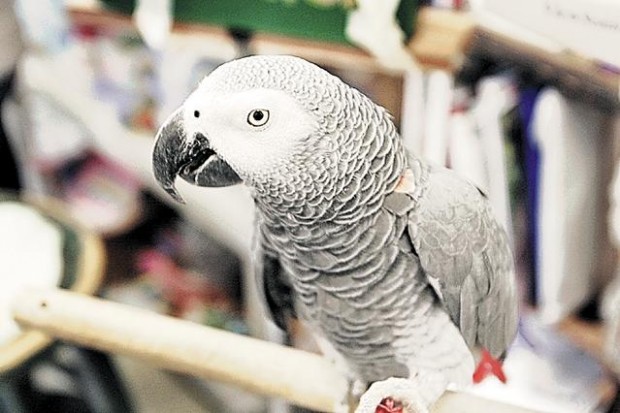
In three decades as a research subject, Alex the parrot dazzled the world with his ability to talk, count and identify colors and shapes, along the way providing scientists with unprecedented insights into the avian brain.
Alex, 31, an African Grey parrot, died unexpectedly last week, said Irene Pepperberg, a former University of Arizona professor who studied and worked with the parrot for most of his life and published reports of his progress in scientific journals. In 2002, Pepperberg's book "The Alex Studies: Cognitive and Communicative Abilities of Grey Parrots" brought the bird and her research widespread attention.
Pepperberg, who now holds positions at Brandeis and Harvard universities, acquired Alex from a pet store in 1977, when she was a a doctoral student in chemistry at Harvard.
"It's devastating to lose an individual you've worked with pretty much every day for 30 years," Pepperberg told The Boston Globe.
People are also reading…
The parrot had an emotional development similar to a 2-year-old child and intellectually was similar to a typical 5-year-old.
By using novel methods of teaching, Pepperberg prompted Alex to learn scores of words, which he could put into categories, and to count small numbers of items, as well as recognize colors and shapes.
"The work revolutionized the way we think of bird brains," said Diana Reiss, a psychologist at Hunter College who works with dolphins and elephants. "That used to be a pejorative, but now we look at those brains — at least Alex's — with some awe."
Pepperberg said Alex was discovered dead in his cage Friday. The cause of death is not yet known, but the African Grey parrot's average life span is 50 years.
Pepperberg joined the UA in 1991 as an associate professor of ecology and evolutionary biology, bringing with her Alex and more than a decade of research into the cognitive abilities of parrots. She was a full-time faculty member at the UA, also affiliated with psychology and neuroscience, until she joined MIT as a visiting professor in 1999. She remained an adjunct faculty member at the UA until 2002.
In experiments, Pepperberg would employ one trainer to, in effect, compete with Alex for a small reward, like a grape. Alex learned to ask for the grape by observing what the trainer was doing to get it; the researchers then worked with the bird to help shape the pronunciation of words.
Alex showed surprising facility. He demonstrated some of his skills on nature shows, including programs on the BBC and PBS, where he famously shared scenes with actor Alan Alda on the PBS series "Look Who's Talking."