

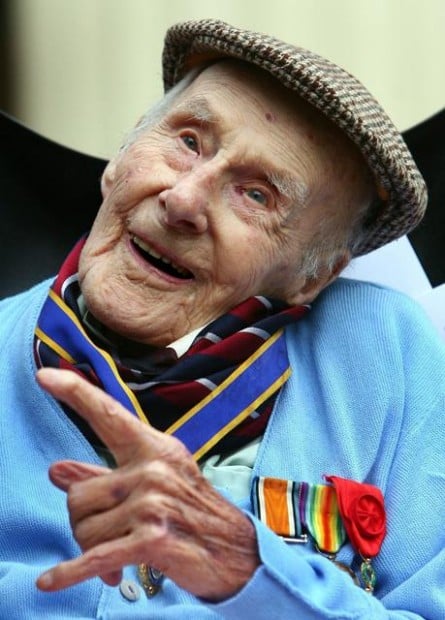
LONDON — Only death could silence Henry Allingham.
He went to war as a teenager, helped keep flimsy aircraft flying, survived his wounds and came home from World War I to a long — very long — and fruitful life.
But only in his last years did he discover his true mission: to remind new generations of the sacrifices of the millions slaughtered in the trenches, killed in the air, or lost at sea in what Britons call the Great War.
Allingham, who was the world's oldest man when he died Saturday at 113, attributed his remarkable longevity to "cigarettes, whisky and wild, wild women."
Jokes aside, he was a modest man who served as Britain's conscience, reminding young people time and time again about the true cost of war.
"I want everyone to know," he told The Associated Press during an interview in November. "They died for us."
People are also reading…
He was the last surviving original member of the Royal Air Force, which was formed in 1918. He made it a personal crusade to talk about a conflict that wiped out much of a generation. Though nearly blind, he would take the outstretched hands of visitors in both of his, gaze into the eyes of children, veterans and journalists and deliver a message he wanted them all to remember about those left on the battlefield.
"I don't want to see them forgotten," he would say quietly. "We were pals."
Only a handful of World War I veterans remain of the estimated 68 million mobilized. There are no French veterans left alive; just one left now in Britain; and the last living American-born veteran is Frank Woodruff Buckles of Charles Town, W.Va. The man believed to have been Germany's last surviving soldier has also died.
"It's the end of a era— a very special and unique generation," said Allingham's friend, Dennis Goodwin. "The British people owe them a great deal of gratitude."
Born June 6, 1896, during the reign of Queen Victoria, Allingham would later recall sitting on his grandfather's shoulders waving a flag for King Edward VII's coronation in 1902.
Allingham left school at 15 and was working in a car factory in east London when war broke out in 1914.
He spent the war's first months refitting trucks for military use, but when his mother died in June 1915, he decided to join up after seeing a plane circling a reservoir in Essex, east of London.
He fought in the Battle of Jutland, the largest naval battle of World War I.
After the war he worked at the Ford motor factory and raised two children with his wife, Dorothy. She died in 1970, and when his daughter Jean died in 2001, friends say he waited to die, too. His will to live was waning; his life seemed without a larger purpose.
That's about the time he met Goodwin, a nursing home inspector who realized that veterans of Allingham's generation were not getting the care they needed to address the trauma they had experienced at the Somme, Gallipoli and Ypres and the other blood-drenched World War I battlefields.
He encouraged Allingham to share his experiences and the veteran, even though he had passed the century mark, started talking to reporters and school groups, providing the connection to a lost generation some had forgotten.




 Historic bank vault now new Tucson speakeasy

