PHOENIX - By day, Morris Jarvis works as an instrumentation and control engineer for Intel Corp.'s newest factory, Fab 32.
By night and on the weekends, he is Arizona's version of the "Astronaut Farmer," building a vehicle he hopes to launch into space some day.
Jarvis and his 10 partners have built a prototype of a craft that would take everyday people on suborbital flights around the Earth for a fee. He named the craft "Hermes," a Greek god of land travel.
"It's something I've chased forever," said Jarvis, who has a bachelor's degree in aerospace engineering. "The whole plan is private space flight for regular people."
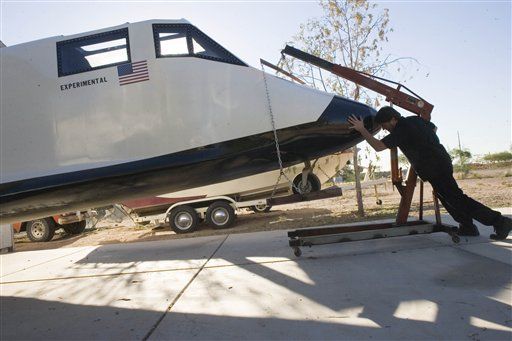
Jarvis is about three years into the latest prototype, a gleaming white craft that resembles a boxy version of the space shuttle and seats four passengers. He works on it in his shop at his east Mesa home.
People are also reading…
The problem is that Jarvis needs money to get a workable model off the ground.
He estimates he needs about $100,000 to do glide testing. He then would need $1.5 million to launch the craft with a helium balloon, the cheaper of two methods he is considering.
Launching the craft with a rocket would take about $5.4 million, he estimates.
Jarvis did not to enter the competition but he is not alone in trying to commercialize private suborbital space flight for civilians.
Virgin Galactic, which is owned by billionaire Richard Branson's Virgin Group, has collected $25 million in deposits from would-be space travelers for flights up to 75 miles above Earth starting as early as 2009. Virgin Galactic is charging $200,000 per flight.
Jarvis' business plan calls for space travelers to pay $25,000 for a trip powered by a helium balloon and $100,000 for a ride powered by a rocket.
His first offering would involve the craft being towed to 113,000 feet (about 21 miles above Earth) behind balloons tethered to a safety parachute. Passengers would get a view of the Earth from space but only experience about five minutes of weightlessness during the freefall back to Earth. The entire flight would last about six or seven hours.
In his second offering, passengers would experience 10 minutes of zero gravity and fly to a suborbital altitude of 330,000 feet, or about 62 miles. The roundtrip flight would take about 45 minutes.
Jarvis said he is focused on the balloon offering first as a way to generate revenue to pay for rocket development.
"From there we can start making money and finish the rocket thing on our own," he said.
There is nothing that prevents anyone from launching a rocket from U.S. soil provided he gets a license from the Federal Aviation Administration, which created a commercial space transportation office for such ventures.
"The hardest part is all this government stuff, honestly," Jarvis said.
"It got a little interesting over here when the FBI showed up looking for me," he said.
That was in March 2001 when Jarvis was trying to import Russian rockets for his craft. They were relatively cheap, $6,000 apiece, surplus rockets sitting in a warehouse, Jarvis recalled.
But the paperwork to buy them was onerous, he said, prompting him and his partners to scrap their plan to build a full-size rocket.
Jarvis, who recently got his private pilots' license to do the flight testing for the balloon launch, said he wouldn't be able to build the rocket if he worked for an aerospace company such as Space Data Corp. or Orbital Sciences Corp.
"I'd have to sign a noncompete clause if I worked for them," he said. "Besides, Intel is a pretty good gig when it comes to building factories and other things."
Jarvis said reaction to his rocket varies, from people whose eyes glaze over, to those who don't want anything to do with civilian space flight to others who are intrigued.
"To me, I'd climb into a rocket in a heartbeat."
Jarvis said his craft would be attached to a parachute in case the balloons malfunctioned. In addition, he has designed a built-in ballistic recovery parachute that would be used in an emergency landing.
For added safety, the craft would be pressurized and occupants would wear pressurized space suits, he said.
But for now, Jarvis is enjoying the curiosity factor from those who see the craft or hear about it.
"It's not something you see every day," Jarvis said. "When I roll it out, I get all the neighbor kids on the street lined up around it.
"It's not that outlandish when you get people talking about it."


 Second wall planned across Arizona as Trump administration doubles down on border