LONDON — All hail the rising sun.
A seemingly curious alliance of druids, pagans, hippies, local residents, tourists and costumed witches and wizards are gathering around a prehistoric stone circle on a plain in southern England to express their devotion to the sun, or to have some communal fun.
They will stay and celebrate at Stonehenge for the night and greet sunrise on Wednesday, which will be the longest day in the Northern Hemisphere.

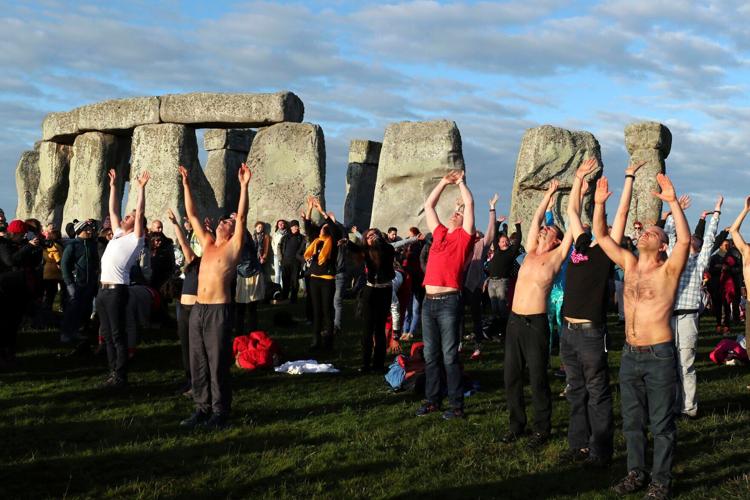
Revelers perform yoga soon after sun rise at the ancient stone circle Stonehenge to celebrate the Summer Solstice, the longest day of the year, near Salisbury, England, on June 21, 2019. Druids, pagans, hippies, local residents, tourists and costumed witches and wizards are expected to start gathering Tuesday evening.
All over the U.K., optimism will reign supreme as summer officially starts. It's no coincidence that the nearby Glastonbury Festival, one of the world's biggest music events, opens its doors on Wednesday, too. Both Stonehenge and Glastonbury supposedly lie on ley lines — mystical energy connections across the U.K.
For the thousands making the pilgrimage to Stonehenge, approximately 80 miles southwest of London, it is more than looking forward to Elton John at Glastonbury or a few ciders in the sun.
People are also reading…
For druids, modern-day spiritualists linked to the ancient Celtic religious order, Stonehenge has a centuries-long importance, and they will be there to perform dawn rituals around the solstice in their traditional white robes. It's effectively all about the cycle of life, of death and rebirth.
This year, the summer solstice at Stonehenge goes from 7 p.m. Tuesday through 8 a.m. Wednesday. For this one night, worshippers are allowed to spend the night inside the stone circle. Others chant or play their acoustic guitars. Alcohol is prohibited, as are sound systems. Bring a blanket, but no sleeping bags, please. And definitely, no climbing on the stones.
The rules have been tightened over the decades, certainly during the coronavirus pandemic. Back in the less-restrained past, tens of thousands would travel by foot, car, bus or motorcycle to worship at the solar temple, or just have a bit of fun.

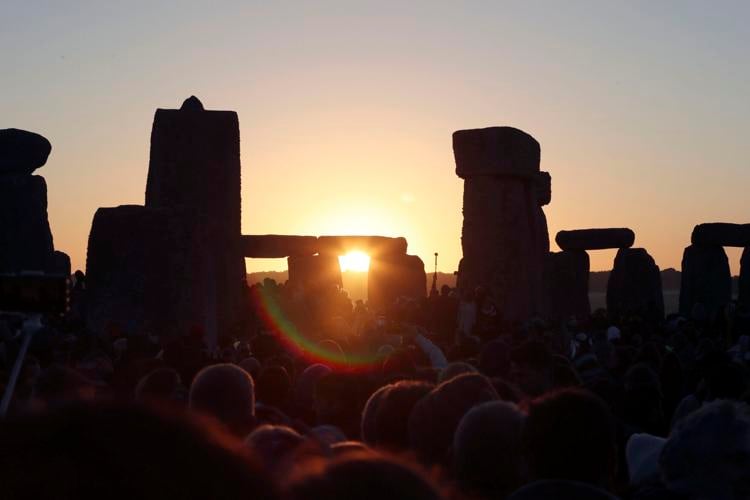
The sun rises as thousands of revelers gather at the ancient stone circle Stonehenge to celebrate the Summer Solstice, the longest day of the year, near Salisbury, England, on June 21, 2019.
It is a symbol of British culture and history and remains one of the country’s biggest tourist draws, despite the seemingly permanent traffic jams on the nearby A303 highway, a popular route for motorists traveling to and from the southwest of England.
Stonehenge, one of the world’s most famous prehistoric monuments and a World Heritage Site, was built on the flat lands of Salisbury Plain in stages starting 5,000 years ago, with the unique stone circle erected in the late Neolithic period about 2,500 B.C. Some of the stones, the so-called bluestones, are known to have come from the Preseli Hills in southwest Wales, nearly 150 miles away, but the origins of others remain a mystery.
The site’s meaning has been the subject of vigorous debate, with some theories seemingly more outlandish, if not alien, than others.
English Heritage, a charity that manages hundreds of historic sites, notes several explanations — from Stonehenge being a coronation place for Danish kings, a druid temple, a cult center for healing, or an astronomical computer for predicting eclipses and solar events.

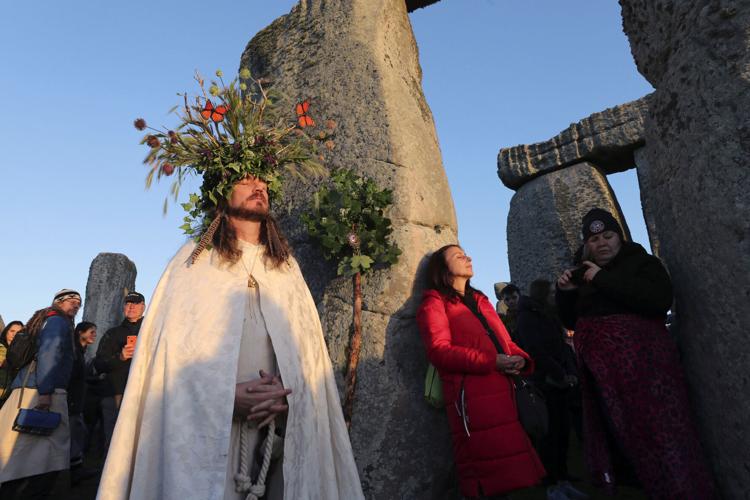
Revelers meditate next to stones at sunrise as thousands gather at the ancient stone circle Stonehenge to celebrate the Summer Solstice, the longest day of the year, near Salisbury, England, on June 21, 2019.
The charity said the most generally accepted interpretation "is that of a prehistoric temple aligned with the movements of the sun.”
After all, the stones match perfectly with the sun at both the summer and winter solstices. On the summer solstice, the sun rises behind the Heel Stone in the northeast part of the horizon and its first rays shine into the heart of the stone circle. When the sky is clear, those rays are a triumphant spectacle to behold.

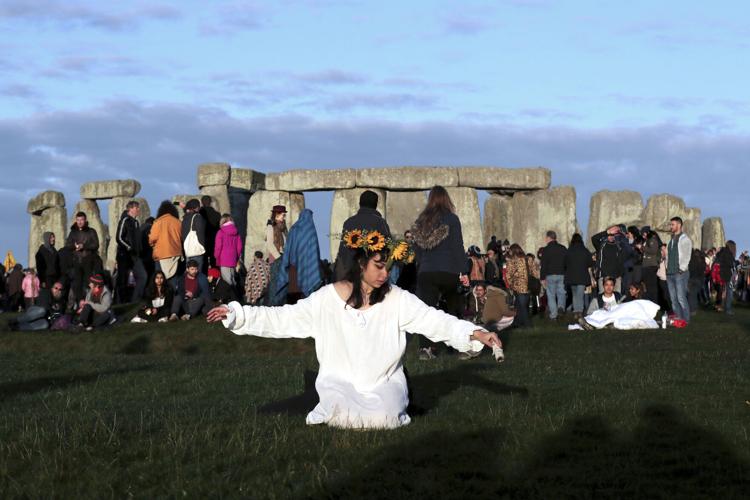
A reveler prays at sunrise as thousands gather at the ancient stone circle Stonehenge to celebrate the Summer Solstice, the longest day of the year, near Salisbury, England, on June 21, 2019.
But, let's be honest, that's not always the case during the British summer. After weeks of dry and sunny weather, the forecast for Tuesday night and Wednesday morning is a bit iffy.
It's time to pray to the sun king.
Photos: Celebrations, protests and more — a look back at Stonehenge through the years

The Stonehenge landscape of Salisbury Plain in England, Wednesday Sept.15, 2004 when it was announced by English Heritage that they are planning one of the biggest creative conservation projects in the World. The planning application is proposing to remove the roads and reunite Stonehenge and its surrounding monuments to their natural setting. A new visitor centre is planned with an environmentally sensitive transport system which will carry visitors to the site. Old pathways will be restored so that the countryside will be visited and explored.(AP Photo/Dave Caulkin)

A reveler jumps in the air after climbing up on one of the stones forming Stonehenge, near Salisbury, England, as crowds gather before sunrise to mark the summer solstice, Tuesday, June 21, 2005. The ancient stone circle of Stonehenge is a World Heritage Site erected between approximately 3000 B.C. and 1600 B.C. and despite years of research the reason behind its construction remains a mystery. The summer solstice in the northern hemisphere occurs annually on June 21 and is the time at which the sun is at its northernmost point in the sky. (AP Photo/Matt Dunham)

A reveller performs a fire breathing trick as people gather before sunrise on the summer solstice at Stonehenge, near Salisbury, in England, Tuesday, June 21, 2005. The ancient stone circle of Stonehenge is a World Heritage Site erected between approximately 3000BC and 1600BC and despite years of research the reason behind its construction remains a mystery. The summer solstice in the northern hemisphere occurs annually on June 21 and is the time at which the sun is at its northernmost point in the sky. (AP Photo/Matt Dunham)

“Ban the Bomb” slogan that appeared in yellow letters, about four feet high, at Stonehenge on Salisbury Plain, Wiltshire, England on March 3, 1961. Police spokesman said stones were defaced in what appeared to be a “kind of distemper.” (AP Photo)

A worshipper of the Pagan Wiccan religion, left, and a friend stand near the ancient stone monument of Stonehenge, in Wiltshire, southern England, as access to the site is given to druids, New Age followers and members of the public to mark the annual Winter Solstice, Friday Dec. 22, 2006. The Pagan celebration of Winter Solstice was marked at sunrise on Friday morning as the solstice occurred at 0022 GMT on Friday. (AP Photo/Matt Dunham)

A procession of Pagans walks away after celebrating in the ancient stone circle of Stonehenge, as access to the site is given to druids, New Age followers and members of the public to mark the annual Winter Solstice, in Wiltshire, southern England, Friday Dec. 22, 2006. The Pagan celebration of Winter Solstice was marked at sunrise on Friday morning as the solstice occurred at 0022 GMT on Friday. (AP Photo/Matt Dunham)

Couples embrace beside stones forming part of the ancient stone circle of Stonehenge, as access to the site is given to druids, New Age followers and members of the public to mark the annual Winter Solstice, in Wiltshire, southern England, Friday Dec. 22, 2006. The Pagan celebration of Winter Solstice was marked at sunrise on Friday morning as the solstice occurred at 0022 GMT on Friday. (AP Photo/Matt Dunham)

Members of the Ancient Order of Druids celebrate the longest day of the year, the Summer Solstice, near Amesbury, Wiltshire, England, June 22, 1979, at the pre-historic stones of Stonehenge. The ceremony is enacted at the rising of the sun. (AP Photo)

England's Stonehenge, prehistoric monument of circular arrangements of large stones, situated 80 miles west of London on Salisbury Plain, is shown in 1983. (AP Photo/Charles C. Lane)

Carl Klinkenborg, right, and his wife Gigha kiss during their wedding ceremony as people gather to celebrate the summer solstice at Stonehenge in west England, early Sunday, June 21, 2009. The monument attracted some 35 thousand people to mark the longest day of the year when the sunrise was expected at 4:58 am under the cloudy sky. (AP Photo/Akira Suemori)

People raise their hands meditating during the summer solstice shortly after 04.52 am at the Stonehenge monument, England, Monday, June 21, 2010. Thousands of New Agers and neo-pagans danced and whooped in delight Monday as a bright early morning sun rose above the ancient stone circle Stonehenge, marking the summer solstice. About 20,000 people crowded the prehistoric site on Salisbury Plain, southern England, to see the sunrise at 4:52 A.M. (1152EST), following an annual all-night party. (AP Photo/Lefteris Pitarakis)

People raise their hands meditating during the summer solstice shortly after 04.52 am at the Stonehenge monument, England, Monday , June 21, 2010. Thousands of New Agers and neo-pagans danced and whooped in delight Monday as a bright early morning sun rose above the ancient stone circle Stonehenge, marking the summer solstice. About 20,000 people crowded the prehistoric site on Salisbury Plain, southern England, to see the sunrise at 4:52 A.M. (1152EST), following an annual all-night party. (AP Photo/Lefteris Pitarakis)

The Stonehenge monument in England is seen, early Monday ,June 21, 2010. Thousands of New Agers and neo-pagans danced and whooped in delight Monday as a bright early morning sun rose above the ancient stone circle Stonehenge, marking the summer solstice. About 20,000 people crowded the prehistoric site on Salisbury Plain, southern England, to see the sunrise at 4:52 A.M. (1152EST), following an annual all-night party. (AP Photo/Lefteris Pitarakis)

A reveller reaches up to the sky during the summer solstice at Stonehenge, near Salisbury in England, Tuesday, June 21, 2011. The ancient stone circle of Stonehenge is a World Heritage Site erected between approximately 3000BC and 1600BC and despite years of research the reason behind its construction remains a mystery. The summer solstice in the northern hemisphere occurs annually on June 21 and is the time at which the sun is at its northernmost point in the sky. (AP Photo/Matt Dunham)

Revellers cheer as the sun finally breaks through the clouds more than a couple of hours after sunrise during the summer solstice at Stonehenge, near Salisbury in England, Tuesday, June 21, 2011. The ancient stone circle of Stonehenge is a World Heritage Site erected between approximately 3000BC and 1600BC and despite years of research the reason behind its construction remains a mystery. The summer solstice in the northern hemisphere occurs annually on June 21 and is the time at which the sun is at its northernmost point in the sky. (AP Photo/Matt Dunham)

People play music and dance near Stonehenge, southern England late Friday June 20, 2008 in anticipation of the mystical moment when the sun rises Saturday over the stones for the summer solstice. Beating drums and wearing rainbow cloaks, the revelers walked through light rain to talk, dance and meditate as they waited for Saturday's 4:58 a.m. sunrise, which starts the longest day of the year in the northern hemisphere. (AP Photo/Lefteris Pitarakis)

Comet Hale-Bopp seen above the ancient stone circle of Stonehenge in south west England Friday, March 28, 1997. Stonehenge, a collection of Bronze Age monuments, was constructed, according to modern archeological research, around 2000 BC. (AP Photo/Alastair Grant)

People dance in celebration during the summer solstice shortly after 04:52 am at the prehistoric Stonehenge monument, near Salisbury, England, Friday, June 21, 2013. Following an annual all-night party, thousands of New Agers and neo-pagans danced and whooped in delight at the ancient stone circle Stonehenge, marking the summer solstice, the longest day of the year. (AP Photo/Lefteris Pitarakis)

Revelers meditate next to stones at sunrise as thousands gather at the ancient stone circle Stonehenge to celebrate the Summer Solstice, the longest day of the year, near Salisbury, England, Friday, June 21, 2019. (AP Photo/Aijaz Rahi)

An Archdruid performs a ritual near to the cordoned off Stonehenge as a small group of people gathered to celebrate the Summer Solstice, the longest day of the year, near Salisbury, England, Sunday, June 21, 2020. The coronavirus pandemic has prevented druids, pagans and partygoers from watching the sun rise at Stonehenge to mark the summer solstice. The ancient stone circle usually draws thousands of people to mark the longest day of the year in the northern hemisphere. But Britain has banned mass gatherings as part of measures to contain the spread of COVID-19. English Heritage, the body that oversees Stonehenge, livestreamed the sunrise instead. (Ben Birchall/PA via AP)