

RUSSIA
Once-banned 'Gulag' to be taught in school
MOSCOW — The book that made "Gulag" a synonym for the horrors of Soviet oppression will be taught in Russian high schools, a generation after the Kremlin banned it as destructive to the Communist cause and exiled its author.
The Education Ministry said Wednesday that excerpts of Alexander Solzhenitsyn's "The Gulag Archipelago," published in 1973, are to be required reading for students.
Coming at a time when Prime Minister Vladimir Putin is pushing to restore pride in the Soviet past, the decision could be a reflection of the Russian establishment's struggle to reconcile that pride with the freedoms that Russians take for granted nearly 20 years after dumping communism and embracing democracy and the free market.
People are also reading…
After publication, "The Gulag Archipelago" circulated underground and soon reached the West in translation. A furious Kremlin expelled Solzhenitsyn from his native country in 1974, and he spent the next 20 years in the U.S.
His massive three-volume book gave the outside world a detailed account of the systematic imprisonment and murder of hundreds of thousands of Russians in the nationwide "archipelago" of prisons and labor camps designed by Soviet founder Vladimir Lenin and expanded by Stalin.
AUSTRIA
OPEC holds steady on crude output
VIENNA — OPEC has decided to leave its crude-oil output targets unchanged because global crude markets are "oversupplied" and there are lingering worries about economic recovery.
The 12-nation Organization of Petroleum Exporting Countries says "market fundamentals have remained weak" — even though oil has rebounded to around $70 a barrel in recent weeks after wild swings over the past 14 months.
Oil ministers meeting in Vienna decided today that the time wasn't ripe to cut the current output target of just less than 25 million barrels a day.
OPEC spokesman Omar Ibrahim told reporters: "While there are signs that economic recovery is under way, there remains great concern about the magnitude and pace of this recovery."
BELGIUM
Euthanasia jumped after legalization
BRUSSELS — Cases of euthanasia in Belgium's Flanders region soared to nearly 2 percent of all deaths in 2007 after the country legalized the practice a few years earlier, a medical study has shown.
The survey, conducted by an end-of-life research group at the Brussels-based Free University, said the rise was mainly due to Belgium's 2002 euthanasia law, which gave terminally ill patients more choices.
"We found that the enactment of the Belgian euthanasia law was followed by an increase in all types of medical end-of-life practices, with the exception of the use of lethal drugs without the patient's explicit request," the group said in a letter published in today's New England Journal of Medicine.
Dr. Johan Bilsen's team surveyed a random sample of 6,202 death certificates of people who died between June and November 2007 in Flanders, a Dutch-speaking region that accounts for six million of Belgium's 10 million people. The certifying doctors involved in the sample were also questioned. In all, 118 cases of euthanasia were found.
UNITED NATIONS
US joins international plan to fight piracy
The United States is signing onto an international plan to fight piracy off the coast of Somalia, committing itself to a leadership role to protect one of the world's busiest shipping routes.
The so-called "New York Declaration" being signed by U.S. Deputy Ambassador Rosemary DiCarlo and her counterparts from China, Britain, France and other powers is an attempt to pool resources and agree on the best ways of deterring the Somali pirates who prey on vessels passing between Europe and Asia.
Though it is a nonbinding political document, proponents say it will commit ship-registry nations to adopt "best management practices" for ship security such as increased lookouts, raised ladders and emergency fire pumps readied to repel boarders.
By signing, the United States says the Coast Guard and U.S. shipping companies will continue adopting measures to protect themselves against piracy that comply with the International Ship and Port Facility Security Code.
A group of almost 40 nations and international organizations, including the United States, China, Britain and France, planned to gather today at U.N. headquarters in New York for its fourth major session on deterring Somali piracy.
The nations are meeting to discuss how best to coordinate international naval patrols and other security measures and how to discourage the secretive payments to pirates who often demand — and receive — multimillion-dollar ransoms.
LIBYA
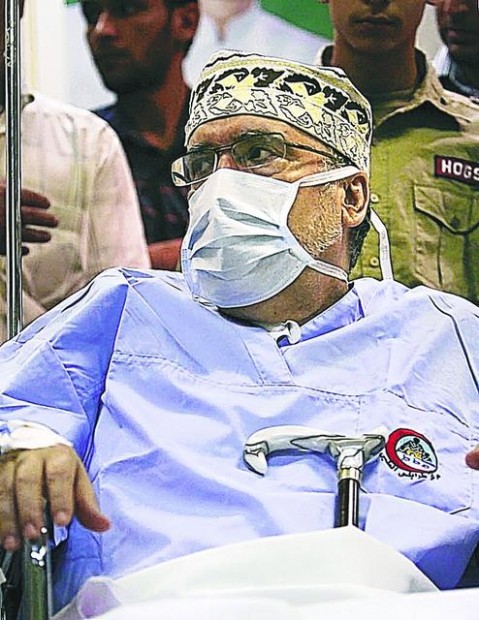
Lockerbie bomber visited in hospital
TRIPOLI — The ailing Lockerbie bomber looked weak and pale, sitting in a wheelchair, as he was visited by a group of African parliamentarians Wednesday in a rare appearance in the hospital where he is being treated for prostate cancer.
Abdel Baset al-Megrahi appeared for only five minutes and did not speak during the visit in the Tripoli Medical Center. Dressed in a hospital gown, he wore a surgical mask over his mouth and nose and a traditional embroidered cap. Al-Megrahi was freed from a Scottish prison last month on compassionate grounds because doctors said he was dying of his cancer. The release outraged the United States and many relatives of the 270 people killed in the 1988 bombing of Pan Am Flight 103 over Lockerbie, Scotland.
Libyan officials have said little about his condition since his Aug. 20 homecoming.
Al-Megrahi was the only person convicted of the Lockerbie bombing, which killed all 259 people on board — mostly Americans — and 11 people on the ground.
The Associated Press


 Faculty concerned about changes to U of A admissions policy


