NEW YORK — From the outside, the residential high-rise on Manhattan’s Upper West Side looks pretty much like any other luxury building: A doorman greets visitors in a spacious lobby adorned with tapestry and marble.
Yet just below, in the basement, is an unusual set of equipment that no other building in New York City — indeed few in the world — can claim. In an effort to drastically reduce the 30-story building’s emissions, the owners have installed a maze of twisting pipes and tanks that collect carbon dioxide from the massive, gas-fired boilers in the basement before it goes to the chimney and is released into the air.

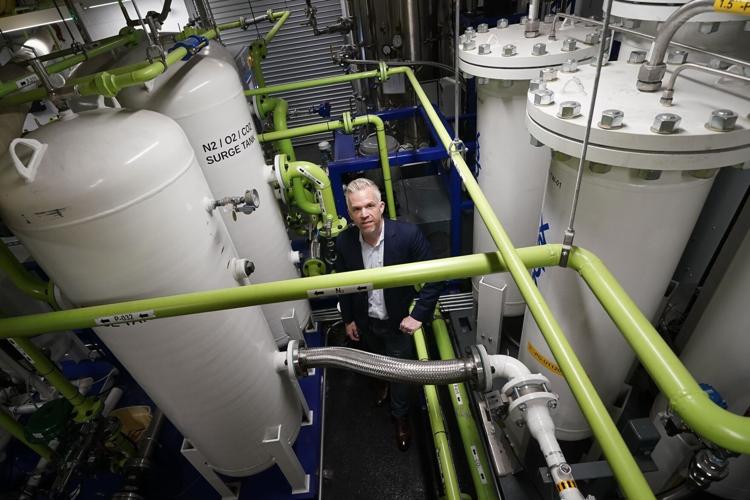
Brian Asparro, chief operating officer of CarbonQuest, stands in a production room where liquid carbon dioxide is converted from a byproduct of a natural gas fired water boiler to a salable industrial product on April 18 in New York. New York is forcing buildings to clean up, and several are experimenting with capturing carbon dioxide that is emitted, cooling it into a liquid and mixing it into concrete where it turns into a mineral.
The goal is to stop that climate-warming gas from entering the atmosphere. And there’s a dire need for reducing emissions from skyscrapers like these in such a vertical city. Buildings are by far the largest source of greenhouse gas emissions here, roughly two-thirds, according to the city buildings department.
People are also reading…
New York state’s buildings also emit more air pollution than any other state’s.
So building owners must make dramatic cuts starting next year or face escalating fines under a new city law. About 50,000 structures — more than half the buildings in the city, are subject to Local Law 97. Other cities such as Boston and Denver followed suit with similar rules.

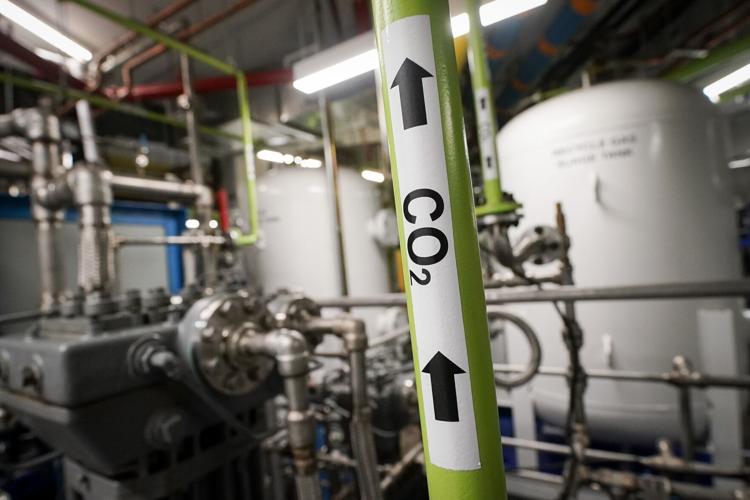
A liquid carbon dioxide pipe is labeled in a production room of The Grand Tier luxury apartment building, where the carbon byproduct of a natural gas fired water boiler is repurposed for industrial sale, on April 18 in New York.
As a result, property managers are scrambling to change how their buildings operate. Some are installing carbon capture systems, which strip out carbon dioxide, direct it into tanks and prepare it for sale to other companies to make carbonated beverages, soap or concrete.
“We think the problem is reducing emissions as quickly as possible,” said Brian Asparro, chief operating officer of CarbonQuest, which built the system. “Time is not on our side, and this type of solution can be installed quickly, cost-effectively and without a major disruption.”
Yet critics, many of them representing environmental groups, say building managers should be going much further: They argue that to achieve meaningful reductions in emissions, buildings should be significantly upgraded and switched to renewable-powered electricity instead of continuing to burn fossil fuels. They also express concerns about the safety of storing large amounts of carbon dioxide, an asphyxiant, in a densely populated community.

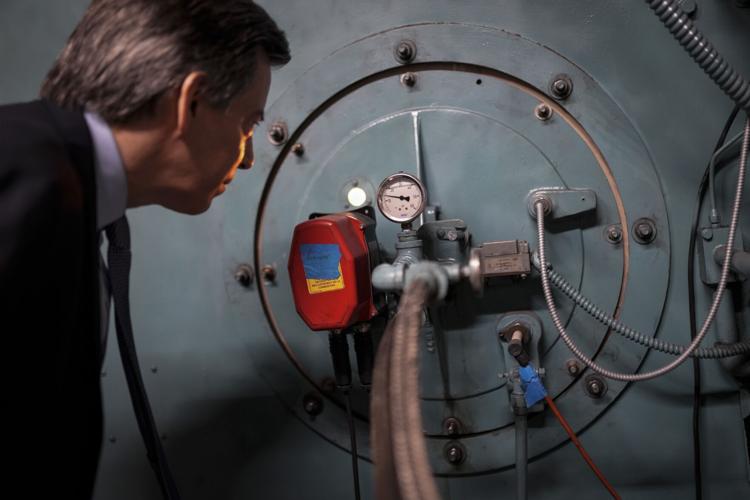
Josh London, senior vice president at Glenwood Management Corp., peers into the port hole of a natural gas fired boiler, located in the basement of The Grand Tier luxury apartment building, that his company uses to produce liquid carbon dioxide, April 18 in New York.
“Carbon capture doesn’t actually reduce emissions; it seeks to put them somewhere else,” said Anthony Rogers-Wright, director of environmental justice at New York Lawyers for the Public Interest. “The emissions still exist. And we should be clear that the only way to reduce emissions ... is to stop emitting.”
It’s still unclear whether carbon capture technology will even be recognized by New York City as a qualifying emissions reduction; the city has yet to decide.
In the basement of the Upper West Side apartment building, two hulking 500-horsepower boilers rumble, burning natural gas and releasing carbon dioxide. The boilers, which are expected to last another 10 or 20 years, produce roughly half the building’s emissions, Asparro said. The carbon capture system, Asparro said, is trapping about 60% of the boilers’ emissions.
Carbon capture technology has existed on an industrial scale for decades. But now a handful of green tech companies and building owners are trying for the first time to deploy this technology on a much smaller scale on residential buildings. Without action, similar high-rise buildings could face fines of nearly $1 million annually starting in 2030.

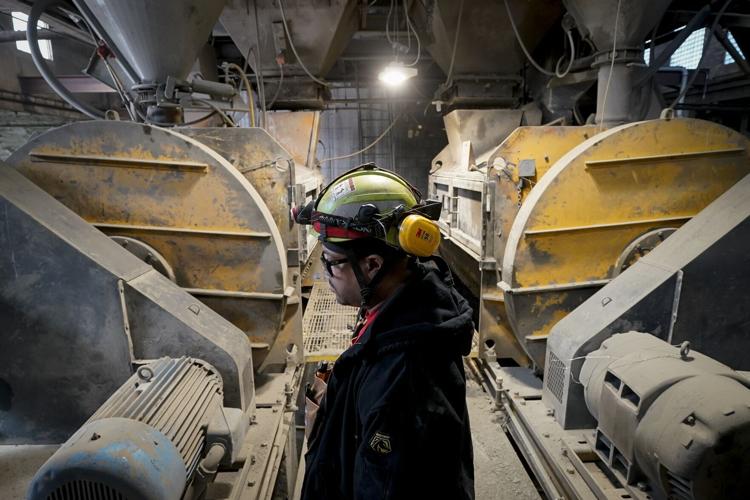
A worker stands beside the mixing machines at the start of a production line creating concrete blocks designed with liquid carbon dioxide as an ingredient at the Glenwood Mason Supply Company, on April 18 in the Brooklyn borough of New York.
Nearly 70% of New York City’s large buildings have steam boilers that run on natural gas or oil, according to NYC Accelerator. Many have heating systems more than a half-century old, and often they’re under-maintained, said Luke Surowiec, director of building decarbonization at ICF, a consulting firm which manages NYC Accelerator.
Over in Brooklyn, the floor rattles and shakes as yellow machines churn at Glenwood Mason Supply Company Inc., a concrete maker unrelated to Glenwood Management Corp. Grey blocks rattle down a conveyor line under a din of metal gears and motors. Somehow, birds have moved in and fly between towering piles of blocks.
One main ingredient of concrete is cement, which contributes about 7% of all greenhouse gas emissions worldwide, according to a study by PBL Netherlands Environmental Assessment Agency.
Many environmental groups remain skeptical of carbon capture and instead favor investing in a transition to renewable energy. They also fear that it could be unsafe to store carbon dioxide, which in extreme concentrations can lead to suffocation or death, in a residential dwelling.
After a carbon dioxide pipeline ruptured in Satartia, Mississippi, in 2020, 45 people sought medical attention at hospitals, including people who had been caught in a vapor cloud while driving. Proponents of carbon capture technology respond that there are safeguards to prevent such scenarios.
“We have carbon dioxide everywhere in cities,” he added. “Hospitals, restaurants, breweries — all utilizing carbon dioxide. And it’s being done in a fairly safe and manageable way.”