

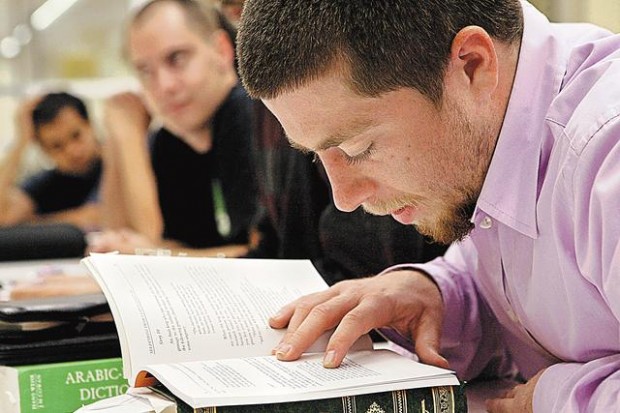
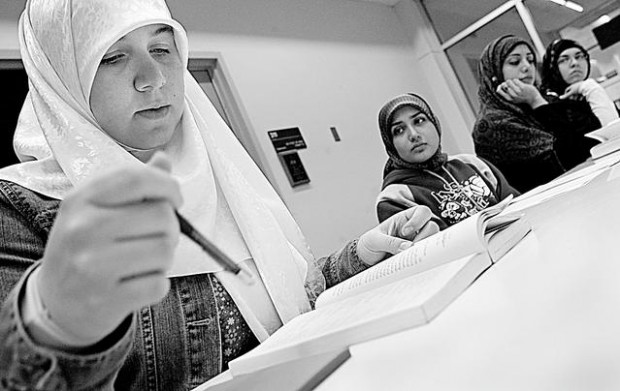
When she arrived at the University of Arizona from Kuwait four years ago, Lina MaHusain easily found other Muslims. She had a more difficult time finding Muslims like herself.
MaHusain, now a UA senior, is Shiite, a sect that's in the minority on the UA campus, and worldwide. The city's largest mosque — the Islamic Center of Tucson, 901 E. First St. — is Sunni, as are most members of the UA's Muslim Student Association.
During the past year, MaHusain and other Shiite Muslim students at the UA have banded together and formed a group of their own that now is officially recognized by the Associated Students of the UA: the Shia Muslim Student Association.
The group's next big event is expected to be a birthday party for the Prophet Muhammad in April — an occasion that their Sunni counterparts don't typically celebrate.
People are also reading…
Shiite often is called Shia, and Shi'ah. MaHusain and the other UA students prefer Shia, though the more popularly used name is Shiite. It's the second-largest sect of Islam, after Sunni. Divisions between the two sects over successors to the Prophet Muhammad as caliph, the spiritual and temporal leader of Muslims, date to the early days of Islam, but recent increased animosity in the Middle East has put a spotlight on the two branches of Islam.
The formation of a Shiite student group at the UA wasn't a result of hostility or hostility or tension with the longstanding UA Muslim Student Association, though, said Jassem Mashouf, a 22-year-old UA senior who is president of the Shiite group. Mashouf also is a vice president of the larger Muslim Student Association.
"I remember when I was choosing a school I was discouraged there was no Shia mosque in Tucson. ... Then when I got here, it took me two years to find the other Shia students," MaHusain said. "The past year since we started this group has been my most amazing time at the UA."
MaHusain is vice president of the Shiite group and keeps a blog — "Through My Eyes" — on the group's new Web site under the name of her alter ego, Teagirl.
The two branches of Islam have several differences that Shiites such as MaHusain and Mashouf say are big enough that they prefer their own communities.
Among other things, Shiites and Sunnis hold different positions during prayer — Shiites hold their hands at their sides, while Sunnis cross theirs over their chests. Many Shiites lie prostrate on a small disk called a turbah. The disk is made of dried and congealed mud, typically from Iraq. Many Shiite Muslims put their foreheads on the turbah while prostrate.
The two groups also differ over the way they mark occasions such as Ashura —a day recognized by Shiites because of mourning for the martyrdom of Hussein, the grandson of the Prophet Muhammad. Hussein died during a battle in Karbala, Iraq, in the seventh century. In some Shiite circles, it's customary to openly mourn by crying and self-flagellating. Ashura fell in January this year, and to mark the occasion, UA Shiite students handed out water bottles. The labels on the bottles included information about their faith.
"We didn't know what the reaction would be, but people were really interested," said Mashouf, who was raised in Tucson by an Iranian father and an American mother. "We told the students how it's customary to give out water in Shia countries. Hussein died deprived of water."
The Shiite student group remains small, with 74 people on its Listserv and about 20 active participants. By comparison, the UA Muslim Student Association, which dates to the 1960s, has 300 people on its Listserv and 150 active members.
"I absolutely understand why they wanted their own club, and everything they did was prefaced on the fact that it would unify us, that we would not be in competition, and that it would only help us in elevating Islam on campus," said Mohammed Abdelwahab, a 22-year-old UA senior who is president of the Muslim Student AssociatIon. He stresses that the group is open to all campus Muslims.
The two groups have discussed holding public education sessions about Shiite and Sunni, particularly in light of international tensions. But first, Abdelwahab says, the groups need to educate each other. On Wednesday they'll hold a joint meeting in which association members can ask the Shiite students about their faith.
"There is a lot of ignorance about Shia Islam, even in our own community," Abdelwahab said. "We want to dispel any misconceptions."
Most of the students in the Shiite group are from Iraq or Iran, or their families are. Others are from Bahrain, Pakistan and India.
"Sometimes when occasions like Ashura come up, other Muslims will say it's time to fast. But Shias don't fast on Ashura," said Shiite group member Mahdi Pessarakli, 21, a first-year UA medical student who, like Mashouf, was raised in Tucson by an Iranian father and an American mother.
Pessarakli prays at both the Islamic Center of Tucson and at separate local Shiite prayer sessions held in homes. But he said other local Shiites are uncomfortable praying at the Islamic Center, which is why he believes it's important for local Shiites to have their own space.
"We've noticed essentially there has been a religious Shia population in Tucson for 30 years. It has been 30 years and nothing has happened, so we thought as students we could help," he said. "I can't project what will happen, but hopefully in the next five to 10 years we will have an established local center."
Find more faith and values coverage at www.azstarnet.com/faith
Did You Know?
About 8,000 Muslims live in the Tucson area. An estimated 500 to 1,000 of them are Shiite. About 85 percent of the world's Muslims — estimated to be more than 1 billion — are Sunni. Shiite is the second-largest branch of Islam. In a 2006 survey conducted by the Washington-based Council on American-Islamic Relations, most respondents said they considered themselves "just Muslims" and avoided a distinction between Sunni and Shiite. Thirty-six percent classified themselves as Sunni, while 12 percent said they were Shiite.
To Learn More
More information about the University of Arizona's Shia Muslim Student Association is available at shiatucson.com


 Diner coming to Tucson's Sunshine Mile


