

MURRAY COUNTY, Minnesota — When a 2003-vintage wind farm in southwestern Minnesota became obsolete, its owner Allete Clean Energy tore it down and built anew.
The new Northern Wind project came online last month with bigger turbines that produce 32% more electricity than the old facility. The new turbines scoop up so much more wind that Allete needed to erect only 37 of them.
There’s only one snag: Most of the blades from those 65 old turbines were cut into chunks and are now interred in a Minnesota landfill.
“We explored different options for blade recycling,” said Kris Spenningsby, Allete Clean Energy’s director of customer solutions and asset optimization. “But we found that the logistics and shipping were cost-prohibitive.”

Wind blades are made of tough-to-reuse fiberglass and plastics — and the blade recycling business is in its infancy. Most blades are dumped in landfills.
It’s a problem the wind industry is grappling with across the country as more turbines are reaching retirement. Wind blades are made of tough-to-reuse fiberglass and plastics — and the blade recycling business is in its infancy. Most blades are dumped in landfills, studies indicate.
People are also reading…
“The challenge (with blades) is that you have very large objects that have been designed to last for decades in all sorts of weather, so they are tough,” said Aubryn Cooperman, an engineering analyst at the National Renewable Energy Laboratory. “They are hard to take apart, and the material does not have a very high value.”
A 2021 study led by Cooperman found that “more profound shifts in recycling technologies, blade materials or policy may be needed to move to a circular economy for wind turbine blades.”
In a circular economy, old stuff is reused, refurbished or recycled as much as possible.
Nationally, 235,000 wind blades will be decommissioned by 2050, based on a 20-year turbine lifetime, the NREL study said.
In parts of the country — including Minnesota — some wind farms are being replaced well before their 20- to 25-year expiration date, accelerating the flow of blade waste. Federal tax subsidies for wind farms have helped fuel that trend.
The rise of wind power has been crucial in reducing carbon dioxide emissions and tackling climate change. Minnesota has been a leader in deploying wind turbines, and wind accounted for 21% of the state’s electricity generation in 2021.
Minnesota’s cumulative wind power capacity grew from 107 megawatts in 1998 to nearly 4,600 megawatts by 2021’s close, according to the Minnesota Department of Commerce. All that wind power came from 3,959 turbines, each with three blades.
The state’s earliest turbines are antiquated — like the ones replaced by Northern Wind. To make way for that project, old towers — and the turbines atop them — were felled where they stood in farm fields.
Allete Clean Energy recycled 90% of the old wind farm’s components, Spenningsby said, a bit higher than the oft-cited 85% industry average.
There’s a strong recycling market for wind towers, which are made of steel. Old turbine transformers can be easily resold. The old towers’ concrete foundations are mostly recyclable, too.
A handful of Northern’s old blades were reused at other wind farms operated by Allete Clean Energy, a subsidiary of Duluth-based Allete Corp., which also owns Minnesota Power. It junked the rest.
Allete Clean Energy will be selling Northern Wind to Minneapolis-based Xcel, along with another small wind farm, for $215 million.
Xcel is repowering four of its own wind farms — three in Minnesota, one in North Dakota. Minnesota utility regulators approved the $750 million project in December 2020, despite opposition from the Commerce Department, which questioned its benefits to Xcel ratepayers.
In Xcel’s four remodeling projects, the old steel towers will remain standing and be topped with new blades and hubs, as well as new driveshafts or completely new nacelles, which house the turbine machinery. Between the four sites, about 1,200 blades will be replaced.
Xcel’s first repowering — at the Nobles Wind farm in Nobles County — was completed last month. The used blades were shipped to Missouri to be recycled by Veolia, a French company, Xcel said.
“They are kind of at the cutting edge now in recycling wind blades,” said Jeff West, Xcel’s senior director for environmental services.
General Electric, which sold Xcel the new blades for Nobles, has a relationship with Veolia. The turbine manufacturer, as part of its contract with the utility, also takes cares of blade disposal, though Xcel ultimately foots the bill.
“Reclamation is the first option and the preferred option, but they can landfill if they need to,” West said.
When landfilled, the old blades — which are nontoxic — are treated as construction waste.
Recycling is expensive, costing three to eight times more than simply carting blades to landfills, West said. Also, “there is a very limited market for (recycling) right now. We expect the market to get better as other companies get into it.”
The economics for recycling are penciled out for Nobles’ repowering and for another Xcel project in Mower County slated to come online early next year. Two more projects are still in design and engineering states.
Transporting chunks of wind blades to the nation’s handful of wind-related recycling centers is expensive. Recycling economics are hindered, too, by the low value of the material generated by the recycling process.
Fortunately, the cement industry has found a use for old blades.
At Veolia’s recycling center in Missouri, blades are ground to dust and shipped to cement plants around the country. The stuff is burned in kilns, partly supplanting coal as a fuel and lowering cement makers’ carbon dioxide emissions.
The ashes are used as a partial substitute for limestone, a key ingredient in cement making.
Old wind blades have also been repurposed into playground equipment and pedestrian bridges, though such markets are small.
Meanwhile, researchers are looking to improve methods for blade recycling. And wind turbine manufacturers are working to make blades with new materials that will make them more recyclable.
The states that produce the most renewable energy
States That Produce the Most Renewable Energy
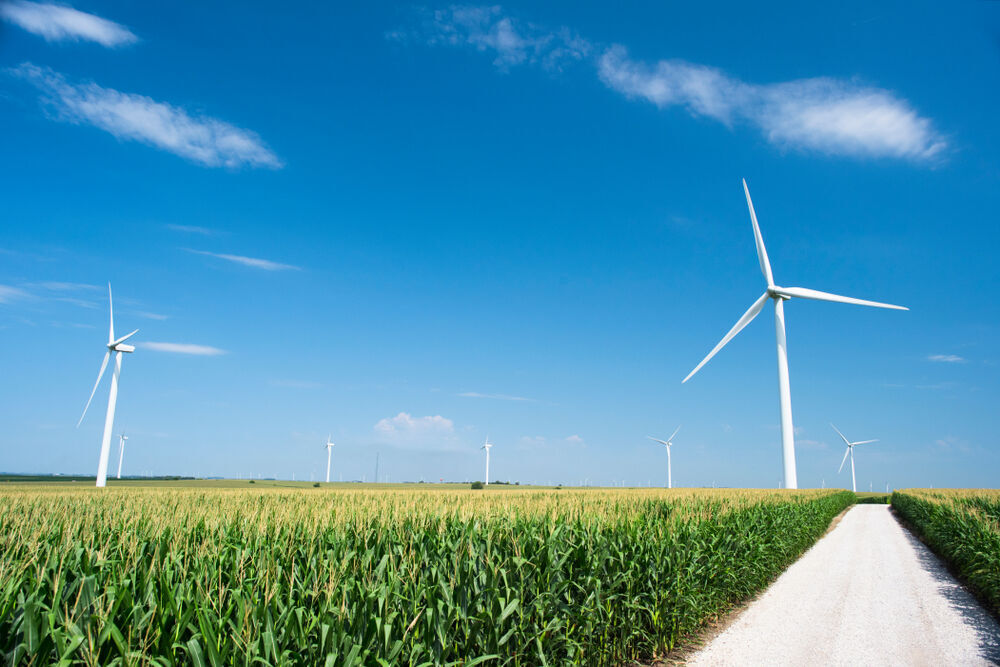
Photo Credit: Jim Cork / Shutterstock
Since President Joe Biden and a new Congress took office earlier this year, federal policymakers have been working to speed up the U.S. transition to clean and renewable energy sources. One of Biden’s first actions in office was to rejoin the Paris Climate Accord, the 2016 agreement in which countries pledged to significantly reduce their CO2 emissions. The Biden Administration followed this up with aggressive carbon reduction targets and the American Jobs Plan proposal, which includes provisions to modernize the power grid, incentivize clean energy generation, and create more jobs in the energy sector. Much of Biden’s agenda builds on prior proposals like the Green New Deal, which would achieve emissions reductions and create jobs through investments in clean energy production and energy-efficient infrastructure upgrades.
The transition to renewables has taken on greater urgency in recent years with the worsening effects of climate change. Carbon emissions from non-renewable sources like coal, oil, and natural gas are one of the primary factors contributing to the warming of the atmosphere, and climate experts project that to limit warming, renewable energy must supply 70 to 85% of electricity by midcentury.
Renewable energy still represents less than a quarter of total annual electricity generation in the U.S., but the good news is that renewable energy has been responsible for a steadily increasing share of electricity generation over the past decade. Most of the upward trajectory comes from exponential growth in the production of solar and wind power. In 1990, solar power generated only 367,087 megawatt-hours of electricity, while wind power was responsible for 2,788,600 megawatt-hours. Since then, technological improvements and public investment in wind and solar helped lower costs and make them viable competitors to non-renewable sources. By 2020, solar production had reached 89,198,715 megawatt-hours, while wind produced 337,938,049 megawatt-hours of electricity.
Renewables account for a growing share of US electric power generation

But this evolution is uneven across the U.S., a product of differences in states’ economies, public policy toward renewables, and perhaps most importantly, geographic features. Even among states that lead in renewable energy production, these factors contribute to different mixes of renewable sources. For instance, Texas—the nation’s top producer of renewable energy—generates most of its renewable electricity from wind turbines. Runner-up Washington and fourth-place Oregon take advantage of large rivers in the Pacific Northwest to generate more hydroelectric power than any other state. And California, which is third in total renewable production, has been a long-time leader in solar energy thanks in part to an abundance of direct sunlight.
TX WA CA and OR are the leading producers of renewable energy

Meanwhile, states that lag behind in renewable generation include several states without the size or geographic features to scale up production, like Delaware, Rhode Island, and Connecticut, along with states whose economies are more traditionally dependent on fossil fuels, like Mississippi and Alaska.
To determine the states producing the most renewable energy, researchers at Commodity.com used data from the U.S. Energy Information Administration to calculate the percentage of total electricity generated from renewable sources. Renewable energy sources include: wind, solar, geothermal, biomass, and hydroelectric. In the event of a tie, the state with the greater five-year growth in renewable electricity production, between 2015 and 2020, was ranked higher.
Here are the states that produce the most renewable energy.
15. Nebraska

Photo Credit: Tami Story Photography / Shutterstock
- Percentage of electricity generated from renewables: 28.9%
- 5-year change in renewable electricity production: +115.7%
- Total electricity generated from renewables (MWh): 10,648,740
- Largest renewable energy source: Wind
14. Alaska

Photo Credit: Roman Sorokin / Shutterstock
- Percentage of electricity generated from renewables: 30.8%
- 5-year change in renewable electricity production: +8.3%
- Total electricity generated from renewables (MWh): 1,931,545
- Largest renewable energy source: Hydroelectric Conventional
13. Colorado

Photo Credit: Bogdan Denysyuk / Shutterstock
- Percentage of electricity generated from renewables: 30.9%
- 5-year change in renewable electricity production: +77.4%
- Total electricity generated from renewables (MWh): 16,724,964
- Largest renewable energy source: Wind
12. North Dakota

Photo Credit: northlight / Shutterstock
- Percentage of electricity generated from renewables: 38.1%
- 5-year change in renewable electricity production: +87.0%
- Total electricity generated from renewables (MWh): 16,084,768
- Largest renewable energy source: Wind
11. Oklahoma

Photo Credit: Bob Pool / Shutterstock
- Percentage of electricity generated from renewables: 39.7%
- 5-year change in renewable electricity production: +91.9%
- Total electricity generated from renewables (MWh): 32,687,539
- Largest renewable energy source: Wind
10. California

Photo Credit: Virrage Images / Shutterstock
- Percentage of electricity generated from renewables: 42.6%
- 5-year change in renewable electricity production: +38.9%
- Total electricity generated from renewables (MWh): 82,239,832
- Largest renewable energy source: Solar Thermal and Photovoltaic
9. Kansas

Photo Credit: Kyle T Perry / Shutterstock
- Percentage of electricity generated from renewables: 44.2%
- 5-year change in renewable electricity production: +117.6%
- Total electricity generated from renewables (MWh): 24,117,519
- Largest renewable energy source: Wind
8. Montana

Photo Credit: Flaxphotos / Shutterstock
- Percentage of electricity generated from renewables: 59.4%
- 5-year change in renewable electricity production: +16.8%
- Total electricity generated from renewables (MWh): 13,872,119
- Largest renewable energy source: Hydroelectric Conventional
7. Iowa

Photo Credit: Jim Cork / Shutterstock
- Percentage of electricity generated from renewables: 59.4%
- 5-year change in renewable electricity production: +85.6%
- Total electricity generated from renewables (MWh): 35,437,099
- Largest renewable energy source: Wind
6. Oregon

Photo Credit: steve estvanik / Shutterstock
- Percentage of electricity generated from renewables: 67.5%
- 5-year change in renewable electricity production: +9.5%
- Total electricity generated from renewables (MWh): 42,928,468
- Largest renewable energy source: Hydroelectric Conventional
5. Washington

Photo Credit: Nick Fox / Shutterstock
- Percentage of electricity generated from renewables: 75.0%
- 5-year change in renewable electricity production: +5.6%
- Total electricity generated from renewables (MWh): 87,109,288
- Largest renewable energy source: Hydroelectric Conventional
4. Idaho

Photo Credit: Charles Knowles / Shutterstock
- Percentage of electricity generated from renewables: 76.1%
- 5-year change in renewable electricity production: +15.0%
- Total electricity generated from renewables (MWh): 13,456,149
- Largest renewable energy source: Hydroelectric Conventional
3. Maine

Photo Credit: Danita Delimont / Shutterstock
- Percentage of electricity generated from renewables: 76.7%
- 5-year change in renewable electricity production: -1.7%
- Total electricity generated from renewables (MWh): 7,674,956
- Largest renewable energy source: Hydroelectric Conventional
2. South Dakota

Photo Credit: marekuliasz / Shutterstock
- Percentage of electricity generated from renewables: 80.5%
- 5-year change in renewable electricity production: +55.0%
- Total electricity generated from renewables (MWh): 11,388,457
- Largest renewable energy source: Hydroelectric Conventional
1. Vermont

Photo Credit: Colin D. Young / Shutterstock
- Percentage of electricity generated from renewables: 99.9%
- 5-year change in renewable electricity production: +9.0%
- Total electricity generated from renewables (MWh): 2,155,177
- Largest renewable energy source: Hydroelectric Conventional


