

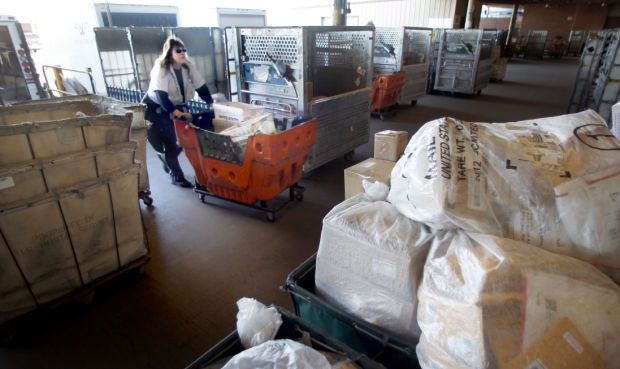
The U.S. Postal Service mail sorting facility in Tucson will cease all remaining processing operations by next year, which could affect more than 200 local jobs.
In February 2013, the processing of mail originating from Tucson moved from the facility at 1501 S. Cherrybell Stravenue to the Phoenix processing center as part of the Postal Service’s national effort to reduce costs.
Delivery of incoming mail and packaging continued to be processed in Tucson after that, but those operations will also be consolidated to the Phoenix facility on April 18, 2015.
“With the declining mail volume there is also a decline in revenue,” said Peter Hass, a spokesman for the local office of the Postal Service. “We have to look at ways to become more efficient and respond to the changing mailing habits of the American public.”
People are also reading…
The 259 employees working at the facility would potentially lose their jobs, though Hass said the Postal Service would try to relocate them internally, which could mean changes in duties, titles, shifts or locations. Last year’s consolidation led to 147 jobs being eliminated.
The consolidation does not mean that the building will be closed, Hass said. The retail operations will remain in service after the processing operations are shut down.
Some of the other changes include the delay in the delivery of first-class mail, he said. Typically, first-class mail takes one to three days to deliver. After the consolidation, service standards will change to two to three days.
The upcoming consolidation is part of the second phase of the Postal Service’s nationwide reduction. Tucson is one of about 82 facilities to be consolidated in the next year. In 2012 and 2013, 141 processing facilities were consolidated nationally.
During that time, the agency recorded $865 million in annual savings. The second phase, Hass said, would save the Postal Service an additional $750 million annually.
The Postal Service does not operate on tax dollars, he said. So it has to adjust accordingly to the shrinking mail delivery volume.
The total mail volume has been steadily declining over the past eight years. The volume had minimal changes between 2004 and 2008. Then in 2009, the total volume took a steep dive from the previous year’s 203 billion pieces to 177 billion. The latest available record from 2013 showed the figure is about 158 billion pieces of mail.
Although the Postal Service has announced the consolidation of the Tucson mail facility, Mayor Jonathan Rothschild said the city and its allies are working to reverse that decision.
“We believe the fight’s not over,” he said. Processing operations will cease next spring, so there is some time for the city to continue lobbying.
There are bills in Congress that could prevent the postal center from closing.
U.S. Rep. Raúl Grijalva, D-Tucson, sponsored the Defending Quality Postal Delivery for the Future Act in 2012, following the February consolidation of the letter processing services in Tucson to the Phoenix facility. That bill, if passed, could prevent the Postal Service from closing or consolidating processing facilities in places that have high population growths.
Grijalva’s bill has been introduced in the House and referred to the House Committee on Oversight and Government Reform on March 7, 2012. There has been no action since then.
In April 2012, a bill providing fiscal relief to the USPS that could have limited the agency’s authority to close and consolidate mail facilities passed the Senate. However, the bill was held up in the House.
“We need one of those bills to pass,” Rothschild said. “We have been lobbying on this ever since it was announced as a possibility. We have met with the chamber of commerce. We have lots of allies.”
Michael Varney, president and CEO of the Tucson Metropolitan Chamber of Commerce, one of the city’s allies in trying to preserve the Cherrybell facility, said the chamber was disappointed to hear the news of the consolidation.
“Everything about this is going to boil down to three things: preserving the Cherrybell processing facility, preserving the jobs and preserving the bulk mail rate to protect those small businesses and mail houses,” he said.
Preserving the Cherrybell facility may not have happened, but he said the chamber negotiated with the Postal Service to make sure that workers would be absorbed into the system and given other opportunities and that local small businesses could still receive the discount bulk mail rate, which he was told was only available in cities with processing centers.
“We got verbal assurance by the USPS,” he said.
Contact reporter Yoohyun Jung at 573-4224 or yjung@tucson.com
On Twitter @Yoohyun_Jung

Yoohyun Jung
Data reporter


