

The founders of Marana, Oro Valley and Sahuarita had this in common: They didn't want to be Tucson.
Then they put out the welcome mat for developers, ushering in population growth rates of 55 percent to 600 percent in the past seven years and bringing big-city problems to small, suburban towns.
Sown into each community's incorporation were policies that enabled incredible growth but hamstrung leaders' ability to build needed roads, sewers and parks.
Now that a slowdown in housing construction has stalled growth, experts say Tucson's suburbs can no longer sustain themselves with fees on new construction and impact fees charged to developers.
The foundations for the challenges facing the towns were laid as long as 30 years ago, when residents of what are now Marana and Oro Valley fought Tucson's attempts to secure water and annex them into the city.
People are also reading…
Sahuarita residents rallied for a similar cause in 1994, forming a town after Green Valley attempted to incorporate and widen its boundaries to include the bedroom community.
Incorporation gave the towns the independence they sought, but caused headaches that continue today.
In Sahuarita, low sewer rates and connection fees — in addition to an agreement not to charge fees that pay for roads and other infrastructure — have forced the town to begin trucking out sewage because the lone treatment plant is near its limit.
In Oro Valley — which like its suburban counterparts prides itself on its lack of property taxes — officials have said a lack of revenue would dry up its reserves in the next five years. They've recently backed off that prediction.
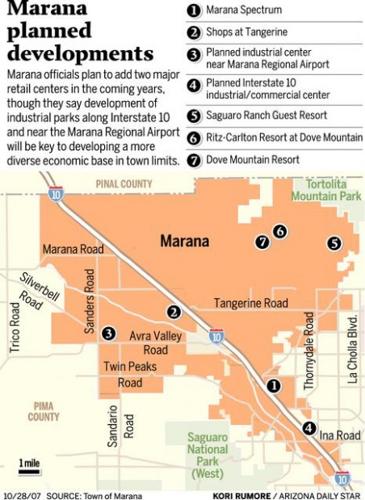
In Marana, the decision against levying property taxes initially caused a struggle to generate enough revenue. That led to massive annexations that defined the community. Town officials expanded their boundaries to swallow sales-tax generating retail centers and created a motto: "Come grow with us."
"They seemed to forget this growth is going to incur costs," Joel D. Valdez, who was Tucson's city manager from 1974 to 1990, said of the towns' early actions.
Sahuarita had help
Immediately after forming in 1994, Sahuarita faced pressure to disincorporate because it couldn't come up with money to pay its bills.
The county was subsidizing the town, and by mid-1995 two county supervisors, Dan Eckstrom and Raul Grijalva, and Tucson-area leaders began to complain.
As calls to fold back into the county grew louder, Tucson developer Bob Sharpe stepped forward with a plan to keep the community afloat with money from a proposed development to be called Rancho Sahuarita.
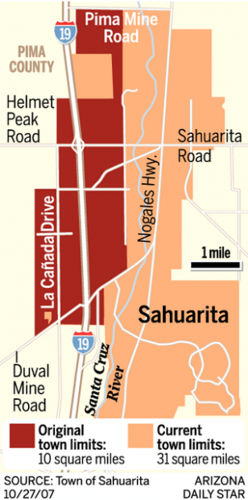
Town officials liked Sharpe — during incorporation, he donated money to pay for signs and other expenses. They also liked his vision for Rancho Sahuarita, which at the time constituted almost a third of the 10-square-mile town and seemed like a timely solution to the town's flagging finances.
The 11,600-home project would provide the young town with jobs and revenues, mainly through a construction sales tax and fees paid for building permits.
Town officials say the project is largely responsible for the population boom that saw Sahuarita swell from roughly 1,600 residents in 1994 to more than 22,000 today.
The partnership benefited both sides, Sharpe says.
"We were able to help the town get started, help them fight back a disincorporation movement, and we were able to zone our property," he said.
Rancho Sahuarita's development agreement contained several provisions that benefited the developer and limited the town's ability to pay for future growth.
The agreement barred the town from charging Rancho Sahuarita impact fees or declaring a building moratorium for 40 years. The town also had to hold down connection fees for its small sewage treatment plant.
While town leaders say they worked hard on the agreement, they acknowledge that it continues to hamper their ability to pay for needed infrastructure.
"In hindsight, the sewer connection fees and user fees should have been much higher," said Charles Oldham, a former elementary school principal and a longtime member of the Sahuarita Town Council. "But once the agreements were made, the town was locked in."
The lack of early funding created a gap between the sewer treatment plant's capacity and the sewage generated by the community, which has grown 600 percent since 2000.
The problem has grown to the point that the town must truck sewage out of the plant to a nearby Pima County treatment plant.
Sahuarita also has had to delay projects on its five-year capital improvement program.
Some projects, such as a proposed $6 million municipal wireless Internet access system, will likely also be postponed — and maybe even canceled.
Marana's boom
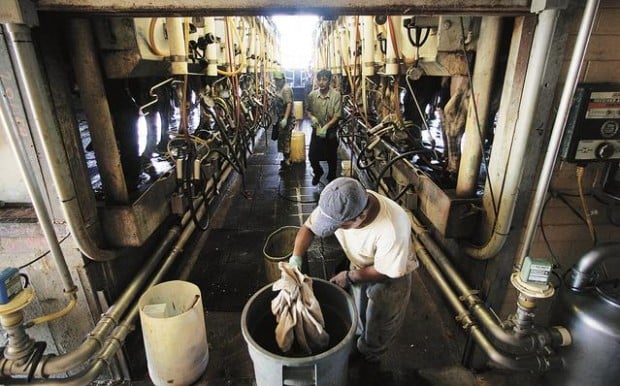
Not far from construction crews building one of the latest residential communities in Marana, Dennis Taylor toils on a farm.
Taylor's dairy farm — 1,000 head of cattle on 342 acres near the town's northwestern border — produces between 45,000 and 70,000 pounds of milk a day, depending on the season.
For Taylor, Marana's booming growth in the past decade has been incredible. While he expected the area to become developed, he didn't think it would happen so quickly.
"I thought the mountains would slow them down, but they climbed right over them," Taylor said of developers. "The expansion has been so fast it's consumed most of Marana."
But before Marana could grow astronomically — the town's population has increased 154 percent in the last seven years to 35,000 residents — leaders had to figure out how to pay the bills.
One early condition of the incorporation was that there wouldn't be a property tax.
The decision helped ensure the incorporation effort's success, but it stymied efforts to provide services, said Brad DeSpain, who helped rally support for incorporation in the late 1970s.
With the town lacking money to hire maintenance workers, its early road crews consisted of politicians and residents who spent afternoons patching potholes and fixing other problems.
"We'd do what we basically needed to do to try to keep the roads in a condition that was safe," said DeSpain, now the town's utilities director.
Marana struggled to make ends meet until leaders realized the benefits of a sales tax and its link to state shared revenues. Then the town outmaneuvered Tucson to annex retail centers along West Ina and North Thornydale roads. Today, nearly all of the town's general fund comes from sales taxes.
While the tax has been a boon for Marana, there are potential pitfalls to basing a government's general fund on a sales tax, said Grady Gammage Jr., a senior research fellow at Arizona State University's Morrison Institute, which specializes in urban planning issues.
Sales tax collections must keep pace with the needs of a growing government, Gammage said.
If governments overestimate their sales tax projections and there's a downturn, town services could be in jeopardy.
"When people have less money," Gammage said, "they pay less tax."
Oro Valley selling point
The lack of a property tax in nearby Oro Valley wasn't the main reason for incorporating in the early 1970s. But it has become a selling point.
Led by town founders such as James D. Kriegh, residents pushed back against threats by Tucson to annex the area, forcing an incorporation that was ultimately settled in court.
Kriegh, who circulated petitions on weekends and held town meetings in his home, died Oct. 10 at the age of 78.
"We wanted to control our own destiny, per se," he said in an interview three weeks before his death.
They worked quickly so that Tucson wouldn't have time to annex within a six-mile radius of the community, which would have put a stop to their incorporation efforts, Kriegh said.
They collected signatures from 77 percent of the area's taxpaying residents — more than the number they needed.
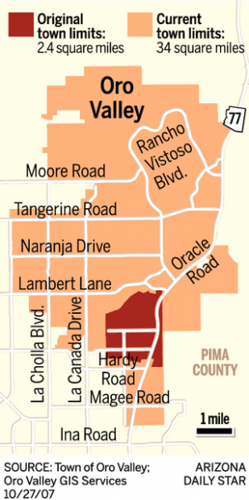
But the Pima County Board of Supervisors rejected their incorporation petition, saying 1.7 miles of the 2.4-square-mile proposed town were uninhabited and rural, an April 22, 1970 Arizona Daily Star article said.
It took four years of court battles before the state Supreme Court ruled in Oro Valley's favor in 1974.
But up to the town's incorporation on April 15, 1974, and even thereafter, Oro Valley faced opposition, and some residents wanted the town to disincorporate.
A county report at the time indicated that Oro Valley would have to levy a property tax to pay for basic governmental services, because federal and state shared revenue wouldn't be enough to cover its expenses.
Instead, the town created economic policies with low taxes as officials relied on growth-related revenue to keep the budget afloat. It worked well, as the town has grown 55 percent in the past seven years, to more than 46,000 residents.
Officials said last year that they'd have to continually tap the town's reserves to pay recurring costs. The savings would be gone by 2012, officials predicted.
They have recently backed off those predictions, saying they can maintain the level of services the town provides with what they take in from sales taxes and other sources.
Brent Davis, a Tucson city councilman in the late 1970s and early 1980s, says Oro Valley residents' belief that they could do a better job of planning and growing than Tucson has come full circle.
"Today we wake up and Oro Valley has its own infrastructure problem," he said. "They're growing up into a city."
Find stories from the series and other related content at azstarnet.com/special/onemillion
more inside: Read about the people who have influenced growth
More on starnet
See a slide show, watch portions of a video interview with Jim Kriegh and hear parts of interviews with Brad DeSpain and Dennis Taylor at go.azstarnet.com/onemillion
Pima County's population surpassed the 1 million mark late last year, planners estimate. This report is part of a monthly series running all this year on the effects of our population growth.
Friday: Tucson's suburbs find themselves in impending financial crisis as development stalls.
Today: Early leaders made decisions based on the idea that growth would continue unabated.
Sunday: For communities to survive and thrive, they must rethink how they plan and bring in revenue.


 $25M distribution center to be built in Tucson

