
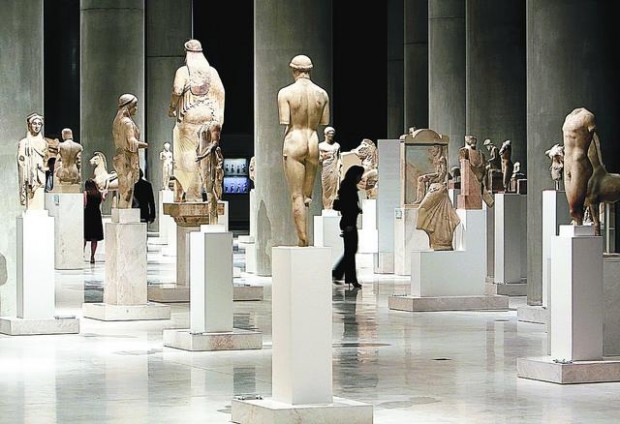
ATHENS, Greece — Gods, heroes and long-dead mortals stepped off their plinths into the evening sky of Athens on Saturday during the lavish launch of the new Acropolis Museum, a decades-old dream that Greece hopes will also help reclaim a cherished part of its heritage from Britain.
The animated display of artifacts on the museum walls ended years of delays and wrangling over the ultramodern building, set among apartment blocks and elegant neoclassical houses at the foot of the Acropolis hill.
The $4.1 million opening ceremony was attended by 400 guests, including European Commission President Jose Manuel Barroso and foreign heads of state and government. Conspicuously, there were no government officials from Britain, which has repeatedly refused to repatriate dozens of 2,500-year-old sculptures from the Parthenon temple that are held in the British Museum.
People are also reading…
President Karolos Papoulias said Greeks think of the Acropolis monuments as their "identity and pride," and renewed the demand for the marble works, displayed in London for 200 years.
"The whole world can now see the most important sculptures from the Parthenon together," Papoulias said. "Some are missing. It is time to heal the wounds on the monument by returning the marbles that belong to it."
Culture Minister Antonis Samaras said the sculptures, known as the Elgin Marbles, "will inevitably return," but ruled out Greece acknowledging the British Museum's legal title to the works — as demanded by officials in London.
Crouching 300 yards from the Parthenon's bones like a skewed stack of glass boxes, the $180 million museum provides a setting for some of the best surviving works of classical sculpture that once adorned the Acropolis.
By day, printed glass panels filter the harsh sunlight while revealing the ancient citadel in the background. The internal lighting projects the battered statues outward at night, contrasting with the floodlit ruins on the hill.
With a glass hall designed to showcase all the surviving Parthenon sculptures in their original alignment, the building is Greece's answer to the argument that it had nowhere to safely house those sawed off the temple in the early 1800s by British diplomat Lord Elgin.
The Parthenon was built at the height of Athens' glory, between 447 and 432 B.C., for the city's patron goddess, Athena.
The British Museum has repeatedly rejected calls for the sculptures' return. It says it legally owns the collection it bought from Elgin and that it is displayed free of charge in an international cultural context.

 U of A president declines to sign shared governance contract with faculty