

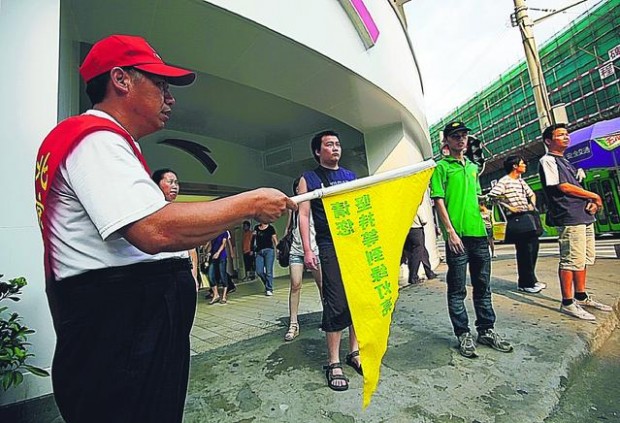
GUANGZHOU, China — Government-backed neighborhood groups are going door-to-door in south China's gritty business capital with a set of simple requests: Please stop spitting in public, cutting in bus lines and talking loudly in the streets.
It's all part of a campaign in Guangzhou, China's third-wealthiest metropolis, to win the coveted "Civilized City" award — an annual ritual that sparks months of frantic scrubbing and buffing in cities across China.
Women wearing red armbands patrol the streets and pick up cigarette butts. Volunteer crossing guards with yellow flags and whistles make sure people wait for green lights. Beggars, even those with legs withered by polio, are banished from their usual haunts on pedestrian bridges.
While some citizens remain skeptical of the cleanup drive, it jibes with Chinese leaders' goal of shifting away from the blind pursuit of blistering economic growth at any cost. They want to focus more on creating a spiffier, healthier, more cultured and harmonious society.
People are also reading…
Each year, the central government awards the prized designation to one or more cities, and it is a big deal for Guangzhou, once known as Canton, as it tries to shed a reputation for being dirty and crime-ridden. Next year, this historic port city of 10 million hosts the Asian Games — the region's equivalent of the Olympics — that will draw 25,000 athletes, coaches and journalists from 45 countries.
"We have a saying: If you haven't been robbed, you're not a real Guangzhou person," said Wu Enwei, 33, a businesswoman whose cell phone was snatched from her hand on the sidewalk a few years ago.
"The crime situation has improved, but I still think Beijing and Shanghai are much better," Wu said.
The civility campaign also highlights how the Communist Party still likes to indulge in often heavy-handed Big Brother social engineering, reaching deep into people's lives — or at least their living rooms — to try to mold the masses.
Beijing launched a similar campaign before the 2008 Olympics, trying to curb spitting, jumping ahead in line, littering and reckless driving.
In Guangzhou, members of neighborhood committees, government-backed councils that monitor households, are knocking on doors in the evening and handing out a survey and brochures about improving civil behavior.
Getting the public to support such campaigns is harder now in China. Dramatic changes in society have given people more freedom in their private lives. Most don't depend on the government to find them a job and an apartment.
Many have also developed a deep cynicism and suspicion about Beijing's edicts and campaigns. They can ignore the propaganda or be unenthusiastic without worrying too much about being branded an anti-revolutionary and sent to prison.
One 20-year-old college student who was serving as a crosswalk guard in Guangzhou said his parents, who work for the government, forced him to volunteer for the duty. He looked embarrassed and bored as he stood on the curb wearing a yellow sash and carrying a matching flag that said, "Please wait for the green light."
"I don't really understand this Civilized City campaign. It seems so silly," said the student, who only gave his surname, Chen, because he feared he would run afoul of the government and his parents. "Every year we do this stuff for a few weeks, and when the inspection is over, things go back to normal. People continue jaywalking and littering. It's just a show."
City officials responsible for the campaign declined interview requests from The Associated Press. They also refused to answer a list of questions submitted in writing.
Johnny Lau, a China analyst at Hong Kong Baptist University, said cleaning up Guangzhou will be a challenge, but it's something all Chinese cities need to do to remain competitive.
"As a prosperous city, Guangzhou can no longer focus on its industrial development only. It has to enhance people's living standard to attract more foreign investors," Lau said.
A recent winner of the Civilized City award is the prosperous southern port city of Xiamen, where the streets are famously clean, skyscrapers gleam on the waterfront and well-restored colonial buildings add a rare charm.
That is a far cry from Guangzhou, which in March ranked 12th — after the Vietnamese capital, Hanoi — on a list of the world's 20 "Hardest Hardship Posts" for expatriates by BusinessWeek magazine. The city was a "high-risk location" because of pollution and problems with disease and sanitation, said the survey.


 Faculty concerned about changes to U of A admissions policy


