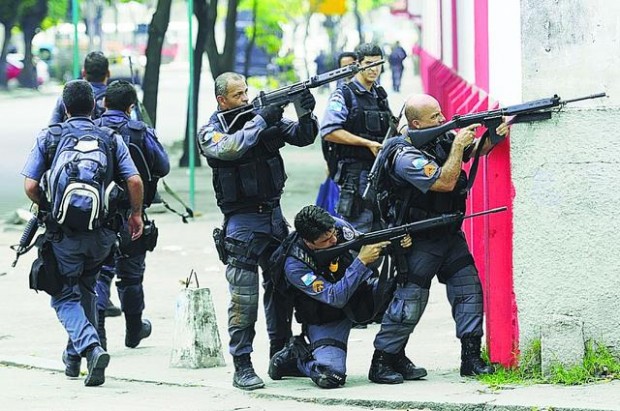
RIO DE JANEIRO — They go by names like "Scooby" and "Big Baby" but carry the best weapons money can buy, are accused of torturing cops and even managed to shoot down a police helicopter.
They are drug dealers who hold court deep inside most of Rio de Janeiro's 1,000 slums, surrounded by foot soldiers carrying Belgian-made assault rifles, Israeli pistols, grenades, anti-aircraft weapons and endless rounds of ammunition.
The criminals drew international attention this week following bloody shootouts that left more than 40 people dead, just days after Rio was awarded the 2016 Olympic Games.
Authorities have pledged to crack down harder than ever on the criminals to ensure safety for the Olympics — while assuring the rest of the world that the violence is actually restricted to small areas of this seaside city of 6 million people, famed for its raucous Carnival and gorgeous beaches.
People are also reading…
"There have always been those mini-regions in Rio de Janeiro where drug traffickers dominate," said Rio state Public Safety Director Jose Beltrame.
Beltrame concedes, however that those "mini-regions" can be found in slums dotting every corner of Rio, rich and poor.
Ask any of the 2 million slum dwellers — taxi drivers, businessmen, housewives, barbers, and police officers — whose lives are dominated by drug chieftains and violent militias, and they will tell you that defeating the criminals is formidable, if not impossible.
"The police are playing a game they have already lost," said vegetable seller Roberto Lima, tending his small stand at the base of the Tabajaras slum in Copacabana, where a heavy police patrol came through the day before. "They have to make their efforts, we understand. But they are working outside the reality that they don't control this place."
Lima's remarks reflect the fatalistic attitude pervading nearly every conversation about controlling crime in Rio. The statistics show why: In 2008, there were 5,717 homicides in Rio state, the vast majority in Rio de Janeiro's metropolitan area. In comparison, Vancouver, Canada, which will host the 2010 Winter Olympics, had a total of 58 slayings last year.
Viva Rio, a Brazilian organization that aims to rid the city of arms, recently released a report stating that criminals in Brazil have three times as many weapons as police.
Beltrame describes the difficulty of confronting the criminals on their own turf: "When we enter a slum … where they have their stockpile of weapons and ammunition," the criminals are "defending their territory and reacting against police as if it were a war."
Brazilian newspapers this week published several photos of masked gunmen, proudly displaying their assault rifles in broad daylight while standing atop hillside slums.
This week's shootouts were yet another episode in an ever-repeating cycle of violence: About 150 members of the Red Command drug gang in northern Rio invaded the Monkey Hill slum controlled by rivals before dawn last Saturday.
Intense gunfire ensued and police responded as they had many times before, in helicopters that hovered over the scene while fellow officers battled criminals on the ground below. But this time, for the first time, one of those helicopters was shot down, crash-landing in flames in a football field and killing three officers — just one mile from the Maracana stadium, where the Olympics' opening and closing ceremonies and the 2014 World Cup final will be held.


 Second wall planned across Arizona as Trump administration doubles down on border