
Tucson's discovery of a potential crash-causing steering defect in Ford police cruisers is reverberating around Arizona, and could become a national safety issue for the car maker.
Ford Motor Co. representatives deny there are widespread problems, but said they will repair any 2006-2007 cruiser that actually exhibits the anomaly — a momentary failure of power steering during hard turns. They will not, however, make wholesale repairs.
Ford installed a smaller-capacity power-steering pump on its '06-07 Crown Victoria police interceptors to give officers a better feel for the road and improve fuel economy.
More than 100 cruisers tested by Tucson, Pima County, Phoenix, the Department of Public Safety, and others have failed. More than 450 pumps have been replaced statewide.
Cities and Ford dealerships are repairing the problem at their own cost by putting in a larger-capacity pump from an earlier police interceptor model.
People are also reading…
But Ford won't pay for repairs on any cars not tested by a Ford technician. Spokesman Dan Jarvis said Ford doesn't see it as a safety issue, but will change the pumps if there is a demonstrable problem.
"It's not a safety issue because you never lose steering," Jarvis said. "It's a temporary change in the feel."
Fleet managers and police officials across Arizona disagree, saying concern for officer and public safety and taxpayer liability if there's an accident dictate that repairs be made.
Personal injury lawyer Louis Hollingsworth said it's known the types of maneuvers that trigger the problem are a big part of police work. That knowledge could leave cities vulnerable to a suit for gross negligence if they do nothing, he said.
The possibility of an innocent third party's being injured or killed is "a monumental concern" from a risk-management perspective, he said.
Although an estimated 57,000 newer-model police cruisers across the country have the same, suspect lower-displacement pump, Jarvis said it's an issue only in Arizona.
Ford has replaced only between 500 and 1,000 pumps nationwide, he said.
"What you have in Arizona is someone getting more excited" about the "perceived issue," Jarvis said, which he said has been stoked by the media. "We're not seeing it anywhere else in the country," he said.
The problem is that the smaller pump doesn't have enough capacity when the power steering is taxed during hard turns, said Vincent Lorefice, Marana's fleet services supervisor.
The maneuvers during which pumps fail are essential to police work and are often conducted under stress and at high speeds, Marana officials said.
On Nov. 6, Ford issued an advisory bulletin warning that 2006-2007 Crown Victoria police interceptors built between Aug. 6, 2005, and Oct. 24, 2006, "may exhibit a momentary increase in steering effort."
The advisory does not indicate a defect, Jarvis said. "We think it's a nuisance," he said.
Ford officials said the steering hesitation is minor and momentary. Police officials and fleet managers throughout Arizona say that's true. But the problem comes when an officer is surprised by it and oversteers to compensate — potentially resulting in loss of control, and accidents.
"The natural tendency is to overcompensate. That's when you lose control," Tucson fleet administrator Gary Lowe said.
Mesa fleet director Pete Scarafiotti said more muscle is needed to turn the wheel when the steering fails, creating the potential to oversteer. "It could surprise you — that alone could cause an accident," he said.
Jarvis said Ford technicians have not noticed drivers overcompensating in the field. He said police departments are repairing the vehicles only because of "a great fear of the unknown." It's easier to repair the pumps than to convince police it's not a problem, he said.
But Lowe said Ford knows every vehicle equipped with the smaller-displacement pump could fail under stress. "They know it's a fact," Lowe said. "I think they fully understand it's a national problem."
Lorefice said he also expects Ford to have issues nationwide, given that all 33 vehicles in Marana's fleet failed road tests, many twice.
"They are all engineered, designed and manufactured exactly the same," he said. "Obviously, there is a design flaw."
"A momentary hesitation"
When the power steering fails, the sensation is similar to another person's grabbing the steering wheel and making it hard to turn, said Marana Police Sgt. Bill Derfus. He said it's "a momentary hesitation" that can be steered through when it occurs — with the power steering "catching up" seconds later.
Several fleet directors said the problem is that the smaller units can't pump power-steering fluid to where it's needed fast enough under stress conditions, causing a momentary hitch in the steering. At some point the pump catches up, and the steering kicks back in.
"It happens when you're putting the vehicle in a situation where you're overrunning the pump capability. So it catches up," said Pete Cates, service director for Jim Click Ford in Tucson.
Cates said correcting the problem is as simple as replacing the pump with the higher-displacement version used in 2003-'04 models — the repair advised in the Ford advisory — at a cost of $200 to $300 each.
Demand outstrips supply
Ford has replaced so many of the pumps in Arizona it temporarily ran out of them, company officials said. Yuma can't repair four of its cruisers because of the pump shortage, said Greg Hyland, a Yuma spokesman.
Lowe said it's obvious Ford knows there's a problem because the new 2007 models are equipped with the larger pump from the 2003-'04 model. He said Tucson retested five vehicles fitted with the larger pump and the steering hesitation was gone.
Rae Tyson, spokesman for the National Highway Traffic Safety Administration, said most safety investigations are triggered by complaints, frequently originating from fleet managers.
"You look to see if there is a pattern of complaints, and whether the number of complaints is excessive," he said.
He declined to comment specifically on Ford's recent issues.
Tucson crash stirred concern
The crash of an on-duty Tucson police officer, whose power steering failed during a high-speed turn, spawned the pump replacements statewide. The officer wasn't hurt in the crash, which caused more than $3,000 in damage to the car.
Ford's Jarvis said he doubts the problem was caused by power steering. He said the officer complained about his brakes going out as well, although TPD won't confirm that because of an ongoing Internal Affairs investigation.
Pumps in more than 100 cruisers have failed in tests by police departments across Arizona, prompting the replacement of the pumps in about 450 vehicles. The exact number of '06-'07 units purchased by Arizona departments is not available.
Marana officials said three maneuvers cause the steering to tighten, all of which are essential to police work. All three occur while decelerating.
The first is a quick U-turn or S-turn as an officer is traveling about 40 mph in an attempt to quickly change directions, which is the test Jim Click Ford used to get the cars to exhibit the problem.
"This is the typical officer scenario to chase the suspect going the opposite direction," Police Sgt. Derfus said.
A second maneuver where the steering often locks up is a constant left-turn taken at speeds above 30 mph. That's the test Phoenix police used last week when all 35 cruisers tested failed. Tests are continuing and "I'd be surprised if any passed at this point," said Ron Serio, Phoenix's Deputy Director of Public Works.
The third, and most serious, action triggering steering hesitation is a quick, evasive maneuver, such as swerving quickly to miss pedestrians or other vehicles. The maneuver is taught in Marana's police academy, Derfus said.
Scarafiotti said some Mesa cruisers failed when taking "violent" left and right turns while decelerating from high speeds, although the lock-up was hard to feel.
Bob Ingulli, Florence police chief, said he got his Ford dealer to pay for changing the pumps on four police cars, including his own, which failed U-turn testing. "You don't have to take it at high speed. You can feel it at low speed," Ingulli said.
Others question seriousness
Several members of the Ford Police Advisory Board — a national group that advises Ford on police vehicles — said they don't see the steering issue as a safety problem.
Advisory board member Andrew Terpak, director of fleet management for Miami Beach, said testers there noticed a hitch in the steering when cars were checked on the track. But his department doesn't feel it needs to repair the cars because of the way they're driven—basically stop and go traffic with no highway to patrol.
The issue was talked about in a cursory fashion at the last Ford Police Advisory Board meeting, said John Alley, fleet administrator for the San Diego Police Department.
Fear it could surprise officers
Arizona city and police officials said they don't see the steering hesitation as an inherent safety problem, but they fear it could surprise officers, causing them to oversteer and lose control when the power steering kicks back in.
"If you're not consciously thinking about it ... you may have the tendency" to oversteer, Marana's Derfus said.
Beyond the basic safety concern, the potential liability from knowing the steering could fail and not repairing it was a driving factor in the decision to spend the money to make repairs.
"It wasn't worth (saving) the $20,000 to have that liability out on the street," Lowe said.
"We're not endangering our police officers. We're not doing that," Yuma's Hyland said.
Department of Public Safety Detective Tim Mason said the DPS pulled all 165 of its affected cars from the street because of the desire to give officers the best equipment, given that DPS cruisers are routinely operated at high speeds.
"We certainly aren't going to be part of a problem, even if it's a potential problem," Mason said.
A potential national issue
While Ford's Crown Victoria police interceptor is the nation's predominant police vehicle, the cruiser has a well-documented history of problems.
There have been four recalls in the past five years, the latest in early March, when Ford recalled nearly 110,000 vehicles because cracks may develop in the wheels.
The most well-known problem was a design flaw that permitted fuel tank explosions during rear-end collisions, which had been linked to the deaths of more than 18 police officers around the country, including three in Arizona. In 2002, Ford agreed to retrofit all 350,000 police interceptors with a fuel tank shield.
While Ford insists the power-steering pumps are merely "a nuisance," not comparable to the vehicle's past problems, there are indications the problem could grow.
Danny Johnson, Scottsdale's fleet director, said his city considered dropping the Crown Vic and going with another carmaker because of its assorted problems. "There's been a lot of hand-wringing over this," Johnson said, adding that Scottsdale is repairing the pumps because "we're not going to bet on the flip of a coin."
Karen Bloodworth, executive director of the Rocky Mountain Fleet Association, said she's heard of problems only in Arizona, but "it seems highly likely" there will be issues over a wider area.
"At this point it's not widespread. I have to assume it will become that way," Bloodworth said. "I do expect there are more cases out there we don't know about."
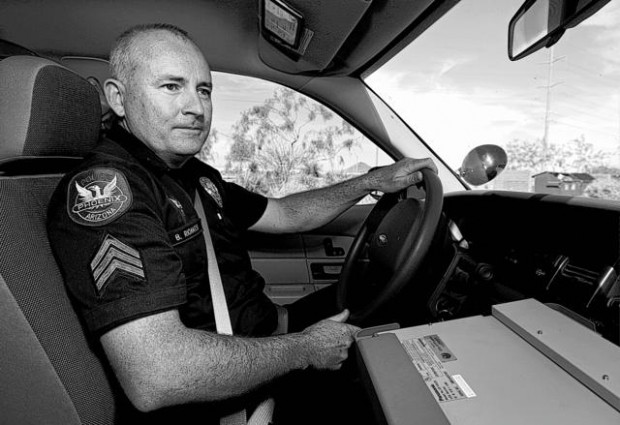
On StarNet: Take a ride with the Phoenix Police Department as they demonstrate the problem, and learn what police departments are doing to correct it at azstarnet.com/video