
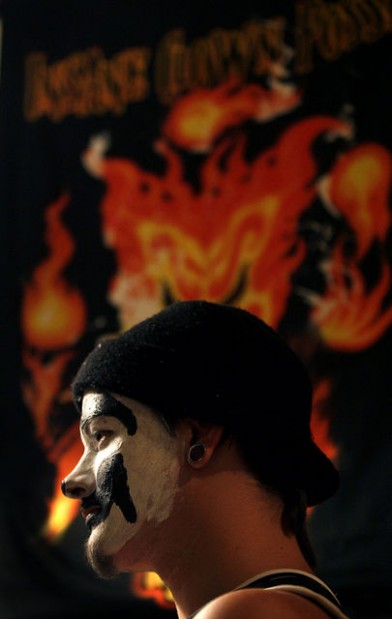
MESA — Derek Sprunk feels a special kinship when he paints black and white clown makeup into a wicked smile on his face.
“When you wear makeup, that unifies everybody,” the 19-year-old Mesa man said.
Sprunk is part of a subculture in metro Phoenix and throughout the country that’s united over love for the music of the underground rap band Insane Clown Posse and a sweet soda called Faygo.
But to some police investigators, the group — which calls itself Juggalos — is a gang.
Lt. Andy Vasquez, who heads up the statewide gang task force and is also a member of the Arizona Gang Investigators Association, said officials have identified two specific sects of Juggalos as gang members. One is in Mesa and the other is in Tucson.
Last month, a group of statewide gang investigators met to discuss the Juggalos in an effort to classify the subculture. They decided that while most Juggalos aren’t considered gang members, a few emerging sects meet the statewide criteria for a criminal street gang.
People are also reading…
“We’re extremely divided,” said Arizona Department of Public Safety gang expert Detective Michelle Vasey. “I’ve kind of made these guys my passion over the past year-and-a-half. You’ve got 90 percent of them that are true fans ... but what we’ve found ... is small groups of gangs breaking off and calling themselves some kind of gang sect.”
Scottsdale police gang officers also met earlier this month with the city’s school resource officers to educate them about Juggalos and how to identify them.
“I think the Juggalos have a pretty overt style with the face paint and the hatchetman,” said Scottsdale police Sgt. Aaron Minor. The hatchetman is a cartoon drawing of a little man running with a hatchet that serves as a logo of sorts for the Juggalos.
“These things are a lot different than some other groups out there,” Minor said.
Insane Clown Posse is an underground rap group that got its start in Detroit in the early 1990s. Band members were poor and grew up drinking a cheap soda popular in Michigan called Faygo.
There’s an annual event called The Gathering of the Juggalos that fans liken to a Woodstock-type event.
Many gang officers say violent undertones permeate the music — produced by the Psychopathic Record label — which the subculture follows.
“The lyrics are often violent and sexual in nature,” said a handout on Insane Clown Posse from Mesa police.
Juggalos also identify themselves by the hatchetman logo and are known to carry hatchets and knives as weapons.
“I had a kid once try to tell me it’s a Christian band and his parents were all for it,” said Chandler police school resource officer Kevin Quinn. “I had a little chat with the parents and showed them the lyrics.”
But those who follow the music and the lifestyle say the songs speak to them. They believe in the messages contained in the Six Joker Cards, otherwise known as the six albums released by the band from 1991 to 2004.
“If you listen to the music ... it’s so much ’Society has done me wrong (and) the world should pay for it,” Vasey said. “We may not have anything here, but together we will.”
Juggalos and their female counterparts, called Juggalettes, were thrust into the spotlight in June when one of them was shot to death in Mesa during a marijuana deal gone bad. Since then, many East Valley Juggalos have been fearing for their safety from people involved in the killing.
A Mesa gang detective who asked that his name not be used because he sometimes receives death threats from gang members said the Juggalos aren’t being targeted by any groups right now. He and his fellow gang investigators don’t consider all Juggalos to be gang members, but said they have documented 34 people in the city who meet the criteria of a criminal street gang.
Sprunk said he firmly believes that Juggalos don’t meet any of the gang criteria, and said it frustrates him that law enforcement sometimes labels him and his friends that way.
“You get picked on a lot more because you’re different,” Sprunk said.
Vasey, who used to work as a police officer on an Indian reservation, said she has seen traditional gang members break away and call themselves Juggalos more frequently over the past three years in Indian communities. She believes it may not be long before the trend becomes more widespread in other parts of the state.