COLUMBIA, S.C. — LaJoia Broughton, a 41-year-old small-business owner, considers herself a fan of President Joe Biden.

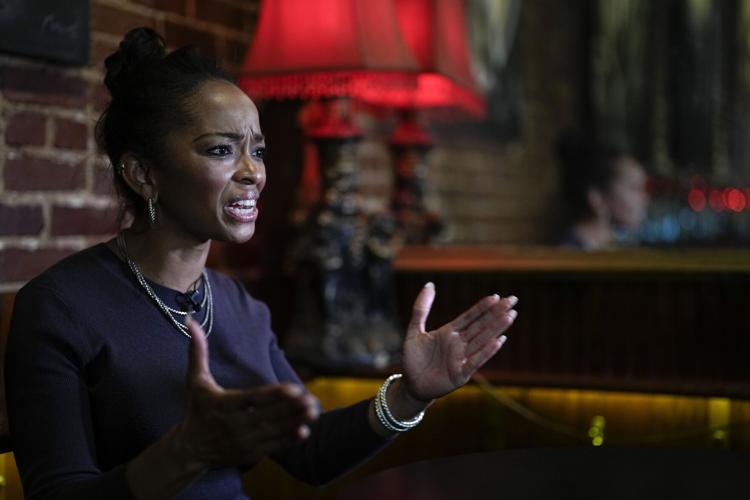
LaJoia Broughton, a 41-year-old small business owner, speaks during an interview at Goat’s restaurant and Tavern on May 2 in Columbia, S.C.
He’s provided opportunities for Black-owned business while bringing integrity to the White House, she said. Her decision for 2024 is not in doubt.
“Biden has proven himself in the last few years, and I’ll be voting for him in the next election,” said Broughton, who owns a lobbying and public affairs firm in Columbia, South Carolina’s capital city.
Destiny Humphreys is less enthusiastic. The 22-year-old senior at South Carolina State University, the state’s only public historically Black college or university, or HBCU, said she’s disappointed in the president, believing his accomplishments have so far not lived up to his promises.

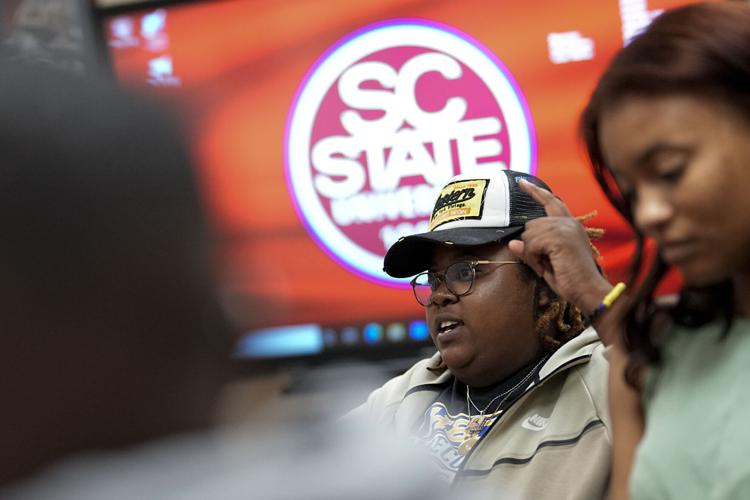
Destiny Humphreys, 22, a senior at South Carolina State University, talks with a reporter May 2 in Orangeburg, S.C.
“Honestly, I feel like right now America is in a state of emergency. We need some real change,” said Humphreys, who remains unsure about her vote in next year’s election.
People are also reading…
After a dismal start to his 2020 presidential campaign, Black voters in South Carolina rallied behind Biden, reviving his White House ambitions by driving his Democratic rivals from the race and ultimately putting him on a path to defeating then-President Donald Trump. But at the outset of Biden’s reelection bid, the conflicting views among the same voters provide an early warning sign of the challenges he faces as he aims to revive the diverse coalition that proved so crucial to him before.
Black voters formed the heart of Biden’s base of support and any dip in support could prove consequential in some of the most fiercely competitive states, such as Georgia, Michigan and Wisconsin. Well aware of the challenge, the Biden campaign says it’s confident in its message and is planning to highlight how the president has prioritized issues that are important to Black Americans.
“The progress made in the first two years — whether it’s the historically low black unemployment rate, unprecedented funding to HBCUs, or halving the black poverty rate in half — is all at stake in 2024,” campaign spokesman Kevin Munoz said in an emailed statement. “The campaign will work hard to earn every vote, and expand on its winning 2020 coalition.”
Yet there are some early signs that Biden will have work to do to generate enthusiasm among Black voters for another run.
Biden’s approval rating among Black adults has fluctuated over his two years in office. As with most demographic groups, the latest Associated Press-NORC Center for Public Affairs Research poll finds his 58% current approval rating among Black adults sitting well below where he began. Roughly 9 in 10 Black adults approved of Biden over his first months in office.
While only about half of Democrats overall say they want Biden to run again in 2024, 81% say they would definitely or probably support him if he were the nominee. The groundswell isn’t as stark among Black adults: 41% say they want him to run and only 55% say they are likely to support him in the general election.
APVoteCast, an extensive national survey of the electorate, also found that support for Republican candidates ticked up slightly among Black voters during last year’s elections, even though those voters overwhelmingly supported Democrats.
South Carolina provides an early barometer on how Black voters are viewing Biden shortly after his quiet campaign launch, via a video message late last month.
After his 2020 campaign was rescued, Biden rewarded the Black voters who are decisive in South Carolina Democratic politics by moving the state to the head of the party’s nominating schedule next year. He also followed through with his campaign pledge to appoint the first Black woman to the Supreme Court.
But interviews two years into his presidency with more than a dozen Black voters representing a variety of ages and backgrounds reveal mixed views, especially between older and younger voters.
Many younger voters said they aren’t convinced that Biden has delivered on their most important priorities.
Biden’s plan, announced last August, would have erased $10,000 in federal student loan debt for those with incomes below $125,000 a year, or households earning less than $250,000, and canceled an additional $10,000 for those who received federal Pell Grants. Its fate is uncertain after the Supreme Court last December said it would deliberate over the program’s future.
“He wouldn’t have been president without us,” said Courtney McClain, a 22-year-old recent graduate of the University of South Carolina, who voted for Biden in 2020, her first presidential election.
Getting her loans forgiven, both for her bachelor’s degree and a planned master’s program, is a top priority for her. She applauds Biden’s attempt at a college loan forgiveness program, but is frustrated that the plan is now in doubt after it was challenged in the courts by Republicans.
“So, I definitely think moving forward, if he wants to promise something as large as that, I think he should put the steps in place to make sure that he’s able to go through with that before he just says it out loud,” McClain said.
Many younger voters also cited the economy, especially lowering inflation, as a top priority. Several noted a lack of enthusiasm among their peers for a second Biden run, even while acknowledging they didn’t see a realistic alternative. But they wondered how lackluster support might affect turnout next year.

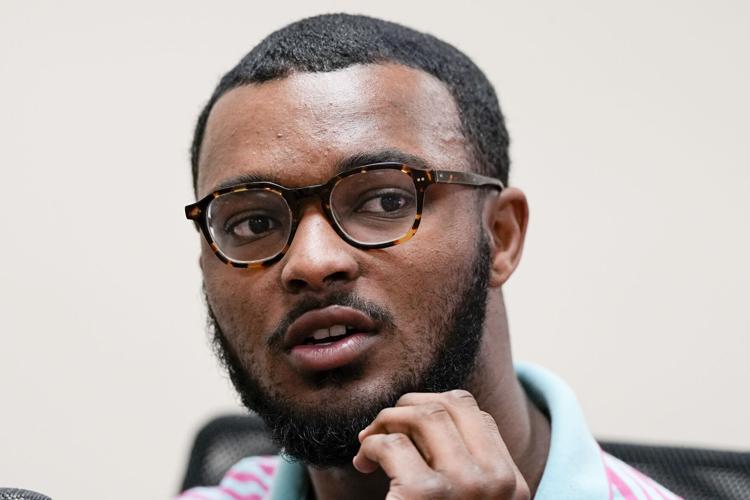
Ace Conyers, 22, of South Carolina State University
“For people to vote, and to be eager to vote, you have to actually want to vote for the person,” said Ace Conyers, a 22-year-old at South Carolina State.
Bailey Scott, a junior at the school, said she’s not excited about voting in the 2024 presidential election because people she would like to see in office won’t be running.”
“So I’m just going to have to pick the lesser evil,” she said. “And as of right now, that does seem like Joe Biden and Kamala Harris.”
Can Biden win again? Here's how past incumbents fared
Intro

No president wants to give up the power and prestige that comes with the office after only one term, and Joe Biden is no exception. He's pushing forward even though polls show a majority of Americans don't want to see him run again.
We went back to look at when modern presidents announced their decisions to seek a second term, what their Gallup approval ratings were at the time and how things turned out for them.
One theme: Primary battles are a sign of whether a president will win reelection. That's good news for Biden, who appears to have avoided any significant challengers.
Harry Truman

HARRY TRUMAN
He was vice president when President Franklin Delano Roosevelt died in 1945, near the end of World War II. Truman decided to run for a full term of his own, and he announced his candidacy on March 8, 1948. He had an approval rating of 53% in a poll conducted two months earlier. Truman was expected to lose the general election to Thomas Dewey, a Republican, but he pulled off a narrow victory.
Truman announced on March 29, 1952, that he would not seek a second full term after losing in the New Hampshire primary to Sen. Estes Kefauver of Tennessee. His approval rating had sunk to 22% amid economic trouble and the Korean War.
Dwight Eisenhower

DWIGHT EISENHOWER
Eisenhower, a Republican, had an approval rating of 75% shortly before he announced his reelection campaign on Feb. 29, 1956. He had suffered a heart attack months earlier at age 64, leading to questions over whether he would run.
As the former supreme allied commander during World War II, Eisenhower convinced Americans that he was the right leader on the world stage. He defeated Democratic candidate Adlai Stevenson.
John F. Kennedy

JOHN F. KENNEDY
Kennedy was assassinated in 1963, before he had a chance to run for a second term.
Lyndon B. Johnson

LYNDON B. JOHNSON
Johnson was vice president at the time of Kennedy's death, and he swiftly ran for his first full term in 1964, winning a landslide victory over Republican Barry Goldwater. However, the Democrat's popularity slipped badly over the Vietnam War and domestic turmoil.
It became clear that Johnson was at risk of losing his party's nomination in 1968 after Eugene McCarthy's strong showing in the New Hampshire primary. Soon after, Johnson shocked the country by announcing on March 31, 1968, that he would not seek a second term. His approval rating was only 36% that month.
Richard Nixon

RICHARD NIXON
Nixon had an approval rating of 50% when he announced his reelection campaign on Jan. 7, 1972. The Watergate break-in at the Democratic National Committee headquarters occurred that summer, but the scandal didn't gain enough momentum to drag him down.
Nixon, a Republican, defeated George McGovern, a Democrat, in a landslide. However, he would not finish his second term, resigning in 1974 after revelations about Watergate caught up with him.
Gerald Ford

GERALD FORD
Ford, a Republican, became president when Nixon stepped down, and he announced that he would run for a full term of his own on July 8, 1975. He had a 52% approval rating the month before.
He faced discontent over inflation and controversy from his decision to pardon Nixon, and he lost the election to Jimmy Carter, a Democrat.
Jimmy Carter

JIMMY CARTER
Carter announced his reelection campaign on Dec. 4, 1979. His approval rating had just hit 51%. However, the American people had grown weary of inflation, an energy crisis and a hostage crisis in Iran. Carter was wounded by a primary challenge from Sen. Ted Kennedy, and he was ultimately defeated by Ronald Reagan, a Republican.
Ronald Reagan

RONALD REAGAN
Reagan announced his reelection bid on Jan. 29, 1984. His approval rating was 52% that month. Despite concerns about his age — he was 73 and the oldest president in history at the time — Reagan handily defeated Walter Mondale, a Democrat.
George H.W. Bush

GEORGE H.W. BUSH
Bush's popularity skyrocketed after the Gulf War, when U.S. forces pushed Iraq out of Kuwait. However, his approval rating had subsided to 65% by the time he announced his reelection campaign on Oct. 11, 1991.
Pat Buchanan challenged Bush in the Republican primary. Although Bush won the nomination, his shot at a second term dimmed amid an economic downturn. He ultimately lost to Bill Clinton, a Democrat.
Bill Clinton

BILL CLINTON
Clinton's approval rating was 47% when he announced that he would run for reelection on April 14, 1995. Democrats had suffered a wipeout midterm election in 1994, leading some to question whether Clinton would be a one-term president. But he rebounded with the help of a growing economy, and he defeated Bob Dole, a Republican.
George W. Bush

GEORGE W. BUSH
The Sept. 11 attacks of 2001 led Bush, a Republican, to invade Afghanistan, followed by another war in Iraq. One month after U.S. forces entered Baghdad, Bush announced he would run for reelection on May 16, 2003. His approval rating was 69% that month. He defeated John Kerry, a Democrat.
Barack Obama

BARACK OBAMA
Obama, a Democrat, had a 48% approval rating when he announced his reelection campaign on April 4, 2011. He struggled to convince Americans that the economy was improving after the financial collapse and subsequent recession, but he ultimately defeated Mitt Romney, a Republican.
Donald Trump

DONALD TRUMP
Trump, a Republican, announced that he would run for reelection on June 18, 2019. The previous month, his approval rating was 41%. He was impeached for the first time at the end of the year, and then the coronavirus pandemic stalled the economy. Joe Biden, a Democrat, defeated Trump, who tried to prevent the peaceful transfer of power.
Joe Biden

JOE BIDEN
Biden announced his reelection campaign on April 25. His approval rating was 40% the previous month. Biden would be 86 at the end of a second term, leading to fears that he's too old to keep such a demanding job.
However, Biden has not drawn any significant primary challengers. The only Democrats running are Marianne Williamson and Robert F. Kennedy Jr. Meanwhile, Trump is leading in Republican primary polls as he seeks the party's nomination, raising the potential for a rematch with Biden.
How do these 7 values make America distinct? | The Ethical Life podcast