

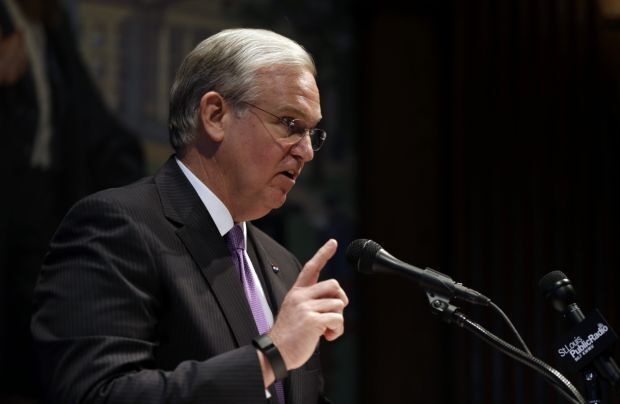
JEFFERSON CITY • Measures that would provide tax breaks to grocery stores, power companies and dry cleaners — to name a few — were vetoed by Gov. Jay Nixon Wednesday.
Nixon projects the 10 bills he vetoed would drop state and local revenues by $776 million each year, with St. Louis’ losing potential at about $20 million.
Those “secret sweetheart deals,” Nixon said, were not accounted for in the fiscal year 2015 budget.
The Legislature “passed a budget and then blew a large, large, large hole in it,” Nixon said at a news conference.
The governor, a Democrat, plans to make budget cuts in the coming weeks in case the GOP-led Legislature overrides his vetoes. The Legislature can override vetoes during a September session, but a two-thirds majority in each chamber is required.
People are also reading…
In this year’s regular session, the Legislature already overrode Nixon’s veto of a $620 million income tax cut, which will begin in 2017 if state revenue targets are met.
Sen. Will Kraus, R-Lee’s Summit, said in a statement that he would work with other senators to override Nixon’s “misguided vetoes.” Kraus is chairman of the Senate Ways and Means Committee. “The goal for any of these tax measures is to deal fairly and across the board with every citizen and business,” Kraus said. “It is important to this state that we work to ensure tax protections for everyone.”
The bills, many passed on the last day of the session, would provide tax breaks to data storage centers, power companies, fitness centers, restaurants and farmers markets, among others.
Nixon previously said the break for data storage could cost the state government $220 million in revenue. Another bill would exempt restaurants and grocery stores from paying sales tax on electricity used to process food, a measure that would affect Schnuck Markets Inc., which sought the break for bakeries it operates in 40 stores.
Nixon said that together, the bills he vetoed would reduce state revenue by $425 million and local revenue by $351 million.
These breaks “pick winners and losers not based on how many jobs would be created or how much economic activity would be generated, but rather based on the power ... of special interest influence,” Nixon said.
However, House Majority Leader John Diehl, R-Town and Country, said Nixon was wrong about the fiscal impact of these bills.
“He seems intent on spreading misinformation about providing tax relief to businesses who create jobs and grow our economy,” Diehl said, adding that Nixon’s office never voiced its objections to the bills during the session.
Sen. Paul LeVota, D-Independence, agreed that some of the bills weren’t as “budget busting” as Nixon claimed. Some, such as the tax break for data storage centers, would create jobs, he said.
“Some things are targeted tax policy that can create jobs as opposed to what we also did with the massive tax cut” this session, LeVota said.
Nixon’s actions disappointed but didn’t surprise House Speaker Tim Jones, R-Eureka.
“By vetoing these bills he has reemphasized the fact that the focus of his tax and spend administration is on growing the size of government rather than growing our economy,” Jones said in a statement.
The bills are SB 693, SB 584, SB 612, SB 860, SB 727, SB 662, SB 829, HB 1296, HB 1455 and HB 1865.
Alex Stuckey covers Missouri politics and state government for the Post-Dispatch. Follow her on Twitter at @alexdstuckey.


