

ST. LOUIS • After a decade of hope and months of public debate, the $380 million renovation of the Gateway Arch grounds is finally starting.
Dignitaries turned a ceremonial shovel this morning. Construction starts as soon as next week.
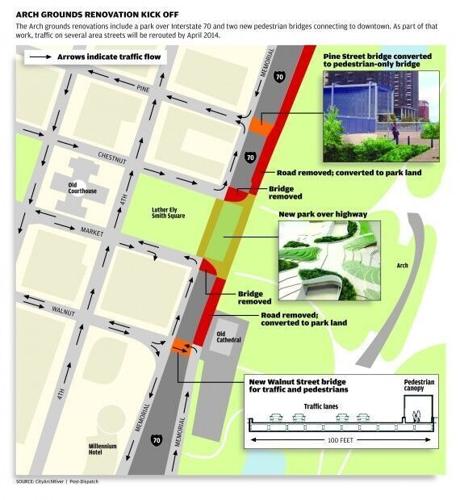
The first project is largely infrastructure: Rerouting roads, building new bridges, and erecting concrete and steel across downtown’s Interstate 70, on which a park will soon sit over the highway.
Up next is a string of improvements stretching more than a half-mile, from Kiener Plaza downtown to the Mississippi riverfront.
Leaders charged with turning design into reality are already sweating. Their October 2015 deadline — the 50th anniversary of the Arch — looms just two years away.
“We’re doing our best to expedite the schedule, to move this thing along,” said Tom Bradley, the National Park Service’s superintendent for the grounds and museum. “It’s getting really aggressive.”
People are also reading…
The project, as a whole, is the same as proposed to St. Louis taxpayers months ago:
A lid and park over the highway will link downtown to the Arch and the Mississippi River below. Bike paths and pedestrian walks will run through the park and down to an elevated Leonor K. Sullivan Boulevard. A grass amphitheater and garden will replace concrete and steel in the north parking garage.
The Museum of Westward Expansion will expand, reaching toward downtown and getting a new entrance facing the city.
Civic leaders have pushed for improvements to the Arch grounds for almost two decades.
Then, in April, St. Louis and St. Louis County residents passed a 3/16-cent sales tax, a boost of about 2 cents on a $10 purchase. The tax is projected to raise about $9.4 million a year and fund a roughly $90 million bond issue. Great Rivers Greenway, the regional trails district, will oversee the disbursement of tax money.
Much of the rest will be raised by the nonprofit group CityArchRiver, created to spearhead the renovation. Foundation leaders say they now have $104 million in private funding and anticipate $26 million more by the end of September.
The first project — the “lid” over I-70 — is largely funded via state and federal transportation dollars.
Early last month, the Missouri Department of Transportation hired KCI Construction. The company’s $26.4 million bid, the department reported, was the lowest of six received.
Thursday, KCI was already moving equipment downtown. Deanna Venker, MoDOT’s area engineer, said work will start around Laclede’s Landing — redoing highway on-ramps and improving the confusing intersection at Memorial Drive and Washington Avenue.
By January, construction will move south, to demolish and rebuild the Walnut Street bridge.
In April 2014, with all of the surrounding roads rerouted, MoDOT will focus on links to the Arch grounds. The Pine Street bridge will be converted to a pedestrian pathway into the grounds. The Market and Chestnut street bridges will come down, making way for the park over the highway.
Despite all the roadwork, there are early glimpses into the engineering and whimsy to come.
For example, to plant trees into the concrete park-over-the-highway, MoDOT has engineered deep wells into the land bridge. Workers will chain tree root balls into the concrete wells to prevent the trees from uprooting, Venker said.
And in several locations, designers are using lighting to entice and direct visitors to the Arch.
The bleak concrete support pedestals holding up the elevated lanes of I-70 will get wrapped with a lighted metallic screen. The effect — a “shimmering” wall — will guide visitors to the Arch grounds and Laclede’s Landing, said project manager James Smith, a senior associate for design team Michael Van Valkenburgh Associates.
Fourteen-foot sun canopies will rise over the Walnut and Pine street pedestrian bridges. “They’ll kind of be gateways beckoning you, ‘This is the way to the Arch grounds,’” Smith said.
Through it all, Venker said, MoDOT hopes to avoid road closures. “We should be able to keep things open, and keep traffic moving,” she said.
The next big project — the elevation and renovation of Leonor K. Sullivan Boulevard, on the Mississippi riverfront — could start as early as this fall.
There is no current schedule for any of the other planned projects.
Many still need National Park Service approval.
Bradley, the park superintendent, said he hopes to keep the park open as much as possible, even arranging pathways on which to watch the construction progress.
Timothy Barker, a city resident, local architect, and member of the project’s Citizen Advisory Committee, said he’s excited to be a part of the work and happy with the concept. But he doesn’t see how the project will conclude by 2015.
“How in the world,” he asked, “are they going to do it?”


