


Parks and trails officials in St. Louis and St. Louis County have about nine months to decide how to spend $31 million a year in new tax dollars.
On Tuesday, voters in the city and the county easily passed Proposition P, the sales tax increase to build trails, overhaul the Gateway Arch grounds and maintain parks.
After months of campaigning, area parks officials awoke weary but triumphant Wednesday.
“We’re never going to have mountains. We’re never going to have oceans,” said Peter Sortino, a Forest Park Forever board member and campaign manager for Prop P. “But we have rivers and streams. And we’re going to have the greatest system of linear parks and trails anywhere in the country.”
Then the parks leaders started figuring out their next steps.
Staffers at the St. Louis County parks department, set to receive about $6 million more annually starting next year, met to identify their most urgent needs, culled from a list of more than 100.
People are also reading…
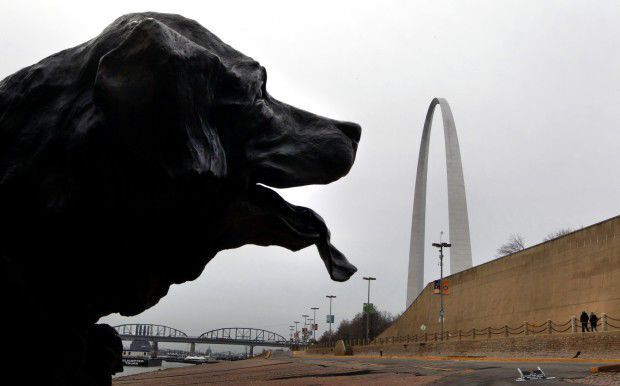
The Arch team, which will bank about $9 million a year from the tax, began talking through a planned bond measure. It hopes to borrow $90 million in bonds toward the $380 million Arch grounds renovations.
Leaders at Great Rivers Greenway, the regional trails district, contemplated hiring project managers, planning for at least 90 more miles of off-street trails. The agency’s $10 million annual budget will nearly double with the new tax dollars. Great Rivers also will collect and monitor the public dollars going to the Arch grounds overhaul.
And all of the parks leaders debated just how soon the state will require area businesses to begin collecting the tax — a question that provided some moments of uncertainty Wednesday.
Some initially figured the tax would be collected July 1. Others thought state law required a longer delay. The state Department of Revenue sorted it out, settling on Oct. 1.
That, said financial directors at Great Rivers and St. Louis city, means that no one will see the money until mid-December.
But parks leaders were already getting ready.
The St. Louis County Municipal League, which will gather about $4 million a year to send to county municipalities, has a list of needs worth millions of dollars.
St. Louis city’s annual capital budget for parks will increase by 50 percent, from $5 million a year to $7.5 million. The city has identified more than $100 million in needs, including disabled-accessible restrooms, playgrounds and athletic fields, said parks Commissioner Dan Skillman.
Wheelchairs, he said, can’t get into the restroom stalls at the Carondelet Park tennis court comfort station, in south St. Louis. The tennis courts at Penrose Park need to be redone completely, in north St. Louis. The playground at Sublette Park, on Southwest Avenue at Arsenal Street, is covered with pea gravel, and wheelchairs sink into it.
None of the city park capital money, Skillman said, can be shifted to other uses — it’s all earmarked for parks.
Tom Ott, the St. Louis County parks department director, said he met with staff members Wednesday morning and “shared the good news.”
County parks desperately need the money, Ott said. He oversees 41 playgrounds, 87 restrooms and 99 athletic fields in 70 parks on 12,700 acres. And most of the infrastructure is at least 40 years old.
Ott said many playgrounds and restrooms need quick attention. The top of the rubber playground in Belle Fontaine Park, in north St. Louis County, is so old it’s peeling, he said. The wooden sea wall at Creve Coeur Park, which holds back the bank by the boat ramps, is deteriorating. If the county lets it go much longer, it could collapse.
And a neighborhood access trail at Queeny Park, in west St. Louis County, is cracking and falling apart.
The county has a $22.9 million budget this year, Ott said. But the funds set aside for capital needs total just $750,000.
Critics of the tax measure have long alleged that County Executive Charlie Dooley will shift money out of parks, then fill the gap with the new tax dollars.
Ott said that didn’t make sense. “If that would happen, that would put us right back where we are,” he said Wednesday. “That’s not the intention of county parks, and that’s not, I believe, the intention of this administration.”
The goal, Ott continued, is to use the money primarily for taking care of the county’s current parks. But maybe the money could add an amenity or two.
For instance, he said, the public has long wanted a dog park. Queeny Park could work well for that, he said. After all, it already has a dog museum.
Maggie Hales, the executive director of CityArchRiver, the nonprofit spearheading the Arch grounds renovation, said the group would have about $100 million in private donations committed by the end of this month. Hales said one of her first priorities was making sure those gifts were on track.
Her attention is also shifting to some of the details of the Arch project. A citizen advisory board will probably be chosen next week, she said. CityArchRiver will lean on that group to help with park programming and amenities, such as signs directing visitors to parking, shops around the park, and music or other attractions.
“What do you want to see?” asked Hales. “Music? A skateboard park?”
“I’m really, really happy that voters in St. Louis city and St. Louis County are endorsing the idea of green trails and parks. People do get it,” Hales said. “And that makes me happy. I really am proud to be a St. Louisan today.”
David Hunn covers taxpayer spending on regional cultural institutions. Follow him on Twitter @davidhunn.


