
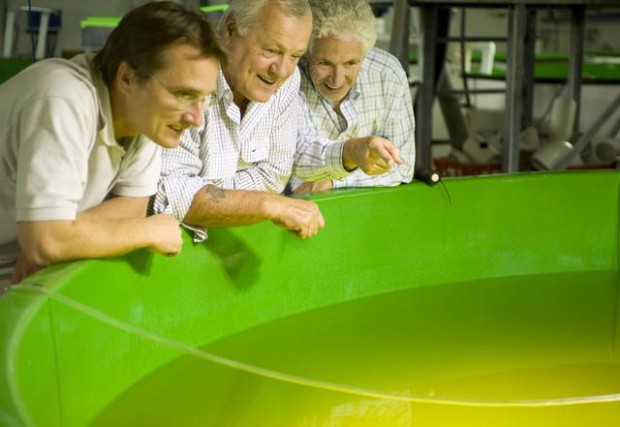
Hagen Stehr was at home in Adelaide, Australia, on March 12 when his company's chief scientist called with news that their bet of about $48 million on the breeding of southern bluefin tuna in captivity — a feat never accomplished before — might finally pay off.
"Big fella, you better come back," scientist Morten Deichmann said to the 6-foot-1-inch Stehr.
Stehr, chairman of Port Lincoln, Australia-based Clean Seas Tuna Ltd., rushed more than 311 miles to his company's fish hatchery outside Arno Bay in southern Australia.
With tears in his eyes, he pushed his Toyota Land Cruiser to its top speed of 110 miles an hour as he raced to see the fertilized eggs for himself. As the owner of a fishing fleet during the past four decades, Stehr had helped empty the seas of the bluefin tuna used in sushi restaurants from New York to Tokyo.
People are also reading…
Now, at 67, he believed he was on the verge of saving the tuna — and the industry that made him rich — from the threat of extinction.
"Everyone thought I was a bloody lunatic," said the suntanned Stehr. "Nobody in the world had ever done this. We've created a sustainable fishing industry for years ahead."
The majestic bluefin, a metallic-blue-and-silver fish, is prized by sushi lovers in Japan, the U.S. and Europe for the rich taste and creamy texture of its meat. In their zeal to feed those palates, fishermen have almost wiped out the two species of bluefin — northern and southern — while also threatening the yellowfin and bigeye tuna.
"In a few years, there'll be nothing left for us to fish," said Atsushi Sasaki, a Japanese fisherman who has caught bluefin for 20 years. "The collapse of bluefin is just around the corner."
The Japanese — the biggest consumers of bluefin — devour 80 percent of the world's catch. The fish has been served at restaurants such as Nobu, a chain of high-end Japanese eateries. The menu at Nobu London, however, warns that bluefin is a threatened species and asks patrons to order an alternative dish.
This is more than another fish story. The saga of the bluefin, a creature that can swim 45,000 miles in 17 months to spawn and feed, shows the difficulties in managing resources across borders — a sign of the challenges ahead as countries confront environmental degradation and global warming. At the same time, Stehr's indoor-breeding breakthrough points to the role technology may play in addressing these broader resource issues.
Since the early 1980s, countries working through the United Nations have tried and failed to set catch quotas tough enough to protect bluefin and other tuna from overfishing.
"Where you have politicians arguing for a share of a quota, that quota will inevitably be inflated," said Callum Roberts, a marine-conservation biologist at the University of York in England. "That kind of decision-making guarantees the collapse of a population."
Stehr and his scientists now must find a way to grow fertilized hatchery eggs into adult tuna. One challenge: The bluefin, a predator, eats its young.
"If Hagen Stehr can solve the issues surrounding breeding predacious fish, he'll have a sustainable product that will last forever," said Barbara Block, a professor of marine science at Stanford University in California. "The future lies somewhere in what they're doing."
Clean Seas plans to build more indoor tanks to protect and grow fingerlings before they're put into the ocean. Stehr aims to produce at least 250,000 bluefin by 2015 — a number that would almost equal the total bluefin catch of Australia's fishermen in a single year.
Bluefin sell for as much as $20,000 a fish at Tokyo's Tsukiji, the world's largest fish market. As prices soar Stehr stands to add to his fortune. He is now estimated to be worth $135 million.
Since the 1970s, Stehr has helped build a tuna industry that was worth $7.2 billion globally in 2006. The fishermen have thrived on the high seas, particularly in the Mediterranean, where they have exceeded quotas established by regulators.