

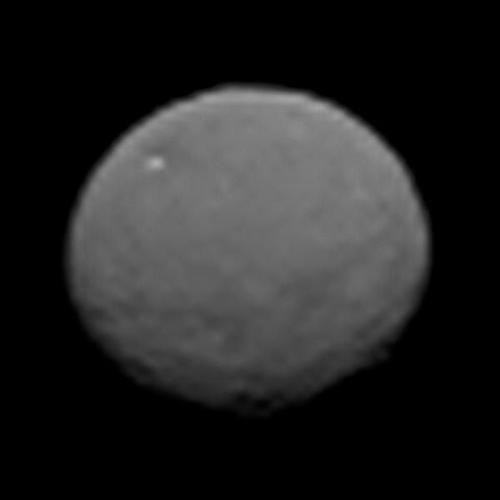

NASA released the clearest images ever taken of dwarf planet Ceres on Tuesday.
They hint at some interesting features, possibly craters and ridges, that will come into sharper focus as the Dawn spacecraft approaches the planet for an orbit scheduled to begin March 6.
“Data from this mission will revolutionize our understanding of this unique body. Ceres is showing us tantalizing features that are whetting our appetite for the detailed exploration to come,” said Carol Raymond, deputy principal investigator of the Dawn mission in a press release.
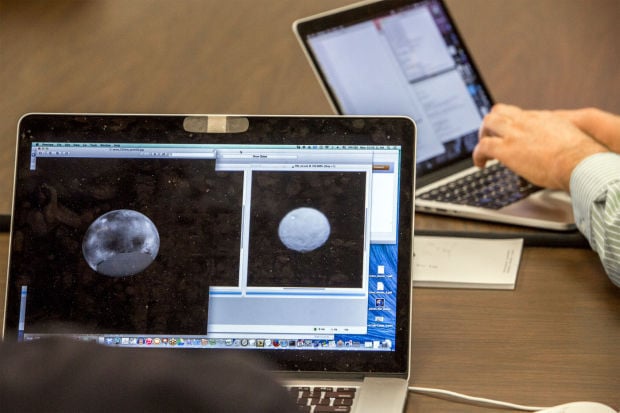
In Tucson, where five Dawn mission scientists met at the Planetary Science Institute to review the images Monday, PSI Director Mark Sykes cautioned that the level of resolution is still too small to make definitive pronouncements about Ceres’ topography.
People are also reading…
It’s too early to tell, for instance, whether dark areas are shadows cast by ridges or simply darker material. Sykes also cautioned against making too much of a big white spot in the upper left corner of the image.
It’s intriguing but not really white — just lighter than the dark surface surrounding it, Sykes said.
Sykes said the Dawn science team, which includes 11 members of his Tucson-based institute, will use these early looks to refine targets for study.
“There is a lot of interesting discussion going on,” Sykes said Tuesday. “Are we seeing lumpiness on the surface or not? There is some deviation from roundness, but not real obvious.”
“The mottled color of the surface makes it look lumpy. Is that topography or just visual effects due to variation in albedo across the surface?”
Really big features would have shown up by now, Sykes said.
The images released Tuesday by NASA’s Jet Propulsion Laboratory, which leads the mission, exceed the resolution of those taken by the Hubble Space Telescope.
Hubble’s telescope captured its images from 150 million miles away, with its 8-foot-diameter primary mirror.
Dawn is now within 147,000 miles of its final destination. Its 150-mm camera needs to get much closer to its target.
Dawn launched in September 2007 for its long, slow haul to the asteroid belt between Mars and Jupiter, where it first orbited Vesta before heading to Ceres, the queen of the asteroid belt, containing 25 percent of its overall mass.
Ceres is, on average, 257 million miles from Earth, but Dawn will have traveled about 3 billion miles to get there, according to NASA, making big loops to get a gravity assist from Mars, and to slide into orbit around Vesta, and now Ceres.
It is the first spacecraft to run on ion propulsion engines, which produce just a whisper of force, but will power Dawn to Ceres on less than 1,000 pounds of fuel (xenon gas) and a couple solar panels.


