


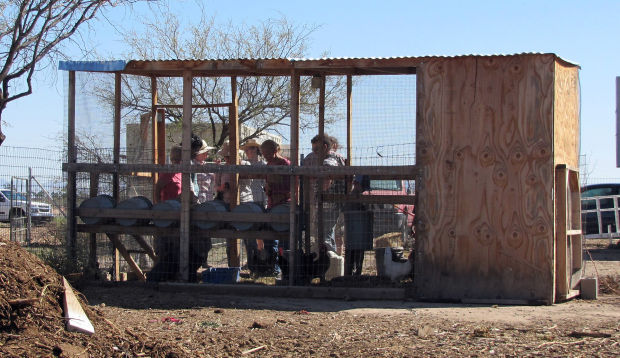
The Community Food Bank recently held a free workshop on raising backyard chickens at Las Milpitas Farm, on the west bank of the Santa Cruz River.
Cute chicks: Let’s say you decide to raise hens from chicks, as opposed to pullets — pullets being the teens of the chicken world. It takes four to six months before the girls will start laying eggs. How do you know when they’re ready to produce that first egg McMuffin? Their comb will stand up and turn red.
A bloom by any other name: Did you know many countries such as Mexico don’t refrigerate eggs? Apparently, all those egg eaters are still alive. You won’t need to refrigerate your eggs — if and only if — you don’t wash them. Washing removes the natural coating that protects the shell. It's a good idea to wash them just before use, however.
Easter egg hunt: Some sneaky hens will lay their eggs outside the nesting box, where they can lie undiscovered for a while. But even if they’ve escaped your notice, they should be perfectly fine for up to a month after being laid. You may remember from third-grade science class how to tell if an egg is good or bad: put it in a bowl of water and if it sinks, it’s good; if it floats — toss it.
People are also reading…
Mean girls: Just like junior high, some hens turn into bullies. There are two good solutions to this problem, and one involves roast chicken or soup. The other method is to remove her from the coop for a few days or so and she will lose her place in the pecking order. Yes, there really is such a thing as pecking order.
Owl versus chicken: One thing to watch out for are predators. Coyotes, hawks, your own dog — all like chicken divan as much as people do. However, owls have a unique way of killing their chicken prey: They chop off her head. Owls are too small to carry off a full-grown chicken but a head is a tasty treat.
A well-fed chicken: Are you feeding your hens too much or not enough? One way to tell is to gently grab their crop — that would be a throat for humans — and see if it feels full. If her crop feels full at the end of the day, she's getting enough to eat.
True grit: Hens need to eat grit in order to process and digest their food. Lauren Sullender told us a story about a rooster who apparently didn’t have access to grit. When his time was up and he was destined for the roasting pan, they cut him open and found ground glass in his crop. Now that’s a pretty badass rooster, if you ask me.
Source: Special thanks to Leona Davis, education and advocacy coordinator and Lauren Sullender, youth education coordinator, for the Community Food Resource Center of the Community Food Bank of Southern Arizona.


