

It's hot outside. But really, how hot is it? Let's quantify the heat.
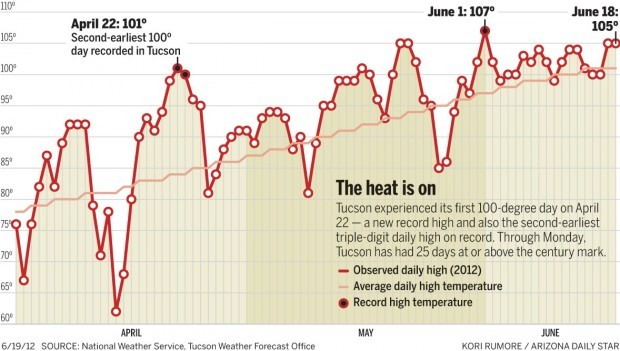
Through Monday, Tucson had recorded 25 days at or above 100 degrees in 2012. Today's high will bring that total to 26. According to the National Weather Service, Tucson Weather Forecast Office, Tucson normally averages 23 triple-digit days by the end of June.
If the daily maximum high temperature reaches the century mark every day for the rest of the month, then Tucson will have had 37 days at or above 100 degrees. That would be slightly ahead of normal, since Tucson averages 62 days each year in that range.
The year 1994 holds multiple records for heat, including the warmest summer on record. There were 99 total days with high temperatures of 100 degrees or more — 82 of those happened during the summer months.
People are also reading…
One record that year doesn't include, however, is the hottest temperature ever recorded in Tucson — 117 degrees. This all-time high was recorded at Tucson International Airport on June 26, 1990. Longtime residents might remember that in Phoenix that same day — where the city had its own record-high temperature of 122 degrees — commercial airplanes were grounded because of the heat.
The hottest temperature ever recorded in Arizona was at Lake Havasu City on June 29, 1994 — 128 degrees.
Get heat advisories delivered to your email
Sign up with The Arizona Department of Health Services to receive alerts on days when dangerous heat occurs. Just enter your email address and choose "Heat alerts" from the available options.
Tips from the Arizona Department of Health Services
- Drink water. Even people that stay mostly indoors all day should drink at least 2 liters of water per day. People that spend time outdoors should drink 1 to 2 liters per hour that they are outdoors. People that do strenuous activity outdoors should be very careful, being your body can lose up to 4 liters of water per hour during strenuous activity. You should carry water with you and drink even if you do not feel thirsty. Be heat safe and avoid alcohol and caffeine, which dehydrate the body. Avoid using salt tablets unless directed to do so by a physician.
- Dress for the heat. Wear lightweight, light-colored clothing. Light colors will reflect away some of the sun's energy. It is also a good idea to wear hats or to use an umbrella. Always apply sunscreen to exposed skin.
- Eat small meals and eat more often. Avoid foods that are high in protein which increase metabolic heat.
- Slow down. Avoid strenuous activity. If you must do strenuous activity, do it during the coolest part of the day, which is usually in the morning between 4 a.m. and 7 a.m.
- Stay indoors when possible.
- Take regular breaks when engaged in physical activity on warm days. Take time out to find a cool place. If you recognize that you, or someone else, are showing symptoms of a heat-related illness, stop activity and find a cool place.
All-time record high temperatures for Tucson (1895-2011)
The top 15 days of high temperatures in Tucson, according to the National Weather Service, Tucson Weather Forecast Office.
| Temperature | Date |
|---|---|
| 117 degrees | June 26, 1990 |
| 116 degrees | June 29, 1994 |
| 115 degrees | June 28, 1994 |
| 115 degrees | June 25, 1994 |
| 114 degrees | July 28, 1995 |
| 114 degrees | July 4, 1989 |
| 114 degrees | June 22, 1988 |
| 113 degrees | June 27, 1995 |
| 113 degrees | June 26, 1994 |
| 113 degrees | June 24, 1994 |
| 113 degrees | June 26, 1993 |
| 113 degrees | June 28, 1990 |
| 113 degrees | June 25, 1990 |
| 113 degrees | June 18, 1989 |
| 113 degrees | June 23, 1988 |


