

Erik Schumann moved to Tucson seeking change.
His mother and aunt live here and are both ill, he said. He wanted to be around to help out.
“I moved partially to go back to school, and also so that I can be closer toward family members with failing health,” he said.
The 28-year-old enrolled in computer courses at the University of Phoenix after moving from Seattle in June 2014 in the hope that he could work in the IT industry like his father.
That dream is now on hold, and the very people he wanted to help take care of must now care for him.
Last month, Schumann was nearly killed in a machete attack that left him with serious, disfiguring wounds and the possibility that he will never walk unassisted again. Veteran police officers who were called to the crime scene said it was one of the worst acts of violence they had ever seen.
People are also reading…
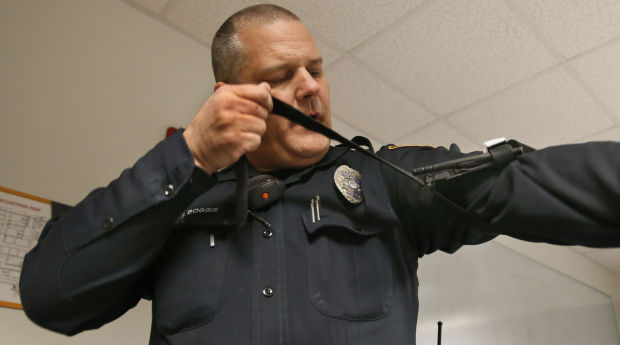
“There was blood everywhere on the floor and the walls,” Officer Steven Boggie told the Star.
Schumann said he was on his second date with a woman he met online, who invited him to stay the night at her midtown house. Things were going well, he said.
Then at about 3 a.m. on Dec. 11, Schumann said he was awakened when he heard someone opening the front door of the woman’s house. Suddenly, the lights flicked on and he saw a large man come at him as though he was going to strike him with something.
“It wasn’t until I was pouring blood out from multiple arteries that I realized what the object was,” Schumann said. “It was a machete.”
He said he made it as far as the edge of the bed when the attacker, later identified by police as Tony Abrego, the woman’s ex-boyfriend, began to swing his weapon.
Schumann was stabbed and cut more than 30 times as the woman screamed for help and begged with the attacker to stop, according to interviews and police reports.
The relentless swinging of the machete stopped only when the attacker chased after the woman, who had run out of the house to seek help from neighbors, Schumann said. Soon, he heard her screaming stop, which led him to believe that the attacker had killed her.
“This is how it’s gonna end,” Schumann said he thought at the time.
The woman was stabbed in the lungs, but survived. She had successfully gotten help from a neighbor, and soon, the police came.
By then, the attacker was gone.
POLICE find BLOOD BATH
When dispatchers radioed about the incident, Boggie said he had no idea what he was getting into. There were no emergency tones on his radio: It was a possible domestic violence call, as far as he knew.
He soon found out it was much more than that.
“That was probably one of the worst things I’ve seen somebody do to another person,” the 10-year veteran officer said.
He and Officer Jacob Smith got to the scene first. When they arrived, he said the female victim told them Schumann was inside the house and that he had been stabbed countless times.
Inside, the officers found Schumann lying on the floor in a pool of blood with his head toward the bedroom closet. Schumann was still conscious, forcing himself to stay awake, thinking that if he passed out, that was going to be the end of it. Boggie said Schumann kept trying to open his eyes as he tried to talk to him.
The officers knew immediately that they couldn’t wait for the paramedics to arrive. They used two tourniquets from department-issued first-aid kits to minimize the bleeding. Schumann said later that he was told he had lost about 13 pints of blood as a result of the attack.
Meanwhile, Officers Raul Navarro, Kyle Frank and Alex Ferguson were outside with the woman.
“She was remarkably calm,” Frank said. She was applying pressure to her own chest wound when officers arrived. She gave a detailed description of her ex-boyfriend.
In situations like this, the instincts developed by training kick in, Boggie and Frank said in an interview. They react as they’re taught to first. It didn’t occur to them until later that what they had witnessed was a truly horrifying scene.
“When you’re in that moment, you’re not stopping and saying, ‘Wow, that’s a lot of blood,’” Frank said.
Five officers who responded to the incident — including Boggie and Frank — received commendations Dec. 17 for saving Schumann’s and the female victim’s lives by quickly providing first aid. Schumann’s father and his wife also attended the ceremony to thank the officers.
But Boggie and Frank said they don’t particularly feel like heroes. They were doing their jobs, they said.
“I’m just glad he’s OK,” Boggie said. “Hope he recovers as fully as he can.”
LIFE AFTER THE ATTACK
Life since the attack has not been easy, Schumann said. It took a couple of weeks before reality started to kick in.
“I was overwhelmed,” he said. “Definitely in shock.”
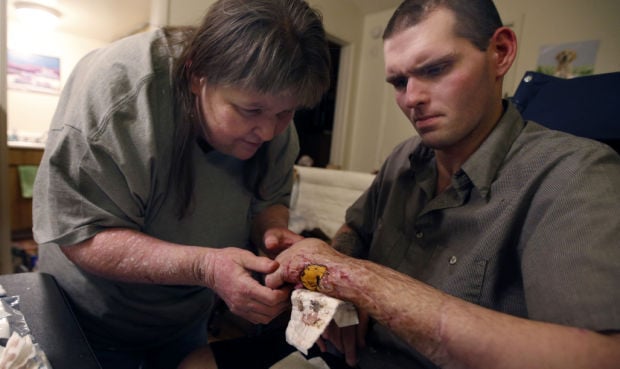
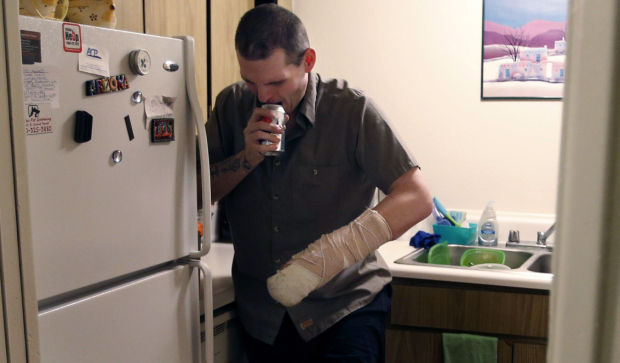
The attack left him with 15 staples on his head, a nearly severed left hand, detached left knee cap, more than a few sliced nerves sewn back together, numerous gaping wounds that are still raw to this day, and smaller cuts all over his body.
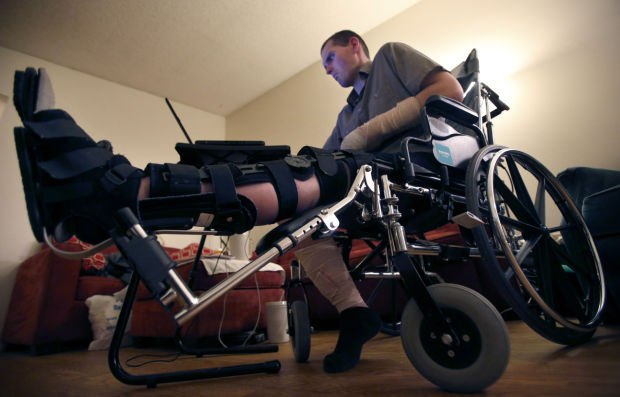
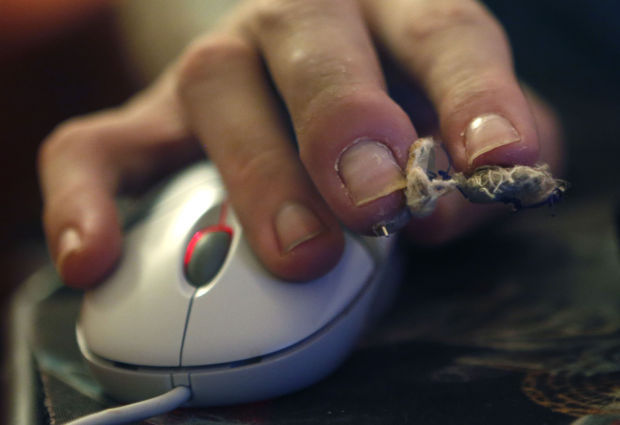
His right thumb was reattached through surgery, and many of his fingers are being held together with pins. Small, button-like devices on his right fingers are there to hold his ligaments and tendons to his finger bones. His left leg, which has undergone reconstructive surgery, is currently bound by a large brace.
The first emergency surgery at the University of Arizona Medical Center lasted about 12 hours. He has had four more since then, with a total hour count of 27. There are at least two more surgeries coming, he said.
“It’s unknown whether I’m ever going to walk again or regain the use of my hands,” he said.
Being active was a natural part of his life. He loved jogging and doing yardwork. He said he knows it will be a long time before he is able to do any of those things again.
“Tony Abrego didn’t just take away my ability to walk,” he said, “he took away a part of my soul.”
Schumann was discharged Tuesday from a care facility back to his apartment. He didn’t qualify for a caretaker under his health insurance plan, so for the time being, his aunt, Janice Tulluck, who is recovering from a broken back and has arthritis, is caring for him.
She helps him with everything from getting him up and out of bed to bringing him food to getting him cleaned up to going to get his medication. At the same time, she must also care for her sister, Schumann’s mother, who is in the hospital for complications from diabetes. Schumann’s father lives out of town.
It’s not an easy task, but Tulluck said what matters in the end is that he survived.
“He’s alive,” his aunt said. “It could be so much worse. We’ll take that over nothing.”
Despite all that’s happened, Schumann hasn’t lost all of his spirit. He said right now, the focus is finding a way to go back to school.
“I’d like to be able to get my degree,” he said, “and live a long, happy life with as much mobility as possible.”
Schumann said he has not been in touch with the woman for several weeks now. She came by to wish him well and told him that she wishes she were the focus of the attack, he said. But seeing her again triggered the already frequent flashbacks to the attack.
“Naturally, I’m not too set on pursuing her romantically,” he said.
Schumann set up a GoFundMe campaign to get help with his climbing medical bills and to buy equipment that will help him go back to school, including voice recognition software and a mobility scooter.
Abrego is being held at the Pima County jail. He surrendered to the Tucson police in the afternoon on Dec. 11. He is facing multiple charges, including attempt to commit first-degree murder and second-degree murder and aggravated assault.
“He deserves to pay for what he did,” Schumann said.
Contact reporter Yoohyun Jung at yjung@tucson.com or 573-4224. On Twitter @yoohyun_jung

Yoohyun Jung
Data reporter


