

A team led by UA astronomer Ian Crossfield has discovered three planets not much larger than Earth orbiting a relatively nearby star.
One is at the proper distance from its sun to be deemed “habitable,” or capable of supporting a liquid ocean.
Crossfield, a Sagan Fellow at the University of Arizona’s Lunar and Planetary Laboratory, commented by telephone during a layover on a flight from Chile, where he performed follow-up observations to help verify the findings at the European Space Observatory’s New Technology Telescope.
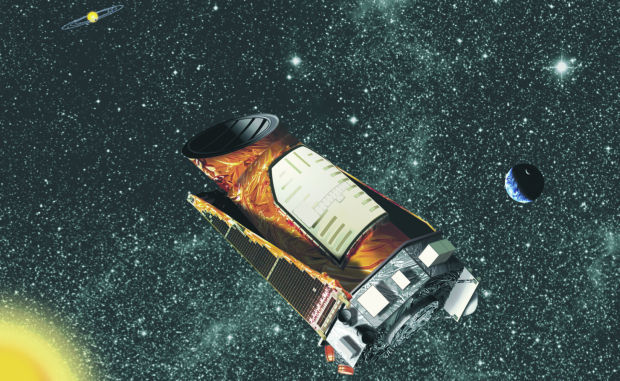
Crossfield said the discovery is exciting, first of all, because it helps validate the worth of K2 — a resurrected mission of NASA’s Kepler Space Telescope that positioned the crippled spacecraft to look for signs of transiting planets around nearby stars.
Kepler project scientist Steve Howell said the K2 mission was pitched by scientists to NASA as a way of finding “high value” planets by recording the slight diminution of light when they pass in front of bright stars in its field of view.
People are also reading…
Howell, a co-author on the paper describing the discovery, said the original Kepler mission gathered “fabulous results,” identifying thousands of exoplanets. The only drawback, he said, is that most are very faint — too far away for detailed study.
Crossfield’s team developed a computer program to search K2 data for nearby targets and found these three planets recently.
“This is the first multi-planet system discovered by K2. It’s really proving that K2 can deliver just as much and more than the original Kepler mission did,” said Crossfield.
The size of the planets— 1.5 to 2 times the diameter of Earth — is also interesting, he said. It places them in the transition zone between rocky and gaseous.
“The outermost of the three planets receives as much sunlight as the Earth does,” said Crossfield. That means it could harbor conditions suitable for life.
The outer planet, 1.5 times the size of Earth, orbits its star in 45 days and is much closer to it than Earth is to the sun. But the star — dubbed EPIC201 — is much smaller than our sun and 1,000 times less energetic, Howell said. “The outer planet is at or near a habitable zone,” he said.
Importantly, the star, 150 light years away, is close enough to study from Earth. “These planets are well within the regime where we can measure mass in the next year or two,” said Crossfield.
That will allow astronomers to calculate the density of the planets and discover whether they are rocky, like Earth and Mars.
If so, said Crossfield, they become prime targets for future investigation by the next generation of space telescopes.
The international team of co-authors on the paper includes astronomers from the University of California, Berkeley, UCLA, Cornell, NASA and the University of Hawaii.
The paper has been submitted, but not yet accepted for publication. A draft is available at http://arxiv.org online.


