

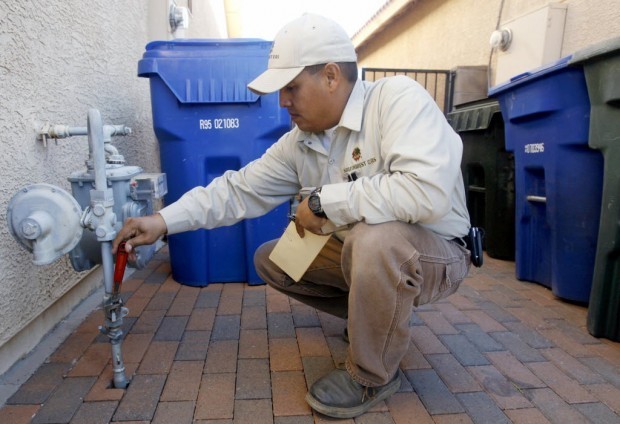
Not everyone is as "satisfied" as Tucson Mayor Bob Walkup is with Southwest Gas' response to the outages that began Thursday.
I asked Walkup about his level of satisfaction with the utility during a press conference Friday, and was surprised at the unqualified contentment he expressed. Many readers contacted me after Saturday's story with the common critique that Walkup is probably happy because he still has gas service (indeed, his neighborhood did), and they raised several common questions.
1. Why did it take so long for SW Gas to come up with a system for communicating response times and other news to customers?
For more than two days after the outage began on Thursday morning, Southwest had communications problems. Customers couldn't reach the company Thursday.
People are also reading…
On Friday morning, at the same press conference where Walkup announced his satisfaction, Director of Administration Bennett Burke said it would be too complicated to update the public on where the technicians were working.
The upshot for people without gas was that they had to wait in their relatively cold homes to be assured of meeting the technicians on their first pass through the neighborhood.
As reader Hollis Moore wrote me: "Their explanations on scheduling and notice are lame at best and arrogant at worst. Maybe my checking account supply pressure will be low next month and I’ll pay someone else first and tell SW Gas to go check the mailbox every day since I can’t possibly be bothered with telling them when I will send them a check."
It was Saturday evening before Southwest began posting updates on their web page.
Also, customers who called Southwest Saturday reported to me that a message told them the office was closed.
2. Is Southwest Gas' infrastructure adequate?
Southwest and El Paso Natural Gas have both said the reason for the gas shortage was a supply problem upstream of Tucson in El Paso's natural gas pipeline. They attributed it to a triple whammy of problems related to the cold: Rolling blackouts in Texas, frozen natural gas wells in Texas, and very high demand along the line due to the cold.
Still, some people can't help but think back to December 2005, when residents in recently built areas on Tucson's Southwest Side lost pressure, forcing the utility into a similar, though smaller, hustle to turn service back on.
3. Why were the areas that lost gas selected for cutting off?
I heard two explanations from Southwest, both of which may be true to an extent. Initially, I was told that areas on the fringes of their local system were cut off in order to keep the pressure up and save service for the rest of the metro area. Then I was told that the utility strategically chose areas that, if cut off, would benefit the rest of the system.
It would be great to know all that was taken into account. For example, was socioeconomic status included? I note that most of the outage areas are well-to-do, meaning they presumably have the means to take care of themselves in an outage without freezing to death. I don't know if this was considered, though. It is notable that all the outages were in the eastern third of the Tucson area.
What are your thoughts on Southwest's performance?
UPDATE:
We've decided today that business reporter Alex Dalenberg will be following this story, including the topics covered in this blog item. If you have ideas or questions, you can contact him at adalenberg@azstarnet.com


