


William F. Scott was born on August 28, 1831, to George and Christina Scott in Lanark, Scotland. He traveled by ship to New York in 1845, and stayed there with his older brother until 1855.
Departing New York he traveled to Chicago, and then to Council Bluffs, Iowa, later crossing the Missouri River into Omaha, Nebraska.
In the fall of 1857, he left with federal troops who were a part of the Utah Expedition, spending the winter in the Rocky Mountains and arriving in Salt Lake City in the spring of 1858. He moved to California and arrived in present-day Arizona in 1859.
After gold was discovered in Pinos Altos, New Mexico, in 1860, he traveled there to mine, but Apache Indians, opposed to the settlement of European-Americans and Mexican-Americans in the area, made mining dangerous.
People are also reading…
To protect themselves against Indian attacks, Scott and other miners “formed a small volunteer ranger company with Thomas J. Mastin ... as their captain.” On July 25, 1861, Col. John R. Baylor’s Texas Confederates defeated Union forces and Mesilla, New Mexico, became part of the Confederacy.
Col. Baylor offered to supply Mastin’s men if they continued to protect the settlements near Pinos Altos from Indian attacks. The men agreed and were mustered into Confederate service on August 8, 1861, as the “Arizona Guards.” Scott stayed until July 1862, when he left along with 1st Lt. Jack Swilling, the founder of Phoenix.
In late 1862, he joined about 40 well-armed prospectors headed by Capt. Joseph R. Walker and traveled down the Gila River to the Hassayampa River, where placer gold was discovered in May 1863. Scott stayed there until the following year, when he came to Tucson.
His name is recorded in the Arizona Territorial Census taken in April 1864, which stated, “Resident in Arizona 5 years, occupation Miner, property valued at $75.”
Around 1864 or 1865 he formed a partnership with James Lee and started operating a water-powered flour mill at Silver Lake (namesake of Silverlake Road) on the Santa Cruz River, about 1½ miles south of Tucson.
They also developed the Naguila silver mine 12 miles west of Tucson, but suffered heavily from Apache attacks both financially and in lives. In 1867, the partners lost at least $1,400 in property, mostly from the theft of mules, burros and horses. The same year, two employees, one an African-American, were sent out to cut wood, and were attacked and killed by Apaches.
Scott became a naturalized U.S. citizen in the U.S. District Court in Tucson on March 4, 1867.
In 1870, he had a total property value of $8,500, a far cry from the $75 he had when he arrived in Tucson. He wed Larcena (Pennington) Page that year, and they went on to have two children, William and Georgie.
The same year, Lee and Scott opened the Eagle Steam Flour Mill on present-day Main Avenue and Broadway, but a few years later he dissolved his partnership with Lee and was appointed mounted inspector of the U.S. Customs Service in Tucson. He served in that role until 1881.
He was justice of the peace in the Tucson District, several times: 1881-82, 1885-1886, 1893-94 and 1906-1912. He died in Tucson on Dec. 31, 1914.
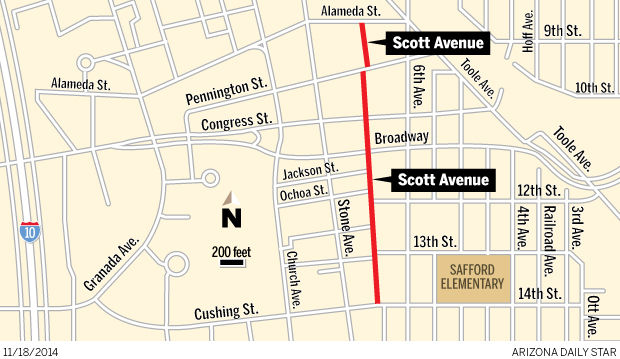
Note: In 1909, the current Scott Avenue was divided into three parts: Scott Street from 14th Street to Congress Street; Belknap Street from Congress Street to Pennington Street; and Driscoll Street (likely named after City Councilman Thomas Driscoll) from Pennington Street to Alameda Street. Belknap Street was made part of Scott Street prior to 1947, and both Scott and Driscoll streets were renamed Scott Avenue in 1960.
Sources:
ASU Library website: asu.edu/lib/archives/azbio/bios/SCOTTW.PDF
1870 U.S. Census (Arizona Territory, Pima County, Tucson)
Robert H. Forbes, “The Penningtons: Pioneers of Early Arizona,” Arizona Archaeological and Historical Society, 1919
Virginia Culin Roberts, “With Their Own Blood: A Saga of Southwestern Pioneers,” Texas Christian University Press, 1992
1909 Tucson Sanborn Fire Insurance Map (AHS Collection)
Tucson City Ordinance # 2108 (Passed, Adopted and Approved Nov. 21, 1960)
“Preserve the Old Landmarks,” Arizona Daily Star, Dec. 29, 1910
“Old Tucson Fast Disappearing Will Be Perpetuated in the Names of City Streets,” Tucson Daily Citizen, June 21, 1919


