Skip to main contentSkip to main content
Register for more free articles.
Log in Sign up
Back to homepage
Subscriber Login
Keep reading with a digital access subscription.
Subscribe now
You have permission to edit this collection.
Edit
Arizona Daily Star
97°
  • Sign in
  • Subscribe Now
  • Manage account
  • Logout
    • Manage account
    • e-Newspaper
    • Logout
  • News
    • Sign up for newsletters
    • Local
    • Arizona
    • Business
    • Crime
    • Nation & World
    • Markets & Stocks
    • SaddleBrooke
    • Politics
    • Archives
    • News Tip
  • Arizona Daily Star
    • E-edition
    • E-edition-Tutorial
    • Archives
    • Special Sections
    • Merchandise
    • Circulars
    • Readers' Choice Awards
    • Buyer's Edge
  • Obituaries
    • Share Your Story
    • Recent Obituaries
    • Find an Obituary
  • Opinion
    • Submit a Letter
    • Submit guest opinion
    • Letters to the Editor
    • Opinion & Editorials
    • National Columnists
  • Sports
    • Arizona Wildcats
    • Greg Hansen
    • High Schools
    • Roadrunners
  • Lifestyles
    • Events Calendar
    • Arts & Theatre
    • Food & Cooking
    • Movies & TV
    • Movie Listings
    • Music
    • Comics
    • Games
    • Columns
    • Play
    • Home & Gardening
    • Health
    • Get Healthy
    • Parenting
    • Fashion
    • People
    • Pets
    • Travel
    • Faith
    • Retro Tucson
    • History
    • Travel
    • Outdoors & Rec
    • Community Pages
  • Brand Ave. Studios
  • Join the community
    • News tip
    • Share video
  • Buy & Sell
    • Place an Ad
    • Shop Local
    • Jobs
    • Homes
    • Marketplace
    • I Love A Deal
  • Shopping
  • Customer Service
    • Manage My Account
    • Newsletter Sign-Up
    • Subscribe
    • Contact us
  • Mobile Apps
  • Weather: Live Radar
  • Facebook
  • Twitter
  • Bluesky
  • YouTube
  • Pinterest
  • Instagram
© 2026 Lee Enterprises
Terms of Service | Privacy Policy
Arizona Daily Star
News+
Read Today's E-edition
Arizona Daily Star
News+
  • Log In
  • $1 for 3 months
    Subscribe Now
    • Manage account
    • e-Newspaper
    • Logout
  • E-edition
  • News
  • Obituaries
  • Opinion
  • Wildcats
  • Lifestyles
  • Newsletters
  • Comics & Puzzles
  • Buyer's Edge
  • Jobs
  • 97° Sunny
Share This
  • Facebook
  • Twitter
  • Bluesky
  • WhatsApp
  • SMS
  • Email

Collins pardoned: A look at the Chris Collins insider trading scandal

  • Dec 22, 2020
  • Dec 22, 2020 Updated Feb 26, 2026
Prefer us on Google

President Trump on Tuesday pardoned former Rep. Chris Collins, who was imprisoned in October after pleading guilty to felony insider trading charges.

"Today, President Trump granted a full pardon to Chris Collins, at the request of many Members of Congress," the White House said in a statement that did not offer any further explanation of Trump's action.

Collins pleaded guilty in October 2019 to charges related to a stock tip he provided to his son. A federal judge sentenced Collins in January to 26 months in prison. He has been serving his sentence in a federal prison camp in Pensacola, Fla.

In this collection, you'll find our stories covering Collins' insider trading scandal and the people and events that it affected, from the lives of his son, Cameron, and Cameron's father-in-law, Stephen Zarsky, to Collins' 2018 race against Nate McMurray for New York's 27th Congressional District.

Critics outraged, Republicans silent as Trump pardons ex-Rep. Chris Collins

WASHINGTON – President Trump on Tuesday pardoned former Rep. Chris Collins, who was imprisoned in October after pleading guilty to felony insider trading charges.

The early evening pardon prompted outrage from Collins' critics and dead silence from Trump's fellow Republicans.

"Today, President Trump granted a full pardon to Chris Collins, at the request of many Members of Congress," the White House said in a statement that did not offer any further explanation of Trump's action.

The Federal Bureau of Prisons on Wednesday listed Collins, 70, as having been released Tuesday.

Collins in 2016 was the first sitting member of Congress to endorse Trump for president. Prior to his indictment and conviction, the Clarence Republican frequently appeared on national news outlets to express support for the president.

Behind the Collins scandal: How one phone call devastated two families

Behind the Collins scandal: How one phone call devastated two families

Bitter — and, in some cases, newly revealed — facts emerge from hundreds of pages of letters from those caught up in the Collins scandal and their friends that were filed in federal court in Manhattan last

The Collins pardon was one of 15 the president issued. Two other congressmen-turned-felons, Duncan Hunter of California and Steve Stockman of Texas, were also pardoned. Hunter and Stockman, like Collins, are Republicans, and Hunter was the second member of Congress to endorse Trump in 2016.

Every president has broad power under the Constitution to grant pardons. Pardons do not absolve federal felons of their crimes; they just remove every form of federal punishment for the offense.

Pardoned federal prisoners are usually released almost immediately after the president acts. That means Collins, a millionaire businessman who started serving his sentence in October at a federal prison camp in Pensacola, Fla., could be home at his waterfront residence in Marco Island, Fla., for Christmas.
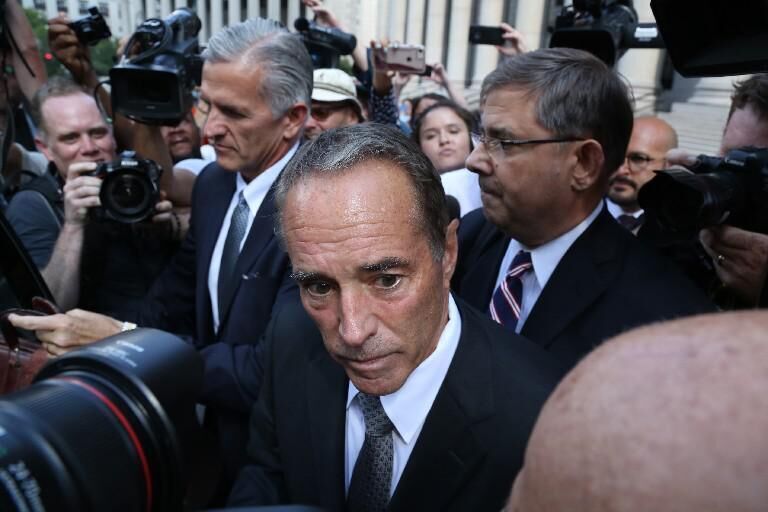
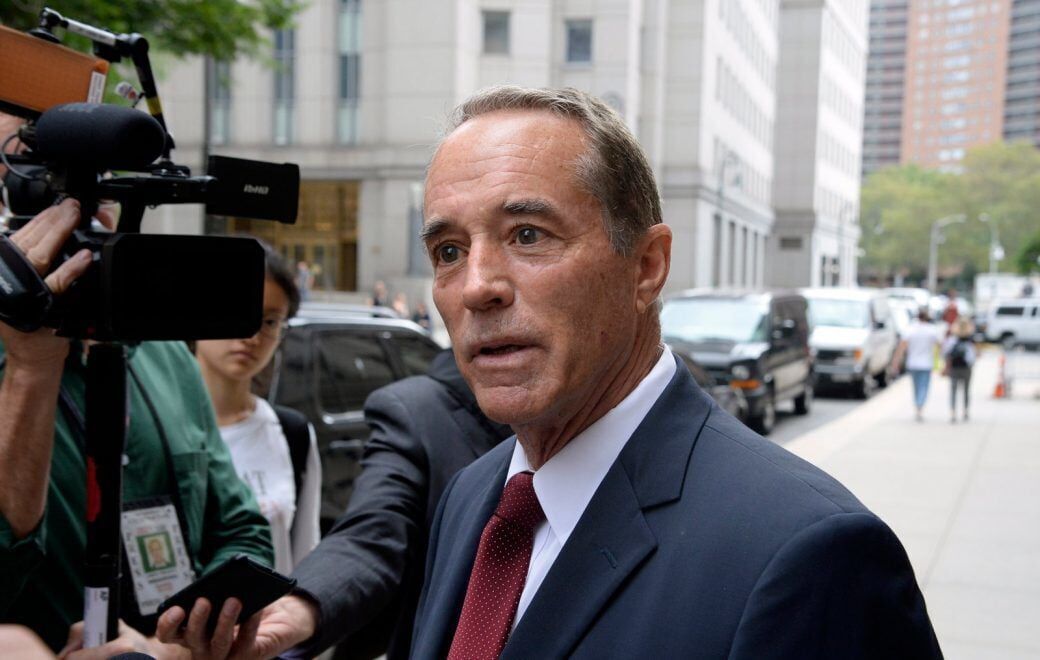
Former Rep. Chris Collins reports to federal prison

Former Rep. Chris Collins reports to federal prison

His lawyers fought for and won three delays in his imprisonment due to the Covid-19 pandemic, but their plea for another delay went nowhere after prosecutors objected to it.

Collins pleaded guilty in October 2019 to charges related to a stock tip he provided to his son. A federal judge sentenced Collins in January to 26 months in prison.

Neither Rep. Chris Jacobs, the Orchard Park Republican elected to Collins' former seat in June, nor Rep. Tom Reed, a Corning Republican, returned calls late Tuesday seeking comment about the Collins pardon.

But Democrats, congressional ethics experts and experts in insider trading reacted with fury to the news.

"It's Banana Republic stuff," said Nate McMurray, the former Grand Island supervisor who narrowly lost to Collins three months after the Republican lawmaker's August 2018 indictment. "This is the kind of stuff we see in developing nations, not the United States. And what's scary is that some people will cheer."

Craig Holman, ethics lobbyist at Public Citizen, filed one of the first ethics complaints about Collins' stock-trading habits in 2017. He indicated that Trump's pardons made a mockery of his 2016 campaign promise to "drain the swamp."

"This shows that things like congressional insider trading – or, with Duncan Hunter, using campaign funds to pay for your girlfriends – is all perfectly fine to Donald Trump," Holman said. "This shows that what Trump is about is the swamp."

And Anthony Ogorek, a Williamsville financial planner, was in June 2017 among the first to raise suspicions about the pattern of apparent insider trading involving an Australian biotech where Collins sat on the board. 

Reacting to Trump's pardon, Ogorek said via text message: "Who said no man is above the law?"

Trump's pardon of Collins came only 11 months after Collins stood weeping in a New York courtroom as he pleaded for leniency from a federal judge.

"I violated my core values," Collins said then, his voice cracking. "I am standing here, probably the last time I will do anything in public. I left Buffalo. I cannot face my constituents. People feel sorry for me. They shouldn't. I did what I did."

How one phone call by Chris Collins made three felons

How one phone call by Chris Collins made three felons

Chris Collins, who once bragged about how many millionaires he made in Buffalo, ended up making three felons on a summer night in

What Collins did took place at a White House picnic in June 2017. There, he received an email from the chairman of Innate Immunotherapeutics, that Australian biotech, bearing devastating news. The biotech company's only product, an experimental muscular sclerosis drug, failed in clinical trials.

Collins – then the company's largest shareholder – immediately started dialing his son Cameron. Collins acknowledged in court that he called his son to advise him to dump his Innate shares, which Cameron Collins started doing the next day.

Cameron Collins then told his then-fiancee, Lauren Zarsky, and her parents, Stephen and Dorothy Zarsky, about the news. They started selling their shares, too.

Days later, The Buffalo News reported that an unusual number of shares of Innate stock had been traded late that previous week, leading to suspicions of insider trading among investment experts both in Buffalo and Australia.

Chris Collins was indicted 13 months later. He pleaded guilty and resigned from Congress in October 2019. Cameron Collins and Stephen Zarsky also pleaded guilty, but were sentenced to short terms of home confinement and probation. Lauren and Dorothy Zarsky settled civil charges filed by the Securities and Exchange Commission.

Given that history, Cecily Molak of Mendon, in Monroe County – the first citizen to file an ethics complaint against Collins in 2017 – said she was "extremely disappointed" with the pardon.

"Insider trading convictions at least can give a message to other people who are doing the same thing, or thinking about doing the same thing," said Molak, a retired attorney. "And the message that this pardon gives is: Don't worry about it – if in fact you get caught, hold out as long as you can because I will take care of you, at least in this administration. And I think that really is just a travesty."

Collins could be released from federal prison immediately, as soon as the Bureau of Prisons processes his paperwork, according to two Buffalo attorneys.

“There’s really no reason they have to hold him,” Paul Cambria said late Tuesday.

“I have little doubt he will be home for Christmas,” said Barry Covert.

News Staff Reporter Barbara O'Brien contributed to this report.

As Trump contemplates pardons, Collins' name continues to be missing

WASHINGTON – As the Trump administration winds down despite the president's cries to the contrary, there are increasing signs that he will deliver parting gifts to some of his closest allies and maybe even his family members: presidential pardons.

But one big name remains missing from all the discussion over whom Trump might exonerate: that of the first member of Congress to endorse the outsider Republican candidate back in 2016, then-Rep. Chris Collins.

Despite rampant speculation about a Collins pardon in Buffalo, his name hasn't even surfaced among Washington's chattering classes about who Trump might pardon and when. And there are good reasons why not.

For one thing, while Collins serves his sentence in a federal prison camp in Pensacola after pleading guilty to insider trading charges, control of the U.S. Senate hinges on two Jan. 5 runoff elections in Georgia – where insider trading allegations swirl around both Republican incumbents. So if Trump were to pardon Collins now, he would be handing Democrats ammunition they could use in ads that would liken GOP Sens. David Perdue and Kelly Loeffler to the disgraced inside trader from Western New York.

Then there's the question: What's in it for Trump? Several experts on presidential pardons noted that Trump's pardons so far have largely gone to far-right celebrities – like former Arizona Sheriff Joe Arpaio – and to those caught in the vortex of various Trump administration scandals, such as former National Security Adviser Michael Flynn and political consultant Roger Stone.

Collins doesn't qualify in either category, but even so, those experts don't dismiss the idea of Trump pardoning the former Buffalo-area lawmaker.

"I think that's a jump ball question," said Mark Osler, a professor of law at the University of St. Thomas in Minnesota who studies the presidential pardon power. "You know, it's easy to imagine Trump giving him a pardon and saying he was very badly treated. But it's also questionable whether Collins was actually close enough to Trump to have that kind of sway."

A parade of pardons?

Presidents George H.W. Bush and Bill Clinton left office in a forgiving mood. Bush pardoned major figures in the Iran-Contra scandal, while Clinton exonerated everybody from top donor Marc Rich to the president's own brother. And now it appears that Trump is about to do the same sort of thing, only more so.

The New York Times reported that Trump is considering pardoning his three eldest children, son-in-law Jared Kushner and Trump's personal lawyer, Rudy Giuliani. Politico reported that Trump is contemplating pardoning upwards of 20 aides and associates. And the Washington Post, compiling a list of those who Trump may pardon, named, among others, former campaign managers Paul Manafort and Steve Bannon as well as WikiLeaks founder Julian Assange and famed government leaker Edward Snowden.

Experts in the president's pardon power reacted with shock that Trump would consider leniency for such people. Osler noted that the Founding Fathers designed the pardon power not to allow presidents to help their cronies and benefactors, but as a way to right the justice system's wrongs.

"There's a lot of talk about the handful of pardons he may give to friends and family, but more than 13,000 petitions (for pardons) have been waiting for years by people who followed the rules, filed support letters, filled out all the forms," Osler said. "They've just been ignored."

It's not unprecedented for a president to pardon someone who hasn't even been indicted. That's what happened when then-President Gerald Ford pardoned his predecessor, Richard Nixon, in 1974. But legal experts such as James Gardner, a constitutional law professor at the University at Buffalo, said it would be unusual for Trump to issue a wave of such preemptive pardons to those close to him.

"It's a gross perversion of the pardon power," he said.

Trouble in Georgia

One conspicuous name has been missing from both the reportage and the speculation in Washington about who Trump might pardon: Collins.

And one possible reason for that can be gleaned from ads that are now running in the state of Georgia, which, in those Jan. 5 runoff elections, will decide which political party controls the U.S. Senate.

"Now we learned the FBI has been looking into David Perdue and a federal grand jury has been investigating him for insider trading," says one ad, from the Democratic political action committee called the Georgia Way.

"Kelly Loeffler investigated for trading on insider information," proclaims an ad from another Democratic PAC, Georgia Honor.

In other words, those two key Senate races – which will determine whether Democrat Charles E. Schumer of New York is minority leader or majority leader – feature Republicans accused of doing exactly what Collins pleaded guilty to doing.

Neither Perdue nor Loeffler have been charged with crimes, and both Republican senators said investigators probed their actions but came up empty.

For that reason and others, Andra Gillespie, a political scientist at Emory University, said the stock scandals haven't alienated the GOP voters from Perdue and Loeffler. 

"Republican voters have made their peace with that, and they're still going to support the candidate of their party," she said.

That's exactly what happened in New York's 27th district in 2018, when Collins narrowly won re-election while under indictment.

Even so, Democratic PACs have already committed more than $10 million to ads ripping into Perdue and Loeffler's stock trading habits. And by the sound of things, Democrats would probably love a pardoned Chris Collins' name to re-emerge in the news as they continue their effort to tar the GOP senators.

"The dam is just beginning to break and we plan to fully expose their unethical and potentially illegal behavior in the weeks ahead," said J.B. Poersch, president of the Democratic Senate Majority PAC.

A Collins pardon?

Collins' lawyers, Jonathan Barr and Jonathan New, did not respond to emailed inquiries about whether they are seeking a presidential pardon or sentence commutation for their client. And a source close to Collins said he has not heard one word about that possibility.

So far, though, all the talk in Washington is about Trump looking to pardon far bigger fish than Collins. What's more, the president is getting pushed in that direction by one of his most ardent media allies.

“If Biden ever became president, I’d tell Trump pardon yourself and pardon your family,” Fox News host Sean Hannity told his viewers late last month.

While a presidential pardon would not shield Trump from prosecution in New York's ongoing investigation of his finances, a self-pardon – which many scholars believe is legal – would shield Trump from any federal prosecution connected with either his business or political activities as president.

It's unclear, though, why Trump might think a pardon would be needed to shield either Donald Trump Jr., Eric Trump, Ivanka Trump or Kushner. Giuliani, however, has been the target of federal investigators looking into his activities in Ukraine, which led to Trump's impeachment last year.

So could Trump slip in a little Chris Collins clemency among what would be a number of far more headline-grabbing pardons? Jeffrey Crouch, an assistant professor of American University, said he didn't know enough about the Collins case to speculate. But Crouch knows enough to say one thing.

"This may be the time in Trump’s presidency that he is the least accountable for controversial clemency decisions: as he has already lost his reelection bid, has already been impeached and has just weeks remaining in office," said Crouch, author of a book called "The Presidential Pardon Power." "He is likely receiving lots of clemency requests, and it’s anyone’s guess who will ultimately receive a pardon or commutation before noon on January 20."

Former Rep. Chris Collins reports to federal prison

WASHINGTON – Rep. Chris Collins reported to a federal prison camp in Pensacola, Fla., Tuesday, and Cecily Molak of Menden planned to drink to that.

So culminated a saga that began with ethics complaints like the one Molak filed against Collins and that continued with Collins pleading guilty to insider trading charges and getting sentenced to prison.

Collins' lawyers, who had been fighting for the judge in the case to delay Collins' imprisonment or change the sentence to home confinement because of the Covid-19 pandemic, never heard back from U.S. District Court Judge Vernon S. Broderick.

That being the case, Collins lawyers Jonathan Barr and Jonathan New issued a statement at about 3 p.m. Tuesday, saying: "In the absence of a decision on his motion for an extension of the reporting date, Mr. Collins has reported as initially directed to FPC Pensacola. Although he is greatly concerned about the serious risks to his health from Covid 19 by reporting, he looks forward to putting this chapter behind him."

Molak, for one, wasn't quite ready to put the Collins scandal behind her.

"We're all celebrating here," said Molak, a retired lawyer in Monroe County who is a lifelong Republican. "I plan to open a little split of champagne at dinnertime and have a drink on Zoom with a few of my friends."

Molak filed a complaint about Collins with the Office of Congressional Ethics back in early 2017, back when his relationship with an obscure Australian biotech named Innate Immunotherapeutics first burst into the headlines. She thought at the time that it was unseemly that Collins was spreading stock tips about Innate among members of Congress and Buffalo's business elite.

That was months before the stock tip that landed Collins in federal prison.

In June of 2017, Collins, an Innate board member at the time, was at a picnic on the White House lawn. He checked his email and found distressing news from Innate's CEO: clinical trials of the company's only drug, which he hoped could cure a form of multiple sclerosis, had failed. That meant Innate's stock, which Collins and his family had invested heavily in, would soon be worthless.

Collins immediately called his son Cameron, who heard the news and started dumping his Innate shares the next day. Cameron Collins also spread the news to his fiancee's family, and the man who is now Cameron's father-in-law, Stephen Zarsky, started dumping his Innate shares, too.

The next week, Innate announced the bad news. The Buffalo News soon reported that an unusual volume of Innate shares had been sold the previous week – which, stock market experts said, was a possible sign that insiders were dumping the stock before the bad news broke.

A little more than 13 months later, federal prosecutors in New York arrested Collins, his son and Zarsky. All three pleaded guilty to insider trading charges in January, but Collins was the only one sentenced to prison time.

"I do believe there is a need to both show respect for the law and to inflict just punishment," the judge said at the time.

Collins was sentenced to 26 months in prison, but he told The Buffalo News Monday that with good behavior, he expects to be free again in 17 months.

Molak said it's about time Collins paid his debt to society.

"Thank goodness he's finally going to prison," she said. "He broke the law. He admitted he broke the law. He has a very light sentence: 26 months for the harm that he caused, and it is probably only because he was a legislator and had some influence."

For those who knew and worked closely with Collins, though, Tuesday was "a very sad day," said Chris Grant, a Republican political consultant who started working with Collins during his successful 2007 bid for Erie County executive.

"On a personal level, Chris is a friend. Chris was a mentor," Grant said. "You know, you get to know people's families and to get to know them on a very personal level. So it's a very sad day in a couple of ways."

Grant said it's a sad day for Collins' family, especially his wife, Mary. But it's also sad, Grant noted, that Innate's experimental drug failed, given how much Collins believed in it. And it's sad, too, that Collins' political career would end this way.

"You don't get elected to Congress four times without people thinking you did a good job," Grant said.

To those who thought Collins didn't do a good job, though, his imprisonment was a sign of something else: that justice was finally being served. Michelle Schoeneman, who co-founded a group called "Citizens Against Collins" several years ago, said he poorly served his constituents by avoiding them and by winning another term in 2018 while lying and saying he was innocent of the charges against him.

"He really showed over and over again that his district was the very last of his concerns," she said.

Chris Collins heads to a prison where doing time is 'a pretty laid-back experience'

WASHINGTON – Former Rep. Chris Collins is scheduled to begin serving his sentence Tuesday afternoon at Federal Prison Camp Pensacola, a Florida facility that, judging from those who know it, lives up to its name.

It is a bit like a prison and a bit like a camp.

'Inexplicable': Pensive Collins prepares for prison while blasting prosecutors, judge

'Inexplicable': Pensive Collins prepares for prison while blasting prosecutors, judge

On his last afternoon of freedom before reporting to prison for at least the next 17 months of his life, Chris Collins seemed to experience just about every emotion possible.

Prisoners at the minimum-security facility generally do not stay locked up in dank, tiny prison cells. Most sleep in bunk beds in dormitories.

And while prisoners cannot leave the facility and cannot use cellphones, they can use a well-stocked library, a gym and a running track. They can play racquetball, volleyball and horseshoes. They can even gather in the prison theater for movie night.

"If I had to do time, that's one of the places I'd want to be designated to," said Alan Ellis, a prominent defense attorney who annually publishes a "Federal Prison Guidebook" that includes the above details about the Pensacola facility. "These federal prison camps are much better to be at than other federal prisons."

Collins requested that he be assigned to Pensacola in January, when a federal judge sentenced him to 26 months in prison after the four-term Republican congressman from Clarence resigned and pleaded guilty to felony insider trading charges.

But as of late Monday, it was not yet certain exactly when Collins would report to Pensacola. His imprisonment has been delayed three times because of the Covid-19 pandemic, and his lawyers want it delayed once more to Dec. 8, or else converted to a sentence of home confinement. Prosecutors, who did not object to those earlier delays, now say it is time for Collins to serve his sentence.

U.S. District Court Judge Vernon S. Broderick will decide whether Collins will go to prison now or later – that is, if the judge decides at all. If Broderick simply lets time pass without ruling, his order from August, which said Collins must report to prison at 2 p.m. Oct. 13, remains in effect.

"The law of the case right now says he goes to prison tomorrow," Dennis C. Vacco, a former U.S. attorney and state attorney general and a Republican, said on Monday.

In the increasingly likely event that that happens, Collins will commence what is likely to be the worst two weeks of his time in prison: a brief visit to Pensacola, followed by two weeks of Covid-19 quarantine.

The Pensacola facility isn't equipped for solitary confinement, so after his Covid-19 test, Collins will be temporarily locked up at a less camp-like prison 144 miles to the east.

"When new prisoners arrive at FPC Pensacola – assuming they test negative – they are then subject to movement (presumably on buses) to another facility, FCI Marianna, a medium security prison, and then shuttled back two weeks later after they are forced to serve in solitary confinement," Collins' attorneys – Jonathan B. New, Jonathan R. Barr and Kendall E. Wangsgard – said in court papers last week. "Such additional, unnecessary movements only risk further exposure and spread."

When Collins returns to Pensacola, though, he will be back at a facility that is among the more comfortable federal facilities, Ellis said. 

FPC Pensacola is adjacent to Eglin Air Force Base, so many inmates work there, doing landscaping or other chores. And because it is a stand-alone facility, not adjacent to a medium- or maximum-security prison, the guards in Pensacola stay there and do not rotate to and from tougher facilities – an experience that, Ellis said, can affect their attitudes.

"So it's a pretty laid-back experience," Ellis said of life at FPC Pensacola.

Prison Professors, a consulting firm that helps prisoners and their families and that prepares ex-convicts to re-enter society, has even warmer words for the Pensacola lock-up.

"The federal prison camp in Pensacola has a great reputation," Prison Professors said on its website.

Sam Mangel, a Prison Professors consultant who joined the firm in July, spent 23 months in a federal prison camp in Miami after a wire fraud conviction. In the similar facility in Pensacola, he said, Collins will have a choice of how to spend his time.

"When one is incarcerated, people do different things," he said. "They can sit around and feel sorry for themselves and for the system and walk around with their head down and feel dejected. Others can really take advantage of the downtime and better themselves and move forward."

Mangel took courses in prison and even taught one. Tim Donaghy, a former National Basketball Association referee who pleaded guilty to two gambling-related charges, said he used his 11 months at Pensacola more than a decade ago to write a book and to work himself into the best shape of his life at the facility's outdoor gym.

"It has every dumbbell and barbell that you could imagine," Donaghy said.

The Pensacola facility is clean and safe, he added. Many of the inmates are either white-collar criminals or drug offenders serving the tail end of long sentences after getting moved to Pensacola for good behavior.

Once there, those prisoners had such a comfortable environment that Donaghy wonders why such a prison even exists, given that its inmates pose no violent threat to society.

Chris Collins' latest delay request reveals bid to stay out of jail altogether

Chris Collins' latest delay request reveals bid to stay out of jail altogether

Instead of another delay, the Collins legal team also suggested an alternative – "time-served plus a period of supervised release with the special condition of home confinement."

"I don't get why you use tax dollars to do that, to pay all those guards, pay all those doctors and nurses and all those people that are there, when you really can just put these people on house arrest," he said.

That is just what Collins pushed for: home confinement at his waterfront home in Marco Island, Fla. But neither the prosecutors nor the judge bought that idea – meaning it is now up to Collins to make the most of prison life, both Donaghy and Mangel said.

Donaghy said Collins might have the opportunity to learn a foreign language in one of the prison's classes – and Mangel suggested Collins might want to teach a class himself. 

"Given his knowledge of government, maybe he can teach a class on government affairs," he suggested.

Lawyers stress Covid-19 risk to keep Collins out of jail

WASHINGTON – Former Rep. Chris Collins appears so desperate to remain out of prison that his lawyers are striking a different tone than President Trump and embracing the words of Sen. Elizabeth Warren.

Hours after Trump on Thursday posted a video in which he appeared to downplay the risk of Covid-19 to America's seniors, Collins' lawyers filed a brief in federal court in Manhattan that said his age – he's 70 – and pre-existing health conditions make him especially susceptible to contracting the virus.

"No matter what the level of precautions, there is a significant and unjustifiable risk that Mr. Collins will contract Covid-19 in prison," the Collins lawyers wrote. "If he does, his age alone makes him at least five times more likely to be hospitalized and 90 times more likely to die than someone in their 20s."

That's a more dire tone than the one Trump struck in the video, where he said: "We're taking care of our seniors. You're not vulnerable but they like to say the vulnerable but you're the least vulnerable but for this one thing, you are vulnerable. So am I."

Then, without identifying the medicine that he said helped him recover from Covid-19, Trump told America's seniors: "You're going to get the same medicine. You're going to get it free, no charge."

The difference in tone between Trump and Collins' lawyers is striking because Collins was the first House member to endorse Trump in 2016.

Collins remained one of Trump's most televised defenders, until the lawmaker's August 2018 arrest on insider trading charges.

Collins, who resigned and pleaded guilty a year ago, was sentenced in January to 26 months in prison, but the pandemic delayed his incarceration date three times. He's now set to go to a prison in Pensacola  on Tuesday, but his lawyers are trying to get the judge to delay his imprisonment to Dec. 8 or to revise his sentence to home confinement.

The latest documents filed by Collins' lawyers came a day after the prosecutor overseeing the case filed a letter telling the judge: "It is time for Collins to begin his prison sentence."

Prosecutors said there had been no Covid-19 cases at the Pensacola prison, but in their filing, Collins' lawyers said four prison staffers and three prisoners have recently tested positive. 

Moreover, the Collins lawyers said conditions are dangerous throughout the federal prison system. To prove their point, they filed a letter that Warren, of Massachusetts, and Sen. Richard Durbin, a fellow Democrat from Illinois, recently sent to Attorney General William Barr and the head of the federal Bureau of Prisons.

"You must do more to protect Bureau of Prisons staff and vulnerable inmates from infection due to the coronavirus," they wrote. "Too many have died, and too many are suffering needlessly."

There's irony in Collins' legal team citing a letter co-signed by Warren, an ideological opposite of Collins who, about two weeks after his arrest, proposed a bill barring lawmakers from owning individual stocks.

"Enough of the spectacle of ... herds of congressmen caught up in insider trading schemes," Warren said at the time.

Prosecutor: 'It is time for Collins to begin his prison sentence'

WASHINGTON – Former Rep. Chris Collins wants his 26-month prison sentence converted to home confinement, but the top government prosecutor in the case is saying, in essence, lock him up – and right away.

"The public has an interest in seeing justice done in this case without further delay," wrote Audrey Strauss, the acting U.S. attorney for the Southern District of New York, in a court filing Wednesday. "It is time for Collins to begin his prison sentence."

Strauss' letter to the judge signals a break with the Collins legal team over when the former Republican congressman should go to prison after pleading guilty to federal insider trading charges.

Collins was originally scheduled to be incarcerated on April 21, but prosecutors and Collins' lawyers agreed that his imprisonment should be delayed till June because of the Covid-19 pandemic.

The two sides then agreed to two additional delays in his imprisonment, which is set to begin Tuesday.

Separate from the court proceedings, Collins' legal team has been pressuring the U.S. Bureau of Prisons to change his sentence to home confinement in light of the pandemic. The Collins lawyers detailed that effort in court papers last week, asking the judge in the case to either convert his sentence to home confinement or to once again delay his incarceration date.

Strauss said both are bad ideas.

"While the world has changed significantly since January (when Collins was sentenced), the need to deter this conduct and to see justice done has not," she wrote.

Strauss noted that another federal judge recently rejected the bid that former Assembly Speaker Sheldon Silver made to have his prison sentence converted to home confinement. Strauss said she agreed with the point the judge made in that case.

"Given that the pandemic has imposed significant limitations on the ability of much of the population to travel and socialize, a sentence of home confinement at the present time would have even less deterrent effect than it might otherwise have," Strauss wrote.

The prosecutor said she was just as adamantly opposed to again delaying Collins' prison term. She noted that the facility where Collins is set to serve his sentence – a federal prison camp in Pensacola, Fla. – has not reported any Covid-19 cases. Things are much worse in the Florida county where Collins' waterfront home is located.

"Nearly 13,000 cases of COVID-19 have been confirmed in Collier County, which translates to an infection rate of about 3.4% of the overall population," Strauss wrote.

Collins' lawyers had argued that his age – 70 – and underlying health conditions put him in the high-risk category for Covid-19.

U.S. District Court Judge Vernon S. Broderick gave the Collins legal team until Friday to respond to Strauss's letter. Broderick will decide Collins' fate after that.

Collins resigned from Congress and pleaded guilty last Oct. 1 to charges that he passed an insider stock tip to his son Cameron, who used it to shield himself from hundreds of thousands of dollars in losses.

Cameron Collins and his prospective father-in-law, Stephen Zarsky, were sentenced to probation in the case.

Chris Collins' latest delay request reveals bid to stay out of jail altogether

WASHINGTON – Former Rep. Chris Collins is once again asking for a delay in his prison sentence – but new court papers filed late Thursday show that he's been working for months to avoid prison entirely.

In a motion filed in federal court in Manhattan, Collins' legal team asked that his prison sentence on insider trading charges be pushed back a fourth time – from Oct. 13 to Dec. 8.

Once again, Collins' attorneys cited the Covid-19 pandemic, which has repeatedly delayed Collins' confinement in a minimum-security prison camp in Pensacola, Fla.

Collins was originally set to report to prison in mid-April.

Start of Chris Collins' prison sentence pushed to October

Start of Chris Collins' prison sentence pushed to October

This was the former congressman's third request to delay the start of his prison sentence.

Instead of another delay, the Collins legal team also suggested an alternative – "time-served plus a period of supervised release with the special condition of home confinement."

In other words, instead of the 26 months Collins would spend in prison under the sentence a judge handed down in January, he would do time in his waterfront property in Marco Island, Fla.

'I cannot face my constituents': Anguished Chris Collins faces 26 months in prison

When Collins, 69, walked out of the courtroom Jan. 17, it signaled the stunning end of a public life that saw him become a wealthy entrepreneur, the Erie County executive and a member of

Other court papers filed late Thursday show that's exactly what Collins has been seeking outside the courtroom for months. He's been asking the federal Bureau of Prisons, rather than the judge in his case, to commit him to home confinement rather than prison.

The Cares Act, the giant Covid-19 relief package Congress passed in March, includes language giving the Bureau of Prisons greater flexibility in adjusting the sentences of older and ill inmates in light of the pandemic. The court papers show that Collins applied to the Bureau of Prisons for a sentence at home on June 16, but that the warden of the Pensacola facility rejected that request, saying he didn't have the authority to change Collins' sentence because he wasn't incarcerated yet.

When Collins appealed that decision, he never got a reply, prompting him to file a third-level appeal on Aug. 21.

Detailing his initial application, Collins wrote: "My request detailed that in light of my age (70 years), health conditions, which include high blood pressure, asthma, and hyperlipidemia, and my vulnerability to experience severe illness or death should I be exposed to and contract the novel coronavirus (COVID· 19), extraordinary and compelling reasons exist for favorable determination of my application."

In that appeal, Collins also cited a memo by Attorney General William Barr calling on the Bureau of Prisons to consider home confinement for nonviolent felons with health issues who are at a low risk of recidivism.

Chris Collins' downfall started with a phone call. It ends today before a judge

Chris Collins' downfall started with a phone call. It ends today before a judge

The final chapter of the story will be written when Collins stands before a judge in Manhattan and learns what his sentence will

The judge will have to consider those issues now, though, in light of Thursday's court filing – and in light of the fact that for the first time, federal prosecutors are objecting to even another delay in Collins' sentence, much less a modification to home confinement.

"The government does not consent to the requested relief," Jonathan New, a Collins attorney, wrote in a court memo. "Rather, the United States Attorney’s Office for the Southern District of New York has advised that it is that Office’s assessment that the (Bureau of Prisons) safety protocols, along with the situation at (Federal Prison Camp) Pensacola in particular, are adequate."

Rep. Chris Collins resigns before pleading guilty to federal charges

With 13 months remaining before the next congressional election, it’s likely that Gov. Andrew M. Cuomo will call a special election to fill Collins’

A year ago this week, Collins – a Republican who represented a district between Buffalo and Rochester – resigned and pleaded guilty to charges that he gave his son Cameron an inside stock tip that allowed him to shield himself from hundreds of thousands of dollars in losses. Cameron Collins and his prospective father-in-law, Stephen Zarsky, were sentenced to probation in the insider trading case.

Judge delays date for Chris Collins to report to prison by 2 months

WASHINGTON – Former Rep. Chris Collins has won a two-month reprieve from imprisonment, as the judge in his insider trading case moved the date that he must report to prison back to June 23.

That's the very day voters in Collins' former congressional district will go to the polls in a special election to replace him.

Without comment, U.S. District Court Judge Vernon S. Broderick late Wednesday approved a request from Collins' lawyers that his imprisonment be delayed because of the coronavirus outbreak. Broderick's order approving that request appeared in the federal online court docket Thursday morning.

The Collins legal team argued that imprisoning Collins now, with the Covid-19 pandemic spreading across the country, would present an unnecessary danger to their 69-year-old client. They noted in their letter to the judge that Collins suffers some underlying health conditions that put him at a higher risk from the coronavirus, although they did not specify what those conditions are.

"The spread of Covid-19 in the United States, the extreme danger to elderly prisoners with high risk factors who enter or remain in incarceration, and the fact that (the U.S. Bureau of Prisons) may have to isolate new prisoners in local and county facilities that may be ill-equipped for such tasks, combined with Mr. Collins’ own high risk factors for susceptibility to severe Covid-19 illness, constitutes good cause for continuing the report date of Mr. Collins to the designated facility from April 21, 2020 to 2:00 p.m. on June 23, 2020," the Collins lawyers wrote.

They also noted that the federal prosecutors in the case did not object to moving back Collins' reporting date once again.

Collins was was sentenced to 26 months in prison on felony insider trading charges in January. He originally was scheduled to report to prison on March 17, but his lawyers asked for and won a delay to April 21 because the Bureau of Prisons had not yet figured out the facility where he would be incarcerated.

The case against Collins stems from a phone call he made to his son, Cameron, from a picnic on the White House lawn in late June 2017. Collins, at the time a board member of Innate Immunotherapeutics, an Australian biotech firm, got an email from the company CEO that night, telling him that clinical trials of Innate's only product – an experimental multiple sclerosis drug – had failed.

Collins then called his son, who started dumping his shares in Innate the next day. Cameron Collins also told his fiance and her family the bad inside news about Innate as well, so they started dumping their Innate shares, too.

Cameron Collins and his future father-in-law, Stephen Zarsky, both were sentenced to home confinement for their roles in the insider trading scheme.

Chris Collins, a four-term Republican who lived in Clarence while serving in Congress, resigned from the House last Oct. 1. On the same day in federal court in Manhattan, he pleaded guilty to conspiracy to commit securities fraud and lying to an FBI agent.

Collins has requested that he be imprisoned at Federal Prison Camp Pensacola, a minimum security facility in Florida, where he now lives. But the letter from Collins' lawyers to the judge does not make clear whether the Bureau of Prisons has officially decided that Collins will go to the Pensacola prison, which is 640 miles northwest of his home in Marco Island, Fla.

The latest delay in Collins' incarceration comes with a twist of irony. Voters in New York's 27th Congressional District between Buffalo and Rochester had been set to go to the polls in a special election to replace him on April 28. But because of the Covid-19 pandemic, Gov. Andrew M. Cuomo recently pushed the special election back to June 23 – the day Collins now is set to be imprisoned.

The special election in the heavily Republican district pits Democrat Nate McMurray, who narrowly lost to the then-indicted Collins in 2018, against State Sen. Chris Jacobs, a Republican.

Change in date for special election could alter race for NY-27

Citing coronavirus outbreak, Collins seeks delay in imprisonment

WASHINGTON – Lawyers for Rep. Chris Collins on Wednesday asked a federal judge to delay his imprisonment until June 23 because of concerns about the coronavirus pandemic.

"Mr. Collins is older than 65 and has additional risk factors, which place him at a high risk of contracting and suffering severe illness from Covid-19 if exposed to the virus," wrote Jonathan B. New, Jonathan R. Barr and Kendall E. Wangsgard, the lawyers for Collins. "It would be particularly dangerous for an elderly person with underlying health conditions like Mr. Collins to report for incarceration right now in the middle of the Covid-19 pandemic that is ravaging the United States."

Collins, who was sentenced to 26 months in prison on felony insider trading charges in January, was originally set to report to prison on March 17. Broderick delayed his imprisonment to April 23, however, because the U.S. Bureau of Prisons had not yet assigned Collins to any one prison.

Now, the Collins lawyers said, the judge should delay Collins' imprisonment again. They cited "the unprecedented circumstances described above concerning the spread of Covid-19 in the United States, the extreme danger to elderly prisoners with high risk factors who enter or remain in incarceration, and the fact that (Bureau of Prisons) may have to isolate new prisoners in local and county facilities that may be ill-equipped for such tasks."

In their letter to the judge, the Collins lawyers said federal prosecutors have no objection to delaying Collins' imprisonment. In addition, the lawyers noted that U.S. Attorney General William Barr has recommended that the Bureau of Prisons explore releasing inmates who are at high risk of catching Covid-19 and allowing them to complete their sentences in home confinement.

The Collins legal team also noted that in another federal criminal case in Manhattan, U.S. District Court Judge Jessie M. Furman wrote this week that "realistically the best – perhaps the only – way to mitigate the damage and reduce the death toll is to decrease the jail and prison population by releasing as many people as possible.”

Collins, 69, pleaded guilty last Oct. 1 to conspiracy to commit securities fraud and lying to FBI agents. He is asking to be imprisoned at Federal Prison Camp Pensacola, a minimum security facility in Florida. Collins now lives in Marco Island, a Gulf Coast community 640 miles southeast of Pensacola.

Escambia County, Fla., which includes Pensacola, has had 94 Covid-19 cases so far, the Florida Department of Health reported Wednesday. Collier County, where Collins now lives, has had 150 cases.

A Republican and the first House member to endorse Donald Trump for president, Collins represented New York's 27th congressional district, between Buffalo and Rochester.

The charges against Collins stemmed from a phone call Collins made to his son, Cameron, from a White House picnic in late June 2017. Collins was a board member at the time of Innate Immunotherapeutics, an Australian biotech company. And as such, he got an email that night saying that the company's only product, a multiple sclerosis drug, had failed in clinical trials.

Collins told his son that inside information. Cameron Collins then dumped much of his Innate stock and started a chain of other inside trades involving his future in-laws.

The former congressman – who resigned on the day of his guilty plea – was the only person charged in the incident who was sentenced to prison. Cameron Collins and his future father-in-law were sentenced to home confinement.

Chris Collins' imprisonment delayed until April 21

WASHINGTON – Former Rep. Chris Collins on Monday won five more weeks of freedom before he has to report to federal prison after pleading guilty to insider trading charges.

Without comment, U.S. District Court Judge Vernon S. Broderick approved a motion that Collins' lawyers filed Friday requesting the delay.

The move means Collins will report to prison on April 21 instead of March 17.

Federal prosecutors did not protest the delay, which stems from the fact that the Federal Bureau of Prisons still has not decided where Collins will spend his time in federal prison.

"Our understanding, through a search of (the Bureau of Prisons) inmate locator is that Mr. Collins has not yet been processed into the (Bureau of Prisons) system," the Collins attorneys said in their letter to the judge. "We further understand based on a call with the United States Marshals Service that it appears that the paperwork required for (Bureau of Prisons) to start the designation process may not have been transmitted to (Bureau of Prisons) prior to" last Friday.

Completing that designation process – that is, deciding the prison where an inmate will do his time – typically takes 30 to 45 days, Collins' lawyers said in the letter.

That being the case, "we anticipate that an additional five weeks will allow sufficient time" for the Bureau of Prisons to process Collins, the letter stated.

Broderick in January sentenced Collins to 26 months in federal prison, but Collins, 69, could be freed in as little as 17 months based on good behavior and a break that older prisoners can get under federal sentencing reform.

At his Jan. 17 sentencing, Collins requested that he serve his sentence at a federal prison camp in Pensacola, a minimum security facility in Florida with about 800 inmates. Collins said he prefers the Florida facility because it is the nearest such prison to his home in Marco Island, Fla., where he moved shortly after pleading guilty.

Collins, a Republican who lived in Clarence while serving in Congress, was elected to four terms serving New York's 27th Congressional District, a largely suburban and rural swath of territory between Buffalo and Rochester.

He was arrested in August 2018. In an 11-count indictment, prosecutors accused Collins of launching an insider trading scheme with a phone call to his son, Cameron, from a picnic on the White House lawn 13 months earlier. Cameron Collins was arrested as well, as was Stephen Zarsky, the father of Cameron Collins' fiancée.

The congressman insisted for more than a year that he was innocent, but then last October resigned from Congress and pleaded guilty to conspiracy to commit securities fraud and lying to an FBI agent. Cameron Collins and Zarsky also pleaded guilty. Broderick spared those two men prison time, instead sentencing them to probation.

A special election to fill Collins' seat will be held April 28. It pits State Sen. Christopher L. Jacobs, a Republican, against Nate McMurray, the former Grand Island supervisor and Democrat who narrowly lost to Collins three months after the congressman's arrest.

How one phone call by Chris Collins made three felons

As Trump rails in defense of Roger Stone, Chris Collins gets no Twitter love

WASHINGTON – President Trump appeared to speak volumes about his relationship with then-Rep. Chris Collins in a speech on Long Island in July 2017.

"Chris – right from the beginning, he said Trump is gonna win," the president said as the first Republican House member to endorse him looked on, one face in a crowd of thousands. "Trump is gonna win. So I like him. I didn't like him that much before; now I love him."

With that last sentence, Trump provided a clue that may explain why the president let the federal insider trading case against Collins – and his sentencing to prison – go by with hardly a tweet.

In contrast, Trump roiled the Justice Department last week when he tweeted that federal prosecutors, including one from Collins' former hometown of Clarence, treated Republican consultant Roger Stone unfairly when they suggested he be sentenced to up to nine years in prison for witness tampering and lying to Congress.

Collins just didn't have the same kind of relationship with Trump that Stone did, said former Trump aide Michael R. Caputo of East Aurora. He likened Collins' relationship to Trump to that of Paul Manafort, the former Trump campaign chairman who similarly got sentenced to prison without Trump so strongly decrying his sentence.

"Chris Collins was an ally," said Caputo, a longtime friend of Stone's whose online petition asking Trump to pardon Stone has gathered more than 126,00 signatures. "Paul Manafort was an ally. Roger Stone is family."

Others say, though, that that fact by no means indicates that Trump will pardon Stone but not Collins. On the contrary, sources said, he still may pardon both.

Trump and Collins

Chris Collins stood where many mainstream Republicans stood in 2015: in the corner of the supposed front-runner for the party's presidential nomination, former Florida Gov. Jeb Bush.

But Bush's campaign never caught fire – while Trump's did. So Collins pounced.

"Donald Trump has clearly demonstrated that he has both the guts and the fortitude to return our nation's jobs stolen by China, take on our enemies like ISIS, Iran, North Korea and Russia, and most importantly, re-establish the opportunity for our children and grandchildren to attain the American dream," Collins said while endorsing Trump on Feb. 24, 2016.

That evening, Collins appeared on Fox News in the first of dozens of television appearances he would make to boost Trump.

But those TV appearances belied a truth that Collins insiders and Trump insiders both knew. The two men weren't really that close.

"I don't think Chris even met Trump until 2014," said one source close to Collins.

And after that, sources allied with the two men said, their relationship was more transactional rather personal. Collins fashioned himself into a top-line Trump defender and won rewards for it: a key speaking slot at the 2016 Republican convention and then, later, a role on Trump's transition team. But the two men did not speak regularly, and usually saw each other only at events where plenty of others were present – such as a congressional picnic on the White House lawn in June 2017.

There, Collins got an email and made a phone call that would doom his career. The email, from the CEO of an Australian biotech firm where Collins sat on the board, said its only product – a multiple sclerosis drug – failed in clinical trials. The phone call went to Collins' son, Cameron, and on it, the father and son made plans for the son to dump his stock in that biotech firm based on that inside information.

The congressman and his son, as well as Cameron Collins' prospective father-in-law, got arrested about 13 months later, on Aug. 8, 2018. Over the next week, Trump tweeted about his approval ratings, "Fake News," an alt-right rally that turned violent in Charlottesville, Va., and a host of other topics – but not Chris Collins.

Trump's only oblique reference to Collins' arrest – and that of Rep. Duncan Hunter, a California Republican and another early Trump supporter – came on Labor Day 2018. But that tweet didn't so much defend Collins and Hunter as it attacked then-Attorney General Jeff Sessions.

"Two long running...investigations of two very popular Republican Congressmen were brought to a well publicized charge, just ahead of the Mid-Terms, by the Jeff Sessions Justice Department," Trump tweeted. "Two easy wins now in doubt because there is not enough time. Good job Jeff......"

Trump later did a robocall urging voters to re-elect Collins, which they did.

Collins resigned and pleaded guilty in October, and on Jan. 13, federal prosecutors in New York suggested that Collins receive prison time in line with federal sentencing guidelines – which is just what prosecutors in Washington would suggest regarding Stone a month later. A judge later sentenced Collins to 26 months in prison.

Trump didn't comment on any of that court action.

Trump and Stone

Trump said plenty last week when prosecutors, citing sentencing guidelines just as they did in the Collins case, called on Stone to be sentenced to from seven to nine years in prison.

"Two months in jail for a Swamp Creature, yet nine years recommended for Roger Stone (who was not even working for the Trump Campaign). Gee, that sounds very fair! Rogue prosecutors maybe? The Swamp!" Trump tweeted Wednesday.

Two months in jail for a Swamp Creature, yet 9 years recommended for Roger Stone (who was not even working for the Trump Campaign). Gee, that sounds very fair! Rogue prosecutors maybe? The Swamp! @foxandfriends @TuckerCarlson

— Donald J. Trump (@realDonaldTrump) February 12, 2020

That was one of three Trump tweets defending Stone last week, and one of seven since Stone's arrest in January 2019. But it was last week's tweets that resulted in turmoil at the Justice Department and beyond.

Word quickly leaked that the Justice Department planned on reducing its sentencing recommendation for Stone. That prompted the four prosecutors who suggested he serve up to nine years – including Clarence native Michael J. Marando – to step away from the case.

Marando declined comment last week, but in delivering his closing argument in the case against Stone last November, the prosecutor thundered "Truth still matters!" and went on to state the truth the jury would end up finding about Stone.

"When Mr. Stone came in, he lied to Congress," he said. "He obstructed their investigation, and he tampered with a witness. And that matters. And you don't look at that and you don't say: 'So what?' "

Clarence High grad's lesson for Roger Stone? 'Truth still matters'

But in 2020, tweets matter, too. U.S. Attorney General William Barr made that clear in an ABC interview broadcast Thursday

Tweets about pending cases and Justice Department employees "make it impossible for me to do my job and to assure the courts and the prosecutors in the department that we're doing our work with integrity," Barr, normally a Trump loyalist, said.

Meantime, Senate Minority Leader Charles E. Schumer called for inspector general and Judiciary Committee probes into Trump's defense of Stone.

"The president ran against the 'swamp' in Washington – a place where the game is rigged by the powerful to benefit them personally," Schumer, a New York Democrat, said on the Senate floor Wednesday. "I ask my fellow Americans: what is more swampy, what is more fetid, what is more stinking, than the most powerful person in our country literally changing the rules to benefit a crony guilty of breaking the law?"

The difference

So why would the president stay silent on Collins while risking the wrath of his own attorney general to help Stone?

The answer lies in history, and the lack thereof.

A database search of "Donald Trump" and "Roger Stone" yields 666 news stories between 1988 and June 15, 2015, the day Trump announced his campaign for president. Among them are several listing Stone as a consultant for Trump as far back as 1990 and as the director of the Trump for President Exploratory Committee in 1999. A Wall Street Journal story noted that the two men became so close that Trump attended Stone's wedding – and that Stone went to two of Trump's weddings and the funerals of his parents.

A database search of "Donald Trump" and "Chris Collins" from the same time frame yields only 50 stories. Almost all of them are political blogs that mention the two men, but not in relation to each other.

Republican insiders cite other reasons, too, why the president came to the defense of Stone but not the former congressman.

For one thing, the Stone case involved his actions in connection with a special counsel probe of Russian interference in the 2016 election. That cut much closer to home for the president.

For another, Stone's defense – including Caputo's public efforts – has been much louder that the one offered by Collins' starched-collar, closed-lipped defense team.

And finally, Collins' sentencing came while Trump was facing an impeachment trial in the Senate, meaning it got little television news exposure. The initial Stone sentencing letter, in contrast, came after the Republican Senate acquitted Trump, meaning the networks and the president had more time to focus on Stone.

Does all this mean Trump is more likely to pardon Stone than Collins? Not necessarily.

As that Collins ally noted, Trump's actions regarding Stone indicate that he's not worried about any political blowback from interfering with Justice Department criminal cases.

That being the case, that source said: "If there ever was going to be a pardon, this week has gone a long way toward helping."

Will President Trump pardon former Rep. Chris Collins?

Documentary tells Australian side of the Chris Collins story

WASHINGTON – The Shakespearean drama of Chris Collins' downfall didn't really end when a federal judge handed him a 26-month prison sentence in January.

In fact, some earlier chapters in that drama never were fully written until now, largely because they took place in Australia and New Zealand. That's about 9,000 miles from the White House lawn where, via cellphone in June 2017, Collins fatefully shared an insider stock tip with his son, Cameron.

Those chapters come clear, though, in "The Inside Trade," a documentary that aired on the Australian Broadcasting Corp.'s "Four Corners" program Monday. Here, for the first time, we meet Australian investors who lost big when Collins' pet Australian biotech firm collapsed. Here, for the first time, we meet people who suffer from secondary progressive multiple sclerosis who actually thought that that biotech firm's only product helped them. And here, we learn more details about all the Australian laws Collins may have been breaking, too.

It's a brisk and bracing 42 minutes, but before I detail what you'll see, some full disclosure is in order. Reporter Stephanie March and producer Jeanavive McGregor contacted me months ago, and March interviewed me at length – and quoted me at length – in the documentary.

The Australian television team came to Washington and to this story well-prepared, which is no surprise. The Australian Broadcasting Corp. is the down-under version of PBS or the BBC: a first-rate, detail-oriented, publicly funded television network. And "Four Corners" is the network's flagship investigative news program – the "60 Minutes" of Australia.

So it's safe to say that hundreds of thousands of Australians learned a lot Monday about an important story that Australia's press had not covered in an in-depth way until now. I have been covering Collins and his relationship with Innate Immunotherapeutics, that ill-fated Aussie biotech firm, for years, and even I learned a lot.

In "The Inside Trade," we hear from some important players in the Collins drama that have been largely silent until now: the investors who bought into Innate stock as Collins and the company promoted the possibility that it might be able to cure a debilitating form of MS.

Those investors lost out when Innate announced in June 2017 that clinical trials of its experimental MS drug had failed.

"When you lose $40,000, it's no fun. That's for sure," said Godfrey Wenness, one of the Australian investors interviewed.

Wenness made clear that he wasn't happy that Collins shared the inside tip about those failed trials with his son, which allowed Cameron Collins and others he tipped to avoid such losses.

"To know that the main guy, a director, a very large shareholder, and – you know, in a public position like that – was conducting very blatant insider trading ... that basically wasn't very pleasant for the rest of us retail investors," he said.

Innate investor Darshak Mehta didn't sound very pleased, either.

"I didn't have the heart to tell my daughter that I had blown up $33,000 on her account," said Mehta, who said that investment in Innate's successor company is now worth only $475 in Australian currency.

Mehta said that he had been fully confident in Innate and its MS drug, given that the company's literature and website made it sound like a "slam dunk."

But Mehta didn't know the complicated tale behind Innate's glossy self-promotion.

"I knew that there was some offshore interest from somebody in American politics," without realizing it was Collins, then a Republican congressman from Clarence, he said.

Collins had been an Innate investor for years, even personally bailing it out when the company was nearly out of cash. Asked why, Collins told congressional investigators that he thought Innate's only product could really help MS patients.

So did some MS patients.

"It was doing so good for me, I couldn't believe it wasn't doing good for other people," said Gillian Pocklington, an MS sufferer from New Zealand who took part in the clinical trials of MIS-416, Innate's experimental drug. "But everyone's MS is different."

Karen Scott, another New Zealander who suffers from MS, said she was shocked to hear the clinical trials failed.

"I was thinking, am I insane?" she said. "This is working for me. Why did it fail?"

Such patients probably thought the drug was working simply because MS symptoms come and go and then come back again, said Tim Coetzee, a top official at the National Multiple Sclerosis Society in the U.S., which invested more than $500,000 in Innate's clinical trials.

Innate even featured some of those clinical trial patients in its promotional materials – but behind the scenes at Innate, troubled lurked. The documentary notes that two of the company's executives had run into problems at other troubled biotech firms.

Moreover, Collins appears to have violated Australian securities law years ago, when he acquired more than 20% of Innate's shares. Investors are only allowed to do that under a strict and clearly defined procedure in Australia, but Collins did it by simply buying up Innate stock.

On top of that, while Australian law requires investors who gobble up 20% or more of a company to report that purchase to Australian authorities within two days, Collins didn't do it for a year and a half.

"That was a clear violation of criminal law by Mr. Collins," said James Wheeldon, an Australian lawyer and Innate investor.

Wheeldon filed a complaint about that with Australian regulators, but they did nothing. Similarly, the Australian Securities and Investments Commission did nothing about the insider trading scheme that Collins hatched from the White House lawn, even though it appears to also violate Australian securities law.

That's hugely important, said Craig Holman, the ethics lobbyist for the Public Citizen good government group.

"I think it quite possible that following the 2020 elections, (President) Trump is going to pardon Chris Collins," Holman, one of the first people to file an ethics complaint about Collins, said in the documentary. "And if that's the case, if there's going to be any justice that's going to be leveled in this case, it's going to have to come from Australian authorities."

Collins is likely to go to prison for a while, though. He's due to report to prison on March 17, probably at a minimum security facility in Pensacola, Fla.

If you're wondering what Collins has to say about all these new revelations regarding his case, you won't find the answer in "The Inside Trade." March, the Australian journalist who reported the documentary, went to the former Clarence congressman's waterfront residence in Marco Island, Fla., to try to interview him – to no avail.

"When I went to the door, I could see Chris Collins through the window, sitting on his back porch, reading the newspaper," March reported. "But when he saw me, he hid. I sent him several text messages asking him to come out and speak with us. He said he's not interested in speaking with me, and he has nothing to say to the investors who lost money."

Collins' guilty plea fails to spur action from Aussie regulators

Some Eagle Scouts go on to greatness. Others go to prison.

Chris Collins made much of his status as an Eagle Scout both before and after a judge sent him to prison for 26 months for masterminding an insider-trading scheme.

But Collins didn't mention that among the many illustrious Americans who achieved scouting's high honor are a number of other Eagles who ended up as, well, jailbirds.

Look no further than the ultimate Washington scandal (so far): Watergate. President Richard Nixon's right-hand men, John Erhlichman and H.R. Haldeman, got caught red-handed in the cover-up. Both went to federal prison. So did Egil Krogh, who approved the break-in at the Watergate offices of the Democratic National Committee in the first place. All three were Eagle Scouts.

So, too, was Marion Barry, the late mayor of Washington, D.C. It should be noted, though, that Barry's most famous words – "expletive deleted set me up" – do not appear anywhere in either the scouts' oath, motto or law. So Barry must have been freelancing when he got arrested for smoking crack in a Washington hotel room during his third term as mayor in 1990.

Of course, plenty of Eagle Scouts really soared. President Gerald Ford, astronaut Neil Armstrong and director Steven Spielberg rank as just three of many truly illustrious Eagles.

Then again, other Eagle Scouts were neither criminal nor especially successful. Here we're talking about Chan Gailey. Remember him?

How one phone call by Chris Collins made three felons

NEW YORK – Chris Collins, who once bragged about how many millionaires he made in Buffalo, ended up making three felons on a summer night in 2017: two in New Jersey and one, himself, on the White House lawn.

With cameras all around and a smoking gun called a cellphone in hand, Collins – then a candidate for a top job in the Trump White House – made a call that ensnared his son and his son's future father-in-law, Stephen Zarsky, in an insider trading scheme.

U.S. District Court Judge Vernon S. Broderick explained it all succinctly as he sentenced Zarsky on Friday.

"Your involvement in this wouldn't have happened but for Chris Collins feeling the need to tell some nonpublic information," the judge told Zarsky.

That being the case, Broderick put Zarsky and Cameron Collins on probation while hitting the former Republican congressman from Clarence with a 26-month prison sentence.

Chris Collins' culpability for the crimes of others stood out as a central theme of the three sentencing hearings this month that offered plenty of rich new details about the case.

Those court sessions showed that while Chris Collins' crimes began with that phone call, they didn't end there. Collins talked his son through his stock-dumping and helped concoct a cover-up. Then he lied again and again for months on end to keep up his cover story.

But at his Jan. 17 sentencing hearing, Collins tearfully told the truth.

"It breaks my heart that my 8-year-old granddaughter is having to think Papa Chris is a criminal – not that she does – but she can't understand it," he said.

The crime

June 22, 2017, should have been a day for Chris Collins to celebrate. He was at a celebration, a White House picnic, where he was something of a celebrity.

The first House member to endorse Donald Trump and one of the president’s most outspoken defenders, Collins arrived at the White House as The Washington Post was preparing a story which would run the next day, saying he might be Trump's next chief of staff.

But then Collins checked his email.

The chairman of Innate Immunotherapeutics, an Australian biotech firm where Collins sat on the board, wrote to say the company's only product, a multiple sclerosis drug, had failed in clinical trials. That meant Collins' pet stock, the one he had touted to congressional colleagues and bought for his son when he was only 12, soon would fail, too.

Collins grabbed his phone and called Cameron in New Jersey and, after a game of phone tag, talked to him for six minutes. No one other than Chris Collins and Cameron Collins knows exactly what the congressman said and how he said it, but Cameron Collins made a few things clear in court last Thursday.

"We eventually agreed I should trade some (Innate) shares if I could," he said.

Later that night, Cameron and his girlfriend, Lauren Zarsky, drove to her parents' home in Summit, N.J. His lawyers said he didn't tell the Zarskys exactly what his father had told him – but Cameron made clear they should dump their Innate stock. They started doing so that night.

The next day, Cameron Collins started selling his Innate shares. Then he called his father.

"He seemed relieved that I could trade and seemed relieved that I would do so," Cameron told the judge.

Chris Collins had a reason for his relief. Cameron owned Innate shares worth $2.7 million at the time – all of it, according to Cameron's testimony, rooted in his father's money.

Cameron talked to his father several times over the next few days, and once even dumped some Innate stock while on the phone with his dad.

That being the case, the judge rejected the argument that Chris Collins' crime was nothing but one stupid phone call. Instead, the judge said, Chris Collins made a series of bad decisions for one bad reason.

He "just didn't want anybody to lose any money, didn't want it coming out of his own pocket," Broderick said.

The cover-up

Innate announced on the night of June 26, 2017, that its only product had failed. Within hours, Innate’s stock price sank 92%. Collins, who never dumped any of his own stock, lost at least $5 million.

But by selling some of his stock based on his father's inside tip, Cameron was able to shield $571,000 of his investment.

Then the cover-up began.

The Buffalo News noticed that on June 23, when there was a hold on trading in Innate stock in Australia – where Chris Collins' shares were held – trading of Innate shares spiked in the over-the-counter market in New York. So The News asked Collins if he, his children or chief of staff Michael Hook had dumped any of their Innate stock.

Collins’ office responded with an artfully crafted but misleading statement.

"Neither Chris Collins, Caitlin Collins nor Michael Hook have sold shares prior, during or after Innate's recent stock halt," the statement said. "Cameron Collins has liquidated all his shares after the stock halt was lifted, suffering a substantial financial loss."

The congressman responded more forthrightly in an email to a staffer that prosecutors included in their original indictment.

“We want this to go away,” he said.

It didn’t. In July, The News reported that Collins was heard just off the House floor the preceding week, apparently talking about selling Innate stock with his son, just before Innate announced more bad news.

The congressman then went on the offensive.

“Enough of the Buffalo Fake News” read the tagline in an August 2017 email in which he suggested that his supporters drop their $12 monthly online Buffalo News subscriptions and send the money to his campaign fund instead. Collins campaign records don’t indicate that anyone ever took him up on that offer.

Collins email

The Chris Collins fundraising email from August

While the congressman bashed the media in public, in private the Collins cover-up turned criminal.

Sometime between the late June stock sales and the following spring, Collins, his son and Lauren Zarsky all decided to lie if ever questioned by law enforcement about what happened. Prosecutors said they all agreed to say that Cameron dumped his Innate shares because the trading halt in Australia spooked him.

So when FBI agents arrived at Chris Collins’ Washington apartment and the New Jersey condo that Cameron shared with Lauren Zarsky at 6 a.m. on April 25, 2018, and interviewed the three separately, they were ready.

“Christopher Collins, Cameron Collins and Lauren Zarsky told the same lie," the judge noted.

The lies

Lying to the FBI is a federal felony, one of 11 that federal prosecutors charged Chris Collins with on Aug. 8, 2018.

Facing the press over the next 14 months, Collins lied again and again.

“I acted properly and within the law at all times,” he said the night of his arrest.

“I am innocent and I’m going to fight this right to the end in court,” Collins told WIVB a month later. “And I will be exonerated.”

Weeks later, after a failed effort to replace Collins on the ballot, he agreed to run again despite the criminal charges against him.

During the campaign, Collins avoided the media and never proclaimed his innocence, his lawyer, Jonathan New, said in court. Collins campaigned largely through a series of TV ads attacking Democrat Nate McMurray. Most memorably, one ad showed McMurray speaking Korean.

“The advertisements were all focused on his opponent,” New said. “They didn’t talk anything about (Collins’) characteristics or his promises or his goals or anything for the district.”

Still, the judge said the ads implied that voters should trust Collins more than McMurray.

“I’m not saying he was out there professing his innocence, but there certainly were ads that even if they didn’t expressly say ‘trust me,' ” they said, “Don’t trust that guy,’ ” Broderick said.

Collins narrowly defeated McMurray that November and returned to Congress. Barred from committees, Collins spent his time meeting with special interest groups and filling his Twitter page with grip-and-grin photos.

Still he maintained his innocence. Speaking to reporters after a court appearance last Sept. 10, Collins said he was considering running for re-election in 2020, adding: “I look forward to being exonerated.”

Less than three weeks later, on Oct. 1, Collins resigned from Congress and pleaded guilty to conspiracy to commit securities fraud and lying to the FBI. Cameron Collins and Zarsky pleaded guilty to a conspiracy count later that week. Two months later, the three men settled separate civil charges with the Securities and Exchange Commission, with Cameron Collins and Zarsky agreeing to pay back their ill-gotten gains.

The former congressman acknowledged his guilt in an emotionless appearance before the judge Oct. 1, but Collins seemed like a different man by the time of his sentencing on Jan. 17.

Looking years older than he did at the time of that White House picnic, Collins stood before the judge, sobbing and pleading for mercy – for himself and, he said, even more so for his son.

“The reason he is in this spot is me,” Collins said. “I am the one that made that phone call.”

Judge sentences Zarsky to probation in Collins insider trading case

NEW YORK – Stephen Zarsky grew up with an abusive father, but went on to lead an honorable life until a young man with a stock portfolio – the son of a congressman and boyfriend of Zarsky's daughter – suggested that he break the law. And now Zarsky is a troubled old man, too sick to go to prison.

That's the portrait of Zarsky that emerged here Friday, via defense attorney Mauro M. Wolfe, U.S. District Court Judge Vernon S. Broderick and Zarsky himself.

And, in the last sentencing in the Chris Collins insider trading saga, Broderick looked at that portrait and reacted with sympathy.

Sentencing Zarsky to four years on probation, including four months of home detention and 250 hours of community service, Broderick told him: “You’re getting a break here.”

That essentially ended a true-crime story that started on June 22, 2017, when then-Rep. Chris Collins called his son Cameron Collins with an inside stock tip. That same day, Cameron Collins passed that tip on to Zarsky, the father of Cameron's girlfriend, Lauren Zarsky.

Zarsky and his family, along with Cameron Collins, then dumped their shares of Innate Immunotherapeutics before the public learned that the company's only product, a multiple sclerosis drug, failed in clinical trials.

Chris Collins – an Innate board member at the time – his son and Zarsky got arrested in August 2018 and pleaded guilty 14 months later.

Through it all, Zarsky had remained the story's most mysterious figure.

But all that changed Friday, a week after Broderick sentenced the former Republican congressman from Clarence to 26 months in prison and a day after the judge sentenced Cameron Collins to five years on probation.

To hear the judge tell it, Zarsky's sentence reflected the decent, largely unnoticed life he has led. It also reflected his crime, which netted him $143,900 in ill-gotten savings that he had to pay back, with interest, to settle a separate Securities and Exchange Commission lawsuit.

"Sometimes smart and good people do commit crimes," Broderick said.

The judge said he took into account the fact that Zarsky's father was an emotionally and physically abusive drug addict, and that his mother suffered from substance abuse problems and depression.

"There's no question that you had a difficult childhood," the judge said, noting that Zarsky still has flashbacks of the abuse his brother suffered at the hands of his father. "Many of the defendants here have similar backgrounds, but to Mr. Wolfe's point, many of them don't go in the same direction as you."

Moments earlier, Wolfe portrayed Zarsky, a 67-year-old information technology specialist from Summit, N.J., as a beloved but complicated family man.

"He is a romantic poet, a songwriter with a love of music," Wolfe said. "As such, he's emotional, obsessive, observant and caring."

He's also deeply troubled. Zarsky acknowledged at an earlier court hearing he is a recovering alcoholic.

And in court on Friday, Wolfe said that at one point during the case, his client had an "relapse" of an unspecified condition that prompted him to inappropriately try to contact prosecutors late at night, prompting the judge to intervene.

That, Wolfe said, was proof of his client's fragile mental and physical health. The lawyer then quoted from a letter from Zarsky's wife, Dorothy, who said of her husband: "For the last 18 months, he has been fighting for his life."

Noting that Zarsky, 67, suffers myriad ailments for which he takes medications, Wolfe said the Bureau of Prisons could not care for Zarsky the way his team of seven medical professionals could.

The judge said later that he took Zarsky's health into consideration while issuing the sentence. Broderick said he also considered that, unlike Chris and Cameron Collins, Zarsky had a comparatively large percentage of his assets invested in Innate, giving him a clearer motive to dump the stock.

Wolfe also argued that Zarsky had suffered much already.

And  Zarsky, in a brief statement, tried to atone for his crime.

“I risked the welfare and future happiness of my family," he said, his voice wavering. "I will regret this decision for the rest of my life.”

Zarsky said, though, that there is much more to him than his one crime, conspiracy to commit securities fraud, would indicate.

He cited the songs he writes, saying he hopes they get heard some day so that people can "experience the good side of me."

Hearing that, the judge suggested that Zarsky make the most of the punishment ahead of him.

"Perhaps you can use that time in home detention to work on some songs," Broderick said.

Cameron Collins gets probation – and his father gets all the blame

NEW YORK – U.S. District Court Judge Vernon S. Broderick on Thursday faced the son of former Rep. Chris Collins in his Manhattan courtroom, and prepared to hand down a sentence in the insider trading scheme hatched by the former Congressman that ensnared the son.

In making the decision to put Cameron Collins on probation and not behind bars, the judge found a precedent not in a law book, but in a much older book.

"I decline to adhere to the idiom that the sins of the father are visited upon the son," Broderick said, paraphrasing a passage from the Book of Exodus in the Bible as he sentenced Cameron Collins to five years of probation – including six months of home confinement – for conspiracy to commit securities fraud. Cameron Collins will also have to pay a $150,000 fine and do 500 hours of community service.

That's a considerably milder sentence than what's recommended under federal sentencing guidelines, which say Cameron Collins should spend 37 to 46 months behind bars. Prosecutors said Cameron Collins deserved "a substantial term of confinement," although less than the 26-month sentence the judge gave the elder Collins last week.

Instead, the judge gave Cameron Collins the sentence his lawyers suggested.

"I hope you realize this is a tremendous break," the judge told him.

The sentence came at the end of a long and dramatic hearing that focused largely on the sins of the father: giving his son an inside stock tip and telling him to trade on it, then lying to the FBI about it all.

All the parties in the case – from the judge to the prosecutors to the defense lawyers to Collins' own son – pinned the crime on the man who launched it. Chris Collins pleaded guilty and resigned from Congress Oct. 1 after 13 months of proclaiming his innocence, and his son pleaded guilty the same week.

Most dramatically of all on Thursday, Cameron Collins acknowledged that the father who was his hero had, in essence, talked him into committing a federal felony.

Noting that his investment in Innate Immunotherapeutics, an Australian biotechnology company, came from his father, Cameron Collins said he unthinkingly agreed he should try to dump his Innate shares based on the inside information his dad gave him in a phone call.

"I didn't view this as my money and I didn't think I should make any financial decisions without his approval," Cameron Collins told the judge. "He always seemed to do the right thing."

Moments later, the younger Collins acknowledged that when his father suggested that he start selling his Innate shares, he should have said no.

"I screwed up royally," he said.

Cameron Collins said his actions stemmed, in part, from the fact when his father called him on June 22, 2017, he didn't sound like himself. He didn't sound like the brash businessman turned Erie County executive turned congressman turned outspoken defender of President Trump.

"My father sounded broken," Cameron Collins said.

That's because moments earlier, the elder Collins had gotten an email from the CEO of Innate, a company where Collins sat on the board. The email said Innate's only product, a multiple sclerosis drug, had failed in clinical trials.

That meant Innate stock – which Rep. Collins had bought for his son and peddled to his congressional colleagues and business associates -- would be nearly worthless as soon as the news became public.

On that six-minute phone call from a congressman on the White House lawn to his son who was drinking in a New Jersey bar, "we decided I should sell some of my shares," Cameron Collins said.

"In my misguided state, I thought if I avoided losses, it might offer my father some relief," he added.

Then, he said, he started thinking about his girlfriend, Lauren Zarsky, and her parents, Stephen and Dorothy Zarsky. Cameron had talked them into investing in Innate, too.

So he told the Zarskys the inside information, and agreed to let them start dumping their Innate stock that night before he started selling the next morning.

As a result, the Securities and Exchange Commission hit Lauren and Dorothy Zarsky with a civil lawsuit and federal authorities arrested Stephen Zarsky, who dumped far more shares than his daughter or wife.

Making matters worse, Cameron Collins – like his father and the Zarskys – then lied about what happened when FBI agents questioned him in April 2018.

"I should have made different choices," starting on the night in June 2017, Cameron Collins said.

"I wish I had hung up the phone," he said.

As Cameron Collins said all this, his voice on the edge of cracking with emotion, Broderick listened intently – and then made clear that he didn't see the young man as the true villain of the story.

"There's no question that on June 22, your actions weren't isolated – and were illegal," the judge said. "But I do also realize that none of this would have happened if not for your decision to pick up the phone."

Broderick then revisited Chris Collins' motives in making that call. Noting that the elder Collins, then a Republican lawmaker from Clarence, tried calling his son several times before finally connecting with him, the judge said it wasn't Chris Collins' anguished emotional state that prompted those calls.

Instead, Chris Collins called his son with a clear-minded motive, which Broderick described as "sharing inside information so you could act on it."

While agreeing that Chris Collins instigated the stock-dumping scheme, prosecutors insisted that his son deserved prison time.

"He certainly was capable of making his own decision about the information his father gave him," said Assistant U.S. Attorney Scott A. Hartman.

But Cameron Collins did not do that. Instead he listened to his father and thereby committed a felony. Then he helped his future father in law – Stephen Zarsky, who will be sentenced Friday – commit one, too.

Cameron Collins' lawyer, Thomas A. Hanusik, offered a succinct description of his client's behavior.

"Very smart people do very dumb things all the time," Hanusik said.

"I agree," the judge replied.

Behind the Collins scandal: How one phone call devastated two families

Will President Trump pardon former Rep. Chris Collins?

Former Rep. Chris Collins was sentenced last week to 26 months in prison after resigning from Congress and pleading guilty to two felony insider trading charges last October. His co-conspirators — son Cameron Collins and Stephen Zarsky, Cameron's prospective father-in-law — will be sentenced Thursday and Friday.

Chris Collins is scheduled to report to prison on St. Patrick's Day. Following Collins' sentencing on Friday, several questions emerged on Twitter.

Here are some of the answers.

From @HamburgGary on Twitter: @realDonaldTrump Are you going to pardon former Congressman Chris Collins after he is sentenced to prison? Just curious. 

From @oneill_greg on Twitter: How long before Trump pardons Chris Collins, his first (House) supporter? 

From Philip James Jarosz: What if Trump can’t pardon him after Trump is impeached?

Zremski: As I wrote back in October, it's possible Trump will pardon Collins. As my piece pointed out, Trump has a history of pardoning controversial right-wing figures such as right-wing provocateur Dinesh D'Souza and former Maricopa County, Ariz., Sheriff Joe Arpaio.

But since I wrote that story, Republicans have increasingly told me that they don't think Trump will pardon Collins. The reason? It won't do Trump much good politically.

Trump's other pardons tended to go to figures with a genuine fan base of one sort or another on the far right; even his pardon of U.S. service members accused of war crimes appealed to some America Firsters who don't think we should be punishing our own.

Collins, who launched an insider trading scheme from the White House lawn, doesn't have such a constituency. Even Trump – the beneficiary of Collins' praise dozens of times before the lawmaker's August 2018 arrest – no longer seems to be an outspoken fan. The president, who tweets multiple times on most days, has tweeted about Collins just once since his arrest.

Combining those facts, it seems unlikely that Trump would pardon Collins. But if he does, top Republicans and experts in the pardon power don't expect the president to do so until after the November election — when, win or lose, Trump couldn't really be hurt politically by pardoning an inside trader.

And yes, Trump can pardon Collins even though the president has been impeached. There's nothing in the Constitution to prevent that.

• • •

From @HandicapperBill on Twitter: How many Trumpers are now in prison? Is it a dozen yet? 

Zremski: ABC News did a good piece on this after Collins' sentencing. It notes that 14 people closely associated with Trump have been either convicted, pleaded guilty or indicted since he took office three years ago. That, the ABC piece said, is an unusually high number.

The question of "how many Trumpers are now in prison?" would produce a much lower but also imprecise figure. After all, Collins is not in prison yet and won't be until March 17. Similarly, former Rep. Duncan Hunter – the California Republican who was the second House member to endorse Trump – won't be sentenced until March on charges that he raided his campaign fund for trips to Disney World, parties and the like. GOP operative Roger Stone won't be sentenced until Feb. 20. Former National Security Adviser Michael Flynn is also awaiting sentencing, but he has recently proposed withdrawing his guilty plea.

On top of that, several other Trump associates find themselves at various earlier stages of the criminal prosecution process.

But former Trump campaign chairman Paul Manafort is locked up, and his aide Rick Gates got a 45-day sentence.

• • •

From @LeftistInsane on Twitter: Rep. Chris Collins sentenced to 26 months in jail for insider trading. How long was Martha Stewart locked up for insider trading?

Zremski: Stewart was locked up for five months, and the prison food was never better. (Kidding.)

In all seriousness, Stewart did serve five months in connection with her illegal inside trades of ImClone stock in the early 2000s, as I noted in this story that aimed to explain why Collins got only a 26-month sentence.

Lawyers say, though, that it's difficult to compare one inside trader's sentence with another's. So many unique factors influence each case, ranging from the amount of the ill-gotten gain to whether the case went to trial to the age of the inside trader.

• • •

From Jannaly Marie: Twenty-six months — that's it. Did they honor his request for the Pensacola one?

Zremski: Collins has requested that he do his time at Federal Prison Camp Pensacola, and U.S. District Court Judge Vernon S. Broderick said he would recommend Pensacola to the Bureau of Prisons. But it's up to the Bureau of Prisons to decide whether Collins goes there, and whether he does may depend solely on whether the 596-bed male-only minimum security prison has room for him.

I will be checking with the Bureau of Prisons regularly regarding Collins' status. A spokesman for the agency told me Tuesday that it will not announce where Collins will be serving his sentence until he arrives there, which is standard Bureau of Prisons policy.

• • •

From Pete Seger: Why two months to report [to prison]? He will weasel his way out of it in that time and won't serve a day.

From Rick Mcdermott: Why isn’t he in prison now and not two months down the road?

Zremski: In America, only violent felons typically get sent to prison immediately. Felons who are not considered to be a threat to society are routinely given time to get their affairs in order. Allowing them that time also gives the Bureau of Prisons the opportunity to deal with its highest-priority maximum-security prisoners first.

As for the notion that Collins won't serve a day, that's highly unlikely. As part of his plea deal, he agreed not to appeal a sentence of less than 57 months. That means his only legal recourse for avoiding prison at this point would be a pardon from President Trump — which, as I mentioned earlier, seems unlikely to occur before Collins heads to prison March 17.

• • •

From Kevin Powers: How much of the money did he have to give back? That’s just as important.

Zremski: It's important to remember that Chris Collins did not personally benefit from the insider trading scheme he hatched with a phone call to his son from the White House lawn in June 2017. So he didn't have any money to give back.

His stock in the company in question, Innate Immunotherapeutics, was held in Australia, where there was a trading halt — so the then-congressman couldn't dump his stock. But Cameron Collins traded on the inside information his father gave him, saving himself about $571,000. Cameron Collins' future father-in-law, Stephen Zarsky, traded, too, averting $143,900 in losses.

Those savings didn't last long. Collins, his son and Zarsky settled a civil case with the Securities and Exchange Commission in December. As part of the settlement, Cameron Collins had to cough up $634,299 in ill-gotten gains and interest, and Zarsky had to forfeit $159,880.

And while that settlement bars Chris Collins from serving on the board of a public company as he did at Innate, it didn't penalize him financially. His only financial penalty is the $200,000 fine the judge slapped him with when sentencing the former congressman to prison last week.

• • •

From Joshua Sawyer: How many of his sheep would still vote for him if he was on the ballot?

Zremski: It's impossible to know how many former Collins supporters would stick by him in an election today, even though he pleaded guilty and is heading to prison. But New York's 27th District, where he served, is the most conservative in the state.

I think I need to note, though, that the voters there are not "sheep." Democrat Nate McMurray almost defeated Collins in November 2018. Also, in my travels across that district that fall, I ran into a surprising number of voters in the most rural areas who didn't even know Collins had been arrested.

It's unfair to dismiss them as "sheep." It's fair to regard them as uninformed.

Judge asks whether Chris Collins bought stock for son

WASHINGTON – Not many 24-year-olds have big money invested in an obscure Australian biotech firm, but Cameron Collins – son of former Rep. Chris Collins – did.

And on the afternoon before sentencing the younger Collins on a felony insider trading charge, the judge asked prosecutors and defense lawyers whether Cameron's shares of Innate Immunotherapeutics stock were really products of his wealth – or his father's.

"Cameron Collins owned approximately 2.3% of the shares in Innate," the judge wrote in an order late Wednesday that included other questions that appeared to be sympathetic to the younger Collins. "Whose money was used to purchase these shares?"

Earlier court documents indicated that the elder Collins started buying Innate stock for his son when the boy was 12, but they do not make clear whether all of Cameron Collins' Innate shares came via his father. That being the case, the judge asked for more details.

"When was the first purchase of Innate shares by Cameron Collins and/or by someone on his behalf?" he asked. "Did Christopher Collins purchase some of the shares for Cameron Collins and/or Caitlin Collins using his money? If so, how many shares were purchased by Christopher Collins?"

U.S. District Court Judge Vernon S. Broderick also seemed intent on finding out whether Chris Collins ordered his son to dump his Innate shares in June 2017 based on the secret news that the company's only product, a multiple sclerosis drug, had failed in clinical trials.

"Can either party provide additional details concerning what was discussed during the six-minute call on June 22 between Christopher Collins and Cameron Collins?" the judge asked.

Then, noting that Collins and his son spoke several other times over the next few days as Cameron Collins dumped his Innate shares, Broderick asked for details on those conversations, too.

Prosecutors have asked to sentence Cameron Collins to 36 to 47 months in prison for conspiracy to commit securities fraud.

That's what federal sentencing guidelines call for, but the judge asked other questions that seemed to indicate that he was leaning against hitting the younger Collins, now 27, with such a stiff sentence.

"Can either party identify any insider trading case where an individual who was 24 years old at the time of the offense was sentenced within the guidelines range for insider trading?" Broderick asked.

Similarly, Broderick asked prosecutors and defense lawyers whether other cases of young inside traders were handled as civil matters before the Securities and Exchange Commission rather than as criminal offenses.

Broderick last week sentenced the elder Collins, who had been a four-term Republican congressman from Clarence, to 26 months in prison for his role in the Innate insider trading scheme.

Chris Collins – an Innate board member at the time – did not dump any of his shares upon learning that the company's only product had failed. But he admitted in court that he shared that information with his son and they discussed Cameron dumping his shares.

By doing so, Cameron Collins saved himself $571,000.

The younger Collins then shared that inside bad news with his girlfriend, Lauren Zarsky, and her parents, Stephen and Dorothy Zarsky. The Zarskys dumped their Innate shares. And while the SEC hit all three with civil charges that have since been settled, federal prosecutors also indicted Stephen Zarsky.

Cameron Collins will be sentenced Thursday afternoon and Zarsky will be sentenced a day later. All three men in the case pleaded guilty in October.

Also on Wednesday, prosecutors in the case asked the judge to sentence Zarsky to "a substantial term of incarceration," although not as long as the term given the former congressman. Zarsky saved himself approximately $143,900 by dumping his Innate stock.

"Zarsky exploited inside information for his own pecuniary benefit and for the benefit of his friends and relatives," prosecutors said in a sentencing memo to the judge.

Prosecutors noted that Zarsky, like Chris and Cameron Collins, lied to the FBI about dumping his Innate stock. In addition, the prosecutors' letter disputes Zarsky's claim that he "could not afford" the losses he tried to avoid through insider trading. Prosecutors also disputed the Zarsky team's contention that he is too ill to be sent to prison.

Prosecutors seek 'substantial term of incarceration' for Zarsky

Prosecutors seek 'substantial term of incarceration' for Zarsky

WASHINGTON – Federal prosecutors say Stephen Zarsky, the New Jersey man who took part in then-Rep. Chris Collins' insider trading scheme, deserves "a substantial term of incarceration," although not one as long as the 26 months a judge gave to the former congressman last week.

"The need to provide a just punishment for the offense counsels in favor of a substantial term of incarceration here," prosecutors said in a sentencing memo to the judge filed late Tuesday. "Zarsky exploited inside information for his own pecuniary benefit and for the benefit of his friends and relatives."

What's more, prosecutors said, Zarsky lied about it. In addition, the sentencing letter indicates that Zarsky's lawyers exaggerated when they said he "could not afford" the stock losses he tried to avoid through insider trading. Prosecutors also debunk the argument that Zarsky is too ill to be sent to prison.

U.S. District Court Judge Vernon S. Broderick will sentence Zarsky in Manhattan Friday afternoon, a day after sentencing Cameron Collins, the son of the former congressman and the fiance of Zarsky's daughter Lauren, to five years' probation. All three men pleaded guilty to conspiracy to commit securities fraud in October. Chris Collins, a Clarence Republican who resigned from Congress at the time, also pleaded guilty to lying to the FBI.

The U.S. Probation Office suggested a six-month sentence for Zarsky, and his lawyers recommend nothing more than community service.

Prosecutors did not specify how much time they think Zarsky should get, but they added: "Zarsky’s sentence should not exceed the 26-month sentence that the Court imposed on Christopher Collins."

Zarsky bought his stock in Innate Immunotherapeutics, an Australian biotech where Collins sat on the board, around the summer of 2016. The prosecutors said he did so on the advice of Cameron Collins. In turn, Zarsky recommended the stock to a brother and a friend.

Then on June 22, 2017, Chris Collins learned that Innate's only product, a multiple sclerosis drug, failed in clinical trials. He called his son to tell him, and then Cameron Collins went to Zarsky's home to share the secret bad news with Zarsky, his wife and daughter. All of them started dumping their Innate shares the next day – as did Zarsky's brother and friend, whom he had told about Innate's impending collapse.

In other words, Zarsky's action was by no means impulsive, wrote Geoffrey S. Berman, U.S. attorney for the Southern District of New York, and his assistants.

"Certainly that was sufficient time for Zarsky to reflect seriously on the consequence of his actions," they said.

Prosecutors also noted that when FBI agents questioned Zarsky about his stock trades, he lied. He said he bought the stock not on the advice of Cameron Collins, but upon the recommendation of an unnamed friend in Connecticut. And he said he decided to sell not because he knew Innate's stock was about to tank, but because he was concerned about the company and its management.

Zarsky "ratified his criminal conduct by lying to the FBI," prosecutors said.

The Zarsky legal team, in an earlier sentencing memo, said Zarsky put his retirement savings into Innate stock and therefore panicked when he saw he would lose his investment.

But prosecutors, citing a U.S. Probation Office report that examined Zarsky's finances, painted a different picture.

'I cannot face my constituents': Anguished Chris Collins faces 26 months in prison

"Zarsky was more than capable of weathering the financial loss that he would have suffered had he not sold his shares in Innate," prosecutors wrote. "He and his wife enjoy a positive net cash flow and have assets well in excess of the approximately $165,000 that they avoided losing" through their inside trades.

The Zarsky defense team also made much of his health issues in their memo to the judge. While that personal information is redacted, Zarsky said earlier in court that he is a recovering alcoholic and that he had received treatment for psychological issues and high cholesterol.

None of that should protect Zarsky from prison, prosecutors said, citing a 1994 opinion from an appeals court judge.

“Post-arrest emotional trauma is a natural consequence of being charged with a crime," that judge wrote. "It is irrelevant for sentencing purposes.”

Cameron Collins sentenced to probation, no prison time

The judge's advice for Chris Collins? Go back to Buffalo

NEW YORK – Chris Collins got some poignant advice from the judge who sentenced the disgraced former Erie County executive and congressman to 26 months in prison on insider trading charges.

The judge's message? You can go home again. What's more, you should.

"I understand it is difficult to go back to the Buffalo area," U.S. District Court Judge Vernon S. Broderick told Collins, according to the court reporter's transcript of Friday's sentencing. "I encourage you that you go back because it is clear you have folks there that are supportive of you. I get it, you have folks who maybe aren't. But, by the same token, those folks I think have to respect the fact that you will have paid your debt to society.

"Again, you don't have to listen to me but I hope that you do," Broderick continued. "You might find it helpful in the long run."

The judge showed his sympathetic side after most reporters rushed out of the courtroom to tweet out the news of Collins' sentence – and after Collins tearfully explained that he fled Buffalo after pleading guilty last Oct. 1.

"I left Buffalo, I went to Florida," Collins said. "I have not been back and I am leaving again tomorrow. I cannot face my constituents. What I have done has marked me for life."

Collins went on to explain uncomfortable moments in metro Buffalo where people came up to him in public and said they felt sorry for him.

"It's awkward to the point I can't go home," said Collins, a four-term Republican lawmaker from Clarence who pleaded guilty to conspiracy to commit securities fraud and lying to the FBI. "At least where I am somewhere where no one knows me I'm not faced with that. It is awkward and it is not right for the other folks."

Hearing all of that, Broderick indicated that Collins should look at the criminal case against him as a life lesson.

"Although it sounded like it, this is not your obituary and you have your future ahead of you, and the only thing I can say to you is that you have to turn this – make some good come out of this bad situation," the judge said. "I recognize it is tragic for you. It is tragic for your family. But it is not your obituary."

Collins himself had used that word that the judge repeated in describing the letters of support that former colleagues, associates and employees had sent the judge.

"As I read these letters, to some extent I thought I was reading my eulogy, my obituary," Collins said. "And, in fact I was, as far as my life is concerned right now."

Collins then went on at length in describing the devastating impact his crimes – passing an inside stock tip to his son Cameron and then lying about it – had on his family as well as his own life. He seemed especially distraught that he had violated the Boy Scout's oath, which starts with the words "on my honor."

By doing so, Collins said he had ensured that after a lifetime of work with the Boy Scouts, he could never be associated with the group again.

"I have tarnished my reputation as a distinguished Eagle Scout," he said, sobbing. "You cannot be a felon and be involved in scouting, which is my life."

What's more, Collins said his son can't be involved in scouting anymore, either.

Cameron Collins acted on his father's stock tip, saving himself $570,000 in the process, and is scheduled to be sentenced Thursday for conspiracy to commit securities fraud. Cameron Collins' future father-in-law, Stephen Zarsky, also traded on that inside information and will be sentenced Friday.

Hearing the former congressman discuss being barred from the Boy Scouts, the judge indicated he hopes that's not true.

"I can understand in some circumstances not wanting having convicted felons involved with young children," Broderick said. "But I can also understand where there are some lessons to be learned. And it's sort of surprising to me that, at least in some degree, although you couldn't be perhaps a troop leader or something like that, that there isn't something there, something else that could be done.

"So," the judge added, "I wish you luck."

Critics, lawyers agree: Chris Collins got lucky with 26-month sentence

Critics, lawyers agree: Chris Collins got lucky with 26-month sentence

NEW YORK – Former Rep. Chris Collins is set to report to prison on St. Patrick's Day for up to 26 months – but it could have been much worse.

A 2005 Supreme Court ruling limited his sentence, and 2018 legislation that Collins supported may end up trimming it. A legal maneuver by Collins' defense team meant that his role with the Boy Scouts may have influenced the sentence more than a congressional ethics probe. And the violation he committed, insider trading, doesn't always meet strict punishment in America.

For those reasons and others, Collins critics and legal experts temper their criticism of the sentence issued by U.S. District Court Judge Vernon S. Broderick.

"There was definitely a thought that he might get more prison time," said Andrea Nikischer, one of the leading members of a citizens group called Citizens Against Collins. "But there is also some recognition that a level of justice was served, and justice is always a good thing."

But that level of justice left Ari Gabinet, former head of the Securities and Exchange Commission's Philadelphia office, thinking the sentence didn't quite fit the crime.

Asked about Collins, Gabinet replied: "He's a lucky guy."

Sentencing reform

Collins' first lucky break came in 2005, the year the wealthy businessman started pouring money into the company that came to be called Innate Immunotherapeutics.

That year the Supreme Court struck down the federal government's sentencing guidelines. If those guidelines remained mandatory, the judge would have had to sentence Collins to 46 to 57 months.

Now that those guidelines are advisory, Broderick was free to reach what Cheryl Bader, a professor of law at Fordham University, called "a compromise sentence" – less than the maximum prosecutors sought, but more than the 366-days the U.S. Probation Office recommended.

"I think the judge was aware of the extreme steep fall from grace that Chris Collins took here," said Bader, a former U.S. attorney in New Jersey. "Here's a man who seemingly had everything – wealth, power, status, family – and now that's all been ruined. So the extra months in prison were probably just one layer of the punishment for Collins."

The four-term Republican lawmaker from Clarence earned his punishment by sharing an inside stock tip – that Innate's only product had failed in clinical trials – with his son, Cameron. Collins then helped his son dump his Innate stock and develop a fake cover story to share with the FBI.

Collins resigned from Congress and pleaded guilty to conspiracy to commit securities fraud and making false statements on Oct. 1. His son and his future father-in-law, Stephen Zarsky, pleaded guilty to the conspiracy charge, too, and will be sentenced later this week.

In limiting the sentence to 26 months, Broderick created the possibility that Collins, 69, could spend less than two years in prison.

That's because of a 2018 law called the First Step Act. Under that law, older inmates may be eligible to be released after serving two-thirds of their sentence, which in Collins' case would be about 17 months.

In issuing the sentence, Broderick also had to consider other factors, such as Collins' long life of following the law and the unlikelihood that he will commit another crime, said Carl Tobias, a law professor at the University of Richmond.

"It seems like a fair sentence to me, all things considered," Tobias said.

Legal maneuvering

The Boy Scouts rated 19 mentions at Friday's sentencing hearing while the Office of Congressional Ethics' probe of Collins rated none.

There are reasons for that. Collins loves the scouts and served the organization in many capacities, so his lawyers called that a sign of his good character. Moreover, the Collins' legal team's maneuvering excluded that ethics report from the court record.

All of that contributed to a sentence that left Craig Holman, who sent that ethics office the first complaint it received about Collins, disappointed.

"I'm not delighted to see anyone go to prison," said Holman, government affairs lobbyist for the left-leaning Public Citizen. "But in this particular case, where the violation was so deliberate, coordinated and then covered up, the maximum would have been appropriate."

The maximum might have been more likely, too, if the judge had before him the 2017 Office of Congressional Ethics report on Collins. That report said that Collins probably violated House rules by advocating for Innate before the National Institutes of Health – and probably broke the law by giving possible investors inside information before Innate issued new stock.

Prosecutors mentioned that in their original August 2018 indictment, but dropped that mention in their superseding indictment a year later for one reason. Collins' lawyers argued that any mention of the congressional ethics report would violate the Constitution's "Speech or Debate" clause, which aims to protect Congress from unjust intrusions from the judiciary.

A legal battle over that question threatened to delay the Collins case, forcing prosecutors to trim the indictment to speed things along, Geoffrey S. Berman, U.S. attorney for the Southern District of New York, said in a letter to the judge.

But it also meant Broderick could not consider Collins' relationship with Innate in its entirety.

The Collins lawyers didn't get everything they wanted, though. They argued that the only punishment Collins deserved was community service and confinement at his waterfront home in Marco Island, Fla.

That thought appalled Michelle Schoeneman, the co-founder of Citizens Against Collins.

"I wish he would have gotten more time, but I'm happy he didn't get house arrest," she said. "So I guess it's a nice balance."

An unusual crime

Chris Collins is an admitted inside trader who did so while serving as a member of Congress – a combination never before seen in American history.

That's why Anthony J. Ogorek, a Williamsville financial planner who spotted possible insider trading at Innate the week it happened, found the Collins sentence disappointing.

When an investor trades based on inside information, "it's really a direct attack on our markets," Ogorek said.

That's because it undermines the faith investors ought to have that the system is fair, he said. What's more, the nearly $800,000 that the inside traders in the Collins case saved is $800,000 other Innate investors lost and will never get back, Ogorek added.

But Collins didn't just betray the American economic system and Innate's other investors, Ogorek said. Both he and John Britt, who spent more than 30 years as a lawyer at the SEC, said Collins betrayed the voters of New York's 27th congressional district, too.

"He had a sworn oath as a congressman, not just as an Eagle Scout," noted Britt, who said of the sentence: "He got off light."

Then again, insider trading has produced a wide range of sentences.

While Collins will go to prison for up to 26 months even though he never dumped any stock himself, lifestyle guru Martha Stewart served five months in prison after trading on inside information in the early 2000s.

Cecily Molak of Menden, a retired lawyer and the first citizen to file a congressional ethics complaint about Collins, cited the Stewart case in delivering a mixed verdict on the Collins sentence.

"We think it should have been longer," Molak said. "But I guess that for a crime that we don't punish heavily in this country, it was a good sentence."

'I cannot face my constituents': Anguished Chris Collins faces 26 months in prison

NEW YORK – Chris Collins cried so hard that many of his words got lost in his anguish.

But that act of contrition only meant so much to U.S. District Court Judge Vernon S. Broderick, who on Friday sentenced Collins to 26 months in prison for launching an insider trading scheme with a call to his son from a White House picnic in June 2017.

When Collins, 69, walked out of the courtroom, it signaled the stunning end of a public life that saw him become a wealthy entrepreneur, the Erie County executive and a member of Congress who was an early and close ally of Donald Trump.

On Friday, his power stripped and his career ended, Collins awaited his fate. And as emotionless as Collins was passionate, Broderick explained his sentence with boilerplate language like that used by judges in every court, for every offense.

"I do believe there is a need to both show respect for the law and to inflict just punishment," the judge said. "And I do agree there is a need for general deterrence."

With those thoughts in mind, Broderick also fined Collins $200,000. And once he leaves prison, the former four-term Republican lawmaker from Clarence will have to go through one year of supervised release.

That sentence came at the end of an unusually long three-hour sentencing hearing. Focused mostly on legal minutiae, the hearing's tone changed abruptly just before Broderick issued his sentence, when he asked Collins if he had anything to say.

Never known as an especially sensitive politician, Collins – looking tanned but visibly older than he did before his August 2018 arrest – stood and started sobbing.

"I violated my core values," Collins said, his voice cracking. "I am standing here, probably the last time I will do anything in public. I left Buffalo. I cannot face my constituents. People feel sorry for me. They shouldn't. I did what I did."

Collins then went on an extended description of what and whom he betrayed when he called his son Cameron with that stock tip.

An Eagle Scout and longtime scout leader, the elder Collins noted that he violated the first three words of the Boy Scout oath: "On my honor."

And as a result, "I will never be involved in scouting again, which is my life," he said. "That has rocked me to the core."

That's just the start. Not only did Collins share secret bad news with his son about Innate Immunotherapeutics, an Australian biotech where the elder Collins sat on the board, he and his son also agreed that Cameron Collins should dump his Innate stock based on that information.

On top of that, Cameron Collins shared that inside information with his girlfriend, Lauren Zarsky, and her parents, Stephen Zarsky and Dorothy Zarsky.

And as a result, Cameron Collins and Stephen Zarsky also got arrested and, like the then-congressman, pleaded guilty in October. Lauren Zarsky and Dorothy Zarsky faced a civil action from the Securities and Exchange Commission and had to forgo their ill-gotten gains and pay penalties.

The elder Collins blamed himself for all of that and more.

"I've destroyed the reputation of my son," he said. "He's 27. He can't be involved in scouting. He'll probably never have a job."

Because of the scandal, Collins' wife, Mary, had her credit card canceled, and his daughter Caitlin's brokerage account got canceled, too, he said.

As for Collins, he had to resign from Congress when he pleaded guilty.

Noting that several of his former colleagues had texted him Friday morning, Collins said: "I let them down – and the president of the United States."

Collins was the first House member to endorse Trump for president, and one of the new Republican president's most televised defenders in 2017 and early 2018. Some in the White House thought he might be a Cabinet secretary someday, or even White House chief of staff.

But after Collins' August 2018 arrest, he fell into what he called "a dark place." He pulled out of it, he said, because of his daughter Caitlin.

"When I was in that dark hole, she said to me, 'Don't leave us, I want you in our kids' life,' " Collins said. "I climbed out of it because of her."

Broderick watched intently as Collins spoke, but he then made it clear that he was much more concerned with enforcing the law than he was with Collins' remorse over breaking it.

The judge seemed troubled by the Collins legal team's argument that the crime was an isolated act – just a stupid, panicked phone call made by an emotionally distraught father.

To the contrary, Broderick noted that after that phone call from the White House lawn, Collins spoke with his son several times over the next few days as Cameron Collins dumped his Innate shares.

Collins and his son could have stopped the illegal scheme at any time, the judge noted.

"There was time for folks to think about this and say: 'What are we doing?' " he said.

The inside stock tip that prompted those illegal trades resulted in one of the two charges to which Collins pleaded guilty: conspiracy to commit securities fraud. But then Collins committed another crime: lying to the FBI about Cameron's stock sales.

What's more, Broderick indicated that he agreed with prosecutors that Collins, his son and Lauren Zarsky together concocted a cover story that all three shared with the FBI.

Adding it all up, the judge said: "I don't view this as just a spur-of-the-moment loss of judgment."

Instead, Broderick characterized the illegal stock trades and the effort to cover them up as an inexplicable attempt to save money by a wealthy businessman-turned-politician who had no reason to break the law.

"Some might say it was a venal choice," the judge said.

And it was a choice with consequences far beyond Collins and his family. Collins' resignation left New York's 27th Congressional District without representation for months, the judge noted.

That seemed to be the only political observation the judge was willing to make. He said he read the dozens of letters he got from Collins' supporters and critics – but stripped out the emotions and politics, instead relying only on the facts as he crafted Collins' sentence.

And when one of Collins' lawyers spoke of living in partisan times, the judge said: "Not here."

After Broderick issued his sentence, Collins' lawyers said he would like to serve it at the Federal Prison Camp in Pensacola, Fla., which is the nearest such facility to Collins' home in Marco Island, Fla. Broderick said he would recommend that Collins be sent to Pensacola, but the final decision will be up to the U.S. Bureau of Prisons.

Despite his tears moments earlier, Collins appeared expressionless upon hearing the sentence, which drew raves from the prosecutors.

"Lawmakers bear the profound privilege and responsibility of writing and passing laws, but equally as important, the absolute obligation of following them," said Geoffrey S. Berman, U.S. attorney for the Southern District of New York – and a Donald Trump appointee. "Collins’ hubris is a stark reminder that the people of New York can and should demand more from their elected officials, and that no matter how powerful, no lawmaker is above the law.”

Meanwhile, Nate McMurray – the Democrat who narrowly lost to Collins months after the lawmaker's arrest – said: "Years of lies by Collins and those who justified his crimes ends like this. Tears. An empty seat. It's a sad moment.

"No sentence can heal the damage caused. The sting will linger," McMurray added. "Remember this: who brought us here."

Prosecutors say Cameron Collins deserves what his father got: prison time

Cameron Collins deserves a prison sentence of at least 37 months, prosecutors said in a scathing letter to the federal judge who on Friday sentenced his father, former Rep. Chris Collins, to 26 months in prison on insider trading charges.

"By exploiting his father’s breach of trust for his own pecuniary benefit, Cameron committed a serious crime that itself warrants a substantial term of incarceration," Geoffrey S. Berman, U.S. attorney for the Southern District of New York, and his assistants said in the letter.

The letter, published on the case's online docket late Thursday night, includes a damning timeline that aims to show that Cameron Collins and his father coordinated not only a series of insider stock trades, but also an effort to cover them up.

[Related: The downfall of Chris Collins started with a phone call. It ends today before a judge]

That narrative seems to shatter the Collins defense team argument that the then-congressman committed a one-off crime when he shared insider information with his son via a cellphone call from the White House lawn on June 22, 2017. It also portrays Cameron Collins' conduct as a series of criminal offenses.

"Far from recognizing the wrongfulness of his criminal conduct, Cameron doubled down on it when he sought purposely to mislead investigators," the prosecutors wrote. "Justice demands that he be punished accordingly."

Prosecutors said Cameron Collins, 27, deserves a prison sentence within the range set for his offenses under federal sentencing guidelines. That would be a sentence of between 37 and 46 months.

That's a substantially stiffer sentence than the one the U.S. Probation Office recommended, which was six months in prison. Cameron Collins' lawyers, citing his long history of good works aside from his criminal conduct, argued that their client should be put on probation.

Cameron Collins will be sentenced Thursday. His future father-in-law, Stephen Zarsky, will be sentenced a day later. Both men pleaded guilty Oct. 1 to conspiracy to commit securities fraud.

According to the prosecutors' letter, Chris Collins ignited not one, but a series of illegal acts when he called his son with secret bad news about Innate Immunotherapeutics, an Australian biotech firm in which both had heavily invested.

The first illegal act, they said, came when Chris Collins – then a Republican congressman from Clarence – passed on a stock tip that he knew only because he was an Innate board member.

The second illegal act came later that night of June 22, 2017, when Cameron shared that illegal stock tip with his girlfriend, Lauren Zarsky, and her parents, Stephen and Dorothy Zarsky.

And the next several illegal acts spilled out over the next several days, as the Zarskys dumped their stock and Cameron did the same, bit by bit, in close coordination with his father.

"Cameron, Lauren, Stephen, and Dorothy agreed that they would sell their shares in Innate, and that Cameron would space out his selling activity in order to avoid depressing the price of the stock before Lauren, Stephen, and Dorothy sold their shares," prosecutors wrote.

Cameron Collins then spaced out his trades over Friday, June 23, usually just after speaking with his father – and on one occasion, while he was on the line with the then-congressman, the letter said.

"Throughout the remainder of the afternoon, Cameron worked to sell his Innate stock in chunks, in some cases modifying the limit price, apparently in an effort to ensure that he sold as much of the stock as possible, at the highest price possible, without depressing the market," prosecutors wrote.

Then on Monday, June 26, Cameron tipped off a friend about Innate's inside information and continued dumping his own Innate shares in chunks, again in coordination with his father.

Hours later, the company announced that its only product, an experimental multiple sclerosis drug, had failed in clinical trials. And the next day, Innate's stock price fell 92%.

On that day, June 27, Cameron Collins and his father began work on a cover-up, prosecutors said. The Buffalo News had noticed an unusually high volume of trades in Innate stock and had already noted that investors and others in Australia and the U.S. were questioning whether inside trading had occurred.

That being the case, Cameron sold the rest of his shares on that June 27. Prosecutors said he apparently did that so that his father could release a misleading statement to The Buffalo News that said his son “liquidated all his shares (in Innate) after the stock halt was lifted, suffering a substantial financial loss.”

The cover-up continued when the congressman, his son and Zarsky coordinated on the cover story they told the FBI the following February: that Cameron and the Zarskys sold his shares because he was nervous about that pending company announcement that Innate said it was about to make on June 26.

In the end, Cameron Collins saved himself about $570,000 through his illegal trades. Between that and the attempted cover-up, he deserves to be severely punished, prosecutors said.

"Cameron’s trading for his own account dwarfs the other illegal trading in this case by a factor of  three to one," they wrote. "Put simply, this was an offense motivated by greed, and any effort to suggest otherwise is a distortion of the facts."

The downfall of Chris Collins started with a phone call. It ends today before a judge

Ahead of Chris Collins' Friday sentencing, experts say prison time awaits

WASHINGTON – Mocked for many months by protesters bearing a cardboard likeness that showed him in orange prison garb, former Rep. Chris Collins is scheduled to find out Friday if he will, literally or at least figuratively, wear it.

At 2:30 p.m. in Manhattan, U.S. District Court Judge Vernon S. Broderick will decide how to punish the four-term Republican congressman from Clarence, who resigned when he pleaded guilty to insider trading charges in October. The judge’s options range from probation to confinement at Collins' Florida home to prison.

In deciding that question, the judge will interpret a clear-cut case through the murky prism of federal insider trading law. He’s already heard from Collins’ critics and defenders. And he will likely hear from Collins himself.

And then, several legal experts said, the judge will likely send Collins to prison.

For how long? Most likely, somewhere between 366 days and four years, nine months – plus, quite possibly, a big fine.

"There's a two-by-four with nails in it coming from the judge," said John Britt, who spent more than 30 years as an attorney at the Securities and Exchange Commission.

The judge

If Collins hoped to get off easy, he may have lost the luck of the draw when the case got assigned to Broderick.

At 56, Broderick has earned a reputation as a smart but fair judge with a genial, if sometimes disorganized, courtroom manner. But what bodes ill for Collins is the judge's background.

The son of a doctor and a nurse and the product of a family with roots in Jamaica and the Dominican Republic, Broderick grew up in New York and got his undergraduate degree from Yale University and his law degree from Harvard University. He then spent eight years as an assistant U.S. attorney in the Southern District of New York, long regarded as the nation's premier proving ground for prosecutors chasing white-collar crime – and for future tough-on-crime judges.

"Judges who are ex-prosecutors act a little bit more harshly than people who had no prior exposure to the criminal justice system," noted John C. Coffee Jr., director of the Center on Corporate Governance at Columbia University Law School.

Broderick later served in private practice as a defense attorney, but also developed a reputation as a clean government advocate. In 2003, New York Mayor Michael Bloomberg named Broderick to the Commission to Combat Police Corruption. And in 2011, Gov. Andrew M. Cuomo appointed him to the New York State Commission on Public Integrity.

Sen. Charles E. Schumer, a New York Democrat and longtime Collins nemesis, recommended Broderick to the federal bench in 2012. Since then, Broderick has presided over a number of high-profile cases, including that of the ISIS supporter accused of killing eight people by driving down a Manhattan bike path in 2017. Broderick also sentenced billionaire developer Ng Lap Seng to four years in prison for bribery.

Britt, the former SEC attorney, said the Collins case is in good hands with Broderick on the bench.

"He's highly intelligent, with a lot of expertise, and I would think he's going to fit the punishment to the crime," he said.

The law

When Collins shared an inside stock tip with his son in a phone call from a White House picnic in 2017, he stepped into one of the most ill-defined areas of federal law: the part that aims to prevent investors from profiting from secret information at the expense of others.

That doesn't mean Collins will get off easy.

"I don’t think the Collins case was that difficult even under our confusing patchwork of insider trading law," said Ari Gabinet, former head of the SEC's Philadelphia office, who now teaches securities law at Brown University.

With that phone call, Collins created a treasure trove of evidence for prosecutors and the judge. They have the email from the CEO of an Australian biotech firm, Innate Immunotherapeutics, that Collins received at the picnic that included the inside information that Innate's only product failed in drug trials. They have cellphone logs that show Collins, an Innate board member, calling his son, Cameron, again and again. They have television news video of him doing it.

Cameron Collins quickly shared Innate's bad news with his girlfriend and her family, then started dumping his Innate shares the next day, averting $570,900 in losses in the process. His future in-laws sold their stock, too. Cameron Collins and Stephen Zarsky, his future father-in-law, also pleaded guilty and are scheduled to be sentenced next week.

Under U.S. law, insider trading isn't a specific federal charge like bribery or extortion. Prosecutors have to shoehorn insider trading violations into other federal laws that govern offenses such as fraud and conspiracy. Experts said that's why sentences in insider trading cases tend to vary widely.

Collins pleaded guilty to two felonies: conspiracy to commit securities fraud and making false statements in an April 2018 FBI interview. He also professed his innocence as he narrowly won re-election later that year.

"He made matters worse by denying it and running again," said David A. Westbrook, a law professor at the University at Buffalo and co-director of its New York City Program in Finance and Law.

The debate

Broderick has received letters from people both urging leniency for Collins and begging the judge to get tough.

Collins' defenders argue in letters to the judge that he was a distraught father who, characteristically, talked too much when he called his son from that White House picnic.

“Being a judge, I’m sure you’ve seen good people make bad decisions, and I truly believe that’s what happened here,” wrote Rep. Billy Long, a Missouri Republican and one of several House members who bought Innate stock at Collins' urging.

Long said Collins' legal problems stem from his talkative personality.

“It was like he had Tourette syndrome minus the cuss words,” Long said of Collins.

But Collins' critics, who long for a long sentence, note that Collins' fast talk broke the law more than once.

"They're trying to say it was a momentary slip, but it wasn't just a momentary slip," said Cecily Molak of Menden, a retired lawyer who complained to the Office of Congressional Ethics about Collins' relationship with Innate in early 2017. "He lied, not just to the FBI but to every single one of the voters here in the 27th Congressional District. He asserted over and over again how innocent he was, knowing all the time he was guilty."

The sentence

Given Collins' status as a wealthy former congressman, several legal experts said they can't imagine that the judge will let Collins get away with confinement at his $2 million home in Marco Island, Fla.

"The idea that he would get house arrest in the Virgin Islands or wherever is really kind of appalling," said Gabinet, the former SEC lawyer who now teaches at Brown. "He should be treated like anybody else."

And he probably will be, several lawyers said – although there's disagreement over how long Collins' sentence may be.

Judges often follow the sentencing recommendation that they receive from the U.S. Sentencing Commission, which, in this case, would leave Collins with a sentence of a year and a day in federal prison.

The Probation Office tacked on that extra day because inmates with sentences of less than a year are not eligible for early release for good behavior. In other words, the Probation Office's recommendation could put Collins in prison for only a few months, which may be a bit on the light side, said Westbrook, of UB.

"A year and change would seem to be par for the course," he said.

Coffee, one of the nation's leading insider trading experts, said he thinks Collins' sentence will be somewhere between the Probation Office's recommendation and the 46- to 57-month sentence called for under federal sentencing guidelines.

He said Collins deserves that.

"He didn't have any sense of respect for the dignity of his office," Coffee said.

Christopher Bruno, a former Justice Department prosecutor and senior counsel with the SEC, predicted that Collins will receive a prison sentence toward the low end of the guideline range of 46 to 57 months.

And Britt, the former SEC attorney, said he expected a tough sentence. He cited the questions the judge asked Collins' lawyers earlier this week, which cast doubt on their plea for leniency while seeming focused on calculating a fine.

"Don't be surprised if he gets the max and has to pay a massive amount of money," Britt said.

Buffalo defense attorney Paul Cambria said he thinks Collins has suffered enough and deserves nothing more than probation, but he doesn't expect the judge to agree.

Like Coffee, Cambria said the judge may use Collins' sentencing to prove that people in high places are not above the law.

"The judge doesn't want the public to think that he's bending over backwards because of their status," Cambria said. "And as a defense lawyer, what you worry about is that the judge will bend over frontwards to show people that he's not bending over backwards."

Judge casts doubt on whether Chris Collins' crime was impulsive

WASHINGTON – The judge who will sentence Chris Collins on insider trading charges on Friday appears to have doubts about the defense argument that the then-congressman's crime was a rash and isolated act.

"How can the argument that Defendant Collins committed an emotional and impulsive act on June 22, 2017, be reconciled with his lying to law enforcement approximately 10 months later?" U.S. District Court Judge Vernon S. Broderick said in an order Wednesday.

That question highlighted more than five pages of inquiries the judge presented to both sides in the case, as well as the U.S. Probation Office. Collins, a Republican who lived in Clarence while serving in Congress, has pleaded guilty to charges of conspiracy to commit securities fraud and lying to an FBI agent.

Some of the judge's questions merely sought evidence that likely would have been presented at trial if Collins had not pleaded guilty.

But several of the questions seemed to cast doubt on arguments made by the Collins defense team that he's an honorable man who made a one-time mistake.

For example, the judge asked: "Soon after being indicted did Christopher Collins issue or cause his staff to issue a false or misleading statement and/or press release concerning the purchase and sale of Innate shares?"

Attending a White House picnic on June 22, 2017, Collins got an email from Innate Immunotherapeutics, an Australian biotech where he sat on the board. The email said the company's only product had failed in clinical trials, meaning its stock would plummet as soon as the news became public.

Collins immediately called his son Cameron and told him the news, which Cameron Collins then shared with Stephen Zarsky, his future father-in-law, and relatives of Zarsky. Cameron Collins and Zarsky started dumping their shares the next day, and they also have pleaded guilty to criminal charges.

The Collins defense team has portrayed that call to his son as a one-off event, but in his list of questions, the judge asked for details that could prove that Collins compounded his crime for months on end.

For example, Broderick asked for the timing and duration of calls the then-congressman made to his son on the day after that White House picnic, along with the exact timing of Cameron Collins' sales of Innate stock that day.

Cameron Collins dumped those shares at a time when there was a trading halt in Innate stock in Australia, although trading continued in the U.S. In a report to the judge, the Probation Office said that after the younger Collins dumped his Innate shares, he and his father "agreed that they would use the fact of the trading suspension as cover if law enforcement ever questioned the timing of Cameron Collins’ stock sales.”

Broderick asked to see any evidence proving that Collins and his son had those discussions.

In addition, Broderick noted that Cameron Collins owned approximately 2.3% of Innate stock before he started selling – and the judge asked how he acquired those shares. Other court filings indicated that Chris Collins started purchasing the stock for his son, who is now 27, when he was only 12 years old.

The maximum sentence the former congressman can receive in the case is 57 months, and prosecutors argue he should be sentenced to something close to that. The Probation Office, which routinely makes sentencing recommendations to federal judges, suggested a prison sentence of a year and a day.

But in arguing for a sentence of home confinement and community service, Collins' lawyers said he had been punished enough already.

“The mere fact of a career-ending felony conviction generally deters bad conduct among first-time offenders, who largely comprise the class of insider-trading defendants," the Collins lawyers wrote. "This is particularly true in the case of a convicted congressman whose offense did not concern the misuse of his office.”

Reading that, Broderick asked: "What is the legal or factual authority for (that) statement?"

The judge also seemed to have doubts about the defense argument that Collins' crime did not involve misuse of his office.

Collins was indicted on Aug. 8, 2018, and at first he said he would not run for re-election. A few weeks later, though, he reversed course, and won re-election that November.

That being the case, Broderick asked: "Does Collins’ suspension of his campaign and reversal of that decision have any relevance to sentencing?"

The judge then went on to ask: "In connection with his campaign for re-election did Collins make any statements professing his innocence in advertisements, press conferences or elsewhere?"

In fact, Collins consistently maintained he was innocent during his 2018 campaign up until Sept. 30, 2019, when he said he would be pleading guilty and resigning from Congress the next day.

In letters to the judge, several of Collins' former constituents argued that by doing so, Collins had repeatedly lied to the people he represented in New York's 27th Congressional District.

Broderick also indicated that he wanted to know the story behind the 140 pages of letters of support that Collins supporters sent to the court.

"Please provide information concerning public requests by Collins or others acting on his behalf soliciting letters from former constituents or others," the judge wrote.

Urging stiff sentence, prosecutors note Chris Collins' wealth

WASHINGTON – Chris Collins didn't have to do it. He could have cashed in his million-dollar baseball card collection to cover the losses his son and his future in-laws suffered when the stock he pushed on them went bust. Or he could have cashed in his million-dollar coin collection.

Such tough talk fills the 11-page letter that Geoffrey S. Berman, U.S. attorney for the Southern District of New York, and his assistants sent to the federal judge who is scheduled to sentence Collins on insider trading charges on Friday.

They recommended the former congressman be sent to prison for up to 57 months.

"His choice to commit fraud instead, as if the two options were morally equivalent, bespeaks a total disregard for the rules that are intended to govern everyone’s actions," federal prosecutors wrote Monday. "His subsequent lies to the FBI indicate the same disregard."

Prosecutors argued that a sentence at the top end of federal sentencing guidelines is "necessary to assure the public that those in power do not stand above the law."

Those guidelines call for Collins, a former Republican congressman from Clarence, to be sentenced to between 46 and 57 months in federal prison. Collins' son, Cameron, and Stephen Zarsky, Cameron Collins' future father-in-law, will be sentenced next week and face up to 46 months in prison.

"Collins’s decision to break the law while making the law – a decision that he made twice, ten months apart – was brazen," the prosecutors wrote.

Berman's push for a stiff sentence for the former congressman stands in sharp contrast with what the U.S. Probation Office and Collins' attorneys suggested. The probation office said Collins should spend a year and a day in prison, followed by supervised release and a $200,000 fine. Collins' lawyers suggested no prison time, but instead a sentence of confinement in his Marco Island, Fla., home along with community service.

That home is worth more than $2 million, the probation office said in a report that pegs Collins' net worth at more than $21 million.

"Collins committed a financial crime without having any financial need," the prosecutors wrote.

On the night of June 22, 2017, Collins called his son, Cameron, several times before reaching him and telling him the devastating news about Innate Immunotherapeutics, an Australian biotech firm where the elder Collins served on the board. The clinical trials of Innate's only product, a multiple sclerosis drug, had failed. That meant Innate's stock would soon be nearly worthless, and that anyone who had invested in it – including Collins and his son – would lose their money.

The elder Collins could have stopped to think before dialing Cameron's number again and again that night, prosecutors noted. But instead he kept dialing – and did so again the next day, when Cameron started dumping his shares.

"This was not a crime of passion," prosecutors said.

Then, when FBI agents paid a surprise visit to Collins' Washington condo 10 months later, Collins compounded his crime by lying to them, prosecutors said. First he said he told no one about Innate's trial results; then he said he told only his wife but not Cameron. Then he invented a rationale for Cameron's stock trading: that Cameron had seen that there was a halt in trading in Innate stock in Australia, and that he sold his shares out of concern about the trading halt.

"Collins’s lies to the FBI also defeat the notion that his criminal conduct can be viewed as a one-off mistake in judgment," the prosecutors wrote.

What's more, Collins should have known better, prosecutors added.

"As a person who spent decades in business before serving in Congress – indeed, as someone who served on the Federal Reserve Bank of New York – Collins knew well that financial crimes have harmful ramifications and can destabilize businesses and markets," they wrote. "He chose to commit one anyway."

Collins' role as a member of Congress at the time only makes matters worse, prosecutors said.

"The circumstances of Collins’s insider trading are unique: at the time he committed that crime, he held not only the trust of Innate’s shareholders, but also the trust of the public as their elected official," they wrote. "He violated both trusts when he committed insider trading and when he then committed a second crime to cover it up."

More than 100 of Collins' family members, friends and colleagues sent letters to the judge pleading for leniency, but in their filing, prosecutors noted that dozens of Collins' constituents also wrote to U.S. District Court Judge Vernon S. Broderick.

"The numerous letters that Congressman Collins’s former constituents have submitted to the court expressing their deep frustration and disappointment with Collins’s secret illegal behavior reinforce the need for a substantial period of incarceration to promote respect for the law," the prosecutors wrote.

Broderick filed another half-dozen of those letters in the court docket late Monday, including one from the Buffalo Chapter of the National Lawyers Guild, a progressive legal organization.

"Imposing the maximum sentence on him will serve as a warning to other public officeholders," the lawyers said.

The prosecutors agreed.

"In committing insider trading and later lying to federal agents to cover it up, and in continuing to actively serve in the House of Representatives during that time period, Collins came to embody the cynical idea that those in power who make the laws are not required to follow them," they wrote. "It is critically important that the sentence imposed on Congressman Collins drive home the message that status does not constitute a basis for leniency."

Behind the Collins scandal: How one phone call devastated two families

Behind the Collins scandal: How one phone call devastated two families

WASHINGTON – Chris Collins didn't just destroy his congressional career and put himself at risk of imprisonment when he called his son Cameron to share an inside stock tip in June 2017.

He destroyed his dream that his son would be his political heir.

And he led Cameron and his future father-in-law into a scheme that turned them into felons, destroyed the careers of some of their loved ones and postponed for years the wedding of the couple that hopes to bear Chris Collins' grandchildren someday.

Those are some of the bitter – and, in some cases, newly revealed – facts that emerge from hundreds of pages of letters from those caught up in the Collins scandal and their friends. Cameron Collins' lawyers and those who represent Stephen Zarsky, Cameron's co-conspirator and father of his fiance, filed the letters along with memos about their clients in federal court in Manhattan last week.

Together, those pages offer rich portraits of Cameron Collins and Zarsky while making clear that the Collins saga is not just a political scandal. It is also a sprawling self-inflicted tragedy for two families that will culminate in the next two weeks as Chris Collins, his son and Zarsky are sentenced for their crimes.

"We've all been living in such horror and limbo not knowing what the future holds," wrote Dorothy Zarsky, the mother of Cameron's fiance and wife of one of his co-conspirators, Stephen Zarsky, in a letter to the judge.

An 'outstanding' young man

Cameron Collins' businessman father gave him an unusual and fateful gift at age 12: shares of stock in a company that would come to be known as Innate Immunotherapeutics.

But Cameron Collins wasn't just born wealthy enough to have a stock portfolio in middle school. He was also a high achiever, as was noted in a 2006 Buffalo News story that his lawyers filed with the court.

"Class Act/An outstanding young Western New Yorker," read the headline on that story, which detailed how Cameron Collin, at 13, became the region's youngest Eagle Scout.

Chris Collins certainly thought his son was outstanding.

"His father had once confided that he hoped one day Cameron would take his place in government," wrote Julia Carey, the mother of one of Cameron's college friends. "My immediate thought was: no way. Cam takes after his mom and is not big on politics. He has the personality and many more of the interests of a typical engineer."

Those interests led Cameron Collins from Nichols School to Villanova University, where he got a degree in electrical engineering and – according to several letters to the judge – earned a reputation as an industrious sort and a friend to all.

"When some bit of technology would break, others would throw it out, but Cam would take it apart and begin soldering the motherboard," his friend Filip Stransky wrote. "In moments of tension or aggression, others would let their emotions get the best of them, while Cam would remain calm, apply logic and solve the conflict like a math problem."

Lauren Zarsky, an accounting major at Villanova, said she quickly fell for this quiet, athletic young man who kept helping friends and family without even being asked.

"Cameron’s mind seems to work differently than the average person’s – he sees problems as opportunities to make a positive contribution," she wrote in a letter to the judge. "He brings peace into every room he enters."

But he wasn't the romantic type.

"I remember for one of our first Valentine’s Days as a couple, he bought me a computer hard drive because I had been complaining about the speed of my laptop," Lauren told the judge in a letter.  "It’s probably safe to say that most people would get their girlfriend chocolate or flowers, but not Cameron."

Still, she loved him, and so did her mother.

"We were so happy when Lauren and Cameron got engaged," Dorothy Zarksy wrote. "It was a parent's dream come true."

A difficult life

Like Cameron Collins, Stephen Zarsky grew up as the son of a businessman. The similarities end there.

Raised in a middle-class family in Summit, N.J., Zarsky overcame "terrible hardships" throughout his life, his lawyers wrote in a memo to the judge in the case.

"Mr. Zarsky's life is a compelling story of someone who was raised under extremely difficult and unsupportive family circumstances, who then became the heart and backbone of his own family despite these early difficulties," his lawyers wrote.

Music was Stephen Zarsky's first passion, but over time – after attending junior college and earning a philosophy degree from the University of Florida – he got a degree in computer programming and settled into a career as an IT program manager.

His personality didn't quite fit the computer geek stereotype.

"He always brings a smile and a joke to start the day and brings joy to everyone," recalled a work friend, Gary Guthreau.

But trouble lurked behind Zarsky's smiles. The hulking, bearded Zarsky said in court last fall he had been treated for alcoholism, that he was seeing a psychiatrist and that he was on medication for high cholesterol.

Zarsky's lawyers devote two and a half pages of their memo to their client's health. That passage is redacted from the public version of the document, but further hints of Zarsky's troubles can be found in the exhibits his lawyers filed, which include a report titled "Treatment Denied – the Mental Health Crisis in Federal Prisons."

Zarsky's daughter, Lauren, told the judge in a letter: "My father is an emotional human being." And it appears that he reacted emotionally when he poured his retirement savings into Innate stock.

"He invested in Innate because he hoped to support the endeavors of his daughter's future husband and father-in-law and benefit his immediate family," Zarsky's lawyers wrote.

The fateful call

Cameron Collins was at the New Jersey condo he shared with Lauren Zarsky when his father called him in a panic on the night of June 22, 2017.

His father was on the White House lawn, at a picnic for members of Congress. There, the Republican congressman from Clarence and longtime Innate Immunotherapeutics board member got some devastating news via email. The clinical trials of that Australian biotech's only product, a multiple sclerosis drug, had failed. As soon as the public found out, the stock he had invested millions in – the stock he gifted to his son years earlier and recommended to congressional and business colleagues – would be nearly worthless.

"I was in a very emotional state at that moment in time, and I called my son Cameron," Chris Collins told the judge last October. "Although I can't remember exactly what I said to him, I certainly know I made it clear, with the news of Innate's drug trial, that the trial had not succeeded and that, understanding he was a shareholder, that if he could trade the stock, he would."

Chris Collins couldn't dump his own Innate stock, but Cameron Collins dumped his, saving himself from $571,000 in losses. Then he shared Innate's inside information with "a few close loved ones" – Zarsky, his wife and daughter.

"At the time I did these things, I knew that I and others would avoid losses by selling our shares, and I knew what I was doing was wrong and illegal," Cameron Collins said in court last fall.

Stephen Zarsky took Innate's bad news especially hard.

"I was beside myself over losing all of my retirement savings," a weeping Zarsky told the judge in October. "On the morning of June 23rd of 2017, out of fear and in agreement with my future family members who had informed me of the negative test results, I sold all of my shares of Innate in order to avoid a major financial loss which I could not afford."

In doing so, Zarsky shielded himself from a $143,900 loss.

The following week, Innate announced the bad news – and the next day, The Buffalo News noticed that an unusually large number of Innate shares had been sold in America on June 23, when there was a hold on trading in Australia, where Chris Collins held his shares. Rep. Collins denied at the time that he or anyone close to him had dumped their shares based on inside information.

But federal authorities noticed the unusual trading pattern, too. And in April 2018, FBI agents paid separate visits to then-Rep. Collins, his son and Stephen Zarsky. According to new information in last week's court papers, all three men lied to the FBI about what happened the previous June.

The lies didn't work. Federal authorities indicted Collins, his son and Zarsky on Aug. 8, 2018.

That night, Chris Collins lied again.

"I acted properly and within the law at all times," the lawmaker told reporters.

The aftermath

Chris Collins insisted on his innocence for nearly 14 more months, narrowly winning re-election in the process. As he did so, the lives of others ensnared in his scheme began to crumble.

Eight days after the arrests, Cameron Collins' fiancée and her mother – who also dumped their Innate stock – settled a civil case with the Securities and Exchange Commission. Federal authorities never explained why they did not arrest Lauren and Dorothy Zarsky, but their ill-gotten gains paled in comparison to those of the men they love.

Lauren Zarsky agreed to pay back her illegal gains of $19,440, plus $839 in interest and a $19,440 fine. She also had to give up her certified public accounting license – which meant she had to leave her job.

"Her career will now be negatively, permanently affected, with zero chance that she will ever work at a reputable public accounting firm again," Cameron Collins told the judge in a letter.

Dorothy Zarsky gave up the $22,600 she saved by dumping her stock and paid $975 in interest and a $22,600 fine. As a result, "my future mother-in-law had to prematurely retire from her job of over 45 years," Cameron wrote.

The SEC went after Stephen Zarsky as well as Chris and Cameron Collins, and they settled the agency's lawsuit against him last month. Cameron Collins and Stephen Zarsky also had to surrender the money they saved by dumping their stock, but those close to Zarsky say that's just part of the punishment he's already suffered.

"His legal troubles have caused him to withdraw from our community, understandably, out of shame, born of regret," his longtime friend Ted Tolles wrote.

Meanwhile, Cameron's sister Caitlin Collins noticed that the arrest changed him.

"He has become mentally devastated to the point that I can feel it when I look at him," Caitlin Collins said.

All that collateral damage occurred behind the scenes during the months in which Chris Collins – the public face of the three inside traders – insisted he was innocent.

Then, last August, prosecutors changed their game plan. In order to thwart the congressman's legal strategy – which was to rely on an obscure constitutional provision that many indicted lawmakers have used to delay their trials – prosecutors proposed trying Cameron Collins and Zarsky separately, before Chris Collins.

The prospect of seeing the legal spotlight shine solely on his son prompted Chris Collins to accept a plea deal last Oct. 1, sources close to him said. Cameron Collins and Zarsky pleaded guilty as well.

Collins resigned from Congress the day he pleaded guilty, leaving New York's 27th Congressional District without representation. He and his family then fled to their waterfront property in Florida.

"Chris has been so devastated and ashamed of his actions that he finds it hard to go back home to Buffalo, where my whole world is," wrote his wife, Mary Collins.

What survives

One thing, though, has managed to survive the crime that shattered so much in the lives of the Collins and Zarsky families.

Cameron Collins and Lauren Zarsky – who got engaged back in 2017 – still plan to get married. They hoped for a wedding in 2019, but delayed it pending the outcome of the criminal case.

"I'm terribly ashamed that I am the reason we've both had to put our future on hold," Cameron Collins wrote. "With such uncertainty for tomorrow, it was impossible for us to set a date and invite friends and family for what should be a celebration."

Lauren Zarsky told the judge she can't wait for that celebration.

"I so look forward to the day when I can finally call him my dearly beloved husband," she wrote. "I pray that day will be soon."

Whether it will be depends on U.S. District Court Judge Vernon S. Broderick. He will sentence Chris Collins on Friday – and could decide to send him away for as much as four years and nine months. Broderick will sentence Cameron Collins and Zarsky the following week, and they could end up with anything from probation to a prison term of 46 months.

Eventually, though, Cameron and Lauren hope to start their own family – years later than planned.

"I hope that once this cloud has finally faded, we can piece our life back together," Cameron told the judge.

But even then, Chris Collins' son expects to bear a burden.

"My name will be forever tainted, and one shameful day in the future, I will have to explain all of this to my children," he wrote.

Six-month sentence eyed for Stephen Zarsky in Collins scandal

WASHINGTON – Stephen Zarsky – ensnared in the Chris Collins scandal when he acted on a secret stock tip shared by the then-congressman's son – should spend six months in prison for insider trading, the U.S. Probation Office said in a report to the judge in the case.

That prison term should be followed by a year of supervised release, said the Probation Office, which also recommended that Zarsky pay a $20,000 fine.

That's a much more lenient term than Zarsky would face under federal sentencing guidelines, which call for him to be incarcerated for 37 to 46 months.

But it's comparable to the sentence probation officers recommended for the former congressman's son, Cameron Collins, who is engaged to Zarsky's daughter, Lauren.

Cameron Collins' recommended sentence includes a six-month prison term, a year of supervised release, 200 hours of community service and a $150,000 fine.

A "variance may be warranted in this case based on the defendant's personal characteristics, such as his lack of a criminal history," the Probation Office wrote of Zarsky, who lives in New Jersey. In addition, the office wrote, he "understands the magnitude of his actions and the seriousness of the offense and is extremely remorseful and regretful."

Probation officers delivered that recommendation in a report to the judge, which Zarsky's lawyers excerpted in their presentencing document, filed late Friday.

Zarsky's lawyers recommended that he spend no time in prison, and that he instead receive community service.

"There is no benefit to society in incarcerating an ailing 67-year-old husband and father," his lawyers wrote.

Zarksy's health issues were redacted from the public version of the filing. Pleading guilty last October to one count of conspiracy to commit security fraud in the case, Zarsky told the judge he is a recovering alcoholic. He also said he was seeing a psychiatrist and that he takes prescription medication for high cholesterol.

His legal troubles started in June 2017, when then-Rep. Chris Collins, a Clarence Republican, was at a White House picnic. There, Collins got an email from the CEO of Innate Immunotherapeutics, an Australian biotech where he served on the board.

The email delivered devastating secret information. Innate's only product, a multiple sclerosis drug, had failed in clinical trials. That meant its stock would tank as soon as the news became public, and the elder Collins would lose millions. Others who invested in the company because of Collins – including his son and Zarsky – would lose their investment, too.

Knowing that, Collins called his son and shared that secret stock tip. Cameron Collins then told Zarsky and others the bad news and started dumping his own shares, he acknowledged upon pleading guilty last October.

The bad news hit Zarsky hard.

"Beside himself with fear and anxiety over potentially losing the majority of his retirement savings, and in agreement with his future family member, Mr. Zarsky sold his shares in Innate the following day," his lawyers said. "He also shared the news with other friends and family members to protect them from major financial loss as well."

Zarsky is scheduled to be sentenced in federal court in Manhattan on Jan. 24, a day after Cameron Collins' sentencing and a week after the judge decides the fate of Chris Collins.

Chris Collins' recommended prison sentence? A year and a day.

Probation Office: Cameron Collins should get six months in prison

Probation Office: Cameron Collins should get six months in prison

WASHINGTON – The U.S. Probation Office recommends that Cameron Collins, the son of disgraced former Rep. Chris Collins, spend six months in prison in connection with the insider trading scheme that his father launched with a phone call to his son from the White House lawn in June 2017.

That's half as long as the prison term the office recommended for the four-term Republican congressman, who will be sentenced Jan. 17. Cameron Collins will be sentenced Jan. 23.

The Probation Office also suggests that Cameron Collins' sentence include a $150,000 fine, one year of supervised release and 200 hours of community service. That would be a significantly softer sentence than the one called for under federal sentencing guidelines, which indicate that he should spend between 37 and 46 months behind bars.

"In evaluating Cameron's personal history and characteristics, the Probation Department acknowledged that not one, but several, aspects of Cameron's life counsel in favor of a variance: the law-abiding life he has led, his profound commitment to volunteerism and service, his extreme remorse and acceptance of responsibility, his young age, and the truly aberrant nature of this conduct by an otherwise good and decent person," Collins' lawyers wrote.

The Probation Office recommendation and the Collins legal team's reaction to it can be found in the sentencing memorandum that Cameron Collins' lawyers filed in the case late Thursday. In that document, his lawyers suggest that probation, community service and a fine would be a more appropriate penalty than imprisonment.

"Cameron Collins is a good young man who made a bad mistake that was totally inconsistent with how he has lived his life," defense lawyers Rebecca M. Ricigliano and Thomas A. Hanusik wrote.

Chris Collins' recommended prison sentence? A year and a day.

Cameron Collins' troubles started on June 22, 2017, when his father, a board member of an Australian biotech called Innate Immunotherapeutics, called to deliver some bad and secret news: Innate's only product, a multiple sclerosis drug, failed in clinical trials.

"Cameron and his father agreed on that call that Cameron would sell a portion of shares (of Innate stock) if possible," Cameron's lawyers wrote.

Cameron Collins did just that. Then he told Stephen Zarsky, the father of his girlfriend Lauren Zarsky, and other Innate investors the secret bad news. Stephen Zarsky also pleaded guilty in the case.

"His concern for Lauren and her family informed Cameron's misguided decision to share inside information with the Zarskys, and to agree with them that they should trade," the defense lawyers wrote.

Nearly a year later, "Cameron compounded his earlier mistake by failing to tell the FBI agents the truth about his knowledge of the confidential trial results and the Zarsky's Innate holdings," the lawyers added.

Nevertheless, the lawyers argued for a reduced sentence for Cameron Collins, who in October pleaded guilty to conspiracy to commit securities fraud.

They noted that the federal sentencing guidelines recommend the same sentence for any financial crime that gains the offender between $550,000 and $1.5 million. Cameron Collins saved himself only $571,000 by dumping his Innate shares, his lawyers noted. He already repaid that money with interest – $634,299 – to settle the parallel Securities and Exchange Commission civil suit in the matter.

The lawyers also noted that several other inside traders had been sentenced to prison terms of no more than three months.

Given that Collins is only 27 and that he has otherwise led an exemplary life, his lawyers suggested no prison time at all. Along with probation and a fine, Collins would like to do community service with Habitat for Humanity, the Humane Society, an organization that serves the homeless in Naples, Fla, and a group that helps beachgoers in Marco Island, Fla., where the Collins family now lives.


What's next in the Collins case?

Former Rep. Chris Collins pleaded guilty to insider trading charges last Oct. 1, but that by no means ended the case against him.

Instead, it merely set up an intense month of January in the Collins case. It all began earlier this week when the U.S. Probation Office recommended that the four-term Republican lawmaker from Clarence serve a prison term of a year and a day – far shorter than the 46 to 57 months recommended under sentencing guidelines.

Collins' lawyers detailed that recommendation Tuesday in a sentencing memo to U.S. District Court Judge Vernon S. Broderick, which included more than 100 letters from Collins' friends and associates, pleading for leniency. Then, in a collection of letters Broderick filed Wednesday, 66 of Collins' constituents urged just the opposite.

But there's more to come. Here's what to expect next in the Collins case:

• At some undetermined time in the next few days, lawyers for Collins' son Cameron and Cameron's future father-in-law, Stephen Zarsky, are expected to file sentencing memos pleading for leniency for their clients. Those court filings are likely to come with letters attesting to Cameron Collins' and Zarsky's character, just as Chris Collins' sentencing memo did.

• On Monday, prosecutors in the case will file their sentencing memo, where they are likely to note that Chris Collins agreed not to appeal a sentence of between 46 to 57 months.

• Sometime later next week, the judge may file an additional document including late-arriving letters from constituents commenting on the Collins case.

• At 2:30 p.m. Jan. 17 in Manhattan, Broderick will sentence Collins on the charges to which he pleaded guilty: conspiracy to commit securities fraud and lying to a federal agent.

• At 2:30 p.m. Jan. 23, Broderick will sentence Cameron Collins on the charge he pleaded guilty to: conspiracy to commit securities fraud.

• At 2:30 p.m. Jan. 24, Broderick will sentence Zarsky on the charge of conspiracy to commit securities fraud.

Constituents urge judge to get tough on Chris Collins

WASHINGTON – Lock him up!

That's what dozens of former Rep. Chris Collins' constituents urged the judge in his insider trading case to do when he sentences the businessman/politician next week.

The 66 letters and notes to the judge, some of them handwritten and all of them posted in the online court filing system late Wednesday, stand in sharp contrast to the more than 100 neatly assembled and laudatory letters Collins' lawyers filed to defend their client.

Anger oozes from many of the letters from the general public – some but not all generated by the group once known as Citizens Against Collins. Democrats and even some Republicans said Collins, a Republican who lived in Clarence at the time, defrauded voters in New York's 27th Congressional District by running for re-election in 2018 while falsely insisting he was innocent.

"I have never written a letter like this but I find it appalling on so many levels on what Collins has done to my district," said Linda C. Stevens, a retired registered nurse from Wheatfield and a Republican. "I feel duped and angry!"

U.S. District Court Judge Vernon S. Broderick will sentence Collins in Manhattan on Jan. 17, and the release of the letters from the public is just the latest of several document dumps expected in the case before then.

And in this batch of documents, one former constituent after another dumped on Collins.

"Christopher Collins is a crook. He deserves to go to jail," wrote Judith Keys of Lewiston.

"He put his needs above those of the people and violated his oath to the Constitution," wrote Cynthia Lankenau, a veterinarian from Colden.

"Collins has been a grifter posing as a public servant," wrote Donald A. Ogilvie of Hamburg, former district superintendent at Erie 1 BOCES.

Such is the vitriol resulting from the Collins case, which began when the Republican from Clarence called his son Cameron from a White House picnic in June 2017 to reveal a devastating secret. The only product produced by a company they both heavily invested in, Innate Immunotherapeutics, had failed in clinical trials – meaning its stock was likely to tank as soon as the news became public.

Cameron Collins started selling his Innate shares the next day, as did his future father-in-law, Stephen Zarsky, and others Cameron Collins told about Innate's coming collapse. The younger Collins and Zarsky thereby shielded themselves from more than $700,000 in losses – which, several letter-writers noted, was tantamount to stealing from other Innate shareholders.

"What about the other investors not tipped off?" wrote Ann Hayes. "Wasn't their stock further devalued because the Collins clan was able to cash out early?"

Federal authorities began investigating, and in August 2018, they arrested the then-congressman along with his son and Zarsky.

Insisting he was innocent, Collins narrowly won re-election in 2018 only to resign last Oct. 1 – the day that he, his son and Zarsky pleaded guilty.

Collins' sudden turnabout enraged many of the letter-writers.

"He ran and ultimately he won his congressional seat back and returned to Congress, knowing that he was guilty of crimes for which he had been indicted," said Rachel T. Hill, a retired prison psychologist from Hamburg. "Now we in New York and in his congressional district are stuck with the bill for a special election."

Chris Collins' recommended prison sentence? A year and a day.

Hill suggested that the judge fine Collins for the cost of the special election to fill his seat, which has not yet been scheduled.

"Why should we pay for his lies?" she asked.

Others noted that the Collins controversy actually began in early 2017, when the Office of Congressional Ethics started investigating his role with Innate.

"Watching him waste three years of our taxes and time while not representing us but himself – and then having the audacity to run and win a re-election and now having no one to represent us – is rubbing salt in our face and the institution of Congress," wrote Edward M. Warnke, a certified public accountant from East Amherst. "He deserves what he gets. I am ashamed that I voted for him in the first place!"

That point of view is far from unanimous. While 66 people wrote to Broderick urging a tough sentence for Collins, six people wrote directly to the judge in support of the former four-term congressman.

Friends defend Collins as the leader Buffalo never really knew

"He is a good man who unthinkingly made a grave error," wrote Richard L. Roach of Youngstown, who praised Collins' work to help property owners affected by flooding along Lake Ontario. "I respectively ask that you be lenient with his sentencing."

Nicholas A. Sinatra, the Buffalo real estate developer whose brother, John L. Sinatra Jr., became a federal judge at Collins' behest, also defended the former lawmaker.

"Please use mercy in your administration of justice," wrote the developer, a real estate partner of Collins who did not mention that fact in his letter to the judge. "Clearly Chris has made mistakes but he is a good, honest man who has served his community and country with integrity."

The vast majority of the people who wrote to the judge disagree.

Lynn Gatto, an associate professor of education at the University of Rochester, said it would be unfair for a wealthy felon like Collins to get off easy when others do not.

"It is a fact that rich white men serve less time than poor black men," Gatto wrote to the judge in the case, who is African American. "I urge you to sentence Chris Collins to the maximum sentence. He deserves it!"

Other letter-writers said that Collins deserves even more punishment than a tough prison sentence.

"I also ask that he be required to forfeit his pension as part of his sentence," wrote Katie Webster of Clarence. "It would be egregious for taxpayers to support him after his criminal activities."

Bob Lonsberry, a conservative talk radio host from the Rochester area, also urged the judge to get tough on Collins.

"While at a reception for members of Congress hosted by the president of the United States, Chris Collins passed illegal insider information in a phone conversation with his son," Lonsberry wrote. "In that setting, at a place sacred to our republic, he chose greed over duty and obedience to the law."

That being the case, Lonsberry told the judge that he should make an example of Collins – just to make sure that other lawmakers don't break the law.

"Punish this one, and thereby scare the others," Lonsberry wrote.

What's next in the Collins case?

Friends defend Collins as the leader Buffalo never really knew

WASHINGTON – A Chris Collins that Buffalo never really knew emerges from the 170 pages of letters the former congressman's lawyers submitted in hopes of winning a soft sentence for a man who admitted passing an inside stock tip to his son.

Nowhere to be found in those pages is the brash politician who pushed his pet stock on the floor of the House of Representatives. Instead there's a kinder, gentler Chris Collins – a family man, a leader of Boy Scouts, a do-gooder who did wrong once but who doesn't deserve a harsh sentence for it.

Those letters, filed in federal court late Tuesday, provide the evidence Collins' lawyers cite in a sentencing memo in which they argue that the former Republican congressman from Clarence deserves home confinement at his residence in Florida rather than a prison term.

"Our family has suffered terribly since the beginning of this ordeal," wrote Mary Collins, the former lawmaker's wife. "As a mother and wife, I find myself reduced often to uncontrollable tears. Chris has been so devastated and ashamed of his actions that he finds it hard to go back home to Buffalo, where my whole world is."

The letters assembled by Collins' lawyers stand in sharp contrast to most of those filed late Wednesday by U.S. District Court Judge Vernon S. Broderick, who will sentence Collins on Jan. 17. Many of those letters – which will be detailed in a forthcoming story – came from voters in Collins' former congressional district, and most were harshly critical.

"We, the constituents of NY-27, have been snubbed, insulted, delayed, marginalized, duped and finally used by Mr. Collins," wrote Gary Bernstein of Clarence, who requested "no further leniency" at Collins' sentencing.

That has been a common sentiment among some outspoken critics of Collins, who have complained that he snubbed constituents by never holding town meetings. Long before he got arrested, critics also attacked Collins for his close relationship with an Australian biotech and his work on legislation that could have benefited the company.

"What about other investors not tipped off?" asked Cindy Fleischer of Menden in a separate letter to the judge. "Wasn't their stock further devalued because the Collins clan was able to cash out early? He was thinking of only himself and his family."

None of the more than 100 people who wrote letters on Collins' behalf defended what he did. But many said it left them flabbergasted, just because it did not comport with the Chris Collins they knew.

"I can't explain his behavior, but I can say with all sincerity that this was completely out of character," wrote Collins' brother, Edward "Ted" Collins.

A family man

Despite his Oct. 1 guilty plea, family members and associates of Collins stress in their letters that he is an excellent family man.

And between the lines, the letters reveal the great stress the Collins family has been under since his August 2018 arrest – and not just because of his arrest.

Collins was charged with – and later admitted to – giving his son Cameron a stock tip about Innate Immunotherapeutics, the Australian biotech where Collins sat on the board. Cameron Collins dumped his Innate stock based on that tip, as did Stephen Zarsky, Cameron's prospective father-in-law. Both Cameron Collins and Zarsky also got arrested in August 2018.

And in December of that year, Chris Collins' daughter Caitlin was diagnosed with a serious medical condition, which is redacted from the letter she sent the judge.

In Caitlin Collins' letter to the judge, she said that at her request, her father organized a family trip to her favorite place in the world – Disney World – in March of last year.

"I wasn't sure how my family would react to the added annoyance and difficulty my condition would cause, but my dad pushed me around Disney World in that wheelchair as if his life depended on it," Caitlin Collins wrote.

Two months earlier, while Collins was still serving in Congress and insisting he was innocent of the charges against him, his mother died.

"When our mother passed away in January, he came to sit beside her death bed to make sure she knew how much he loved her and wanted to thank her for being the best mother a son could ask for," Collins' sister, Claudia Topping, wrote last October in a letter to the judge in the case. "The encounter brought us all to tears."

That kind of family devotion is actually what got Collins in trouble with the law, several people said in their letters to the judge.

"I suspect he must have panicked following receipt of bad news and acted to protect his son, like many imperfect human fathers would do in a similar situation," wrote E. Ronald Graham Chairman/CEO of Volland Electric, one of Collins' companies.

An Eagle Scout

Chris Collins is an Eagle Scout, as is his son. And to hear the former congressman's friends tell it, he's always acted like one.

Not only did Chris Collins become a scoutmaster, but also a businessman who led by strength of character and generosity, his friends told the judge.

Richard F. Nowak, a scoutmaster who served alongside Collins in that role, portrayed Collins as a positive role model.

"Despite his busy work schedule, Chris attended almost every scout meeting, campouts, fundraisers and many other activities the troop was involved in," Nowak said.

Victor A. Martucci of Clarence wrote that shortly after his son joined the Cub Scouts, he met Collins. Martucci recalled a Boy Scout den meeting in a Clarence high school that began in a disorderly manner until a natural-born leader stepped in.

"This confident gentleman stepped into the middle of the chaos, raised his hand high in the air making the peace sign, and – magically – order and quiet permeated the room," Martucci wrote. "That gentleman, that leader was Chris Collins."

The letters to the judge are filled with other examples of Collins living the Boy Scout oath and doing a good turn often and helping when needed.

Elizabeth Donatello Vito, a former Niagara County prosecutor, noted how supportive Collins and his wife were when she filed a sexual harassment lawsuit against the county. Sawrie Becker, a longtime friend of Collins, said he helped her get a job when her husband came down with a progressive and eventually fatal neurological condition. And at Bloch Industries in Rochester, Collins encouraged managers to hire ex-convicts – and when that happened, Collins even loaned them money to help them resettle into life outside of prison.

"I was able to watch Chris interact with these former convicts, listen and learn about their life stories often filled with hardships, and show compassion for them while supporting their efforts at rebuilding their lives," wrote Brian J. Geary, Collins' former business partner at Bloch Industries.

All of this stands in sharp contrast to the image Collins cultivated in public as a hard-charging businessman with the bottom-line sense to run government better.

"Quite frankly, it was professionally frustrating because Chris did not want me to share positive, private details that would have helped him in the public eye," wrote Stefan Mychajliw, a former Collins spokesman who now serves as Erie County comptroller. "All of the stories about his charitable works, the good he did for others, even private anecdotes that would have helped his image politically, he asked me to keep quiet."

An uncharacteristic mistake

Collins made his mark in business before winning a race for Erie County executive in 2007 and for Congress in 2012. And those who wrote to the judge on his behalf uniformly portrayed his stock tip to his son as a jarring anomaly.

"Chris is a driven serial entrepreneur himself and has created hundreds of jobs for people while investing in medical, industrial and manufacturing businesses," wrote Joseph M. McMahon, Collins' business partner in Audubon Machinery.

W.C. Kolkebeck,  a longtime Collins friend and former business partner, noted that Collins saved hundreds of jobs locally when he bought out Westinghouse's local gear operation. Despite his arrest and subsequent guilty plea, "Chris is an honest and good person," Kolkebeck wrote.

Several others noted that Collins also enjoyed great success in public life. Rep. Tom Reed, a Corning Republican, joined several others in lauding his work with the Families of Continental Flight 3407.

Simon Wilkinson, Innate's former CEO, said that by tipping his son about Innate's bad news – that the clinical trial of its only drug had failed – Collins was likely acting emotionally and irrationally.

"I was shocked to learn of the allegations made against Mr Collins last year," Wilkinson wrote. "Given Mr Collins personal wealth, I can only think that he had something akin to a 'brain explosion' upon learning of the completely unexpected clinical trial result."

But Paul D. Reid of Lockport, who came to know Collins through a group of young business leaders decades ago, said Collin's actions may simply showed him trying to protect his son.

"Sadly, it may have been his dedication to his family that sealed his fate," Reid said.

Chris Collins' recommended prison sentence? A year and a day.

WASHINGTON – The U.S. Probation Office is recommending that former Rep. Chris Collins spend a year and a day in custody, followed by supervised release and a $200,000 fine, for the insider trading violations that he pleaded guilty to last October.

The proposed sentence is far more lenient than the maximum called for in Collins' plea agreement – which was four years and nine months.

But Collins' lawyers, in a memo to the judge who will sentence Collins Jan. 17, said the former Republican lawmaker from Clarence doesn't deserve any prison time at all.

"Society, as a whole, will gain no benefit from incarcerating a 69-year-old husband, father, and grandfather," Collins' lawyers wrote.

Noting that Congress recently passed the First Step Act, which suggests home confinement for older felons who pose no danger to society, the defense lawyers argued that for Collins, "a significant term of home confinement with extensive community service and a fine is a suitable alternative to incarceration."

Collins' lawyers argued for leniency in a 58-page memo to U.S. District Court Judge Vernon S. Broderick, which was filed Tuesday night.

Accompanying the memo were more than 100 letters in support of Collins, who resigned from Congress at the time of his guilty plea. Collins' wife, children, former congressional staffers, employees and business associates all asked Broderick to go easy on him. Collins got letters of support from a dozen current or former members of Congress, including former House Speaker John Boehner, an Ohio Republican.

The full U.S. Probation Office's report on Collins is not public, but Collins' lawyers quoted extensively from it in their sentencing memorandum to the judge.

The federal probation office routinely publishes pre-sentencing reports that judges can refer to before sentencing federal convicts. And to some degree, the probation office and the Collins defense team made the same arguments.

Both stressed that Collins – a longtime entrepreneur and Boy Scout leader – was by no means a career criminal.

“[I]t is difficult to adjoin the individual who committed the illicit actions in this offense, with the otherwise commendable life Collins has led,” the probation office said in its report.

Collins pleaded guilty to conspiracy to commit securities fraud and lying to an FBI agent. In doing so, he acknowledged that in late June 2017 – while at a White House picnic – he called his son Cameron with an inside stock tip.

Both Collins and his son were heavily invested in Innate Immunotherapeutics, an Australian biotech firm where Chris Collins sat on the board. And that night, Collins got an email from Innate's CEO, saying that its only product – a multiple sclerosis drug – had failed in clinical trials.

Collins immediately called his son to tell him, which prompted Cameron Collins to dump his Innate shares and spread the inside information to others – including his future father-in-law, Stephen Zarsky.

Cameron Collins and Zarsky pleaded guilty to federal charges on Oct. 1.

Reviewing those events, the probation office responded with a degree of sympathy toward Chris Collins.

"We understand that his motivation in becoming involved in the offense was out of concern for his son," the probation officers wrote. "This is no excuse to commit a crime, but it appears that Collins had a moment of weakness and executed bad judgment in the offense."

That being the case, the probation office suggested "a substantial variance" from the sentence called for under federal sentencing guidelines, which indicate Collins should serve 46 to 57 months in prison.

"Given Collins’s lack of a criminal history record, the non-violent nature of his offense, his acceptance of responsibility in the offense and his service to his community, we believe that a non-guideline sentence is warranted," the probation officers wrote.

While the probation officers said Collins deserves some prison time, his lawyers argued it would be most fair for Collins to serve his time at his home in Marco Island, Fla.

"A non-custodial sentence which incorporates significant home confinement is appropriate when looking at other similarly situated individuals who have pled guilty to insider trading offenses," wrote Collins lawyers Jonathan B. New, Jonathan R. Barr and Kendall E. Wangsgard. "Indeed, a broad survey of insider trading cases shows that a probationary sentence (or time served) is common where individuals have pled to at least one substantive insider trading offense or an insider trading conspiracy."

The Collins lawyers also cited the many testimonials to Collins' character that his loved ones and former colleagues submitted.

Boehner – who served as House speaker during Collins' first three years in Congress – called Collins "a good man."

"We served together in Congress during challenging times for our country," Boehner wrote. "In times like that, you get a glimpse of who people really are. You see their character at their core. Chris was my friend at times when he didn't have to be my friend, and I'm sure he took some political heat for supporting me as Speaker at a time when supporting me wasn't popular. He is a person of loyalty and courage."

Along with their plea for leniency, Collins' lawyers shed some light on the former lawmaker's decision late last year to move from Clarence to Florida – where he and Boehner are now neighbors.

"Having spent much of his life serving his community in upstate New York by creating jobs through entrepreneurship, through charitable works, and through public service, he is now too ashamed to spend significant time in the community he loves," the Collins lawyers wrote.

Chris Collins ends political career by paying himself back from campaign funds

Chris Collins ends political career by paying himself back from campaign funds

WASHINGTON – Former Rep. Chris Collins closed out his political career in late December by repaying himself $146,393.71 in leftover campaign funds – without reimbursing his donors for the $15,400 they gave to his campaign committee early last year when he said he was innocent of insider trading charges.

Federal campaign documents filed late last month show Collins used that campaign money to repay himself for a loan he gave to his 1998 race for Congress against then-Rep. John J. LaFalce, a Democrat from the Town of Tonawanda.

Campaign finance experts said Collins' move is legal, but some question its wisdom – especially given that Collins is scheduled to face a federal judge in New York next week who will sentence him after his guilty plea to charges stemming from that insider trading case.

"He's operating within the limits of the law, but it sure does look bad," said Craig Holman, public affairs lobbyist for the left-leaning Public Citizen good government group. Holman filed the first congressional ethics complaint against Collins three years ago.

Collins' last political maneuverings are spelled out in a series of filings he made with the Federal Election Commission in December.

On Dec. 20, Collins transferred $146,393.71 out of the campaign committee he's been using in recent years and sent it to his 1998 campaign committee. That same day, he repaid himself $146,393.71 out of that 1998 campaign committee – 22 years after he loaned that committee hundreds of thousands of dollars to wage his race against LaFalce.

Told about Collins' move, LaFalce seemed less than impressed.

"I think he had really nice parents who contributed to all of my campaigns until he ran against me," LaFalce said. "That's the nicest thing I can say about Chris Collins."

Collins' attorney, however, said the former congressman had to repay that loan to himself to close out the 1998 campaign committee's activities, even though the FEC sent the campaign a letter in 2004 terminating its obligation to report quarterly to that agency.

"The FEC specifically acknowledged in its August 10, 2004, letter to the committee’s treasurer that notwithstanding the administrative termination of reporting obligations, the 1998 Collins for Congress Committee was not relieved of its legal responsibility for outstanding debts or obligations," that attorney, Jonathan R. Barr, said in an email. "To close the committee, the law requires that all debts be zeroed out and that the committee must have a zero balance."

Barr said Collins did not use funds raised for his 2020 campaign as part of the repayment for the 1998 loan, but he did not reply to an email seeking a further explanation of how this could be.

Collins' campaign took in $15,400 in 2019, ahead of the November 2020 election. But Collins resigned in September shortly before pleading guilty in federal court. A special election is expected to be held to fill Collins' seat.

So an eclectic group of donors gave money to Collins last year and never got their money back, even though federal law allows candidates and former candidates to reimburse unused donations.

Those Collins donors include the Humane Society Legislative PAC, which gave Collins $1,000 last April 22 – more than eight months after he was indicted.

The last donor to give money Collins was Silvio Palermo, a police sergeant in the Town of Gates who ran an unsuccessful race for Ontario County sheriff last year. He gave Collins $100 last Aug. 15, part of $300 in total that the law enforcement officer gave to the indicted Republican lawmaker from Clarence.

Neither the Humane Society nor Palermo responded to requests for comment, but Collins' most generous individual donor last year – Richard Young, CEO of Performance Advantage Co. of Lancaster – defended Collins' decision to repay that old personal loan with modern-day campaign funds.

"It doesn't bother me," said Young, who gave Collins' campaign $2,700 last June.

Young also defended Collins against the insider trading charges to which he pleaded guilty.

Collins will be sentenced on Jan. 17 on charges of conspiracy to commit securities fraud and lying to a federal agent. The charges stem from a June 2017 phone call in which Collins – a longtime board member of an Australian biotech called Innate Immunotherapeutics – gave his son, Cameron, inside information that allowed him to dump his shares in the company before it announced bad news the following week. Cameron Collins and his future father-in-law, Stephen Zarsky, also pleaded guilty and will be sentenced later in January.

Calling Collins "one hell of a guy" who did an excellent job in Congress, Young noted that Collins never dumped his own Innate shares.

"So what the hell did he do wrong?" asked Young.

It wasn't just donors like the Humane Society and Young who never got their donations to Collins returned. About three dozen people – including Orchard Park Town Supervisor Patrick Keem – paid the Collins' campaign $55 last year to have coffee with the congressman.

Told of Collins' decision to repay the loan to himself out of campaign funds, Keem, a Republican, noted that retired politicians often keep their campaign funds open and use them to make contributions to charities or other politicians. Like Holman, of Public Citizen, he said Collins' decision to repay himself appeared to be unusual.

"I'm not gonna comment on it," Keem said. "It's his life, his choice. Would I have done it? Probably not."

Keem also noted that his $55 contribution to join Collins' "coffee club" didn't pay off.  He never got a notice for any such meeting with the then-congressman.

"I didn't even get a coffee – not even one coffee," Keem said.

Chris Collins, son, Zarsky settle civil charges with SEC in insider trading case

WASHINGTON – Former Rep. Chris Collins, who built his career in politics on his self-proclaimed business acumen, will never again be able to serve on the board of a publicly traded company.

His son, Cameron, will have to cough up $634,299 in ill-gotten gains and interest.

And Stephen Zarsky, whose daughter is engaged to Cameron Collins, will have to forfeit $159,880.

Those are the main terms of settlements the three men reached with the Securities and Exchange Commission that the agency announced Monday. The settlements end a civil case the SEC had brought against the three related to the same insider trading scheme that led them to plead guilty to criminal charges in October.

“Insider trading undermines investor confidence in the fairness and integrity of the securities markets,” said Stephanie Avakian, co-director of the SEC's Enforcement Division. “Today’s settlements, along with the previous criminal pleas, should deter others who may be tempted to engage in this pernicious conduct.”

The SEC settlement could have been far worse for Cameron Collins and Zarsky, who, under federal law, could have been subject to civil fines of up to three times the amount of their ill-gotten gains. The former congressman – who launched a series of insider trades with a phone call to his son – could not be liable for a civil fine because he did not profit from the scheme he set in motion.

Court documents in the case show that all three men agreed to settle the charges with the SEC in mid-October, but the settlements were not filed in federal court in Manhattan until Monday. The settlements are subject to approval by the federal judge in the civil case, Katherine Polk Failla.

For all three men, the settlements are one more echo from the events of June 22, 2017, when Collins, a Republican congressman who represented a district stretching from Buffalo's suburbs to Rochester's, was attending a White House picnic.

Soon after he arrived, he received an email from the CEO of Innate Immunotherapeutics, an Australian biotech firm upon whose board Collins served as a director. The email contained devastating news for the congressman, who was the company's largest shareholder. Clinical trials of the company's only product had failed. That meant that Innate's stock – which Collins had touted to friends, family and congressional colleagues – soon would collapse.

Knowing that, Collins called his son, Cameron.

"I certainly know I made it clear, with the news of Innate's drug trial, that the trial had not succeeded and that, understanding he was a shareholder, that if he could trade the stock, he would," Collins said in court when he pleaded guilty to criminal charges.

The then-congressman could not sell his shares because they were held in Australia, where they were subject to a trading halt. But Cameron Collins was able to avoid $570,900 in losses by selling his shares on the over-the-counter market in New York, where they were held. What's more, Cameron Collins spread Innate's secret bad news to others.

"At the time I did these things, I knew that I and others would avoid losses by selling our shares, and I knew what I was doing was wrong and illegal," Cameron Collins said upon pleading guilty to conspiracy to commit securities fraud on Oct. 3.

The SEC settlement requires Cameron Collins not only to return his ill-gotten gains, but also to pay $63,399 in interest on them.

Among those Cameron Collins told about Innate's bad news was Zarsky, the father of his fiancee, Lauren Zarsky.

"I sold all of my shares of Innate in order to avoid a major financial loss which I could not afford," Zarsky said when he pleaded guilty to conspiracy to commit securities fraud.

Zarsky, who told the court he invested his retirement savings in Innate stock, will now have to give up the $143,900 he saved by dumping his shares. In addition, Zarsky will have to pay $15,980 in interest.

The settlements come more than a month before the three men will appear in federal court for sentencing in the criminal case.

The former congressman is to be sentenced Jan. 17 for conspiracy to commit securities fraud and making false statements to a federal agent. He resigned from Congress on Oct. 1.

Cameron Collins' sentencing in federal court in Manhattan is set for Jan. 23, and Zarsky's sentencing is scheduled a day later.

In settling the civil case, the SEC is doing its part in bringing the three men to justice, said Steven Peikin, co-director of the agency's enforcement division.

“Our complaint alleged in detail how the defendants obtained and misused material nonpublic information for their own financial and personal gain,” Peikin said. “Upon approval, this resolution will strip former Representative Collins of the privilege of serving as an officer or director of a public company and ensure that the traders are deprived of their ill-gotten gains.”

It all started with an email at a picnic: A timeline of the Collins insider trading case

Collins' guilty plea fails to spur action from Aussie regulators

WASHINGTON – An Australian stock tip will likely land former Rep. Chris Collins in federal prison in the United States, but it still hasn't put him in any legal jeopardy in the land down under.

More than a month after Collins pleaded guilty to insider trading charges in New York, sources in Australia said they see no signs that regulators in that country plan to take any legal action against him – even though his U.S. guilty plea seems to be a tacit admission that he violated Australian securities law, too.

"From what I have read of Chris Collins' conduct, it appears that he and the co-defendants also acted in breach of the Australian insider trading prohibition," said Juliette Overland, an associate professor of law at the University of Sydney and an expert on insider trading in that country.

So why wouldn't Australian authorities want to crack down on Collins when it appears that he violated an Australian law that carries a penalty of up to 10 years in prison there along with hundreds of dollars in fines?

Sources said it's likely because Australian authorities see that justice has already been served in the Collins case, albeit 9,929 miles from Sydney.

"Given that Collins has pleaded guilty to the charges in the U.S. and will likely be imprisoned there, it would be difficult to bring him to Australia to face charges here," Overland said.

In addition, the Australian agency that regulates the securities markets "may consider that it is sufficient punishment and deterrence to others that he be imprisoned in the U.S. for this conduct," she added.

It seems pretty clear, though, that Collins — at the time a Republican congressman from Clarence – violated Australian securities law on that same night in June 2017 when he got himself in trouble with the law in the United States.

Australian securities law says that if a person has inside information about a public company's prospects, "the insider must not, directly or indirectly, communicate the information, or cause the information to be communicated, to another person if the insider knows, or ought reasonably to know, that the other person would or would be likely to ... apply for, acquire, or dispose of ... financial products."

That's exactly what Collins admitted to doing when he pleaded guilty in federal court on Oct. 1. A member of the board of Innate Immunotherapeutics, an Australian biotech firm, back in 2017, Collins admitted that he got inside information of that company's failed drug trials in June of that year and immediately called his son, Cameron, to share the news.

Cameron Collins dumped his Innate shares and spread the company's inside bad news to Stephen Zarsky, his fiancee's father. Both Cameron Collins and Zarsky pleaded guilty, too.

All three men await sentencing in January. As part of his plea agreement, the former congressman, who pleaded guilty to conspiracy to commit securities fraud and lying to an FBI agent, agreed not to contest a sentence of more than 57 months in prison. Cameron Collins and Zarsky, who pleaded guilty only to the conspiracy charge, agreed to not contest sentences of more than 46 months.

Rep. Chris Collins resigns before pleading guilty to federal charges

And while the three defendants admitted their guilt in an American courtroom, their conduct hasn't produced consequences in Australia.

"Collins or people associated with him have not as yet been charged with anything here, and nor has any civil action been launched against them as far as I am aware," said Gervase Greene, national manager for media at the Australian Securities and Investments Commission, that nation's securities regulator. "Regardless of the matter in question, ASIC would never comment on whether any such action might be contemplated or likely in the future."

Greene went on to note, though, that the actual insider trading – and therefore the crime in the Collins case – took place in America, giving U.S. authorities jurisdiction over it. After all, while Innate was an Australian company, its stock traded both on the Australian Stock Exchange and in the over-the-counter stock market in New York, which is where Cameron Collins and Zarsky dumped their shares.

There's still a possibility that Australian authorities will act, but it may take a long time for them to do so.

One Australian investor who is deeply familiar with how that country's securities regulator operates noted that it is "notoriously slow to move." That source, who asked not to be identified by name, cited one recent and prominent securities law case in that country that involved alleged wrongdoing that occurred in 2015, two years before Collins' notorious phone call to his son from a White House picnic.

Like Overland, that source noted that Australian authorities might have difficulties in bringing any kind of case against three defendants who are half a world away – and that the Aussie regulators may think that justice has already been served.

"I would be very surprised if ASIC takes any more than token action in this case," that source said.

An additional complication could come from the fact that in Australia, just like the United States, insider trading cases often start with securities regulators who don't have the power to prosecute criminal matters. In both countries, securities regulators who come across possible insider trading cases then have to reach out to federal prosecutors who will build the case that the defendants are criminals.

And just like in the United States, it is possible under Australian law for investors who have been wronged to sue those who wronged them. But such cases are rare, Overland said, simply because investors often don't even realize they've been cheated by someone trading on insider information.

That means it's usually up to Australia's regulators to crack down on insider trading. And a dissident Innate shareholder – securities lawyer James Wheeldon – wishes his home country's securities watchdogs were more aggressive.

“It’s disappointing that Australia’s regulators don’t seem to have taken any action so far even though it seems clear there have been serious contraventions of Australian law," Wheeldon said.

Chris Collins' guilty plea fails to ignite congressional reform efforts

WASHINGTON – Chris Collins' guilty plea and resignation from Congress haven't exactly led to a wave of reform sweeping across Capitol Hill.

Instead, efforts aimed at preventing congressional wrongdoing remain exactly where they were before Collins left Congress on Oct. 1.

They're nowhere in sight.

The House Ethics Committee abandoned its probe of Collins on the day he resigned, but remains quietly working on a separate reform package. Meanwhile, a broad reform bill lays on its deathbed in the Senate. And larger-scale proposals that would have prevented a Collins-like scandal from recurring – like a ban on lawmakers owning individual stocks – still rank as nothing but talking points.

That leaves advocates of change worried that the Collins insider trading case may end up as a blip on the congressional radar screen, even though it highlighted broad ethical concerns that remain unaddressed.

"While this insider trading scandal appears at its end, the scandal involving Collins’ own stock portfolio and the blatant conflicts of interest it created – as he pushed for pharmaceutical industry legislation – remains unabated," said Donna M. Nagy, a law professor at Indiana University who has been pushing for a ban on lawmakers owning stocks in companies affected by legislative activity.

Nagy's comment points to the often-overlooked fact that Collins, through his actions as a board member of an Australian biotech named Innate Immunotherapeutics, actually spawned more than one scandal.

The second and much more noticed one resulted in Collins, his son, Cameron, and Stephen Zarsky – Cameron Collins' prospective father-in-law – pleading guilty in federal court earlier this month. That scandal stemmed from a phone call the then-congressman made to his son, in which the elder Collins set off a string of illegal insider trades by noting that Innate's only product, a multiple sclerosis drug, had failed in clinical trials.

But long before Collins' August 2018 arrest, the Office of Congressional Ethics had been probing his relationship with Innate. And that investigation led to an October 2017 report in which the office said it has "substantial reason to believe" that Collins had broken federal law by engaging in another, earlier episode of insider trading.

In that case, the ethics office found that Collins likely violated federal securities law in 2015 and 2016 by spreading inside information about Innate in emails in which he was trying to persuade investors to drop more money on its stock.

That allegation now appears dead in the water. Federal prosecutors never touched it, focusing instead on Collins' now-infamous phone call to his son in June 2017.

And while the ethics office turned its findings over to the House Ethics Committee for further investigation, that panel never acted publicly on that other Collins insider trading allegation. In fact, the Ethics Committee abandoned its Collins investigation entirely on the day of his guilty plea.

"The House received Representative Collins’ resignation on October 1, 2019," the Ethics Committee said in a news release. "As a consequence, the Investigative Subcommittee and the Committee no longer have jurisdiction over him. The Committee considers this matter closed."

However, the Ethics Committee is still privately pondering reforms that it might suggest in the wake of Collins' arrest.

"Our task is very narrow," and totally focused on preventing lawmakers from serving in outside positions that could pose conflicts, Rep. Van Taylor, a Texas Republican, said in July, at the first and so far only meeting of a House task force aimed at drawing up new ethics rules in response to the Collins scandal.

Ethics experts call for further reforms in response to Collins scandal

The House in January passed one such reform, which would bar federal lawmakers from serving on the boards of public corporations such as Innate.

But that change is part of a controversial bill called H.R.1, or the "For the People Act." That measure would create public financing for House campaigns, implement automatic voter registration, boost campaign finance reporting requirements, end the partisan gerrymandering of congressional districts and bolster federal efforts to prevent foreign meddling in U.S. elections.

Republicans regard several of those proposals as daggers aimed at their hearts, which is why Senate Majority Leader Mitch McConnell, a Kentucky Republican, has vowed to never bring the measure to the Senate floor.

"I don’t see anything in here salvageable,” McConnell told reporters earlier this year. “This is a solution in search of a problem. What it really is is a bill designed to make it more likely Democrats win more often.”

Senate Minority Leader Charles E. Schumer, a Democrat, disagreed.

"We must shine a light on the dark money and nefarious practices that corrode our democracy; the For the People Act is a crucial step in doing so and should be passed immediately,” said Schumer, who acknowledged the bill had become "yet another tombstone in Majority Leader McConnell’s legislative graveyard."

Equally dead, it seems, are more ambitious proposals such as that of Nagy, the Indiana University law professor.

She noted that Collins didn't just provide investors and family inside tips about Innate. He also pushed – and helped write – the 21st Century Cures Act, 2016 legislation that could have benefited the company by making it easier for Innate to conduct clinical trials in the United States.

There's only one way to prevent lawmakers from that sort of self-interested legislating, Nagy said: By banning them from owning stocks in companies that could be affected by the legislation they try to pass.

"Similar restrictions on stock ownership are currently in place to protect the public from self-interested decision-making by federal judges and agency officials," she said. "The Collins scandals show why such conflicts-of-interest safeguards are urgently needed for the legislative branch as well."

State law targets Trump's pardons – but Collins doesn't have to worry

WASHINGTON – New York State now has a law that could spell further legal danger to people who President Trump might pardon.

That list will not include felons such as former Rep. Chris Collins.

Gov. Andrew M. Cuomo on Wednesday announced that he had signed a bill that narrows the state's protections against double jeopardy, which is the prosecution of a person twice for the same offense. Under the new state law, state prosecutors could file charges against people indicted on the federal level in the future if any president pardons them.

Trump has pardoned several Republican figures, but there is no indication that he has any plans to pardon Collins, who resigned and pleaded guilty Oct. 1 to two federal felony charges in connection with an insider trading scheme.

Nevertheless, Collins critics have speculated that Trump — long a close ally of Collins — might pardon the former lawmaker, a Republican who represented New York's 27th congressional district.

If Trump does so, there's nothing in the new state law that would allow state prosecutors to file charges against Collins in the insider trading scheme that led to his guilty plea. That's because the state law is not retroactive. It does not apply to people who pleaded guilty or were convicted of felonies at the federal level.

That means New York also could not file charges against Paul Manafort, the former Trump campaign manager who was convicted last year of tax and bank fraud, if Trump were to pardon him.

One big Chris Collins question remains: Will Trump pardon him?

Passing a law that exposed all pardoned federal felons to state prosecution would likely raise constitutional concerns. That's because the Constitution bars states from targeting identifiable groups from prosecution — and Trump allies whom the president pardons could be seen as an identifiable group.

In fact, even the future felons who Trump might pardon could be sheltered by that constitutional protection, the New York Civil Liberties Union said in a memo criticizing the new New York law on prosecuting the pardoned.

Noting that the new state law could lead to state cases against innocent people properly pardoned by future presidents, the NYCLU said: "New York should not undermine its important statutory safeguards for short-term political gain."

The new state law won widespread support from New York Democrats, though, with Cuomo lauding it as a contribution to justice.

"No one is above the law, and New York will not turn a blind eye to criminality, no matter who seeks to protect them," Cuomo said.

Cuomo thanked State Attorney General Letitia James for pushing for the new law.

"We have a responsibility to ensure that individuals who commit crimes under New York State law are held accountable for those crimes," James said. "This critical new law closes a gaping loophole that could have allowed any president to abuse the presidential pardon power by unfairly granting a pardon to a family member or close associate and possibly allow that individual to evade justice altogether."

The new state law takes effect immediately and applies to both future and past offenses, provided that the person pardoned by the president has not already pleaded guilty or been convicted at the federal level.

One big Chris Collins question remains: Will Trump pardon him?

WASHINGTON – Former Rep. Chris Collins' guilty plea to two felony insider trading charges left him with one last-ditch hope:

His friend in the White House could pardon him.

Will he? Only President Trump – if he is even thinking about it – knows for sure.

There's no doubt, though, that people in metro Buffalo are thinking about it, and there is no doubt that it's a possibility.

Collins' critics have been speculating about a potential presidential pardon since his Aug. 8, 2018, arrest. They note that Collins was the first House member to endorse Trump and that Collins has been one of Trump's most ardent defenders ever since.

Then there's Trump's own history of using the Constitution's pardon power to help people whose political beliefs align with his own. Among them: conservative media magnate Conrad Black; right-wing provocateur Dinesh D'Souza; former Maricopa County, Ariz., Sheriff Joe Arpaio; and Lewis "Scooter" Libby," an aide to former Republican Vice President Dick Cheney.

It might look bad for Trump to pardon Collins, a man who launched an insider-trading scheme with a cellphone call from the White House lawn and who won re-election insisting he was innocent.

But experts in the president's pardon power aren't sure if that sort of political consideration would ever stop Trump. After all, seven of Trump's 15 pardons have gone to controversial right-wing figures.

"As far as I can tell, Trump's criteria for pardons is: You qualify if you are a white Republican who's ethically challenged," said James A. Gardner, a constitutional law scholar at the University at Buffalo. "Chris Collins certainly fits the profile."

Collins and Trump

With President Trump embroiled in controversy about a phone call in which he suggested to the Ukrainian president that Democratic presidential candidate Joe Biden should be investigated, Collins tweeted out a vociferous statement attacking Democrats on Sept. 24.

"Democrats just can't help themselves in their quest to impeach President Trump," Collins said.

That statement is entirely in character with others Collins has issued defending Trump in dozens of news releases and television appearances since the then-lawmaker endorsed the New York billionaire in February 2016.

But one thing was different. Collins' last tweet defending Trump came on the day the Republican lawmaker from Clarence signed his plea agreement. Collins officially pleaded guilty in court Oct. 1. His resignation took effect that day, and he deleted his Twitter account that day, too.

Not surprisingly, then, some see Collins' continued defense of the president as a de facto plea for help from the man with the constitutional power to help him.

"I think he wants his pardon in time for the election (and before Trump is impeached)," Andrea Nikischer, one of the founding members of the "Citizens Against Collins" group, said on Twitter on Sept. 30, the day news broke of Collins plea deal. "Criminal Chris Collins has no shame. He will run again if he can."

The notion of Trump pardoning Collins is nothing new.

Speculation about a pardon filled social media at the time of Collins' arrest and got a boost on Labor Day 2018. That's when Trump took to defending Collins and Rep. Duncan Hunter of California, another indicted Republican, in a Twitter attack on then-Attorney General Jeff Sessions.

"Two long running, Obama era, investigations of two very popular Republican Congressmen were brought to a well publicized charge, just ahead of the Mid-Terms, by the Jeff Sessions Justice Department," Trump tweeted at the time. "Two easy wins now in doubt because there is not enough time. Good job Jeff......"

While both the White House and Collins refused to comment for this story. CNN reporter Manu Raju asked Collins last November whether Trump should pardon him.

“Oh no, that would be not be appropriate," Collins said. "I will have my day in court; I’m innocent, and that will be February 2020," when his trial had been scheduled.

The second half of that quote is no longer operative in light of Collins' guilty plea.

One thing that remains, though, is Collins' undying ardor for the president.

The day after Collins signed his plea agreement — which wasn't publicly revealed till the following week — The Buffalo News asked Collins for a more detailed explanation of his stance on Trump's Ukraine call.

"The transcript of the call between President Trump and his Ukraine counterpart clearly shows there was nothing improper about the call and certainly no quid pro quo," Collins replied in an emailed statement that gave no hint that his days in Congress were numbered.

Trump and pardons

It's not just Collins' long history of praising Trump that makes some think it's conceivable that the president will pardon the former congressman.

The way Trump has used the pardon power makes people wonder, too.

"Trump’s early clemency grants seemed to be targeted mostly at people he knows or knows about: people with a celebrity connection or a tie to the Republican Party," said Jeffrey Crouch, an assistant professor of American politics at American University and author of a book called "The Presidential Pardon Power."

For example, there's Conrad Black, the conservative media mogul convicted of mail fraud, wire fraud and obstruction of justice in 2007 and pardoned by Trump this May. Black is not only a longtime friend of Trump's, but also the author of a book called “Donald J. Trump: A President Like No Other.”

Consider, too, the case of Dinesh D'Souza. He pleaded guilty in 2014 to making illegal campaign contributions to Wendy Long, a Republican Senate candidate in New York. Trump pardoned him last year, saying he had been "treated very unfairly."

Then there's Arpaio. He was convicted of disobeying court orders to no longer target Hispanics in traffic stops, but Trump pardoned him, saying he spent his life "protecting the public from the scourges of crime and illegal immigration."

One thing differentiates such Trump pardons from the majority of the pardons granted by other recent presidents, said Gardner, the UB professor: Those earlier cases usually went through a rigorous review process.

"Historically, the presidential pardon has been understood to be a last line of defense against egregious injustice," Gardner said. "This president doesn't seem to be following that pattern."

Instead, he seems to be doubling down on a strategy that President Bill Clinton issued in the last days of his time in office, when he pardoned campaign donor Marc Rich.

"What happens sometimes is that the president pardons somebody because this person is a friend is or is a supporter or even a contributor," said Charles Fried, a professor of law at Harvard University.

But Trump has indicated his standards might be even looser than that. He's mused about possibly of commuting the sentence of former Illinois Gov. Rod Blagojevich, a Democrat convicted of threatening to sell off an appointment to a vacant U.S. Senate seat.

Trump apparently doesn't think much of Blagojevich's conviction because he never followed through on his threat and because it was made over the phone.

"He's been in jail for seven years, over a phone call where nothing happens," Trump told reporters in August.

So that raises the question: What would Trump think of Collins' June 2017 phone call to his son Cameron, where he shared an inside stock tip that allowed Cameron Collins and others to shield themselves from more than $700,000 in potential losses?

But could he, really?

Some political figures in Buffalo speculate that if Trump were to pardon Collins, it would happen after the 2020 presidential election. Before that, they said, it would be too politically explosive to pardon a close ally who, as a member of Congress, hatched an insider trading scheme while attending a White House picnic.

Then again, the Constitution grants Trump the power to pardon Collins at any time -- either before his Jan. 17 sentencing, when the former lawmaker could get a prison sentence of 57 months or more, or afterward.

And if it happens, the public has every right to be outraged, said Nate McMurray, the Democrat who narrowly lost to Collins in last November's election, back when Collins was insisting he was innocent.

"He lied to the people," McMurray said of Collins. "He predicated his election based upon that lie. People helped him to do it, and now you're going to have additional help from the most powerful man in the world? I mean, it would be just more uneven treatment and more unfairness."

Granting a pardon to a close political ally who already admitted his guilt would, of course, flout political norms. But several scholars noted that political norms haven't guided Trump on his past pardons, and may not do so in the future, either.

"The big difference between Trump and other recent presidents here is that he does not seem to worry much about the consequences of a political pardon," said Crouch, of American University.

Jonathan L. Entin, a professor of constitutional law at Case Western Reserve University in Cleveland, agreed.

"President Trump is operating in such an unconventional way, all the way along, that sort of the normal kinds of constraints seem to carry less weight with him," Entin said.

With Collins gone, nearby lawmakers offer to help his constituents

WASHINGTON – Western New York's remaining federal lawmakers have a message for the residents of former Rep. Chris Collins' 27th congressional district:

You're not really totally without a congressman.

Staffers for the House members from the three districts that surround the one Collins represented until his resignation said this week that they are happy to help Collins' former constituents.

That's good news for anyone from the 27th district who's worried about a lost Social Security check or a stalled disability claim or any of the other problems that congressional offices routinely tackle on behalf of their constituents.

"We're already doing Collins' constituent service," said Rep. Brian Higgins, a Buffalo Democrat who represents a district to the west of New York 27. "They're calling us because, you know, district lines change; some people think you're like a regional representative, right? So we've been doing constituent service that transcends our congressional district for a long time. I'm pleased to do it."

Rep. Tom Reed, a Corning Republican whose district is to the south of the one Collins represented, said his staff is prepared to help people from NY-27, which connects Buffalo's suburbs with Rochester's via the countryside in between.

Chris Collins is pleading for leniency. His critics have other ideas

"We are always ready, willing and capable of helping any constituents of not only our district, but any district across the country, and particular obviously with New York 27," Reed said. "Now that they don't have a representative in office to assist them, we extend that point blank to every constituent there, and we will do our best to serve their needs."

Rep. Joe Morelle, a Democrat who represents a Rochester-based district to the east of NY-27, extended a similar invitation to the 700,000 or so residents of NY-27.

“In partnership with our colleagues in the New York delegation, Rep. Morelle’s office is happy to help assist constituents of New York-27 while they go through the process of electing a new representative," said Dana Vernetti, Morelle's spokeswoman. "We are committed to supporting our neighbors in New York-27 and encourage them to reach out to our office if we can be of service.”

New York's two senators have staffers that help people work their way through the federal bureaucracy, too.

"To anyone who needs help with an issue, no matter how big or small, don’t hesitate to call my office,” said Senate Minority Leader Charles E. Schumer, a New York Democrat.

Similarly, Whitney Brennan, a spokeswoman for Sen. Kirsten E. Gillibrand, a New York Democrat, said: "We encourage anyone in Western New York who needs help with a casework issue to contact our office.”

It's important that all those lawmakers are available to help because it's likely going to be many months before a special election is held to replace Collins, who resigned last week after pleading guilty to two felony insider trading charges. Gov. Andrew M. Cuomo has not yet scheduled a date for that special election, but he has speculated that he might set it for April 28, the day of the state's Democratic presidential primary.

In the interim, Collins' offices are still open and operating under the auspices of the Clerk of the House. Staffers there can't advocate for or against any particular public policy, but they can and do continue to help constituents with their struggles with the federal government.

Under House rules, residents of Collins' district have to approach his office to schedule White House tours and obtain flags that have flown over the Capitol; other lawmakers are not allowed to help with those routine requests.

But for more complicated matters, it seems some NY-27 residents already are reaching out to other congressional offices for help. Their thinking seems to be that a congressional office with a congressman has more clout than one that does not.

Higgins said his office has already handled disability and immigration cases from Collins district. And when Higgins' veterans advisory group met recently to consider recommending local candidates for U.S. military academies, one member asked: what are we going to do with applicants from Collins' district?

"I'm like: if they need us to do it, we'll do it," Higgins said.

Meanwhile, Reed reassured voters in NY-27 that Collins' staffers are still at work to help them – and that neighboring lawmakers are willing to help, too.

"The biggest concern I have for the future of that district is to get a special election called to get a representative into that office," Reed said. "But in the meantime, we stand ready and the door is wide open to anyone who needs assistance."

McMurray to judge: Revoke Collins' congressional salary, pension

WASHINGTON – The Democrat who narrowly lost to then-Rep. Chris Collins last November on Wednesday asked the judge in the former lawmaker's insider trading case to give him a tough sentence – and take back his congressional salary and pension.

In a letter to U.S. Court Judge Vernon S. Broderick, Nate McMurray – who plans on running for Collins' open seat in an upcoming special election – acknowledged "some discomfort" in celebrating Collins' guilty plea last week.

"However, with his re-election predicated on an admittedly false claim of innocence, I urge that in sentencing, you recognize this fraud on the taxpayers of this nation and the people of New York's 27th congressional district and require him, in addition to whatever other penalties you deem appropriate, to also require him to repay his salary from the date of his indictment until his resignation and forfeit his taxpayer-funded pension," McMurray wrote.

If Broderick were to agree with McMurray, it would cost Collins approximately $373,742 in disgorged salary.

However, it's difficult to estimate how much Collins would lose if Broderick revoked his pension.

The maximum congressional pension for those who served at least 10 years in Congress is $139,200, but given that Collins served less than seven years in the House, his pension would be less than that.

Chris Collins' likely scenario? Fines, prison, SEC penalties

Under federal law, though, it appears that Collins would be entitled to that pension, unless Congress or the judge were to act. Federal lawmakers automatically lose their pension if they are convicted of a felony involving espionage, treason or other acts that endanger national security. But otherwise, they can keep their pensions unless, as federal law states, they are convicted of a felony that “directly relates to the performance of the individual’s official duties," although Congress or a judge can revoke those retirement benefits.

Collins pleaded guilty to conspiracy to commit securities fraud and lying to the FBI after admitting that he gave his son Cameron an inside stock tip. And while Collins called his son with that inside information from a White House picnic, that stock tip does not appear to be directly related to Collins' work as a congressman.

McMurray told the judge, though, that he had plenty of reasons to give Collins a tough sentence.

"As a member of Congress, Mr. Collins said he worked for his donors – not the people of Batavia, Hamburg, Canandaigua, Warsaw or the countless other small towns and communities within New York's 27th district," McMurray wrote. "Following his guilty plea last week, Mr. Collins has admitted that his actions were in fact illegal; that he knew they were illegal; and that his claims of innocence were false."

Given that Collins ran for re-election knowing in his heart that he was guilty, "he knowingly abused the trust of the people of Western New York," McMurray said.

McMurray – who posted his letter to Twitter Wednesday evening – is likely to be among the first of many interested parties who want to give Broderick some advice, before he sentences Collins next Jan. 17.

The plea deal Collins signed with prosecutors says he will not contest a sentence of up to 57 months in prison – but under federal law, the maximum sentence for the two crimes Collins committed is 10 years.

In addition, under federal sentencing guidelines, Collins is likely to have to pay fines in the tens, if not hundreds of thousands, of dollars, and a civil suit filed against him by the Securities and Exchange Commission could cost him even more.

Earlier this week, Collins sent an email to friends and associates, asking them to write to the judge and recommend a lenient sentence.

"It is important for us to get letters of support from those who know me best and can attest to my character and years of service and accomplishments," Collins wrote.

Chris Collins is pleading for leniency. His critics have other ideas

But that prompted grassroots critics of Collins to say that they would write to the judge, too.

As for McMurray, he combined his criticism with a dose of sympathy for Collins along with his son Cameron and Stephen Zarsky, Cameron Collins' future father-in-law, who pleaded guilty to conspiracy to commit securities fraud in the case. Then-Rep. Collins, a Clarence Republican who has since moved to Florida, passed on an inside stock tip to his son, who passed it on to Zarsky.

"Much about this case is inherently tragic," McMurray said. "A district has been denied its due representation in Congress; an individual of great progress, a fellow Eagle Scout no less, betrayed his constituents and will forever have his name tainted; a son followed his father's request and now stands on the verge of incarceration and a lifetime defined by a criminal act not of his own creation," McMurray wrote. "I have true sympathy for everyone caught up in Mr. Collins' web of illegal activity and look forward to our district moving on."

Chris Collins is pleading for leniency. His critics have other ideas

WASHINGTON – Former Rep. Chris Collins Monday sent an email to friends and associate asking them to reach out to the judge in his insider trading case and argue for leniency.

But longtime Collins critics plan on writing to the judge, too – to press for just the opposite.

That means U.S. District Court Judge Vernon S. Broderick is likely to get radically different portrayals of the now-departed four-term lawmaker from Clarence – who recently moved to Florida – before the sentencing hearing next Jan. 17.

Collins, not surprisingly, wants people to accentuate the positive.

"It is important for us to get letters of support from those who know me best and can attest to my character and years of service and accomplishments," Collins wrote.

Asked about Collins' letter, Michelle Schoeneman – one of the co-founders of  a group called Citizens Against Collins – said a grassroots effort already was underway among the group's 3,500 members to make sure Broderick hears from Collins' critics.

"There was something going around Citizens Against Collins yesterday with regards to this, with the address of the judge, asking people to write letters, saying ... how we were just as without representation then (with Collins in Congress) as we are now," said Schoeneman, whose group bought billboards criticizing Collins even before his August 2018 arrest.

Collins, who resigned from Congress and pleaded guilty to two felony charges in the insider trading case last week, noted his change of residence in an email to friends, donors and associates. A source provided the email to The Buffalo News.

"I'm now a FL resident and will be in FL for a while as the press settles down and moves on," said Collins, a Republican who previously kept his legal residence in Clarence while maintaining homes in Marco Island, Fla., and Manhattan.

In the email, Collins also provided some insight as to why he pleaded guilty after insisting for 14 months that he was innocent. He did it, he said, in part to help his son, Cameron, who also pleaded guilty in the insider trading case last week.

"I feel like I've let everyone down, but our decision to plead guilty is the right decision for Cameron and the family," Collins said.

Microsoft Outlook - Memo Style
By smeehan

Collins pleaded guilty to conspiracy to commit securities fraud and lying to the FBI, while his son and Stephen Zarsky – Cameron Collins' prospective father-in-law – pleaded guilty only to that conspiracy charge.

They acknowledged taking part in an insider trading scheme that the then-congressman hatched in a phone call to his son from the White House lawn in June 2017.

A board member of an Australian biotech called Innate Immunotherapeutics, Collins got an email during a White House picnic from the company's CEO. The email noted that the company's only product, a multiple sclerosis drug, had failed in clinical trials.

Knowing the news would devastate Innate's stock price, Collins called his son, who started dumping his Innate shares the next day, before the company announced that its only product was essentially worthless. Cameron Collins also told Zarsky and others the inside information about Innate, and Zarsky dumped his stock, too.

The former congressman acknowledged in court last week that he knew what he was doing was illegal when he gave his son that stock tip, but he struck a much different tone in his email to his friends.

"I know I always did my best to serve the community and the nation," he said. "And I am proud of our many accomplishments in Erie County and in Congress. You were a critical part of our success and I know the congressional office will continue to provide exceptional service to our constituents in my absence. We will get through this."

For now, though, Collins acknowledged that he needed his friends' help before his sentencing. The plea agreement Collins signed with prosecutors says he will not appeal a sentence of up to 57 months in prison, but under federal sentencing rules, the judge could give Collins either more or less time.

Hoping that he will get a lesser sentence, Collins attached to the email a form letter from his lawyers with advice on how to plea for leniency.

"Make it personal," the letter from the BakerHostetler law firm said. "Consider writing about one or two anecdotal experiences or examples that highlight the defendant’s positive traits, charitable work, good deeds, community service, generosity, moral character, honesty, work ethic, or dedication to family and community, etc."

Collins doesn't want such letters to just come from his closest associates, either.

"Feel free to pass this on to anyone you think could be helpful," he added in the email.

It's common for white-collar felons to seek such letters. For example, Buffalo developer Louis Ciminelli collected numerous letters of support before a federal judge last year sentenced him to 28 months in prison.

But the judge in the Collins case may get an uncommonly large number of letters from Collins' former constituents in New York's 27th Congressional District, a stretch of suburbs and countryside between Buffalo and Rochester.

Along with the nascent social media campaign among members of Citizens Against Collins – now called "NY-27 for Real Leadership" – local progressive blogger Alan Bedenko also tweeted out the judge's address.

Others took to Twitter to express their thoughts.

"I’m still working on my letter to the judge. But I’m not asking for leniency," said Katie Webster, a Clarence mother of three and longtime critic of Collins. "This is just another cowardly act by Chris Collins."

Schoeneman said many Collins critics will write to the judge knowing that it will only do so much good.

"He will pay his debt to society through his prison time, but he will never be able to pay for the damage he did to NY-27 through poor and absentee leadership," she said.

Chris Collins' likely scenario? Fines, prison, SEC penalties

WASHINGTON – Chris Collins faces a likely criminal sentence of up to 57 months in federal prison, but his troubles don't begin and end there.

Collins also likely faces fines of tens if not hundreds of thousands of dollars, as do his son and his son's future father-in-law.

And that's not even taking into account what they might have to pay to settle a separate civil lawsuit filed by the Securities and Exchange Commission.

In other words, last week's guilty pleas in the Collins insider trading case merely serve as dramatic chapters in the ongoing saga of the Republican congressman from Clarence who resigned in disgrace effective last Tuesday.

Much will be decided when U.S. District Court Judge Vernon S. Broderick sentences Collins and his co-conspirators in January – but it's possible the SEC case could linger deeper into next year.

That's the lay of the land in the Collins story as it's spelled out in the plea agreements the three defendants signed last last month, which The Buffalo News obtained Friday. Other hints about the felons' future can be found in the court filings in that separate SEC case.

Those documents are written in less than luminous legalese, but one short sentence in the plea deal Collins signed stands out:

"The total maximum term of imprisonment on Counts One and Eleven is ten years."

The prison terms

The former congressman, 69, pleaded guilty to one count of conspiracy to commit securities fraud and one count of making false statements. In court, he admitted that he shared some secret bad news about Innate Immunotherapeutics, an Australian biotech, with his son Cameron – who then dumped his Innate shares and spread the bad news to others. The four-term congressman and longtime Boy Scout leader also admitted in court that he lied about the episode to the FBI.

In acknowledging that he did all that and pleading guilty to two felony counts, Chris Collins likely assured himself a far lesser prison sentence than he would have received if he had faced a jury and been convicted of all the original charges against him, which included securities fraud and wire fraud. The cumulative maximum sentence of all the charges in the original indictment against Collins was 150 years.

The question is: Will U.S. District Court Judge Vernon S. Broderick stick with the sort of sentence that the two sides agreed to in the plea deal, which calls for the former congressman to be imprisoned for between 46 and 57 months?

Broderick will make his judgment on Collins' sentence based not only on the plea deal, but also on a pre-sentencing report to be drawn up by probation officers. Submissions from the prosecution and the defense, as well as comments from the public, could also figure in to Collins' sentence.

Usually, federal judges stick to something close to the sentences mentioned in plea agreements. But Broderick reminded Collins there's no guarantee of that.

"The agreement is binding on yourself, it's binding on your attorneys, it's binding on the government attorneys, but it's not binding on me," the judge said. "I have my own obligation to determine what the correct guideline range is for you and what an appropriate sentence is for you in this case."

The same standard applies to Cameron Collins and Stephen Zarsky, Cameron Collins' prospective father-in-law, who also pleaded guilty in the case.

The defense agreed not to appeal sentences of between 37 and 46 months for those two men, but Broderick could give them the legal maximum of five years in prison for the guilty plea on the one count: conspiracy to commit securities fraud.

No matter what their sentences turn out to be, they will likely have to serve 85 percent of them. There's no parole in the federal system, although inmates can get their sentences cut short by up to 15 percent as a reward for good behavior.

Collins, his son and Zarsky also could be sentenced to up to three years of supervised release once they leave federal prison. The three also could get sent back to prison if they violate a strict set of rules during that period of supervised release.

Those who complained about Chris Collins breathe sigh of relief

The fines

Collins and his accomplices also face the possibility of stiff fines.

Under the plea deal, the former congressman said he would not contest a fine – to be determined by the judge – of between $20,000 and $200,000.

Similarly, Cameron Collins and Zarsky agreed to not contest fines of between $15,000 and $150,000.

Those actually are bargains.

For the former congressman, the two charges to which he pleaded guilty could, under federal sentencing guidelines, leave him liable for fines of more than $3 million. That's because each of the charges carries a penalty of either $250,000 or "twice the gross pecuniary loss to persons other than the defendant resulting from the offense."

Prosecutors said that Cameron Collins, Zarsky and the people they told about Innate's pending bad news saved themselves more than $768,000 by dumping their stock before it collapsed in value by 90%. That means other Innate investors lost as much as the inside traders saved.

Multiply those ill-gotten savings by two, and you get $1.54 million. Multiply that figure by two again – Chris Collins pleaded guilty to two charges – and that puts Collins' maximum potential fine at $3.1 million.

Since they pleaded guilty to only one federal charge, Cameron Collins and Zarsky would have to pay no more than half that, or about $1.5 million each.

Broderick still could impose fines up to those levels, but it's unlikely that he will impose a fine on Cameron Collins or Zarsky that's anywhere near the one that the former congressman will have to pay.

That's because the judge will determine the fines against the defendants "after determining the defendant's ability to pay," the plea agreements say.

According to a personal financial disclosure report filed in May, Chris Collins – a businessman turned politician – was worth somewhere between $40.4 million and $114.1 million at the end of last year.

It's implausible that his 26-year-old son, who has been out of college for only four years, would be anywhere near as wealthy as his father.

And as for Zarsky, 67, he gave Broderick a hint about his personal finances when he explained why he dumped $143,900 in Innate stock based on inside information before the stock price dropped 90 percent.

"I was beside myself over losing all of my retirement savings," Zarsky said.

The SEC case

One of the striking exchanges during the hearing in which Cameron Collins pleaded guilty Thursday came when Broderick asked prosecutors: "Am I correct with regard to restitution and forfeiture, that neither are being sought in this case?"

Assistant U.S. Attorney Scott Hartman replied: "Yes, your honor."

That might make it seem that the court was letting Cameron Collins get away with his ill-gotten gains of $570,900, and that Zarsky could keep the $143,900 he saved by dumping his Innate stock.

But that's not so. It's just that prosecutors aren't trying to get the two men to pay up – the Securities and Exchange Commission is.

On the same day in August 2018 when Collins and his accomplices were indicted, the SEC filed civil charges against them.

And in that complaint, the federal agency that oversees stock trading asked U.S. District Court Judge Katherine Polk Failla to issue a judgment "ordering defendants to disgorge, with prejudgment interest, all illicit trading profits, avoided losses, or other ill-gotten gains received by any person or entity as a result of the actions alleged herein."

There's been no news about that SEC civil case for a long time, and for a reason: Prosecutors asked Failla to hold off and delay almost all action in that case until the criminal charges against the men are resolved.

Last Nov. 9, Failla agreed.

Asked last week if anything had changed in the civil case, an SEC spokesman said: "Thanks for checking. No change in status."

It's possible that lawyers for the former congressman and the other defendants will settle that case with the SEC before the three men are sentenced on the criminal charges next January.

But if not, the three men could face additional court dates even if, and after, they head off to federal prison.

Proof can be found in the heading of the SEC lawsuit.

"Jury trial demanded," lawyers for the agency wrote.

As Collins exits, advice for those who want the job: 'Think about these families'

Guilty pleas leave Cameron Collins, fiancée's father facing prison

NEW YORK – Like father, like son. Just as former Rep. Chris Collins showed no emotion when pleading guilty to felony insider trading charges, neither did his son Cameron.

But the face and voice of Cameron Collins' future father-in-law told a much different story.

Moments after Cameron Collins pleaded guilty Thursday to one count of conspiracy to commit securities fraud, Stephen Zarsky – the father of Cameron Collins' fiance – broke down crying before the judge as he confessed to the same crime.

"I'm truly sorry for my action," Zarsky said. "It is a moment of weakness that will haunt me for the rest of my days.”

Both Cameron Collins and Zarsky face the same potential sentence of 37 to 46 months as part of their guilty pleas. That compares to a sentence of up to 57 months for the former Republican congressman from Clarence – who, unlike his son and Zarsky, also pleaded guilty to lying to the FBI in the insider trading case.

U.S. District Court Judge Vernon S. Broderick could sentence the three men to either more time or less, based on the recommendations of probation officers who do a pre-sentencing report along with the recommendations of prosecutors and defense lawyers. All three men will be sentenced in January.

Thursday's change-of-plea hearing, coming two days after the former congressman pleaded guilty, served as a study in contrasts.

Whereas Chris Collins, 69, entered the courtroom Tuesday smiling and winking at a Buffalo television reporter, his son walked in stone-faced.

Cameron Collins maintained that emotionless demeanor as he confessed to the crime his father induced him to commit.

"Over a few days in June 2017, I agreed with others, including my father, to sell my shares in Innate Immunotherapeutics," an Australian biotech firm where Chris Collins served on the board, his son said.

"I did this based on information I received from my father, whom I understood owed a fiduciary duty to the company not to share that information," added Cameron Collins, 26.

That information, which Chris Collins got from Innate's CEO via email, showed that the company's only product – a multiple sclerosis drug – had failed in clinical trials. That meant the company's stock was destined to tank as soon as the bad news became public.

That being the case, Cameron Collins started dumping his shares the day after his father called him with the inside information. Prosecutors said he saved himself from $570,900 in losses in the process.

What's more, "I passed on the information to a few close loved ones," including Zarsky, Cameron Collins said.

"I knew what I was doing was wrong and I truly regret the pain I have caused my family, my fiancée and my fiancée's family," he added.

But Cameron Collins didn't come close to demonstrating remorse the way Zarsky did.

He obtained the inside information about Innate's failed drug trials from his future son-in-law on the very night that the congressman had told his son, Zarsky said, and he knew that then-Rep. Collins had a fiduciary duty not to disclose that information.

To hear Zarsky tell it, he panicked upon hearing the bad news.

"I was beside myself over losing all my retirement savings," which he had invested in Innate, Zarsky said, his voice cracking. "On the morning of June 23, out of fear, in agreement with my family, I sold all my shares of Innate to avoid financial losses I could not afford."

Prosecutors said Zarsky shielded himself from $143,900 in losses by dumping his Innate shares.

But that wasn't all he did.

"I also shared the news with other individuals in anticipation that they would sell," added Zarsky, 67.

Shortly after Chris Collins, Cameron Collins and Zarsky were arrested in August 2018, Cameron's fiancée, Lauren Zarsky, reached a civil settlement with the Securities and Exchange Commission over her sale of Innate shares. She had to pay out $19,440 in losses that she avoided by selling her Innate shares early, along with a civil penalty of $19,440 and $839 in interest, according to SEC documents.

Dorothy Zarsky, Lauren's mother, agreed to "disgorge her ill-gotten gains" of $22,600, pay a civil penalty of $22,600 and and interest of $975, the SEC said at the time.

In addition, four other people "are alleged to be downstream tippees but not members of the charged conspiracy," said Geoffrey S. Berman, the U.S. attorney for the Southern District of New York, in an August letter to the judge.

This week's guilty pleas came as a surprise. Lawyers for all three defendants had insisted on their innocence since their arrest. And then-Rep. Collins said as recently as three weeks ago that he expected to be exonerated.

But sources close to Chris Collins said earlier this week that he decided to plead guilty after prosecutors threatened to split the case in two. Under that scenario, Cameron Collins and Zarsky would have gone on trial while Rep. Collins filed appeals that would have  challenged his prosecution on a constitutional technicality.

Fearing that scenario could lead to a longer prison sentence for his son, Collins decided last week to plead guilty, and his son and Zarsky agreed, sources close to Collins said.

As a result, "change of plea hearings" unexpectedly appeared on the electronic docket in the case Monday.

Hours later, then-Rep. Collins submitted his resignation to two of the Democratic politicians he most frequently criticized: House Speaker Nancy Pelosi and Gov. Andrew M. Cuomo.

Now Cuomo will have to schedule a special election to fill Collins' seat in New York's 27th congressional district, a heavily Republican stretch of suburbs, small towns and countryside between Buffalo and Rochester. Cuomo said earlier this week that he may schedule the special election for April 28 – the day of the state's Democratic primary.

All three men who pleaded guilty will learn their punishment months before that. The judge scheduled Chris Collins' sentencing for 2:30 p.m. Jan. 17. His son's sentencing is set for 2:30 p.m. Jan. 23, and Zarsky will be sentenced at the same time on the next day.

Those who complained about Chris Collins breathe sigh of relief

NEW YORK – They complained about then-Rep. Chris Collins long before prosecutors did.

And on Wednesday, a day after the Clarence Republican pleaded guilty to two felony insider trading charges and resigned in disgrace, many of the people who were on to Collins early said they were glad to see justice being done.

"My first reaction was relief, followed almost immediately by satisfaction and renewed hope," said Cecily G. Molak, a retired lawyer and a Republican from Honeoye Falls in Collins’ congressional district. "Relief that there was finally closure, satisfaction that the legal system worked as it should."

Molak filed a complaint against Collins with the Office of Congressional Ethics in March 2017, three months before Collins launched a series of illegal insider stock trades with a phone call to his son from the White House lawn.

She and several others complained about Collins' already-apparent ties to an Australian biotech called Innate Immunotherapeutics. Collins had been touting the company's stock to business contacts in Buffalo as well as his colleagues in the House, and Molak was among those sick of it.

[Related: Blindsided by resignation, Collins loyalists say he pleaded guilty to shield his son]

Molak wondered if language Collins inserted into federal legislation were intended to benefit Innate. She wondered, too, if Collins had violated a federal law barring insider stock trading among members of Congress when he tipped off his associates before Innate issued new stock.

Craig Holman, government affairs lobbyist at Public Citizen, a good-government group, suggested the same things even earlier than Molak. He complained to the ethics office and other agencies about Collins in January 2017.

The ethics office took up those complaints, and in October 2017 said there was "substantial reason to believe" that Collins violated federal law with the actions he took. That investigation, however, was entirely separate from the case federal prosecutors eventually brought against Collins for the insider trading scheme.

On Wednesday, Holman was the only person interviewed for this story who did not stress that Collins was getting the sort of punishment he deserved. On the contrary, Holman said Collins deserved more than the maximum sentence of 57 months in prison that the two sides agreed to in the plea agreement.

The judge in the case can give Collins that sentence or a higher or lower one in a Jan. 17, 2020, sentencing hearing. And Holman said he hopes the judge goes tough on Collins.

"Chris Collins' whole service in Congress has been very self-serving," he said. "His service here in Washington, D.C., was not noble. It was profiteering in nature. So I would favor a longer sentence."

Both Molak's complaint and Holman's predate a June 2017 Buffalo News story that said that it appeared that some Innate insiders had dumped their stock before a public announcement that the company's one product, a drug for multiple sclerosis, had failed in clinical trials.

Several Australian investment experts complained about an unusual trading pattern in Innate stock that indicated possible insider trading. And so did Anthony J. Ogorek, a longtime financial planner from Williamsville – making him the first Buffalo-area source who noticed the actions that would lead to Collins indictment.

Asked about Collins' guilty plea on Wednesday, Ogorek said it's obvious that it will lead to prison time for the former congressman.

"If a congressman can engage in insider trading and not receive any prison time, then the public's going to look at this and say: 'Well, you know, if he can get away with it, in his exalted position, what's to prevent me from doing it?' Or people will say: 'I don't think I want to play in that game anymore, and I'm going to take my money out of the capital markets and invest it somewhere else.' "

Insider trading is not a victimless crime, Ogorek noted. Collins' insider stock tip saved his son, Cameron, and Stephen Zarsky, Cameron Collins' prospective father-in-law, more than $700,000.

"That means somebody else absorbed $700,000 of losses," Ogorek noted. "And that's the real issue. It's really a theft."

One major Washington figure talked in such strong words about Collins all through 2017: Rep. Louise M. Slaughter, a Fairport Democrat.

She filed complaints about Collins with New York prosecutors months before and right after the News reported about the apparent insider trading involving Innate. But she died at the age of 88 in March 2018, five months before Collins' arrest.

Not surprisingly, people who knew Slaughter well looked at Collins's plea deal and thought of her.

“Louise reported this illegal conduct as soon as she heard about it because she cared about this institution and members upholding the public trust," said Rep. Jim McGovern, a Massachusetts Democrat who replaced Slaughter as the top Democrat on the House Rules Committee. "Chris Collins violated that trust to benefit himself and his family."

Slaughter's daughter, Robin Slaughter Minerva, said she recalls talking with her mother about whether she ought to file ethics complaints about a congressman who represented a neighboring district. But her mother wouldn't budge, insisting it was the right thing to do.

Asked on Wednesday how her mother would have reacted to Collins' guilty plea, Minerva said Slaughter probably would be pleased to see justice being done, while remaining aghast at his actions.

"She would be satisfied," Minerva said. "She probably wouldn't be happy or proud."

For her part, Molak – the citizen who complained to the ethics office about Collins – noted that the complaints that she and others filed ultimately made a difference.

"I hope that others who are fed up with unethical behavior will see that filing a complaint really does work, and will decide to take action themselves," Molak said.

'I let them down,' Chris Collins says of constituents, family after pleading guilty

NEW YORK – Former Rep. Chris Collins Tuesday pleaded guilty to two felony counts tied to an insider trading scheme in a deal with prosecutors that calls for him to spend up to 57 months in federal prison.

In doing so, Collins – whose resignation from Congress took effect Tuesday – essentially admitted he had been lying when he insisted for the past 14 months that he was innocent.

In a statement to the judge, Collins acknowledged that while at a picnic on the White House lawn in June of 2017, he called his son with an inside stock tip that saved Cameron Collins hundreds of thousands of dollars.

Collins then told the judge that when the FBI asked about that phone call eight months after it happened, he lied.

"When I did these things, I knew they were illegal and improper," Collins said.

And now, he said, he's sorry about it.

"The actions I took are anything but what a model citizen would take," Collins said. "I am sorry with regret. There's nothing I can do to change that other than to take responsibility, own up to my actions and tell the truth."

Telling the truth meant that, in an agreement with prosecutors, Collins pleaded guilty to one count of conspiracy to commit securities fraud and one count of making false statements to the FBI.

In signing onto the plea deal, prosecutors agreed to forego the other charges they brought against Collins in a revised indictment issued in early August: seven counts of securities fraud, plus one count of wire fraud and one count of conspiracy to commit wire fraud.

Still, the charges Collins pleaded guilty to carry with them potentially severe penalties.

Under the deal, Collins agreed not to appeal a sentence of up to 57 months – although U.S. District Court Judge Vernon S. Broderick made clear that he could give Collins a prison term of more or less than that.

Each of the two charges includes a maximum sentence of five years in prison plus two years of supervised release, along with possible fines of $250,000 or more.

Broderick set Collins' sentencing for Jan. 17.

In sentencing Collins, Broderick will take into account a pre-sentencing report prepared by probation officers, as well as the opinions that prosecutors and Collins' lawyers file in court papers.

The judge also may take into account the apologetic act of contrition that Collins delivered during Tuesday's change of plea hearing.

In his own words, Collins acknowledged that for years, he served as a board member of Innate Immunotherapeutics, an Australian biotech firm with one product: an experimental treatment for a severe form of multiple sclerosis.

He was still an Innate board member when he went to a congressional picnic at the White House on June 22, 2017. There, he got an email from Innate's CEO, saying the company's only drug had failed in clinical trials.

"I was stunned," Collins said. "I was devastated by the news, and thinking of the MS patients who would not be able to get treatment.

"I was in a very emotional state, and I called my son, Cameron," Collins told the judge. "I made it clear (to him) that the trial had not been successful."

In doing so, "I understood I was allowing him to avoid trading losses. I knew the news would have a devastating effect on the stock price."

Armed with that knowledge, Cameron Collins started dumping his Innate shares the next day, three days before the company publicly announced that its drug failed. Prosecutors say Cameron Collins, 26, saved himself from about $570,900 in losses. Prosecutors also say Cameron Collins then passed the bad news on to Stephen Zarsky, his prospective father-in-law, thereby averting losses of around $143,900.

Cameron Collins and Zarsky have also agreed to plead guilty. They will do so at a hearing before Broderick on Thursday.

Chris Collins was by no means ready to do that, though, when FBI agents knocked on the door of his Washington condo in April 2018.

"I falsely denied to the agents that I had told Cameron about the drug trials," Collins told Broderick.

Collins then launched into an extended apology.

"I'm sorry for the pain I have cause my wife, who has been devastated these last 18 months, for my son, for putting him in this jeopardy at this young age.

"I don't think regret is the proper word for it," Collins continued, noting that he had let down his friends, Innate's other board members and "my constituents as a member of Congress."

That's a far different sentiment than the one that Collins, a Clarence Republican, had expressed since his arrest on Aug. 8 of last year.

Repeatedly, and as recently as three weeks ago, he proclaimed his innocence.

"I continue to say I'm innocent and have every confidence I will be exonerated," Collins told reporters after pleading not guilty to the renewed indictment in federal court here on Sept. 12.

Twelve days later, on Sept. 24, Collins signed the plea agreement. Several sources close to Collins said Tuesday that he did so to protect his son, who is likely to get a lesser sentence by pleading guilty to fewer charges than if found guilty by a jury to multiple felonies.

The same is true for Collins.

Collins did not respond to questions shouted at him by reporters as he rushed down the courthouse steps and slid into the back of a black SUV that was quickly swarmed by camera crews.

Geoffrey S. Berman, the U.S. attorney for the Southern District of New York, did not say why prosecutors agreed to the lesser deal.

Speaking with the press after the hearing, Berman took no questions, instead simply reading a prepared statement.

"By virtue of his office, Christopher Collins helped write the laws of this country, but he acted as if the law did not apply to him," Berman said. "Today, by pleading guilty, Collins acknowledged that while he was a member of Congress he committed insider trading and then lied to the FBI in an attempt to cover it up."

Despite Collins' admissions in court Tuesday, the judge seemed concerned that Collins might keep lying when he speaks to the probation officers who will prepare his pre-sentencing report.

Accepting the plea agreement, Broderick pleaded with Collins.

"I'd ask that when you speak to the probation officers, that everything you tell them is the complete truth," the judge said.

Blindsided by resignation, Collins loyalists say he pleaded guilty to shield his son

Blindsided by resignation, Collins loyalists say he pleaded guilty to shield his son

WASHINGTON – Rep. Chris Collins breezed through "Buffalo Nite in Washington" last week as if it were just any other Buffalo Nite. He gripped. He grinned. He noted that the chicken wings seemed better this year than they were in earlier years.

Then, later in the week, he went to his office in the Rayburn House Office Building and collected some of his most prized personal possessions.

That was the only sign that those close to Collins had that the Clarence Republican, after 14 months of proclaiming his innocence and decrying "fake news," was about to resign and plead guilty.

In retrospect, though, sources who know Collins well said they should have seen his guilty plea, and resignation, coming.

[Related: 'I let them down,' Chris Collins says of family, constituents after pleading guilty]

Everything changed, they said, on Sept. 3, when federal prosecutors in Manhattan sent a letter to the judge. In that letter, prosecutors suggested breaking the Collins insider trading trial in two – and putting the congressman's son, Cameron, on trial before him.

That meant Cameron Collins quite possibly would face jurors while his father was continuing to fight his own indictment.

That would maximize the legal danger that Cameron Collins faced – so the congressman picked a safer alternative. He agreed to plead guilty in hopes of minimizing his son's legal risk.

"He had to do this to protect Cameron," said one source with longtime ties to Collins.

Collins pleaded guilty Tuesday in a Manhattan courtroom to charges of conspiracy to commit securities fraud and making false statements, charges he long disputed. He now begins an agonizing wait for the sentence Judge Vernon S. Broderick will hand down Jan. 17.

Cameron Collins, as well as his prospective father-in-law, Stephen Zarsky, will change their pleas in a separate court hearing Thursday.

All of this came as a surprise to the politicos closest to Collins.

Four people with intimate knowledge of Collins' office operations, all questioned on the condition that they not be identified by name or title, said they had no forewarning that Collins was about to plead guilty.

But two of them noted that late last week, Collins started collecting some of his things from his Washington office. He cleaned his desk, too.

Those who noticed that didn't make too much of it until Monday morning, when reporters discovered a sudden and shocking filing in the court docket in the criminal case against Collins.

"Set/Reset Hearings as to Christopher Collins: Change of Plea Hearing scheduled for 10/1/2019 at p.m. in Courtroom 518, 40 Centre Street, New York, NY 10007 before Judge Vernon S. Broderick," the notice said.

One of Collins' closest allies heard that news when a Fox News reporter called. Another learned of it through a Buffalo News tweet.

With no word from Collins himself, staffers at his Washington office soon realized their boss would likely resign.

Finally, Collins called his chief of staff, Erynn Hook, and told her of his plea deal and resignation. Collins left it to Hook to tell his staff the news.

The understandable reaction? Shock and sadness, said one person close to Collins.

For months, Collins made a concerted effort to look like a congressman hard at work, even though he was barred from serving on congressional committees after his arrest. He filled his schedule with meetings with interest groups and appearances at events in his district where he knew he would feel welcome, and he filled his Twitter feed with all of it.

Collins even talked openly of running for a fifth term in Congress in 2020, thereby making his unexpected plea deal and resignation all the more shocking to his staffers and supporters.

But with that shock came a degree of understanding. Two of the people interviewed for this story said that in retrospect, it's clear that Collins' decision to plead guilty was tied to the prosecutors' decision to try to break the trial in two.

Collins' own defense strategy prompted prosecutors to make that move. For months, Collins' lawyers had argued that prosecutors had trampled his rights under the Constitution's speech or debate clause, which aims to protect federal lawmaking activities from undue interference from the other branches of the federal government.

Prosecutors took that argument seriously. In early August, they even filed an updated indictment, dropping some of the charges as well as references in the previous indictment that the Collins team said amounted to speech or debate violations.

But the prosecutors' key strategic move seems to have come in the Sept. 3 letter to the judge, which was based on a cold, hard truth: the speech or debate clause may offer some protection to members of Congress, but it gives no legal cover to their sons or daughters.

That meant Collins' son was potentially in more legal trouble than he was. And to hear prosecutors tell it, it's all because of the calls Collins made to his son, Cameron, from a White House picnic on the evening of June 22, 2017.

Prosecutors say the congressman called his son immediately after getting an email from the CEO of Innate Immunotherapeutics, an Australian biotech firm where Collins served on the board. That email included devastating news.

Innate's only product, an experimental drug for multiple sclerosis, had failed in clinical trials. That meant Innate's stock, which had skyrocketed in the previous year, would certainly crash back down to earth as soon as the bad news became public.

Cameron Collins started selling his Innate shares the day after his father called him. Zarsky, Cameron Collins' prospective father-in-law, started dumping his shares, too.

The News wrote about apparent insider trading in Innate stock the following week, and federal investigators noticed it, too. Collins, his son and Zarsky were arrested a little more than 13 months later, on Aug. 8, 2018. Prosecutors charged them with wire and securities fraud, conspiracy and lying to the FBI.

Collins immediately proclaimed his innocence and has done so ever since. But he pleaded guilty, two sources said, to forego the legal risk and family agony of seeing his son go before jurors before him.

That seemed likely to happen after Broderick, the judge, curtly dismissed a defense motion Sept. 11 seeking more evidence on possible speech or debate violations, and after Broderick expressed some willingness to break the trial in two.

That left Collins facing the prospect of watching his son go on trial while his appeal of Broderick's ruling languished before the 2nd U.S. Circuit Court of Appeals.

"That letter from the prosecutors (about splitting the trial in two), and the judge's decision, brought us to where we are today," one source close to Collins said.

Collins pleaded guilty to two of the 11 counts in the indictment against him. Cameron Collins and Zarsky will enter guilty pleas on Thursday, although it is not yet known to which crimes.

Yet even with Collins' sudden decision to plead guilty and leave Congress, one thing hasn't changed, said the source who noted the impact of the prosecutors' letter.

Collins has said for 14 months that he's innocent – and he still believes it.

"He still thinks he didn't do anything wrong," that source said.

'I let them down,' Chris Collins says of family, constituents after pleading guilty

Business ties ultimately spell doom for Collins' congressional career

WASHINGTON — Chris Collins rode into politics promising to use his business know-how to make government work better.

But what he knew about one business — and what he did with what he knew — brought an end to the Clarence Republican's career in Congress Monday, as he resigned from office less than halfway through his fourth term.

Collins' business ties also bought him a fateful date with a federal judge in Manhattan Tuesday afternoon, where the Clarence Republican is expected to plead guilty to federal charges tied to an insider trading scheme.

Collins, 69, will leave Congress about 14 months after federal prosecutors charged him with wire and securities fraud, conspiracy and lying to the FBI. His alleged accomplices in the insider trading scheme — his son Cameron Collins, 26, and Cameron Collins' prospective father-in-law, Stephen Zarsky — are expected to plead guilty to federal charges in a separate court appearance on Thursday.

Much remains uncertain about the Collins case, including the crimes to which he and his alleged co-conspirators will plead guilty. Then Collins and his co-defendants will likely have to wait before they receive their sentences. And New York's 27th congressional district, which connects several Buffalo suburbs with Rochester's via the countryside in between, will have to wait to see exactly when Gov. Andrew M. Cuomo schedules a special election to fill Collins' seat.

Also unknown is why a man who for more than a year has insisted he was innocent would now decide to plead guilty.

What's certain, though, is that a businessman and politician who has been a force in Western New York politics for a dozen years is no longer that.

Collins burst on the political scene in 2007, winning a surprise victory in his race for Erie County executive. A longtime entrepreneur who has run several companies, Collins won by vowing to run the county just like a business.

He kept his promise, cutting funding for libraries, cultural organizations and social programs with the zeal of a CEO with his eye on the bottom line.

He quickly wore out his welcome. Erie County voters ushered Collins out of county hall in the fall of 2011, electing Democrat Mark C. Poloncarz to replace him.

But Collins wasn't done — with politics or business. When Democrat Kathy Hochul, now New York's lieutenant governor, won an upset in a special election in the 27th district in 2011, Collins quickly surfaced as the GOP's likely candidate against her a year later.

Collins narrowly beat Hochul, and brought his unusual mix of politics and business with him as he went to Washington.

Unlike other businesspeople who win public office, Collins never set his business interests aside.

As he rose in stature in the House Republican Conference after being the first GOP lawmaker to endorse Donald Trump for president in 2016, Collins even brought his business interests to the floor of the House of Representatives. Then-Rep. Tom Price, a Georgia Republican nominated to be Trump's health secretary, told senators all about it at his confirmation hearing in early 2017. Price said Collins had given him a stock tip, that he really ought to buy shares of an Australian biotech called Innate Immunotherapeutics, where Collins served on the board. Price did just that.

Hearing Collins brag that Innate might be on the cusp of discovering a successful treatment for the most dreadful form of multiple sclerosis, several other members of Congress bought Innate stock, too. So did several prominent Buffalo-area businesspeople, and so did former Buffalo Sabres coach Lindy Ruff.

Innate's stock took a wild ride upward, rising 900 percent in the year ending Jan. 31, 2017. And Collins seemed proud of it all.

“Do you know how many millionaires I've made in Buffalo the past few months?” he was heard saying just off the House floor earlier that month.

It didn't last. By May 2017, The Buffalo News confirmed that the Office of Congressional Ethics was investigating Collins' relationship with Innate. Then-Rep. Louise M. Slaughter, a Fairport Democrat, had complained that Collins was mixing business with lawmaking, and congressional investigators set out to determine if it were true.

In late June of that year, Innate reported that trials of its multiple sclerosis drug — the company's only product — failed in clinical trials in Australia and New Zealand.

Collins got word of that via email from Innate's CEO while gathering with congressional colleagues for a picnic on the White House lawn. To hear prosecutors tell it, that's when he called his son with the bad news.

Cameron Collins started dumping his Innate shares the next day, before the public knew that stock was essentially worthless, shielding himself from $570,900 in losses in the process, prosecutors said. Zarsky, the father of Cameron's fiance, started dumping his shares, too, saving himself $143,900.

The Buffalo News noted an unusual trading pattern — marking possible insider trading — in a June 27, 2017 story that reported that the congressman had lost at least $5 million when Innate's stock price collapsed. Collins' office denied at the time that his son had sold any shares, but prosecutors found an ominous note from Collins to his press secretary commenting on The Buffalo News inquiries.

"We want this to go away," Collins said.

It didn't.

In October 2017, the Office of Congressional Ethics said it found "substantial reason to believe" that Collins violated federal law by touting Innate's stock based on inside information, while also possibly breaking House ethics rules by persuading National Institutes of Health officials to meet with an Innate staffer.

And 10 months after that, Collins got arrested. Innate's unusual stock trading pattern piqued the interest of the FBI, federal prosecutors and the Securities and Exchange Commission. Prosecutors filed criminal charges against Collins, his son and Zarsky, and the SEC hit them with civil charges.

Collins fought back hard. He said, again and again, he was innocent. He said the charges were "meritless." He dismissed Buffalo News stories as "fake news." He rode his campaign war chest to a narrow victory over Democrat Nate McMurray. Then he filled his Twitter feed with grip-and-grin photos that aimed to show him hard at work when in fact the scandal left him barred from serving on congressional committees.

Collins' hard-nosed tactics extended to the courtroom. He and his lawyers accused federal prosecutors of violating his rights under the Constitution's "Speech or Debate Clause," which aims to shield lawmaking from the prying eyes of presidents and prosecutors. And when Broderick, the judge in the case, rejected that argument in early September, Collins' lawyers quickly appealed.

All that changed suddenly Monday, with a nondescript filing in the court docket saying Collins wanted to change his plea.

Three weeks and five days after telling reporters "I look forward to being exonerated," Collins will enter his new plea at about 3 p.m. Tuesday in the Thurgood Marshall U.S. Courthouse in lower Manhattan.

Listen: Jerry Zremski talks about Chris Collins case on NPR

Buffalo News Washington Bureau Chief Jerry Zremski, who broke the story of Rep. Chris Collins' insider trading case and relentlessly pursued it over the course of more than a year, spoke with NPR on Monday about his reporting on the soon-to-be-former congressman.

Zremski spoke with NPR's Mary Louise Kelly on Monday afternoon. Listen here:

Twitter reacts to Rep. Chris Collins' resignation

Nearly fourteen months after Rep. Chris Collins was indicted, the Republican congressman has submitted his resignation letter. #NY27 was trending on Twitter in Buffalo and Washington, D.C., following Collins' resignation.

1st congressman to endorse Trump is reportedly going to plead guilty to insider trading tomorrow

2nd congressman to endorse Trump is fighting a 60-count corruption indictment

Trump's campaign manager is in jail

Trump's deputy campaign manager will be sentenced in a few weeks

— Robert Maguire (@RobertMaguire_) September 30, 2019

INSPIRING: This Republican Congressman Loved President Trump So Much He Also Committed a Career-Ending Crime https://t.co/37oGbXjHCx

— The Daily Show (@TheDailyShow) September 30, 2019

Hey! We have no representation in Congress!

But to be fair, #NY27 hasn't had representation in a while.

I'm glad he's out. https://t.co/jeIc6JEesP

— Scott W Hill (@scottwhill) September 30, 2019

Maybe the worst thing about all of this: 140,146 Western New Yorkers felt he deserved the seat -- and their trust and faith -- last November. If that doesn't teach a lesson about allegiance to party (and not to the best people or principles) nothing ever will. #NY27 https://t.co/S1SS1ftwFP

— Bob Confer (@bobconfer) September 30, 2019

Chris Collins has resigned his seat to spend more time in jail, but Western New Yorkers will probably find a way to re-elect him all the same.

— Edward Carney (@Edward_Carney) September 30, 2019

Essential reading for those who follow politics, Congress and western New York state. Reporting on @RepChrisCollins resignation by @JerryZremski, Washington bureau chief for @TheBuffaloNews https://t.co/ry8lHP9OWI

— Curtis Tate (@tatecurtis) September 30, 2019

Looks like I picked the right moment to look at Chris Collins’s Wikipedia page. pic.twitter.com/VwWkNaxj81

— Dan Moren (@dmoren) September 30, 2019

RIP to the political career of Chris Collins, who once accidentally copied @mj_lee on a reply-all to the pharma CEO whose company was at the heart of Collins's subsequent indictmenthttps://t.co/5JT7egAG90 pic.twitter.com/3cIJ6VpSJq

— Alex Burns (@alexburnsNYT) September 30, 2019

What a day. Chris Collins is dunzo and so is Lynne Dixon’s campaign. And it’s not even 2:30pm. Golly. pic.twitter.com/blqlzf2ery

— Ser Onions (@BfloDude) September 30, 2019

Can we stop saying Chris Collins is resigning because of insider trading "charges?"

He said "I didn't do insider trading, I only..." And then described a pretty straightforward case of insider trading.

— P̛̛͈͖̤̞̬̫̜̱̪̀̌͐͠h̵͔̼̙̯̻̰̮̰̃̑̔͑̿̌͟i̗̞̝͇̙̙͗̃͛̾̓̑͗͝l͂ (@Duke_of_neural) September 30, 2019

Rep. Chris Collins was the first member of Congress to endorse Donald Trump.

Tomorrow he will be pleading guilty for financial crimes and going to prison.

This is poetic justice.

— Travis Akers (@travisakers) September 30, 2019

#ByeBye "not so innocent" Chris Collins. In July he said: 'I am innocent of the charges. Why would I ever even enter a plea deal? I’m innocent.' '...I’m quite comfortable where I’ll be at the end of all this, which is not guilty." #notnotguilty #notawitchhunt

— Elissa M. Banas📎 (@elissabflo) September 30, 2019

No other way to see it: @TheBuffaloNews’ @JerryZremski — through relentless reporting month after month — just took down a member of Congress. https://t.co/MWMpsSStcU

— Dave Levinthal (@davelevinthal) September 30, 2019


Rep. Chris Collins resigns before pleading guilty to federal charges

WASHINGTON – Rep. Chris Collins resigned Monday, a day before he is expected to plead guilty Tuesday to federal charges stemming from an insider trading scheme that prosecutors first detailed in an indictment nearly 14 months ago.

A spokesman for House Speaker Nancy Pelosi said her office received Collins' resignation letter Monday. The aide said Collins' resignation will become effective Tuesday.

A new court filing in the case, filed in federal court in Manhattan, shows that U.S. District Court Judge Vernon S. Broderick scheduled a court hearing where Collins – who had pleaded not guilty to all the charges against him – will change his plea.

A new entry on the docket in the case read: "As to Christopher Collins: Change of Plea Hearing scheduled for 10/1/2019 at 3 p.m."

[RELATED: Business ties ultimately spelled doom for Collins' congressional career]

Moments after that docket entry was filed, a second appeared, indicating that Collins' co-defendants – his son Cameron Collins and Cameron Collins' prospective father-in-law, Stephen Zarsky – plan to change their not-guilty pleas as well. A hearing in their case is set for Thursday.

Details of the pending plea deals were not available. Collins' congressional office declined comment, and his lawyers did not return phone calls seeking comment.

Collins, his son and Zarsky are charged with securities and wire fraud, conspiracy and lying to the FBI. They were arrested in August 2018 in connection with an alleged insider trading scheme involving Innate Immunotherapeutics, an Australian biotech.

Collins, a Clarence Republican, served on Innate's board for years. Prosecutors said that while at a White House picnic in June 2017, he got inside information that the company's only product, an experimental drug for multiple sclerosis, had failed in clinical trials.

Prosecutors say Collins then called his son, who started dumping his shares of Innate stock the next day. The indictment charges Cameron Collins with then sharing that inside information with Zarsky.

[RELATED: "I am innocent of the charges," Chris Collins said in a rare news conference in July]

The court documents did not offer any additional details as to exactly how Collins and his co-defendants will change their pleas. It's possible that they will plead guilty to some or all of the charges they are facing, but it's also conceivable that they will plead guilty to lesser charges.

In response to an email, Jennifer Brown, Collins' congressional press secretary, said: "The Congressman, nor his office, will comment on this ongoing legal matter."

Brown steered inquiries to Jonathan Barr, Collins' lead attorney. Barr did not return a phone call seeking comment.

Collins' decision to change his plea comes more than a year after The Buffalo News reported that the four-term lawmaker had turned down a plea deal.

In choosing to change their pleas, it appears that Collins and his co-defendants will cut short a complicated criminal case that was scheduled to go to trial on Feb. 3 of next year.

Collins' resignation is also likely to jump-start a hard-fought battle to succeed Collins in Congress. With 13 months remaining before the next congressional election, it's likely that Gov. Andrew M. Cuomo will call a special election to fill Collins' seat.

Republican candidates for the seat already include State Sens. Chris Jacobs and Rob Ortt and lawyer Beth Parlato. Erie County Comptroller Stefan Mychajliw is also expected to run for the GOP nomination, and Assemblyman Steve Hawley is another possible candidate.

Democrat Nate McMurray, who lost narrowly to Collins in New York's highly Republican 27th district last year, is expected to run again.

It all started with an email at a picnic: A timeline of the Collins insider trading case

Collins to appeal judge's 'Speech or Debate' ruling

WASHINGTON – As expected, Rep. Chris Collins plans to appeal a federal judge's ruling that defense lawyers are not entitled to see more evidence to check if federal officials violated the lawmaker's constitutional rights in investigating the insider trading allegations he faces.

Lawyers for Collins, a Clarence Republican, filed a notice in federal court in Manhattan late Friday telling the judge that they would be appealing his ruling on evidence pertaining to the Constitution's "Speech or Debate Clause." That clause bars prosecutors and other federal officials from interfering with the legislative duties of members of Congress.

Along with that notice, Collins' lawyers sent Judge Vernon S. Broderick a letter that offered details of their appeal strategy – which could perhaps force a delay in Collins' trial, set for next Feb. 3.

Broderick had asked defense lawyers to say if they planned to cite the Speech or Debate clause in separate motion to dismiss the charges against Collins. In response, Jonathan R. Barr, a lawyer for Collins, wrote: "Congressman Collins does not anticipate filing any further motions in this Court bearing on the Speech or Debate Clause during the pendency of this appeal."

Barr said Collins doesn't plan to file any more Speech or Debate motions "at this time." But that doesn't bar Collins from filing a motion to dismiss once the 2nd Circuit U.S. Court of Appeals rules on his appeal of the motion seeking more evidence.

Concerned that Speech or Debate appeals could delay the trial, prosecutors have suggesting splitting the trial in two. In that scenario, Collins' alleged accomplices in the insider trading scheme – his son Cameron Collins and Stephen Zarsky, Cameron Collins' future father-in-law – would go on trial as scheduled on Feb. 3, with the congressman facing jurors at an undetermined later date.

Collins' lawyers have objected to the idea of splitting the trial in two, saying it would be waste of time and resources.

Because the Speech or Debate Clause is enshrined in the Constitution, motions involving it can be appealed before a case can go to trial. A Buffalo News analysis earlier this year found that no indicted lawmaker citing the clause won freedom because of it in the past 50 years – but that legal battles over the Speech or Debate Clause caused several of those cases to drag on for years.

Debate over constitutional clause could delay Collins' trial

Federal lawmakers who are under arrest routinely rely on that clause as part of their defense, and Collins' lawyers have done the same, arguing they need to see more evidence to determine just how badly investigators trampled on Collins' Speech or Debate rights.

In his ruling earlier this month, though, Broderick would have none of that.

"I find that Defendant Christopher Collins is not legally entitled to the discovery he asserts bears on the privilege established by the Speech or Debate Clause, and so his motion to compel limited production of those materials is DENIED," Broderick wrote.

But thanks to the Speech or Debate Clause, Broderick also barred some evidence from being used at Collins' trial. The lawmaker's interview with the Office of Congressional Ethics, other transcripts produced during that office's probe, and any documents used in that separate Congressional investigation are all off limits, Broderick ruled.

In addition, Broderick said prosecutors will not be allowed to cite any testimony concerning the effect of any legislation on Innate Immunotherapeutics, the Australian biotech at the heart of the insider trading case.

At a hearing in the case on Sept. 12, Broderick gave Collins' legal team until this coming Monday to file a notice of appeal.

Judge rejects Chris Collins' bid for more evidence; bars talk of ethics investigation at trial

Collins, a longtime Innate Immunotherapeutics board member, stands accused of giving his son inside information that the company's one product failed in clinical trials – a fact that would, when it became public, drive down Innate's stock price more than 90 percent.

Prosecutors say Collins' son Cameron acted on that tip and dumped Innate shares based on that inside information, thereby saving himself from $570,900 in losses. Government lawyers say Cameron Collins tipped off Zarsky, who then dumped his Innate shares, avoiding $143,900 in losses.

Collins, his son and Zarsky all face charges of fraud, conspiracy and lying to an FBI agent.


Judge in Chris Collins case sympathetic to breaking trial in two

NEW YORK – The judge in the insider trading case against Rep. Chris Collins said Thursday that a trial should go forward as scheduled Feb. 3 – even if it means that only Collins' son and another co-defendant face jurors at that time.

Concerned that the congressman's appeals citing a constitutional clause could force a delay in the case, U.S. District Court Judge Vernon S. Broderick made clear that he was willing to first try the two other co-defendants: Cameron Collins and Stephen Zarsky.

In that scenario, Rep. Collins would go on trial separately next summer or even sometime later, Broderick said at a status conference in the case.

"I want to preserve that (Feb. 3) trial date, whether it's three defendants or two," Broderick said.

Broderick's statement indicates that on the issue of timing, he generally agrees with prosecutors in the case. U.S. Attorney in the Southern District of New York Geoffrey S. Berman suggested earlier this month that the trial should be broken in two if Collins' pretrial appeals force a delay in the case against him.

Speaking to reporters after the 90-minute hearing in the case, Collins, a Clarence Republican, made clear that he prefers that there be one trial and one trial only.

"You know, there's one instance that they're alleging," Collins said. "So we made clear today that we believe there should be one trial. ... And, you know, I look forward to being exonerated."

Thursday's conference in the case began with Collins, his son and Zarsky being arraigned on the charges in the superseding indictment prosecutors in the case filed last month. All three men pleaded not guilty.

Prosecutors narrowed the charges slightly and dropped some language from the first indictment in hopes of steering clear of concerns that they may have violated the congressman's rights under the Constitution's speech or debate clause.

Collins stands accused of passing an inside stock tip on to his son, who is accused of then passing it on to Zarsky, the father of his fiancee. The inside tip involved failed clinical trials of an experimental drug made by Innate Immunotherapeutics, an Australian biotech where Rep. Collins served on the board.

Prosecutors say that armed with that bad news, Cameron Collins was able to dump his Innate stock and save himself from $570,900 in losses. Meanwhile, prosecutors say Zarsky sold his Innate shares and shielded himself from $143,900 in losses he would have suffered if he waited to sell until the stock tanked.

While the three men are charged with fraud, conspiracy and lying to the FBI, much of Thursday's conference in the case – like much of Rep. Collins' defense – centered on the Constitution's speech or debate clause.

That clause aims to shield federal lawmakers from undue intrusions from presidents or prosecutors. And a lawyer for Collins, Jonathan B. New, made clear that he planned to wage an aggressive defense on the grounds that investigators trampled on Collins' speech or debate rights by sweeping up evidence involving his legislative activities.

"Our client has constitutional rights, Your Honor," New told the judge. "We're going to do everything we can to protect those rights."

That being the case, New indicated that he may file a motion to dismiss the case based on the argument that it was too tainted by speech or debate violations to ever go to trial. He also said he may file a motion to suppress evidence on speech or debate grounds.

Broderick last week rejected the defense's motion seeking to examine more evidence to determine if it infringes on Collins' constitutional rights. And on Thursday, he seemed impatient with the idea that the speech or debate clause issues could slow down the case.

"Let me just say this: The case has been pending a long time," Broderick said.

But it could end up pending even longer.

Collins' defense team has until Sept. 23 to appeal Broderick's speech or debate ruling from last week. Under federal law, appeals on that motion or any other one citing the speech or debate clause must be resolved before the congressman's case can go to trial.

That's why Broderick set a series of deadlines for any additional pretrial motions to be filed in October.

Lawyers for Cameron Collins and Zarsky said they expect to file separate pretrial motions on legal issues other than the speech or debate clause, which does not offer any protection to defendants who are not members of Congress.

The rulings in those motions do not threaten to slow the case down the way additional motions involving the speech or debate clause could.

But Scott Hartman, an assistant U.S. attorney who is prosecuting the case, indicated that Collins' appeals under that constitutional provision might move quickly through the court system.

"If they are meritless appeals, the court can proceed to trial," Hartman said.

That's clearly what the judge wants to do.

"I don't want to move the trial date," Broderick said. "The trial date is going to be what it is."

Judge rejects Chris Collins' bid for more evidence; bars talk of ethics investigation at trial

Judge rejects Chris Collins' bid for more evidence; bars talk of ethics investigation at trial

NEW YORK — A federal judge has dealt a blow to Rep. Chris Collins' defense team, rejecting two motions aiming to force prosecutors to release more of the evidence they have against the Clarence Republican, who is charged with felony insider trading.

U.S. District Court Judge Vernon S. Broderick rejected the Collins' lawyer's motion seeking evidence that could conceivably indicate that prosecutors violated the congressman's rights under the Constitution's "Speech or Debate" clause.

But the Collins defense team also got some of what it wanted in the ruling made public Wednesday.

Broderick said that when the case goes to trial, prosecutors will be barred from introducing a wide array of evidence from a separate Office of Congressional Ethics investigation of Collins' relationship with Innate Immunotherapeutics, the Australian biotech firm at the heart of the insider trading case.

The release of Broderick's opinion came on the eve of a key status conference in Manhattan in the case against Collins, his son Cameron Collins and co-defendant Stephen Zarsky.

Collins' lawyers will enter that courtroom Thursday having lost their first bid for legal relief based on the constitutional provision at the heart of their case. Collins' lawyers argue that prosecutors trampled on a constitutional provision aimed at protecting lawmakers from undue influence from other branches of the federal government.

"I find that Defendant Christopher Collins is not legally entitled to the discovery he asserts bears on the privilege established by the Speech or Debate Clause, and so his motion to compel limited production of those materials is DENIED," Broderick wrote in his opinion.

The judge also rejected a Collins defense motion seeking the release of more evidence on other legal grounds.

At the same time, the Collins defense team got some relief in the judge's order. Collins' interview with the Office of Congressional Ethics, other transcripts produced during that office's probe, and any documents used in that separate Congressional investigation cannot be used as evidence in Collins' criminal trial, Broderick ruled.

In addition, prosecutors will not be allowed to cite any testimony concerning the effect of any legislation on Innate.

Broderick issued those restrictions because the Speech or Debate Clause aims to protect congressional actions from pressure from presidents and prosecutors. Congress created the Office of Congressional Ethics, thereby granting its investigations a shield under the Speech or Debate Clause. And legislation affecting Innate would be shielded, too, just because the clause aims to protect all federal lawmaking activities.

Separately, Broderick denied a defense motion aimed at forcing prosecutors to turn over more evidence that might help prove that Collins and his co-defendants are not guilty.

Under a 1963 Supreme Court ruling in a case called Brady v. Maryland, prosecutors are required to turn over evidence that might help exonerate federal criminal defendants. But Broderick ruled that in the Collins case, prosecutors had already turned over all the evidence they needed to give to the defense.

Broderick's ruling on those two motions may not be the end of the story. Motions involving the Speech or Debate clause — as well as those involving the so-called "Brady Rule" on evidence that could help the defense — can be appealed before a case goes to trial.

Those potential appeals have threatened to put Collins' Feb. 3, 2020 trial date in jeopardy. In fact, prosecutors have already proposed splitting the trial in two — with Cameron Collins and Zarsky facing jurors first, in February — to allow the congressman time for appeals under the Speech or Debate clause.

The trial date, as well as those potential appeals, will be among the issues discussed at the status conference that Broderick was expected to convene at 10:30 a.m. Thursday.

Collins, his son and Zarsky — Cameron Collins' prospective father-in-law — are charged with fraud, conspiracy and lying to the FBI. All three have maintained their innocence.

Prosecutors say Rep. Collins launched a series of insider stock trades with a cell phone call to his son from a White House picnic in late June 2017.

As guests gathered for the picnic, Collins — then an Innate Immunotherapeutics board member — got an email from the company's CEO with devastating news. The company's only product, an experimental treatment for secondary progressive multiple sclerosis, had failed in clinical trials.

Rep. Collins' stock was held in Australia, where trading in Innate stock had been halted, and he didn't sell any of his shares. But prosecutors say that thanks to the insider information Cameron Collins got from his father, the younger Collins was able to quickly dump his Innate stock on the U.S. over-the-counter market, thereby saving himself from $570,900 in losses.

Prosecutors also allege that Cameron Collins told Zarsky the bad news, prompting him to sell his Innate shares, too, thereby avoiding $143,900 in losses.

Broderick issued his ruling on the two defense motions Friday but released it publicly on Wednesday after giving both sides several days to comment on whether parts of the opinion should be redacted.

In the end, the judge's 282-word motion appeared in full Wednesday on the federal court system's electronic filing system.

Broderick had previously hinted that he had rejected the two defense motions, telling Collins' lawyers in an earlier court filing that they should come to Thursday's hearing ready to discuss whether they were planning any pre-trial appeals.

Judge's order hints at trouble for Collins' defense in insider trading case

WASHINGTON – The judge in the insider trading case against Rep. Chris Collins has made his biggest decision in the case so far this year, and while the judge kept that decision a secret for now, a bare-bones order he filed publicly appears to bode badly for the Republican lawmaker from Clarence.

In an order issued Friday and made public Monday, U.S. District Court Judge Vernon S. Broderick said that he had finished his opinion on two defense motions that aim to force prosecutors to turn over more evidence in the case.

Broderick said he was keeping that opinion under seal for the time being because it refers to evidence that was redacted or filed under court seal. But he also wrote that at an status conference in the case this Thursday, Collins' lawyers should be prepared to discuss whether they plan to appeal the judge's decisions on pretrial motions.

Collins wouldn't have to appeal if the judge ruled in his favor.

Broderick didn't make clear, though, whether he was discussing motions the defense team has already made or will make in the future.

In either case, the judge's comment indicates that he might not have much sympathy for the defense's key argument: that prosecutors violated Collins' rights under the Constitution's speech or debate clause. That constitutional clause aims to protect federal lawmakers from improper pressure or interference from the other branches of the government.

Motions involving the speech or debate clause can be appealed all the way to the U.S. Supreme Court before a criminal case against a member of Congress can go to trial.

The Collins defense team already has filed one such motion: one that aims to force prosecutors to turn over more evidence so that the lawmaker's lawyers can see if it shows violations of Collins' speech or debate rights.

Broderick's opinion, which he is expected to release later this week after conferring with both sides in the case, will include a decision on that motion, along with the judge's decision on a separate defense motion seeking more evidence on other legal grounds.

Collins' lawyers have also indicated they may file a separate motion directly alleging that prosecutors violated the lawmaker's speech or debate rights – and that motion, too, could be appealed all the way to the Supreme Court.

Those potential pretrial appeals have put the case's Feb. 3, 2020, trial date in jeopardy.

[Related: Debate over constitutional clause could delay Collins' trial]

Collins was arrested along with his son, Cameron, and Stephen Zarsky, Cameron Collins' prospective father-in-law, in August 2018. All three men are charged with fraud, conspiracy and lying to the FBI.

Prosecutors say the congressman – then a board member at Innate Immunotherapeutics, an Australian biotech – gave his son a tip in June 2017 that that company's only product had failed in clinical trials.

Cameron Collins started dumping his Innate shares the next day and, according to prosecutors, averted $570,900 in losses that he would have suffered if he sold the stock after the bad news went public. Prosecutors say Cameron Collins then told Zarsky, who dumped his Innate stock, too, thereby avoiding $143,900 in losses.

The Collins defense team has raised questions about the speech or debate clause for months now. That prompted prosecutors to issue a second, revised indictment in early August – one that omitted two passages that the Collins lawyers objected to on speech or debate grounds.

One of those omitted passages referred to a separate Office of Congressional Ethics investigation of Collins' relationship with Innate, and the other involved communications between the congressman and his press secretary.

Omitting those passages from the new indictment did nothing to satisfy the Collins lawyers, who have raised the speech or debate issue in nearly every legal filing they have made in the case this year.

And while it's still unclear exactly what Broderick will say about the issue, two other elements of the judge's order seemed likely to rankle the Collins lawyers as well.

They have objected to the idea of splitting the trial in two, with Collins' son, Cameron, and another alleged co-conspirator going on trial first in February and the congressman facing jurors at a later date. But the judge made clear in his order that he is considering that two-trial proposal, which prosecutors suggested last week.

At Thursday's status conference, "the parties should be prepared to discuss ... their positions on proceeding with the trial against Cameron Collins and Stephen Zarsky as scheduled," even if Chris Collins is still appealing his speech or debate clause motions, Broderick wrote.

And while Collins' lawyers have steadfastly asked for and obtained waivers allowing Collins to skip most of the hearings in the case so far, Broderick said all three defendants must attend Thursday's status conference "because the parties will be discussing scheduling."

That means Collins will appear in court in the Southern District of New York on Thursday for the first time this year. The House is scheduled to be in session that day, meaning it's likely Collins will miss some floor votes because of his court appearance.

Chris Collins' defense team is not at all happy about splitting trial in two

The idea of splitting Rep. Chris Collins' criminal trial in two – with his son facing jurors before he does – came as a complete surprise to the Clarence lawmaker's defense team.

And his top lawyer is not at all happy about it.

"The proposed approach would involve at least twice as much of the court’s time and resources, two juries, additional defense expenses (particularly for the second trial team), and at least twice the resources from the government," said Collins' chief lawyer in the insider stock trading case, Jonathan R. Barr, in a letter late Friday.

Barr wrote to U.S. District Court Judge Vernon S. Broderick in response to the proposal prosecutors put forth in a letter to the judge a few days earlier, in which they said Collins' own defense tactics might make it better to split the trial in two.

Collins is alleging that prosecutors have violated his rights under the Constitution's "Speech or Debate" clause, which aims to protect lawmakers' legislative activities from undue interference from the other branches of government.

Since any pre-trial rulings regarding that constitutional clause can be appealed all the way to the Supreme Court, the Collins defense tactics could force a delay in the trial, currently scheduled for Feb. 3, 2020.

That being the case, prosecutors have proposed that Collins' alleged accomplices in an insider trading scheme – his son Cameron and Stephen Zarsky, Cameron Collin's future father-in-law – go to trial as scheduled in February. The congressman's trial would then be delayed to an undetermined future date.

"Because of the strong public interest in seeing the facts of this case adjudicated as soon as possible, the government is prepared to proceed to trial against Cameron Collins and Stephen Zarsky in February 2020," wrote Geoffrey S. Berman, U.S. attorney for the Southern District of New York.

Prosecutors say they can move forward with the case against Cameron Collins and Zarsky because the Speech or Debate Clause offers no legal protection to them, since they are not members of Congress.

Berman made clear, though, that splitting the trial in two would not be the prosecutors' preferred choice.

In hopes that the Republican congressman will exhaust all his pre-trial appeals before the February trial date, prosecutors also proposed a new, accelerated schedule for motions in the case.

But Barr, Collins' top lawyer, vehemently objected.

"The government’s unilateral request without conferring with defense counsel to dramatically change the current motion schedule based upon its own arbitrary desired deadline is premature and puts the cart before the horse," Barr wrote in his letter the judge.

Rep. Collins stands accused of launching a series of illegal stock trades based on inside information he got regarding a company where he served on the board: Innate Immunotherapeutics, an Australian biotech.

Federal prosecutors in Manhattan say that Collins got an email from Innate's CEO while attending a White House picnic in late June 2017. The mail included devastating news. Innate's only product, an experimental drug for multiple sclerosis, had failed in clinical trials in Australia and New Zealand. That meant its stock was destined for a big drop.

The congressman – Innate's largest shareholder at the time – could not sell any of his shares because they were held in Australia, where there was a hold on trading of the company's stock. But prosecutors say Collins quickly called his son, who started dumping his Innate shares on the U.S. over-the-counter market, where trading continued. Prosecutors say that move shielded Cameron Collins from $570,900 in potential losses.

Government lawyers also say Cameron Collins told Zarsky about Innate's bad news, prompting him to start selling his Innate shares, too, thereby saving himself from $143,900 in losses.

The three men are charged with fraud, conspiracy and lying to the FBI, and each could be sentenced to several years in federal prison if convicted.

Rep. Collins has built his defense on the charge that prosecutors trampled on his rights under the Speech or Debate Clause. They have been particularly upset that the original indictment in the case included a reference to a separate Office of Congressional Ethics investigation of Collins' relationship with Innate and that the indictment referred to communications between Collins and his press secretary at the time.

Hoping to dodge the Speech or Debate issue, prosecutors narrowed the charges against Collins in a new indictment issued in early August. That new indictment omits any mention of that separate congressional investigation or that email exchange between Collins and his spokeswoman.

Those changes did nothing to satisfy Collins' lawyers. They still want Broderick, the judge, to rule on an outstanding motion that aims to force prosecutors to turn over more evidence to the defense team, which wants to see if that evidence shows the government violating the congressman's Speech or Debate rights.

If Broderick rejects that motion, prosecutors can appeal the decision before the case can go to trial.

The Collins defense team is also expected to file a motion asking Broderick to dismiss the case, again based on the allegation that prosecutors interfered with the constitutional clause that aims to shield Collins' lawmaking duties from undue interference. That motion, too, could also be appealed all the way to the nation's highest court.

All of this has put the Feb. 3, 2020, trial date in jeopardy, potentially moving it closer to – or even until after – the June Republican primary or the November election. Collins, who has not yet decided whether to run for a fifth term in Congress, already faces three potential challengers for the GOP congressional nomination in New York's heavily Republican 27th congressional district.

Broderick will decide where things stand with the trial date – or trial dates – and the pre-trial motions schedule. The judge's decisions on those matters could come as early as Thursday, when a conference in the case is scheduled to take place in federal court in Manhattan.

Prosecutors: Collins' son may go on trial before him

WASHINGTON — Prosecutors in the felony insider trading case against Rep. Chris Collins this week raised the possibility of pushing back his Feb. 3 trial — so long as his son Cameron, as well as alleged co-conspirator Stephen Zarsky, still go to trial on that date.

Faced with the likelihood that the congressman's defense team will file appeals that could force the trial to be postponed, prosecutors sent the judge in the case a letter late Tuesday spelling out two options.

One sets out a brisk schedule for the case that aims to ensure that Collins exhausts his appeals by the scheduled trial date.

But the other option would break the case into two. That would force Collins to watch from the sidelines as his son and Zarsky go on trial months before the congressman, a Republican from Clarence, faces a jury of his peers.

"The government writes to make its position clear that the February 2020 trial should proceed as scheduled, including against only Cameron Collins and Stephen Zarsky if necessary," Geoffrey S. Berman, the U.S. attorney in the Southern District of New York, said in the letter to U.S. District Court Judge Vernon S. Broderick.

Berman's letter came a week after Collins' top lawyer told the judge that prosecutors had violated Rep. Collins' rights under the Constitution's "Speech or Debate Clause," which aims to protect federal lawmakers from undue intrusions from the executive or judicial branches.

The Collins team says prosecutors violated the lawmaker's rights under that clause by citing a separate Office of Congressional Ethics investigation into his relationship with Innate Immunotherapeutics, the company at the center of the Collins stock trading scandal, and by citing communications between Collins and one of his congressional aides.

Prosecutors issued a revised indictment in the case in early August in hopes of steering clear of the defense team's objections, but Collins attorney Jonathan R. Barr told Broderick in a letter last week that the defense still wants him to rule on a motion that would force prosecutors to turn over more evidence. The defense team wants to see whether that evidence includes proof that a Speech or Debate violation occurred.

Chris Collins' top lawyer challenges revised indictment in insider trading case

Collins also contends that once Broderick issues any such ruling, the congressman can appeal the decision all the way to the Supreme Court — a move that could force a delay in the trial.

The Collins defense team also is expected to file a separate motion to dismiss the case based on the alleged constitutional violation, which could also delay the trial.

To prevent that, Berman suggested that Broderick set the last filing deadline on any additional Speech or Debate motions be set no later than Oct. 21. Broderick would then have three weeks to rule on any such motions.

In order to allow time for the appeals to be resolved before early February, "any of Congressman Collins’s motions relating in any way to Speech or Debate issues would need to be resolved by Nov. 11, 2019," Berman wrote.

Prosecutors want the trial to move forward as planned, Berman said, for two reasons: A quick resolution of any case serves justice best, he wrote; and besides, delays could hurt the government's case against Collins because the memory of witnesses could fade with time.

"That concern is particularly acute here, because any adjournment of the trial date will risk pushing the trial into the 2020 primary and general election cycle," Berman wrote.

Berman acknowledged, though, that it's possible that the trial will have to be broken in two. That's possible because neither Cameron Collins nor Stephen Zarsky — Cameron Collins' prospective father-in-law — are members of Congress, meaning the Speech or Debate Clause doesn't protect them in any way.

"Because of the strong public interest in seeing the facts of this case adjudicated as soon as possible, the government is prepared to proceed to trial against Cameron Collins and Stephen Zarsky in February 2020," Berman said.

Politically, that could be a worst-case scenario for Collins, who is still considering running for a fifth term next year. It would mean that the case against him would be spelled out in court months before his own case could be resolved. And it could push the congressman's own trial either closer to the June Republican primary — in which Collins already faces several challengers — or the November general election.

Debate over constitutional clause could delay Collins' trial

Collins stands accused of launching a series of insider stock trades with a call to his son from a White House picnic in June 2017.

A longtime Innate board member, Collins got an email that night from the company's CEO telling him that Innate's only product, an experimental treatment for secondary progressive multiple sclerosis, had failed in clinical trials.

Prosecutors say Collins then called his son Cameron, who started dumping his shares in Innate the next day, before the bad news became public. They say Cameron Collins shielded himself from $570,900 in losses by selling his Innate shares then.

And they say Cameron Collins shared the bad news with Zarsky, who dumped his Innate stock, thereby averting $143,900 in losses.

All three men have said they are innocent. But prosecutors, who have phone logs showing Collins calling his son along with records of the subsequent stock trades, have indicated that it's a rather simple case, aside from Collins' arguments on the Speech or Debate Clause.

Berman gave another hint of how simple he thinks the case is in his letter to the judge.

"Trial will be short," Berman said. "It should last two weeks — or less."

Chris Collins' top lawyer challenges revised indictment in insider trading case

WASHINGTON – Rep. Chris Collins' top lawyer is continuing to bank on a constitutional clause as the linchpin of the lawmaker's defense against criminal insider trading charges, even after prosecutors narrowed the scope of the case earlier this month in hopes of skirting any constitutional concerns.

To hear Collins' attorney, Jonathan R. Barr, tell it, a superseding indictment that prosecutors filed in the case earlier this month is nothing but cover for the fact that they violated Collins' rights under the Constitution's speech or debate clause. That provision aims to shield legislative activity from undue interference from the other branches of government.

"To be clear, the government's superseding indictment maneuver is telling and troubling because it is a tacit admission that a violation occurred, and it is a thin, eleventh-hour attempt to sidestep the consequences of that violation by suggesting they did nothing wrong," Barr said in a letter to the judge in the case late Monday.

U.S. District Court Judge Vernon S. Broderick gave Barr until Monday to respond to the superseding indictment federal prosecutors in Manhattan filed in the case on Aug. 6.

Coming nearly a year after Collins' arrest, the new indictment dropped three of the securities charges that the Republican lawmaker from Clarence had been facing, while renewing five others. The new indictment also dropped two of the original eight securities fraud charges against the congressman's son, Cameron Collins, while leaving the remaining charges in place.

In addition, the new indictment eliminated two passages of text that Collins' lawyers pointed to as evidence that prosecutors had violated the speech or debate clause.

One of those passages mentioned a separate Office of Congressional Ethics investigation into Collins' relationship with Innate Immunotherapeutics, the Australian biotech company at the heart of the insider trading case. Collins' lawyers argued that mentioning that probe violated the speech or debate clause because Congress created the ethics office in a legislative act that's clearly sheltered under that constitutional clause.

The other deleted passage cited an email dialogue between Collins and his press spokeswoman in response to The Buffalo News' inquiries in June 2017 about an unusual trading pattern in Innate's stock. Collins' lawyers argued that that email dialogue touched on legislative activity and so also deserved protection under the speech or debate clause.

But narrowing the charges and deleting those passages did nothing to satisfy Collins' lawyers. That's partly because prosecutors said, in unveiling the new indictment, that they still plan to cite the Office of Congressional Ethics investigation when the case goes to trial – while also presenting testimony from congressional staffers.

"The government continues to advance the untenable position that it can obtain material in violation of the Speech or Debate Clause; maintain, use and rely on that material without restriction; and in the future support its case ... with the same information," Barr wrote.

Prosecutors had hoped that by trimming the charges and the language in the indictment, they could avoid a long pretrial legal battle over possible violations of the speech or debate clause.

But Barr made clear in his letter to Broderick that the Collins defense team still wants the judge to rule on a motion that aims to force prosecutors to release more evidence before the trial. The Collins lawyers want to look over that evidence to see if investigators might have violated the lawmakers' speech or debate rights in gathering it.

Broderick's ruling on that motion could conceivably lead to a delay in Collins' trial, which is set for Feb. 3. That's because under federal law, Broderick's ruling on the speech or debate motion could be immediately appealed, first to the Second Circuit Court of Appeals in New York and then to the Supreme Court, thereby pushing back any other action in the case.

The judge also still has to rule on a separate defense motion seeking access to other evidence in the case before the trial.

Once Broderick rules on those two motions – and once higher courts deal with any appeal on the speech or debate issue – the defense is expected to file a separate motion to dismiss the charges on speech or debate grounds. The ruling on that motion, too, could be appealed all the way to the Supreme Court.

Prosecutors accuse Collins of launching a series of insider stock trades with a cellphone call to his son from the White House lawn in late June 2017.

Attending a White House picnic, Collins – an Innate board member who had touted its stock to his congressional colleagues – got an email from the company's CEO with some devastating news: Innate's only product, an experimental treatment for secondary progressive multiple sclerosis, had failed in clinical trials.

Prosecutors say Collins then called his son, Cameron, who started dumping his shares in Innate the next day, before the bad news went public. They say Cameron Collins shielded himself from $570,900 in losses by selling his Innate shares then. And they say Cameron Collins shared the bad news with his prospective father-in-law, Stephen Zarsky, who dumped his Innate stock, thereby averting $143,900 in losses.

Chris Collins has long maintained that he, his son and Zarsky are innocent. But in their court appearances and legal filings, the Collins' legal team has focused almost exclusively on the government's alleged violation of the speech or debate clause.

Regarding the superseding indictment, Barr told the judge: "The government has not changed how it intends to prove its case. The latest maneuver is simply an attempt to shield its violations of the Speech or Debate Clause from any serious scrutiny."

Feds narrow insider trading case against Chris Collins to sidestep legal hurdles

Feds narrow insider trading case against Chris Collins to sidestep legal hurdles

NEW YORK – Federal prosecutors Tuesday narrowed the criminal charges against Rep. Chris Collins in a new indictment that aims to sidestep a potential legal obstacle that could slow the case to a crawl.

The new court filing drops three of the securities charges that the Republican lawmaker from Clarence had been facing – but it renews five of the original eight securities fraud charges. Similarly, the new indictment drops two of the original eight securities fraud charges against the congressman's son, Cameron Collins, while leaving the remaining charges in place.

The essence of the case against Collins remains the same.

"The government has made these modifications in the original indictment in an effort to avoid unnecessary pretrial litigation that could delay the resolution of the matter," said the U.S. Attorney for the Southern District of New York Geoffrey S. Berman in a letter to the judge in the case.

[Read: Letter from U.S. Attorney explaining superseding indictment]

The new indictment comes 363 days after Chris Collins, Cameron Collins and Stephen Zarsky – Cameron Collins' prospective father-in-law – were arrested in connection with an alleged insider stock trading scheme.

The new indictment, like the original, charges all three men with conspiracy, wire fraud and lying to the FBI. But the new indictment "narrows the scope of the conspiracy," Berman wrote, in that it reduces the number of unindicted co-conspirators in the case from six to two.

The four individuals who are no longer seen as co-conspirators "are alleged to be downstream tippees but not members of the charged conspiracy," Berman wrote.

Prosecutors charge that, as a board member for an Australian biotech called Innate Immunotherapeutics, the congressman in June 2017 received an email with devastating information about the company's only product.

That product, an experimental treatment for secondary progressive multiple sclerosis, failed in clinical trials, meaning it was essentially worthless.

Prosecutors allege that within minutes of when Collins heard that bad news, he started calling his son.

Chris Collins could not dump his shares because his Innate shares were held in Australia and subject to a trading halt at the time.

But Cameron Collins' shares were held in the U.S., where trading on Innate stock continued – and prosecutors say he started dumping them the day after his father called. By doing so, prosecutors said, Cameron Collins saved himself from $570,900 in losses he would have suffered if he had held onto that stock.

Prosecutors say Cameron Collins told Zarsky about Innate's bad news, meaning Zarsky was able to dump his Innate shares and avert $143,900 in losses.

It's unclear exactly what the new indictment, handed down by a grand jury Tuesday, will mean in terms of timing for the Collins case.

The trial in the case is currently set for next Feb. 3.

Berman made clear in his letter to the judge, though, that he was concerned about delays in the case stemming from Collins' argument regarding the Constitution's obscure speech or debate clause.

Collins maintains he is innocent, and his lawyers have argued that federal investigators violated his rights as a congressman by accessing legislative information that the speech or debate clause is intended to protect.

"Although the government continues to vigorously dispute Congressman Collins' claim that the original indictment was tainted by violations of the Speech or Debate Clause, the grand jury presentation that resulted in the (new) indictment did not include those facts over which Collins has asserted a claim of privilege," Berman wrote.

Prosecutors removed two passages of the original indictment that Collins argued had violated his speech or debate clause privilege, which aims to protect legislative actions from improper interference from the executive branch or the courts.

The new indictment removes a reference to an earlier Office of Congressional Ethics investigation into Collins' involvement with Innate. That investigation found "substantial reason to believe" that Collins had violated federal law by touting Innate's stock to colleagues and friends in 2016 based on inside information.

That insider-trading allegation is entirely separate from the case federal prosecutors brought against Collins. Collins' lawyers argued the Office of Congressional Ethics investigation should not be mentioned in the indictment because the office itself is part of Congress and therefore subject to speech or debate clause protection.

Prosecutors also removed a section of the indictment that involved correspondence between Collins and his press secretary in the days after Innate's stock collapsed in June 2017. That now-omitted section included a press secretary statement in response to Buffalo News questions about an apparent unusual trading pattern in Innate stock. In addition, prosecutors removed a section of the original indictment that included Collins' reaction to the Buffalo News' questions: "We want this to go away."

The Collins legal team argued that interactions between Collins and his press secretary were legislative in nature and thus subject to protection under the speech or debate clause.

Prosecutors told the federal judge they were concerned that leaving those speech or debate questions open at this point in the case could lead to serious delays.

That's because the defense team not only could file motions aimed at blocking that evidence – but could also appeal also the judge's eventual ruling on those motions all the way to the U.S. Supreme Court.

Berman made clear in his letter to the judge, though, that jurors may get to eventually hear and consider some of that evidence anyway.

He said the prosecution could introduce evidence at the trial in the case that the defense would say should be protected by the speech or debate clause.

"Should the defendants object to any of that evidence, and should their objections be overruled, they will of course be entitled to seek redress in the Court of Appeals" – but only after the jury had rendered a verdict in the case, Berman said.

A year after indictment, Collins looks – and sounds – like a candidate again

WASHINGTON — A year after Rep. Chris Collins got arrested on felony insider trading charges, he goes about his days as if he's running for re-election in 2020.

Long criticized for not mingling with his constituents, lately the Republican from Clarence has been hosting a steady stream of visitors and appearing at events across the heavily Republican 27th congressional district.

Collins critics call this a public relations campaign, a distraction from the fact that Collins' indictment left him stripped of his committee assignments and his ability to legislate.

But as his court case lurches toward a February trial date, Collins also is stepping up his political activity.

The businessman-turned-politician dropped $500,000 of his own money into his campaign fund in June. And at a rare news conference in Grand Island last week, he issued what sounded like a warning to anyone angling for his job.

"The message to my supporters and to others who may want to oppose me is simple," he said. "My campaign will be properly funded. Period. End of story."

Getting in touch

The Collins at that event — combative and confident — seemed different than the Collins who rushed out of a federal courthouse in Manhattan, head bowed and surrounded by lawyers, on Aug. 8, 2018.

Prosecutors said he saved his son and others hundreds of thousands of dollars by sharing a secret stock tip. Nevertheless, Collins went on to wage a stealth re-election campaign, bombarding Democrat Nate McMurray with negative ads while campaigning at private Republican events.

After a narrow win, though, Collins began inching out of his comfort zone.

Jeff Brylski, president of Teamsters Local 449, saw proof of that a few weeks ago when he bumped into Collins at Reagan National Airport in Washington. Brylski introduced himself to the famously anti-union lawmaker and started discussing the plight of retired Teamsters who will see their pensions cut unless Congress acts.

"He listened," Brylski recalled. "You know, he didn't roll his eyes. I was really impressed. He wasn't arrogant."

Several others who met with Collins recently also said he seemed both accessible and eager to listen.

"It was refreshing that he was able to spend time with us," said Dean Norton, president of the New York Corn and Soybean Growers Association. "If you go to some other offices, you hardly ever meet a representative because they're just too busy with committee assignments and conferences and everything else."

Collins has also stepped up his travel across his district. His Twitter feed features pictures of Collins at the Buffalo Bills training camp, the Niagara County Fair, Genesee Community College and other venues in his district.

Art Lawson, mayor of Wilson, raved about the lawmaker's June tour of that Niagara County village.

"I kind of hope he runs again because to me, he was just very friendly and he seemed to have a great handle on everything," said Lawson, a Republican who had never met Collins before.

What the critics say

Two and a half years after Michelle Schoeneman and her friends bought billboards to protest Collins' refusal to hold a town hall meeting with his constituents, and she doesn't think much of the outreach he's doing now.

"It just looks like photo ops to us," Schoenman said.

That's pretty much the consensus among Collins' critics.

"He is doing this in a way that gives the impression of activity or representation, but there's no town halls, and there's no opportunity to find out where he is in advance so that we can meet him," said McMurray, who recently filed federal paperwork indicating he plans to challenge Collins again in 2020.

Asked why Collins still refuses to do town hall meetings, his spokeswoman, Jennifer Brown, said: "Congressman Collins has said time and time again that town meetings are nothing more than opportunities for special interests and malcontents to complain, intimidate and demand that their beliefs are more important than others."

But State Sen. Chris Jacobs, who already has nearly $750,000 for his bid for the Republican nomination for the congressional seat Collins now holds, raised another issue with Collins' selective meet-the-people strategy.

"I think that it's great that he's out in the community more, but I think that he was elected to be able to do everything under the role of being a congressman," Jacobs said. "And being on committees is very important."

Collins used to say so himself, touting his role on the powerful Energy and Commerce Committee. But then his arrest left him barred from committee work, and he isn't happy about it.

"It sucks," he told the Washington Post earlier this year.

Collins serves on 37 caucuses and those now get his focus in lieu of serving on committees. They range from the Upstate New York Caucus to the Taiwan Caucus to the Internet of Things Caucus. But congressional caucuses function as little more than chat groups, with no legislative power.

That seems to be what Collins is left with, too. He's sponsored nine bills so far this year, including the "Red Light Act," which would bar New York from granting driver's licenses to undocumented immigrants. None of those measure has more than six co-sponsors.

"Those bills will die a lonely death because no one wants to work with him to get it done," Jacobs said.

Collins remains a regular presence on the House floor. He's missed only a handful of votes this year.

But there's more to being a member of Congress than casting votes. Lawmakers from various areas of the country often band together to press for local concerns, and at one time, Collins and Rep. Brian Higgins, a Buffalo Democrat, would do that on a fairly regular basis.

Since Collins' arrest, though, "there's a noticeable noticeable drop-off of engagement in terms of legislative activity," Higgins said.

Collins counters by citing his relationship with President Trump as an alternative means of getting things done. Collins' pick to be U.S. marshal, Peter M. Vito, stalled thanks to opposition from Senate Minority Leader Charles E. Schumer, a New York Democrat. But Collins was able to get former state Assemblywoman Jane Corwin appointed to the International Joint Commission, and is about to see John L. Sinatra of Buffalo confirmed as a federal judge.

"My effectiveness is probably stronger today than any other local member of Congress because the administration is still a phone call away," Collins told reporters last week.

Schoeneman isn't buying it. She said Collins has become so irrelevant that the Facebook group she helped create, "Citizens Against Collins," changed its name to "New York 27 for Real Leadership."

That doesn't mean Schoeneman and her fellow Democratic activists have forgotten Collins. About 100 of them plan to send Collins cards this week to mark the one-year anniversary of his indictment.

Where the court case stands

As Collins has ramped up his public appearances, the criminal case against him has moved forward in fits and starts.

Prosecutors and the Collins defense team averted a clash over the evidence the defense would be allowed to see before the trial — a clash that, thanks to appeals, could have delayed Collins' trial, which is scheduled to begin in federal court in Manhattan next Feb. 2.

In a June 14 letter to U.S. District Court Judge Vernon S. Broderick, prosecutors said four cooperating witnesses agreed to let the defense review evidence they provided. But a fifth witness, a Florida-based financial adviser, refused.

That means Broderick must decide whether to free up that evidence.

The defense also is expected to file motions challenging the substance of the case against Collins and the other defendants: his son Cameron Collins and Cameron Collins' prospective father-in-law, Stephen Zarsky.

Collins' lawyers are likely to ask the judge to dismiss the case on the grounds that investigators violated the Constitution's "Speech or Debate" clause. That provision aims to protect lawmakers' legislative materials from presidents and prosecutors.

A fight over that issue could also force a delay in Collins' trial date, but prosecutors made clear last year they thought they had a strong case.

"Representative Collins, who, by virtue of his office, helps write the laws of this country, acted as if the law did not apply to him," said Geoffrey S. Berman, the U.S. attorney for the Southern District of New York.

Berman's office charged Collins, his son and Zarsky with fraud, conspiracy and lying to an FBI agent.

The case that stems from Collins' role on the board of Innate Immunotherapeutics, an Australian biotech. Prosecutors say that in June 2017, Collins got an email from Innate's CEO noting that the clinical trials of the company's experimental multiple sclerosis drug had failed. Within minutes, Collins called his son, and the next day, Cameron Collins, Zarsky and others began dumping their Innate stock, said William F. Sweeney, assistant director in charge at the FBI.

"Congressman Collins thought giving his family and friends a heads-up about material, nonpublic information would benefit them in the long run," Sweeney said at the time of Collins' arrest.

Collins rejected a plea deal before his arrest, and last week, he insisted that he's not clinging to his congressional seat as a bargaining chip in negotiations with prosecutors.

"Why would I ever even enter a plea deal?" Collins told reporters. "I’m innocent."

Collins said the case against him was not based on substantial evidence.

"Unfortunately, there are those that say if you're charged with something you, must be guilty," he said. "Well, I'm not guilty of any crime."

Ethics experts call for further reforms in response to Collins scandal

WASHINGTON — The House has only just begun cleaning up its act in the wake of last year's arrest of Rep. Chris Collins — and the proof lies in what lawmakers like Collins can still do, legally and without reproach.

That's the message a panel of ethics experts brought Thursday to a bipartisan House task force charged with drawing up new ethics rules based on lessons learned after the arrest of Collins, a Clarence Republican facing felony insider trading charges.

"There are innumerable ways members (of Congress) can have, or create the perception of, a conflict of interest," said Ben Hammer, external relations associate at GovTrack.us, a nonprofit that maintains a Congressional Misconduct Database.

Most notably, ethics experts expressed worries about lawmakers who sit on the boards of privately owned companies, or who serve as partners in other businesses or who are directors of nonprofit organizations.

According to Collins' 2018 personal financial disclosure report, as of the end of last year, he still did all three.

A House resolution passed earlier this year shut down one pathway to potential conflicts. It bars lawmakers from serving on the boards of publicly traded companies — which is what Collins did, and how he got the insider information that prosecutors said he used illegally.

But that House resolution also calls on the Ethics Committee to draw up further rules limiting the outside positions lawmakers can hold that can result in conflicts of interest.

The bipartisan task force that met Thursday is charged with proposing those additional rules.

And when it does that, it should bar lawmakers from serving on the boards of privately held corporations too, said Craig Holman, government affairs lobbyist for Public Citizen, a good government group. He said lawmakers with close ties to privately owned companies can use their power to benefit those companies.

"The same types of conflicts of interest apply," Holman said.

According to Collins' latest personal financial disclosure report, he still served on the boards of two privately held firms: Audubon Machinery Corp., a North Tonawanda maker of oxygen systems for the health care industry as well as other products; and Volland Electric Equipment Corp., of Cheektowaga.

Both companies could conceivably have some interest in the activities of the House Energy and Commerce Committee, the panel Collins served on until he was barred from House committees after his arrest. That panel oversees the health care and energy industries.

But under a rules change suggested by Delaney Marsco, the legal counsel for ethics at the Campaign Legal Center, lawmakers could never again join a committee that oversees their business interests.

"Before serving on a House committee, a member, officer or employee (of the House) should be required to resign any position with an entity that is overseen by the committee," she said.

Holman expressed concerns about lawmakers serving as partners in limited liability corporations, or LLCs. Collins' latest disclosure form lists him as a partner in nine such entities — many of them real estate partnerships.

Such partnerships can raise the same conflict of interest issues as other kinds of companies, Holman said.

"At least require a broader disclosure of all the members who are sitting on a particular LLC that involves a lawmaker as well," Holman said. "That way we can determine if there's a conflict of interest."

Another ethics expert even voiced concerns about lawmakers and their staffers serving on the boards of nonprofit organizations.

Donald Sherman, deputy director of Citizens for Responsibility and Ethics in Washington, said it would be especially problematic if a lawmaker or staffer were to serve on the board of an educational institution if that person were involved in education policymaking.

But Sherman raised concerns about a House member or staffer serving on the board of a group like the Boy Scouts — something else Collins does. He has served for years as a director of the Greater Niagara Frontier Council of the Boy Scouts of America.

"If they were on the board of the Scouts, depending on their responsibilities in office, that outside position could conflict with their role as a congressional employee," Sherman said.

Collins' spokeswoman, Jennifer Brown, did not respond to a request for comment on Thursday's ethics hearing.

Collins is charged with fraud, conspiracy and lying to an FBI agent. While he maintains his innocence, federal prosecutors in New York say he launched a series of insider stock trades involving Innate Immunotherapeutics, an Australian biotech firm, with a phone call to his son in June 2017. Collins served on Innate's board at the time.

And while some Republicans have defended Collins, the Republican on the ethics task force — Rep. Van Taylor, of Texas — expressed no disagreements with the panel's Democrat, Rep. Susan Wild of Pennsylvania, during Thursday's session.

"Our task is very narrow," and totally focused on preventing lawmakers from serving in outside positions that could pose conflicts, Taylor said.

"We're going to move forward rather quickly and create a rule," Wild said.

Lawmakers to draw up ethics rules in wake of Collins arrest

WASHINGTON — The House Ethics Committee Monday appointed two lawmakers to develop ethics rules stemming from last year's arrest of Rep. Chris Collins, a Clarence Republican.

A House resolution approved in June prohibits House members, officers and employees from serving as a director of a publicly traded company. In addition, that resolution says the Ethics Committee "shall develop regulations addressing other types of prohibited service or positions that could lead to conflicts of interest."

Democratic Rep. Susan Wild of Pennsylvania and Republican Van Taylor of Texas will draw up those regulations, the Ethics Committee said.

Collins was the last lawmaker to serve on the board of a publicly traded company.

For several years, Collins served on the board of Innate Immunotherapeutics, an Australian biotech. Federal prosecutors — who last August charged Collins with several federal felonies — say Collins took inside information he got as an Innate director in June 2017 and passed it on to his son Cameron, thereby spurring a series of illegal insider stock trades.

Getting indicted hasn't hurt Rep. Chris Collins' bottom line

WASHINGTON – Getting arrested didn't made Rep. Chris Collins any poorer.

In fact, the value of the millionaire lawmaker's assets increased between 3.8% and 5.5% in 2018, the year he was charged with fraud, conspiracy and lying to an FBI officer in connection with an alleged insider stock trading scheme. He was worth somewhere between $40.4 million and $114.1 million at the end of last year, up from between $38.9 million and $108.1 million a year earlier.

Meantime, his non-congressional income last year totaled between $2.4 million and $12.6 million – up by about half since 2017.

Those are the key takeaways from the 2018 personal financial disclosure statement Collins filed with the Clerk of the House in May, which became publicly available late last month.

The same documents show Western New York's two other members of Congress are not doing nearly as well financially, and one remains one of the least-wealthy representatives.

A close look at Collins' last three such statements show that he took a big hit in 2017 when the stock price of Innate Immunotherapeutics – an Australian biotech firm the lawmaker touted to friends, family and staff – collapsed. But the year 2018 found him on the road to financial recovery.

That happened even though Collins stands accused of telling his son Cameron in June 2017 that Innate's one product had failed in clinical trials, thereby setting off a series of what prosecutors call insider stock trades. Collins, who maintains his innocence and is set to go on trial in New York next February, is not accused of dumping any Innate stock himself.

Regardless of Collins' arrest last August, the federal reports indicate that several of his cash investments increased in value last year as he sold off other assets.

A Clarence Republican, Collins made his mark in business before entering politics, and he's still earning a lot more than his $174,000 congressional salary through his businesses.

The congressman's stake in ZeptoMetrix, a Buffalo-based biotech company, was worth between $25 million and $50 million, thereby making up more than half of the assets listed in Collins' 2018 financial report. What's more, he garnered between $1 million and $5 million in income from the firm last year.

Collins' investment in another venture, Volland Electric of Buffalo, was worth less – $5 million to $25 million. But like ZeptoMetrix, Volland provided him with between $1 million and $5 million in income last year.

Volland brought Collins far less income in 2017. In fact, Volland's improved performance is the main reason his income increased so dramatically last year, the federal reports show.

At the same time, Collins curtailed his involvement in several companies in 2018. He resigned as director and chairman of ZeptoMetrix and left the boards of both Innate and ICU Diagnostics, another biotech firm. He also left two real estate partnerships.

Collins remained as a director of Volland, Audubon Machinery Corp. of North Tonawanda and the Greater Niagara Frontier Council of the Boy Scouts of America. He also continued as a partner in nine real estate ventures.

Collins' Innate losses didn't ruin him

Asked a series of questions about Collins' involvement in private businesses, his spokeswoman, Jennifer Brown, replied: “Neither Congressman Collins, nor his wife Mary, have an active role in any company and are passive investors. As a result, Mr. Collins barely spends a few minutes a month on his investments."

Collins' financial reports indicate that while he took a bath on Innate's stock in 2017, he endured only a light rinse last year.

As part of what it called "a wider branding refresh" after the name "Innate" appeared 99 times in the Collins indictment, the company now goes by the name Amplia Therapeutics. And Collins – once Innate's largest shareholder – held a stake in Amplia worth between $250,001 and $500,000 at the end of last year after selling shares worth between $15,001 and $50,000 in June 2018.

At the end of 2017, Collins' stake in Innate was worth much more: between $1 million and $5 million.

And at the end of 2016, when Innate's stock was on a meteoric rise, Collins owned shares in the company worth somewhere between $25 million and $50 million.

In other words, it appears that sources close to Collins were a bit conservative in late June 2017, when they estimated that the 92 percent drop in Innate's stock price cost him about $5 million. Bloomberg estimated at the time that Collins suffered a loss of $16.7 million, while Statnews, another business news website, put Collins' loss at $44 million. Based on his financial reports, his actual loss appears to be somewhere between those two figures.

Whatever Collins lost on Innate, it didn't exactly ruin his finances. His 2016 personal financial disclosure showed that his assets were worth between $44 million and $133.3 million at the end of that year. That means the overall value of his assets fell between 8.2 percent and 14.4 percent between 2016 and 2018.

And those figures underestimate what Collins is really worth. Thanks to the loose financial reporting requirements Congress has placed on itself, Collins didn't have to report the value of his home in Clarence's Spaulding Lake subdivision, nor his homes in Washington and Florida. Nor did he have to report his wife's salary at ZeptoMetrix and the Worth Collection, a New York fashion designer.

In addition, Congress doesn't require its members to report the exact value of their assets or their income streams. Instead, lawmakers only have to report those figures in dollar-amount ranges. That's why any federal lawmaker's personal financial disclosure statement provides only an out-of-focus snapshot of his or her true wealth.

Collins, long one of the richest member of Congress, is by far the wealthiest in Western New York.

Rep. Tom Reed, a Republican who represents the Southern Tier and parts of the Finger Lakes region, and his wife, Jean, reported assets of between $232,006 and $630,000. But the Reeds also reported liabilities of between $215,003 and $550,000, which included mortgages on homes in Corning and on Keuka Lake as well as an auto loan.

The Reeds, who retain a stake in their family medical billing and debt collection businesses, reported non-congressional income of between $115,004 and $250,200.

Reed was also the only local member to report taking a foreign trip paid for by an outside entity. He was one of 30 members on a week-long trip to Paris for a conference with French officials. The conservative Ripon Society sponsored the trip and paid the $13,008 tab for Reed and his wife. Rep. Sean Patrick Maloney of the Hudson Valley and Rep. Kathleen Rice of Long Island, both Democrats, were the only other New Yorkers on the trip.

Rep. Brian Higgins, a Buffalo Democrat and long one of the least wealthy members of Congress, reported assets of between $7,007 and $105,000. His income off those investments ranged between $407 and $3,000.

Higgins also reported a mortgage of between $100,001 and $250,000 on his South Buffalo home.

Collins scandal hits county executive race as Poloncarz, Dixon trade attacks

The insider trading scandal surrounding Rep. Chris Collins exploded into the race for Erie County executive Friday, with the incumbent Democrat, Mark C. Poloncarz, inaccurately portraying an FBI document to attack his Republican opponent's campaign consultant.

The campaign of Republican Lynne Dixon, meanwhile, lashed back by noting various controversies in the Poloncarz administration. Other Republicans privately highlighted the fact that Poloncarz took more than $10,000 in campaign donations from a local businessman whose home and electronic devices were searched as part of the Collins probe.

It all started in the morning, when Poloncarz released a statement lashing into Dixon's consultant, longtime Collins associate Christopher M. Grant.

Citing a Buffalo News story Friday that said Grant had dumped shares of the same stock on the same day as people charged with felonies in the Collins investigation, Poloncarz asserted that Grant "engaged in illegal insider trading." The Buffalo News story did not say that. Based on two affidavits from an FBI agent involved in the Collins probe, the story instead said Grant averted losses of $11,200 by selling his shares of Innate Immunotherapeutics on the same day in June 2017 that Cameron Collins — the congressman's son — did. Federal prosecutors say Cameron Collins and his prospective father-in-law, Stephen Zarsky, based their stock trades on inside information that Cameron Collins got from his father.

The affidavits never accuse Grant of a crime. Nevertheless, Poloncarz called on Dixon to fire Grant and to disclose whether she had ever received any inside stock tips from Grant or Collins.

The county executive also noted that law enforcement raided Grant's home in 2015 in a separate probe that ended with him never accused of any wrongdoing.

"Insider trading is a serious crime," Poloncarz said in his campaign statement. "Regardless of whether (Grant) has been charged with a crime, a charge that still may be pending, Mr. Grant’s repeated history of being involved in corruption and on the wrong side of the law indicates he should be nowhere near a public office, nevertheless the head of a campaign for county executive."

Told that Poloncarz was incorrect in accusing Grant of a crime, the county executive's spokesman, Peter Anderson, said: "We have a difference of opinion on this topic. It is obvious that Chris Grant had access to insider information and acted on it."

Meanwhile, Dixon's campaign viewed Poloncarz's attack on Grant – which he elaborated on in an afternoon news conference – as a sign of desperation.

"While Lynne Dixon is focused on the real issues that the voters of Erie County care about, Mark Poloncarz is focused on settling decade-old political scores," said Dixon campaign manager Bryan Fiume. "And it is why voters are looking for something different come November."

Fiume's statement also lashed into Poloncarz for the fact that several of the county's directors have left under a cloud, including one, Al Dirschberger, who was imprisoned after a rape conviction.

Meanwhile, Republicans also privately noted that Poloncarz himself had taken contributions from local businessman Gerald A. Buchheit Jr. – who, according to those FBI affidavits, saved himself about $19,000 by dumping Innate stock on the same day that Collins' son and Zarsky did.

The Poloncarz campaign appeared unaware of the Buchheit contributions, prompting Fiume to dismiss the county executive's news conference as "a fiasco."

Asked about Buchheit's contributions, Anderson — Poloncarz's spokesman — said the county executive would be returning any donations that Buchheit had made in the past year, and would not accept any more money from the local developer. That means Poloncarz will be giving back $5,000 of the $10,198 he has received from Buchheit over the years.

"There is a big difference here," Anderson said. "Mark learned of Mr. Buchheit's activities and is now returning those donations, while conversely Lynne is aware of Mr. Grant's illegal activities but they apparently don't bother her, as she will continue to employ and pay him."

Federal authorities have not accused Grant — long Collins' top political adviser — of a crime. He was not charged when Collins was arrested last August, and the FBI affidavits from July 2018 detail Grant's stock trades but never say he committed a crime.

FBI agent: Other Collins associates dumped Innate stock

WASHINGTON – The day after Rep. Chris Collins learned that the Australian biotech stock he had been touting might soon be worthless, his son and his fiancee's family dumped their shares – and according to newly discovered court papers, so did Christopher M. Grant, Collins' longtime political adviser.

So did two relatives of Michael Hook, Collins' top congressional aide at the time.

And so did Buffalo businessman – and Collins campaign donor – Gerald A. Buchheit Jr.

Grant, Hook's relatives and Buchheit saved themselves from tens of thousands of dollars in losses by dumping shares of Innate Immunotherapeutics on June 23, 2017, according to affidavits filed in July 2018 by Tina M. Taylor, an FBI agent investigating possible insider trading among Collins' associates.

While prosecutors charged Collins, his son, Cameron, and Stephen Zarsky – Cameron Collins' prospective father-in-law – with insider trading, Grant, Hook and Buchheit have not been charged with a crime.

The Buffalo News obtained Taylor's affidavits – which were part of search warrant applications – on Thursday, a day after WKBW reported on the warrants. WKBW noted that the warrants authorized searches of the personal devices of Buchheit and a Collins business partner, Christopher Graham.

Taylor's affidavits provide new insight into the breadth of the investigation into Collins and his associates, which is scheduled to culminate when Collins, his son and Zarsky go on trial in federal court in New York next February.

Here's a closer look at what the search warrant applications, and Taylor's affidavits in particular, have to say about several longtime associates of Collins, a Republican from Clarence:

Chris Grant

Grant, who engineered Collins' rise from businessman to Erie County executive to four-term member of Congress, now ranks as one of Western New York's leading Republican campaign gurus. Currently, he's the main operative behind Erie County Legislator Lynne Dixon's bid to oust Erie County Executive Mark Poloncarz, a Democrat. Dixon is an Independence Party member from Hamburg.

Under Grant's guidance, Collins won re-election last fall even though only three months earlier, federal prosecutors charged the congressman with fraud, conspiracy and lying to an FBI agent.

Taylor's affidavits indicate that while investigating the Collins case, she discovered that Grant – like many Collins associates – had invested in Innate.

Grant owned approximately 23,300 shares of the company's stock as of May 31, 2017.

On June 22, 2017, Innate called a halt in its trading in Australia, pending a major announcement. Collins – who served on Innate's board – learned why in an email while attending a White House picnic on June 22, 2017, according to prosecutors. Innate's only product, an experimental multiple sclerosis drug, had failed in clinical trials.

Prosecutors said Collins told his son, Cameron, the bad news in a cellphone call from the picnic. They say that allowed Cameron Collins and Zarsky to dump their shares the next day on the U.S. over-the-counter market, where trading continued.

Grant dumped his Innate shares on the same day as Cameron Collins and Zarsky.

"These sales allowed Grant to avoid losses of approximately $11,200," Taylor wrote.

At 7:40 a.m. on the morning that Grant sold, he began a 17-minute cellphone conversation with Hook.

"Shortly thereafter, at approximately 8:51 a.m. EDT, Grant sold substantially all of his holdings in Innate," Taylor wrote.

Asked for comment, Grant issued a statement, cleared by his lawyer, that said: "As one of nearly 40 people interviewed in this investigation and countless other investors, I was hopeful that Innate would find a cure for MS."

Michael Hook

A leading Republican staffer and consultant for decades, Hook served as Collins' chief of staff in 2017 and remains on his congressional staff today.

And while Hook has not been charged with a crime in the insider trading case and did not dump any of his Innate shares, Taylor indicated in the affidavit that she was suspicious of his actions regarding Innate.

Mandi Scott, a daughter of Hook's wife, Vicki, owned about 201,000 shares of Innate in May 2017 with her husband, Michael Culhane. But on or about June 23, 2017, the couple sold all their Innate shares, avoiding losses of approximately $83,600, Taylor said.

Another of Vicki Hook's daughters, Mindy Scott, owned about 110,700 shares of Innate with her husband, Eric Welninski, only to sell all that stock on or about June 23, 2017. Taylor said that allowed her and her husband to avoid losses of approximately $47,700.

Taylor indicated that Hook prompted those stock sales.

"On the morning of June 23, 2017, at 7:18 a.m. EDT, Michael Hook forwarded an email chain to Michael Culhane, Eric Welninski, Mandi Scott, and Mindy Scott indicating that a trading halt had been announced in Innate," the FBI agent wrote. "Hook commented on the news, advising that '[a] trading halt means bad news.' "

The night before, Hook had attended the White House picnic where Collins received the email from Innate's CEO about Innate's failed drug trial.

"I submit that there is probable cause to believe that Michael Hook knew that the results of the trial were negative at the time he sent the above-quoted email, in which he advised that a trading halt indicated bad news," Taylor wrote.

Asked about Taylor's affidavit, Hook said in an email that he could not discuss pending litigation.

Gerald Buchheit

A longtime Buffalo-area businessman and real estate developer, Buchheit most recently made news with plans for a 23-story residential tower on Buffalo's Outer Harbor.

Behind the scenes, though, he's been a longtime friend and supporter of Collins. Federal records show that he gave Collins' congressional campaigns $13,o00 since 2012. That explains why Buchheit was at the White House with Collins, Hook and Graham for that picnic on June 22, 2017.

The next day, Taylor said in her affidavit, Buchheit sold approximately 45,000 of his Innate shares, saving himself from potential losses of about $19,000.

The FBI agent said in her affidavit that she believed Collins told Buchheit about Innate's pending bad news before he dumped his stock. But Buchheit's lawyer, Joseph M. LaTona, denied any wrongdoing.

"Gerry did nothing wrong, and an analysis of his trading history conclusively demonstrated that he did nothing wrong," LaTona said. "Gerry was not interviewed by the United States Attorney's Office, nor did he testify in the grand jury."

Christopher Graham

Graham is president of Volland Electric of Cheektowaga, a company in which Collins has a major ownership stake. The congressman's 2018 personal financial disclosure form shows that the value of Collins' investment in Volland is somewhere between $5 million and $25 million, and that his investment earned the congressman between $1 million and $5 million last year.

And Graham, like Buchheit, is a longtime Collins donor, giving his campaigns $18,300 over the years.

Graham attended that White House picnic, too. And that's why, according to the search warrants issued in the Collins case, FBI agents raided both Graham's home in Williamsville and Buchheit's Lake View residence last July, all in search of electronic devices and the information on them.

"In light of the fact that Graham posted to the public portion of his Facebook account photographs of himself with Christopher Collins, Buchheit, and Hook together at the Congressional Picnic on June 22, 2017, it is likely that those same photographs and others showing those individuals at the Congressional Picnic are also stored on (Graham's) cellphone," Taylor, the FBI agent, wrote.

Graham also invested in Innate, but Taylor's affidavits noted that his shares were held in Australia, meaning he couldn't sell them because of the trading halt.

Still, the FBI agent wrote that Graham might know something about Innate's failed clinical trials, having possibly heard something about them from Collins on the night of the picnic.

Graham did not return a phone call seeking comment.

News staff reporter Phil Fairbanks contributed to this story.

Collins lawyers try to bar jury from seeing his bills that 'might affect Innate'

WASHINGTON – Rep. Chris Collins' lawyers don't want jurors to see a memo from his staff discussing legislation that could affect Innate Immunotherapeutics, the Australian biotech firm that's at the center of the criminal insider trading case against the Republican lawmaker from Clarence.

Mention of that memo at a court hearing earlier this month hearkened back to one of the earliest strands of the scandal that has enveloped Collins for more than two years. Congressional ethics experts have said Collins introduced legislation that could have benefited a company where he was the largest shareholder and served on the board of directors.

While Collins' team says that helping Innate was never his intent, a review of the 53 bills Collins has authored since his 2012 election shows that seven of them involve issues of importance to biotech companies that, like Innate, invent drugs.

None of those bills became law on their own – but ideas he pushed in three of them ended up being incorporated into widely praised bipartisan legislation that modernized the prescription drug market in 2016.

None of this looks good to Donna M. Nagy, executive associate dean and law professor at Indiana University.

"His personal securities investments in Innate call his legislative judgments into serious question," said Nagy, a security law expert who believes lawmakers should not be allowed to invest in individual stocks. "Was he advocating/proposing legislation for the public good or for his own personal profit as a principal shareholder in Innate?"

'Some sort of talking points'

Collins' spokeswoman, Jennifer Brown, bristled when asked whether Collins' investment in Innate and his lawmaking activities were intertwined.

"Congressman Collins never sponsored or co-sponsored legislation with Innate in mind," Brown said.

Still, one of Collins' own defense lawyers sparked such questions at a court hearing in the criminal case against Collins in New York earlier this month.

Attorney Jonathan B. New argued that the Constitution's speech or debate clause – which aims to protect congressional business from the prying eyes of presidents or prosecutors – bars plenty of evidence from being used against Collins.

[Related: Collins criticized Hillary Clinton's use of private emails. Now he wants to shield his own.]

Among the items jurors should not be able to see, New said, was "some sort of talking points about legislation that might affect Innate."

Yet Brown, Collins' congressional spokeswoman, appeared to deny the very existence of the memo that New cited in court.

“We are unaware of any so-called 'talking points about legislation that might affect Innate’ other than responses to baseless accusations in the media," she said.

Innate conflicts? Collins pushed bills to help pharmaceutical industry

The 21st Century Cures Act

Among any "legislation that might affect Innate," the most important could be the 21st Century Cures Act.

In January 2017, the Wall Street Journal, The Buffalo News and other media outlets noted that Collins had played an important role in the passage of that major 2016 legislation that aimed to modernize drug regulation.

That bill expanded the number of senior researchers at the Food and Drug Administration, just as an earlier Collins bill had suggested.

Similarly, just as Collins had suggested in two earlier bills, the 21st Century Cures Act speeds up the clinical trials of new drugs – a move that won praise from then-President Barack Obama, a Democrat.

"We’re building on the FDA’s work to modernize clinical trial design so that we’re updating necessary rules and regulations to protect consumers so that they’re taking into account this genetic biotech age," Obama said upon signing the legislation.

But Richard W. Painter, a lawyer who served as chief ethics officer in the White House under President George W. Bush – a Republican – termed Collins' involvement in such legislation an "absolutely terrible" conflict of interest, given the bill's possible impact on Innate.

"The real problem we have is that members of Congress are not criminally liable simply for passing a bill that helps a company they own stock in," Painter said. "They are not subject to the criminal conflict of interest statute."

An impact on Innate?

Collins had long told reporters that his involvement in the 21st Century Cures Act posed no conflict because Innate was based in Australia and had no business in front of the U.S. government.

But six months after Obama signed that bill, Innate announced that it wanted to conduct clinical trials of its experimental multiple sclerosis drug in the U.S.

That never happened. Days after making that announcement – which boosted Innate's stock price – the company announced that its clinical trials in Australia and New Zealand had failed.

Prosecutors say that Collins, an Innate board member, got that inside information before the public did and passed it on to his son, Cameron, who passed it on to his prospective father-in-law, Stephen Zarsky. Cameron Collins and Zarsky stand accused of dumping their shares based on inside information, while Collins is accused of launching their inside trades. All three men were arrested last August and charged with fraud, conspiracy and lying to the FBI.

That big news obscured what Collins had done before, but Craig Holman never forgot. He's the public affairs lobbyist for Public Citizen, a good-government group, who filed a complaint about Collins with the Office of Congressional Ethics back in January 2017.

He wanted that office to investigate whether Collins "was using his official position to introduce and promote legislation that would benefit his bottom line."

And now, "You know, it appears very likely the case," Holman said last week.

'A shill for pharma'

Collins kept on legislating pharmaceutical issues even after the Office of Congressional Ethics began probing him in early 2017.

In May of that year, he reintroduced an earlier proposal that would have forced the FDA to change its rules regarding its testing of new medications.

And last June – two months after FBI agents visited him at his Washington condo for an interview – Collins introduced a bill aimed at reforming a federal drug discount program in a way that could make it more profitable for pharmaceutical companies.

Neither of those proposals made their way into law. But for Michael Weinstein, president of the Los Angeles-based AIDS Healthcare Foundation, those bills solidified Collins' reputation as the pharmaceutical industry's main man on Capitol Hill.

"He's a shill for pharma," Weinstein said last week. "I don't know how it relates to Innate, but he was by far the most brazen person in Congress when it came to carrying water for the industry."

Weinstein said he was particularly outraged about the bill Collins introduced last June, which the Daily Beast reported on at the time. That bill would have imposed user fees and strict audits on health care providers that get discount drugs under the federal government's 340B program. That program allows nonprofit health care providers to buy drugs at the cheaper price the government pays, rather than the full mark-up paid by private hospitals.

But Brown, the Collins spokeswoman, said the congressman is simply trying to fix a federal program that is not working.

"His concerns revolve around a program that has become extremely large and has no accountability or transparency with federal regulators," Brown said. "Reform of the 340B program would have nothing to do with Innate."

Call for reform

Collins' investment in Innate ended in big trouble for the congressman and a call for reform in Congress.

Collins lost millions of dollars when Innate's stock collapsed in late June 2017. Then the Office of Congressional Ethics issued a report four months later saying it had "substantial reason to believe" Collins violated federal law by touting Innate's stock based on inside information.

Ten months after that, Collins got indicted on entirely separate insider trading charges. And earlier this month, the House Ethics Committee announced that it would resume its probe of Collins after his criminal trial, which is set for next February.

Collins' troubles resonated in the Senate. Last August, Sen. Elizabeth Warren of Massachusetts, a Democratic presidential candidate, proposed barring all federal elected officials from owning individual stocks.

And earlier this month, Sens. Sherrod Brown of Ohio and Jeff Merkley of Oregon – both Democrats – introduced narrower legislation that would bar members of Congress from buying and selling shares in individual companies.

“Members of Congress serve the American people, not their stock portfolios,” Brown said.

Neither of those proposals is likely to pass soon. Painter, the ethics expert, noted that many powerful members of Congress or their spouses are heavily invested in the stock market, thereby making the bill a tough sell.

Asked for Collins' view of the legislation, his spokeswoman did not reply.

Innate changed its names to Amplia Therapeutics late last year, and Collins is no longer listed as among its top 20 shareholders. But his daughter, Caitlin Collins, retains 1.27 percent of Amplia's stock.

Her father remains deeply interested in the pharmaceutical industry.

The Republican House leadership barred him from serving on congressional committees, where legislation gets honed. But that did not stop Collins from proposing a far more extensive proposal reforming the 340B drug discount program.

Introduced in March, that bill has no cosponsors.

Innate conflicts? Collins pushed bills to help pharmaceutical industry

Here are bills introduced by Chris Collins that could have impacted firms like Innate Immunotherapeutics.

• The 340B Protection and Accountability Act of 2019: Introduced on March 6 of this year, this bill would overhaul a government program that offers discount drugs to hospitals and clinics that serve large numbers of poor people. The bill called for fees on the medical institutions that use the program – a move that could curtail its use and boost profits for drug companies.

• The Drug Discount Accountability Act of 2018: Introduced on June 27, 2018, this was an earlier, bare-bones attempt to reform the 340B program to make it more profitable for pharmaceutical companies.

• The Patient Safety and Toxicology Modernization Act of 2017: Introduced on May 19, 2017, this bill would force the Food and Drug Administration to issue guidance on new ways to test the effectiveness and toxicology of new medications.

• The Patient Safety and Toxicology Modernization Act of 2016: Introduced on Dec. 7, 2016, this was an earlier version of the bill Collins wrote in 2017 regarding federal guidelines for the testing of new drugs.

• Amending the Public Health Service Act with respect to the Silvio O. Conte Senior Biomedical Research Service: This May 19, 2015, proposal – which later passed as part of the 21st Century CURES Act – would lift the cap limiting the number of senior researchers the FDA could hire.

• Amending the Federal Food, Drug, and Cosmetic Act with respect to broader application of Bayesian statistics and adaptive trial designs: Introduced on May 19, 2015, this legislation would have forced the FDA to issue guidance regarding alternative statistical methods that could be used in determining the effectiveness of new drugs. Similar changes were included in the 21st Century Cures Act.

• The Clinical Trials Modernization Act of 2015: Introduced on Feb. 25, 2015, this proposal is an earlier version of Collins’ legislation forcing the FDA to set rules regarding the use of alternative statistical methods in clinical trials of new drugs.

Collins lawyers try to bar jury from seeing his bills that 'might affect Innate'


Collins criticized Hillary Clinton's use of private emails. Now he wants to shield his own.

NEW YORK — Like Hillary Clinton, Rep. Chris Collins used a private email account to do public business — and now, his lawyers are using that fact to defend him against insider trading charges.

In addition, the Collins legal team sees an Office of Congressional Ethics investigation of the Republican congressman from Clarence not as a problem, but as part of his defense.

Those lawyers also argue that the U.S. Constitution's "Speech or Debate" clause shields documents that might, to the average person, seem like criminal evidence — like a Collins staff memo outlining how legislation could affect a company in which he was the largest shareholder.

Those counterintuitive defense arguments spilled out over the course of a two-hour court hearing here Friday in the criminal case against Collins, his son Cameron and Stephen Zarsky, Cameron Collins' prospective father-in-law.

The three men face charges of fraud, conspiracy and lying to the FBI, but Friday's hearing made clear that Collins' lawyers think the Speech or Debate clause will provide an effective defense against most, if not all, of those charges.

That clause says members of Congress "in all Cases, except Treason, Felony and Breach of the Peace, be privileged from Arrest during their attendance at the Session of their Respective Houses, and in going to and from the same; and for any Speech or Debate in either House, they shall not be questioned in any other Place."

Debate over constitutional clause could delay Collins' trial

Federal courts have interpreted that clause broadly, saying that it protects any congressional communications or documents dealing with lawmaking in any way from being used as criminal evidence.

That includes any legislative business that Collins or his staff transacted via private email accounts, his lawyers argued Friday.

"His staff does sometimes use personal devices for various things," and those things should be off limits to prosecutors if legislation was discussed on those personal accounts, Collins' lawyer Jonathan B. New argued.

Both the judge and the prosecution reacted with surprise, not because Collins and his team was doing public business over private channels, but because the House has no rules prohibiting that.

U.S. District Court Judge Vernon S. Broderick said the House should consider such a policy.

"I'm talking about security," Broderick said, noting that private email servers could be easier to hack than public ones.

Collins and his staff apparently used personal email accounts extensively. Scott A. Hartman, the assistant U.S. attorney prosecuting the Collins case, told the court Friday that none of the evidence in the case came from congressional email accounts — but that some came from private ones.

That revelation comes three years after Clinton, the 2016 Democratic presidential nominee, found herself under attack from Collins and other Republicans for using a private email server as secretary of state.

"This just shows again the absolute poor judgment that Hillary Clinton has shown for her 30 years in the public," Collins said on CNN in October 2016.

The revelation about Collins' private emails was by no means the only ironic turn during Friday's hearing.

In October 2017, the Office of Congressional Ethics found it had "substantial reason to believe" that Collins violated federal law by using inside information to tout the stock of Innate Immunotherapeutics, an Australian company where he was the largest shareholder.

Ethics panel: 'Substantial reason to believe' Collins broke federal law

Collins rejected that conclusion at the time — but, on Friday, his lawyers used the existence of that ethics report as a key prong in his defense.

Prosecutors cited that ethics report in their August 2018 indictment of Collins and his co-defendants, but the Collins defense team argued that the entire Office of Congressional Ethics report qualifies as protected information under the Speech or Debate clause. Congress created the ethics watchdog, and that very fact makes everything the ethics office does a protected legislative matter, they said.

That being the case, the defense said the ethics report never should have been mentioned in the indictment. Because it was, they said, the grand jury that indicted Collins might have been tainted by that inadmissible evidence.

The prosecution countered by noting that ethics report only rates a casual mention in the indictment, which includes plenty of other evidence against Collins and his co-defendants.

"It's just not true that the (the ethics report) is a pillar of the case," Hartman, the prosecutor, said.

Prosecutors in Collins case defend probe that led to arrest

Private emails and the ethics report are by no means the only potential evidence shielded from use by the Speech or Debate Clause, the Collins lawyers argued.

Documents can be protected, too — even a document that discusses legislation that would affect Innate.

Prosecutors allege that Collins — an Innate board member — got an email from the company president in June 2017 containing bad news. The company's one product, a multiple sclerosis drug, had failed in clinical trials.

The indictment indicates that Collins then called his son, who started dumping his Innate shares and told others to do the same.

Even so, defense lawyers argued that one Collins staff document in the case clearly must be protected under the Speech or Debate clause. New, the Collins attorney, described that document as "some sort of talking points about legislation that might affect Innate."

Collins' attorneys think there might be more such legislative information that can't be used as evidence thanks to the Speech or Debate clause, and Friday's hearing was on their motion to try to force prosecutors to turn over more such evidence.

Broderick, the judge, said he plans to rule on that motion this summer.

That would only be the beginning of the debate on the Speech or Debate clause. Collins' lawyers then would have the opportunity to file a motion seeking to dismiss counts of the indictment based on that constitutional clause.

That could delay the trial in the case, which is set to begin next Feb. 2. But the judge made clear he doesn't want that to happen.

"I want to make sure this case moves forward," he said.

Debate over constitutional clause could delay Collins' trial

WASHINGTON – For generations, lawyers representing indicted members of Congress have tried to turn an obscure clause in the Constitution into a get-out-of-jail-free card for their clients.

Now, attorneys for Rep. Chris Collins, a Clarence Republican indicted on federal insider trading charges, appear to be doing the same.

But this strategy hasn't worked in the past. Not one indicted lawmaker in the past 50 years won freedom because federal investigators violated the Constitution's "Speech or Debate Clause."

The clause aims to protect members of Congress from improper abuse from the other branches of government.

In practice, though, many endangered lawmakers have used the Speech or Debate Clause as the basis for a judicial rope-a-dope strategy that only delayed their convictions, sometimes for years.

Will that happen to Collins, too? Some think so.

Collins' trial is set to start next Feb. 3 in Manhattan, but Kerry W. Kircher – who spent more than five years as the chief counsel for the House of Representatives – has doubts about that trial date.

"This thing probably won't be able to be tried next February if they are going to go down this Speech or Debate route," Kircher said. "This probably will take time."

One reason: 230 years after the Founding Fathers wrote the Speech or Debate Clause, the federal courts still have not agreed on what it exactly means.

A protection from tyrants

Monarchs routinely harassed and intimidated members of Parliament in old England. And that fact led to a line of legal reasoning that protects members of the British Parliament – and the U.S. Congress – to this day.

Parliament passed a Bill of Rights in 1689 that guaranteed free-speech rights for its members. Schooled in the British legal system and wary of tyrants, America's Founding Fathers adapted that free-speech guarantee for lawmakers and included it in the Constitution they wrote in 1789.

Members of Congress shall "in all Cases, except Treason, Felony and Breach of the Peace, be privileged from Arrest during their attendance at the Session of their Respective Houses, and in going to and from the same; and for any Speech or Debate in either House, they shall not be questioned in any other Place," the Founders wrote.

The federal courts have come to read that clause as a three-pronged protection for lawmakers that goes way beyond free speech.

First, the clause means that members of Congress can't be sued or arrested  for their "legislative acts" – anything that touches on lawmaking.

Second, the clause means that any material written or collected during the legislative process cannot be used as evidence against members of Congress.

And third, the courts have found that the clause contains a "testimonial" protection, one that bars law enforcement from questioning lawmakers and their staffers about legislative matters.

One federal appeals court even viewed that testimonial protection as one that blocks investigators from rifling through a lawmaker's files or communications without permission. That is what Collins' lawyers say happened in the case against him.

That all adds up to a lot of cover for lawmakers, but it's there for good reason, Kircher said.

"Our liberties, yours and mine, depend to some degree on the existence of this clause and the vigorous enforcement of this clause," he said. "We should all want our members in Congress to be independent, and to not operate under the fear of intimidation or retaliation of some sort by the executive."

Collins' case

 To hear Chris Collins' lawyers tell it, he didn't do anything wrong – but the lawyers contend the FBI agents and prosecutors who investigated him did.

"Evidence already indicates that the government's investigation and prosecution have violated Congressman Collins' privileges under the Speech or Debate Clause," Collins defense lawyers Jonathan B. New and Jonathan R. Barr wrote in a court filing in February.

That court filing lists ways in which the defense thinks investigators trampled on Collins' Constitutional rights by sweeping up protected materials associated with lawmaking:

• They obtained search warrants that allowed them to access email accounts and other electronic communications of Collins' staffers.

• They interviewed Collins' staffers and former staffers without consulting with the House's general counsel, who has since raised concerns about the matter.

• They included in their indictment references to a separate Office of Congressional Ethics investigation, and may have used evidence from that probe to persuade the grand jury to indict Collins.

"Consequently, there is significant reason for pause and cause for concern about taint with respect to the investigation and grand jury proceedings," the Collins lawyers wrote.

Prosecutors disagree.

"To conclude that the searches in this case necessarily violated the Speech or Debate Clause — where they, as a worst case scenario, incidentally resulted in the collection of protected material — would impede legitimate law enforcement activities and give shelter to criminal conduct," wrote Geoffrey S. Berman, the U.S. attorney for the Southern District of New York, in an April court filing.

That disagreement is likely to slow the Collins case to a crawl.

The Collins defense team has filed a motion that aims to force prosecutors to turn over way more evidence. Collins' lawyers want to review that material to see if it ought to be protected by the Speech or Debate Clause.

U.S. District Court Judge Vernon S. Broderick tentatively set a court hearing for this Friday where he will consider that motion. If he turns it down, Collins' lawyers can appeal, first to the U.S. Court of Appeals for the Second Circuit, then to the Supreme Court.

Meantime, Collins' lawyers hinted in an April 4 court conference that they may ask the judge to dismiss the case on the grounds that the evidence was gathered in violation of the Speech or Debate Clause.

If the judge disagrees, the Collins defense team can appeal that decision, too.

All of that legal jousting must end before the case goes to trial.

The Speech and Debate Clause "does enable you to delay things quite a bit," said Michael Stern, who served as senior counsel to the House from 1996 to 2004.

That's why some legal experts think Collins' trial will have to be pushed back – perhaps even until after the 2020 election.

Collins won his bid for re-election while under indictment last year, and if his trial is delayed, he could, if he chooses, run for re-election a second time with criminal charges still hanging over his head.

A common defense

Accused of passing an inside stock tip to his son, Chris Collins actually has something in common with the congressman charged with using federal funds to model his office after "Downton Abbey," as well as the congressman found guilty of storing bribe money in his freezer.

All three, and plenty of other federal lawmakers who have been indicted over the decades, sought shelter under the Speech or Debate Clause.

The most recent to do so before Collins was former Rep. Aaron Schock, the Illinois Republican with a thing for "Downton Abbey," who was charged with misusing federal funds to fund his lavish lifestyle. But Judge Frank H. Easterbrook, a Kenmore native who sits on the U.S. Court of Appeals for the Seventh Circuit in Chicago, noted a harsh truth about these cases while turning down Schock's appeal.

"Charges of the kind brought against Schock have featured in criminal prosecutions of other legislators, and Speech-or-Debate defenses to those charges have failed," Easterbrook wrote last year.

That's for sure. A review of criminal cases against members of Congress found that in the last half-century, Collins is at least the 10th to cite the Speech or Debate Clause in their defense. Seven of the 10 got convicted. The two that did not – Sen. Robert Menendez, a New Jersey Democrat, and Schock – went free for reasons that had nothing to do with the Speech or Debate Clause.

So what good is this clause, then, from a defense attorney's standpoint?

For one thing, it buys indicted members of Congress time that they can enjoy in the comfort of their homes. For proof, just look at the timelines of these federal court cases where lawmakers raised Speech or Debate issues:

• Then-Rep. Rick Renzi, an Arizona Republican, got hit with extortion, conspiracy, insurance fraud and money laundering charges in February 2008 and finally got convicted in June 2013.

• The IRS and FBI began probing the finances of then-Rep. Chaka Fattah Jr. in March 2013. The Pennsylvania Democrat was convicted three years and three months later.

• FBI agents raided Schock's ruby-red congressional office in June 2015 – and prosecutors settled their case with him this March.

Renzi even continued pursuing "Speech or Debate" appeals after his conviction. The Supreme Court rejected his last such appeal in late 2017, nearly a decade after his arrest.

Why would he keep appealing? On the off chance that the Supreme Court will finally decide exactly what the Speech or Debate Clause means.

An open question

The feds didn't just raid then-Rep. William Jefferson's cash-filled freezer when they began investigating his relationship with a Kentucky-based IT firm in 2006.

They raided the Louisiana Democrat's Capitol Hill office, too.

That raid opened a gaping question in the case law surrounding the Speech or Debate Clause: Can federal officers search a lawmaker's offices or email accounts for signs of criminality if they redact any information that involves lawmaking in any way?

The appeals court in the District of Columbia, ruling in the Jefferson case in 2007, said no.

"We hold that a search that allows agents of the Executive to review privileged materials without the Member's consent violates the Clause," the D.C. appeals court said.

The ruling did nothing to stop the lower court from finding Jefferson guilty of bribery, but it opened a conflict in the federal courts.

Two other U.S. appellate courts, in Chicago and Philadelphia, quickly disagreed with the D.C. ruling, saying the clause allows investigators to sort through a lawmaker's files or communications so long as they don't use any material associated with lawmaking.

While the Constitution protects legislative material, "the Supreme Court has made equally clear that the Speech or Debate Clause 'does not make Members of Congress supercitizens, immune from criminal responsibility'," the appeals court in Chicago ruled.

What does this disagreement among the federal appeals courts mean for the Collins case?

It's difficult to say.

The Manhattan court where Collins is set to be tried is in the Second Circuit, which has never ruled on a Speech or Debate Clause case.

Only time will tell who will decide the Speech or Debate question in the Collins case. It could be the judge in the Collins case, the Second Circuit Court of Appeals or the highest court in the land.

That would likely delay its outcome for years, legal experts said.

Why might the justices opt to hear Collins' Speech and Debate argument? Because there's a conflict on the clause's meaning.

Resolving such conflicts is one of the main reasons the high court agrees to hear cases, noted Jonathan Manes, an assistant clinical professor of law at the University at Buffalo.

"It strikes me," Manes said, "that if this ends up being a key issue in the Collins case, then that's the kind of issue the Supreme Court might be interested in looking at."

...........

Eight lawmakers who tried to use Speech or Debate Clause

• Sen. Daniel Brewster (D-Maryland): Convicted in 1972. He cited the clause in his defense against bribery charges, but the Supreme Court said lawmakers are not “super-citizens, immune from criminal responsibility.”

• Rep. Dan Rostenkowski (D-Illinois): Pleaded guilty in 1996. He argued that the clause protected his decision to use federal funds to pay for personal services, but federal judges disagreed.

• Rep. William Jefferson (D-Louisiana): Convicted in 2009, he served five years in prison for taking bribes. But an appeals court in Washington said FBI agents violated the clause when they raided his D.C. office.

• Rep. Rick Renzi (R-Arizona) “Speech or debate” appeals delayed his case for years. Indicted on corruption charges in 2008, he was convicted in 2013 and spent three years in prison.

• Rep. Chaka Fattah (D-Pennsylvania): Convicted in 2016, two years after his indictment. An appeals court ruled the clause didn’t protect him from money laundering and racketeering charges.

• Sen. Bob Menendez (D-New Jersey): Conspiracy and bribery charges against him were dropped in 2018, nearly three years after his indictment. Failed “Speech or Debate” appeals delayed his trial.

• Rep. Aaron Schock (R-Illinois): Charged in 2016 with misusing office funds, he said the FBI violated the clause when it “wired” his employees. Courts disagreed, but prosecutors dropped the charges this year for other reasons.

• Rep. Chris Collins (R-New York): Faces insider trading charges. His lawyers say the FBI may have violated the clause by searching staff emails. As a result, they may try to get evidence quashed or the case dismissed.

Collins' team loses bid to see more evidence before insider trading trial

NEW YORK – Rep. Chris Collins on Friday was dealt his first courtroom defeat in the felony insider trading case against him, as a judge here rejected the Collins attorneys' request for more details about the charges he's facing.

The ruling by U.S. District Court Judge Vernon S. Broderick highlighted a two and a half hour hearing that seemed to serve as a preview for what's to come in the case against the Clarence Republican, his son Cameron and his son's prospective father-in-law, Stephen Zarsky.

Prosecutors, defense attorneys and Broderick belabored both major and minor issues in such detail that they only worked their way through eight of the 27 questions the judge had hoped to answer. Broderick said he would try to schedule another hearing for next Friday to finish that agenda in what appears to be an increasingly complicated case.

The evidence gathered so far is "very voluminous," noted Jonathan Barr, a defense attorney for Collins. "It's hundreds of thousands of pages."

Even so, the Collins defense team wanted to see even more evidence. That's why it filed a motion aiming to force prosecutors to deliver a "bill of particulars" in the case, spelling out the 11 charges against each of the three defendants in far more detail than the indictment handed down last August.

Broderick denied that motion, saying it would force prosecutors to divulge too much of the case they intend to make against the defendants.

"The indictment provides defendants with more than sufficient information on the charges so that the defense can prepare for trial," Broderick said.

Broderick also informally dismissed any hope the defense might have had to get the trial moved out of New York, a possibility the defense team raised in court filings. The judge said he would not consider that issue of "venue" before the trial in the case.

Collins and his co-defendants are scheduled to go on trial Feb. 2, 2020. They are charged with fraud, conspiracy and lying to the FBI.

According to the indictment, in June 2017 Rep. Collins gave his son inside information that they knew would drive down the stock price of Innate Immunotherapeutics, an Australian biotech in which they were both heavily invested. The indictment says that set off a chain of illegal stock trades in which Cameron Collins and Zarsky dumped their Innate shares before the stock price tanked.

Rep. Collins and the other defendants have maintained their innocence.

The congressman's defense to date has focused heavily on the Constitution's "Speech or Debate Clause," which aims to shield information tied to the legislative process from the reach of prosecutors.

Collins' lawyers have been demanding to see far more evidence than the prosecutors have turned over in the pretrial "discovery" process.

Their aim is to review that material to see if prosecutors scooped up information that, under the Constitution, they never should have seen. That would give the defense the argument that such evidence can't be used at trial, or that the charges should be dropped entirely.

That matter seems a long way from being resolved, but it will likely get its first full court hearing next Friday. Of the 19 unanswered questions on Broderick's agenda, 14 involve the Speech or Debate Clause.

"We haven't made that much progress today," the judge acknowledged.

Friday's hearing focused on court matters much more routine than the Speech or Debate Clause.

The judge and the lawyers hammered out the parameters of additional information that prosecutors must turn over to the defense. As in all federal cases, prosecutors will have to hand over any evidence that may actually help the defense, as well as any information pertaining to nonprosecution agreements prosecutors may have struck with potential witnesses.

Those talks proved nonproductive at one point because the defendants were given permission to miss the hearing. Broderick posed a question that required the direct agreement of the defendants, so the defense team said it would have to get back to the judge with answers.

Broderick indicated that he may not excuse Collins and the other defendants from future court hearings.

"I have questions for them, also," he said.

Prosecutors in Collins case defend probe that led to arrest

WASHINGTON — Prosecutors are defending the investigation that led to the arrest of Rep. Chris Collins, answering concerns that the probe may have violated an obscure constitutional clause in a way that could complicate or upend their case.

In a letter to the judge presiding over the felony insider trading case against Collins, prosecutor Geoffrey S. Berman took issue with a friend of the court brief filed by the chief counsel of the House of Representatives. The House's top lawyer indicated that federal investigators, in digging through emails between Collins and his staff, may have violated the Constitution's "Speech or Debate Clause," which aims to protect lawmakers from harassment from other branches of the federal government.

Lawyers for Collins, a Republican from Clarence, have raised the same issue. But Berman, in a letter Friday evening to the judge in the case, said investigators did nothing wrong.

"To conclude that the searches in this case necessarily violated the Speech or Debate Clause —  where they, as a worst case scenario, incidentally resulted in the collection of protected material — would impede legitimate law enforcement activities and give shelter to criminal conduct," wrote Berman, the U.S. attorney for the Southern District of New York.

Federal prosecutors rarely respond to friend of the court or "amicus" briefs filed by interested parties that are not directly involved in criminal cases.

But Berman chose to respond to House General Counsel Douglas N. Letter's court filing on the Speech or Debate Clause, in which Letter wrote: "Representative Collins’s legislative documents are his personal property, whether they are stored in a personal email or cloud account, or in a third party’s email or cloud account. Well-established precedent forecloses DOJ from end-running the Speech or Debate Clause by obtaining a member’s legislative communications from a third party."

Counsel for House raises concerns about Collins prosecution

The dust-up over the Speech or Debate clause started at a court hearing last December. It continued in February, when the Collins legal team filed a motion aiming to force the prosecution to release evidence that the defense says it needs to see to determine whether investigators violated that constitutional provision.

That clause says that members of Congress "shall in all Cases, except Treason, Felony and Breach of the Peace be privileged from Arrest during their attendance at the Session of their Respective Houses, and in going to and from the same; and for any Speech or Debate in either House, they shall not be questioned in any other Place.”

The clause is generally seen as a way to protect lawmakers from undue interference from the executive and judicial branches.

But federal appeals courts have disagreed on how broadly the clause should be read, meaning it's possible that the Collins legal team will ask that the constitutional issue be resolved before the court hears the Collins case — a move that could delay the congressman's February 2020 trial.

The Collins team got a boost when Letter, the House counsel, filed his brief with the court on April 4. In that brief, Letter sided with a federal appeals court in the District of Columbia, which ruled in 1995 that the Speech or Debate Clause bars prosecutors from even seeing congressional communications that falls “within the sphere of legitimate legislative activity."

Under that reading of the Constitution, federal investigators may have overstepped their authority if, in their probe, they accidentally scooped up some emails or other communications between Collins and his staff that deal with legislation.

Prosecutors searched devices of Collins associates in trading case

But two other federal appeals courts, in Philadelphia and San Francisco, have taken a more narrow view of the Speech or Debate Clause. Those courts ruled that prosecutors can look at communications between lawmakers and their staff members, but simply can't use it as evidence in court if it deals with legislation.

Not surprisingly, Berman sided with the courts that took the narrow view of the Speech and Debate Clause, and he urged U.S. District Court Judge Vernon S. Broderick — the judge in the Collins case — to do the same if he has to rule on that matter.

Berman noted that in searching for communications between Collins and his staff members, investigators weren't looking for anything about legislation. They were looking for evidence of federal crimes.

"The searches here are far removed from the concerns that animate the Speech or Debate Clause, which the framers devised to ensure that Members 'enjoy the fullest liberty of speech,' ” Berman wrote.

Berman and Letter agreed, though, that the court doesn't necessarily have to address that constitutional matter in the Collins case — and that it shouldn't if it can resolve concerns about the Speech or Debate Clause in other ways.

"Congressman Collins will also have the opportunity to seek exclusion of any government exhibits at trial on the basis that they are covered by the Speech or Debate Clause," Berman wrote in his letter to Broderick.

Collins' lawyers to N.Y. prosecutors: None of your business

Emails and other communications between Collins and his staff would be excluded from evidence if they involved legislation in any way. But if they do not, the judge could see them as fair game for use as evidence in Collins' trial because of the big exception included in the Speech or Debate Clause.

The clause offers its legal protections to lawmakers in all cases "except Treason, Felony and Breach of the Peace." And Collins stands accused of 11 felonies: seven counts of securities fraud, two counts of conspiracy, one count of wire fraud and a charge of making false statements to the FBI.

Prosecutors indicted Collins on Aug. 8. Prosecutors say the congressman called his son Cameron with inside information about the failed clinical trial of a drug made by Innate Immunotherapeutics, an Australian biotech company in which both the congressman and his son were heavily invested.

Cameron Collins and his prospective father-in-law, Stephen Zarsky of New Jersey, face similar charges in the case. Prosecutors say Cameron Collins and Zarsky dumped Innate shares to avoid losses, knowing the stock would tank once the company announced its trial results.

In his letter to the judge, Berman — the prosecutor — urged Broderick to focus squarely on the criminal case at hand and not get hung up on the precise meaning of the Speech or Debate Clause.

"Any arguable violation of the Speech or Debate Clause can be adequately remedied at trial," he said.

Chris Collins' fundraising slows to a trickle

WASHINGTON – Rep. Chris Collins' campaign committee pretty much stopped fundraising in the first quarter of 2019, a year before his scheduled criminal trial on insider trading charges.

Collins raised only $5,000 between January and March, according to a federal campaign finance report filed earlier this week. In contrast, Collins, a Clarence Republican, raised $279,125 in the same period two years earlier, before a congressional ethics investigation and his August 2018 arrest.

The 2019 donations to Collins came from other GOP campaign committees. Not one individual contributed to his campaign.

Collins' low fundraising total highlighted the first-quarter campaign finance reports filed by local lawmakers this week, which also showed Reps. Tom Reed and Brian Higgins off to strong head starts in fundraising for their expected re-election bids.

A spokesman for Collins, Bryan Piligra, downplayed the significance of Collins' lack of fundraising.

"Congressman Collins campaigns have always been properly funded and through a combination of personal funds and fundraising always ensure his message is heard by voters," Piligra said.

Collins had $167,449 in his campaign war chest as of March 31. He was a multimillionaire businessman before entering politics, meaning he always has money to pull out of his pocket for his campaigns if necessary.

Still, Collins himself recently acknowledged that he's unsure about whether to seek a fifth term next year. He noted that his criminal trial is set for next February, although it's uncertain whether it will go forward then.

“There’s some things up in the air," he told the Batavia Daily News last week. "We’ll have to see where that stands, what the timing of that is. At some point, you sit down with your family and say, ‘Do I want to stay in the public’s eye and do this again or not?’ ”

Collins is charged with fraud, conspiracy and lying to the FBI. Federal prosecutors in New York say he called his son, Cameron, from the White House lawn in June 2017 to tell him inside information that would soon devastate the stock price of an Australian biotech firm in which they were both heavily invested. Collins, his son and Cameron Collins' prospective father-in-law, Stephen Zarsky, all face similar charges.

Despite the court case against him, Collins narrowly won re-election in November against Democrat Nathan McMurray, the Grand Island town supervisor.

McMurray is considering running again in New York's 27th Congressional District, which stretches from suburban Buffalo to suburban Rochester. His campaign finance form showed that he raised $10,388 during the first quarter, leaving him with $20,002 on had as of March 31.

Those donations came in to the McMurray campaign committee even though he didn't have an active fundraising effort. McMurray said he was pleased and honored that people gave him money when he didn't even ask for it, saying that could be an encouraging sign if he were to run again.

In the Southern Tier's 23rd District, Reed, a Republican from Corning, reported raising $347,220 during the first quarter, leaving him with $2.72 million on hand. In contrast, the Democrat who challenged him last year and who wants to do so again – Penn Yan cyber security expert Tracy Mitrano – raised $22,913 but had just $17,719 left at the end of March.

Meanwhile, Higgins, a Buffalo Democrat who often faces underfunded opponents in the heavily Democratic 26th District, raised $72,818 in the first quarter. As of March 31, the Higgins campaign had $907,606 on hand.

Counsel for House raises concerns about Collins prosecution

WASHINGTON – Lawyers for the House of Representatives are raising concerns about the evidence the Justice Department gathered to bring criminal insider trading charges against Rep. Chris Collins, warning that the investigation could have violated a key constitutional provision aimed at protecting lawmakers from being harassed by other branches of government.

In a brief filed this week in the federal court in Manhattan where Collins is scheduled to go on trial next February, the House's general counsel shows sympathy for an argument the Collins legal team made in court papers two months ago.

The Collins lawyers said federal investigators may have violated the Constitution's "Speech or Debate Clause," which aims to protect the lawmaking process from undue interference from the executive or judicial branches, by searching Collins' electronic communications with staffers and by questioning them.

The House general counsel, Douglas N. Letter, agreed in his court filing that the constitutional protection extends to Collins' staff and his communications with employees. An email exchange between Collins and a staffer is cited in the indictment, and it's possible that the investigation unearthed other communications between the congressman and his employees.

"Representative Collins’s legislative documents are his personal property, whether they are stored in a personal email or cloud account, or in a third party’s email or cloud account," Letter wrote. "Well-established precedent forecloses DOJ from end-running the Speech or Debate Clause by obtaining a member’s legislative communications from a third party."

In his brief, Letter makes clear he is offering no opinion on whether Collins, a Clarence Republican, is innocent or guilty. Letter also acknowledged that the Speech or Debate Clause only protects "legislative communications," not communications about matters other than lawmaking.

Nevertheless, Letter's court brief is the first sign that the criminal case against Collins – which many legal experts see as an open-and-shut one – may be far more complicated than it originally seemed.

Legal experts say Chris Collins will find it tough to clear his name

Collins was indicted last Aug. 8 in connection with an alleged insider trading scheme.

Prosecutors say that Collins, while attending a White House picnic on June 22, 2017, received an email from the head of an Australian biotech firm where he served on the board – and in which he and his family had heavily invested. The email said the company's only product, an experimental drug for multiple sclerosis, had failed in clinical trials.

Within minutes, Collins called his son Cameron. Prosecutors said Cameron Collins quickly began dumping his shares of the company, Innate Immunotherapeutics, as did Cameron Collins' prospective father-in-law, Stephen Zarsky. Cameron Collins and Zarsky face similar criminal charges to those that Rep. Collins faces.

Prosecutors make their case in an indictment that includes records of Rep. Collins' phone calls to his son on the night of that White House picnic. In addition, the indictment cites an email the congressman sent to a member of his staff regarding Buffalo News inquiries about whether members of the Collins family had dumped Innate stock.

"We want this to go away," Collins wrote.

Prosecutors searched devices of Collins associates in trading case

Now, though, the Collins legal team – and the House counsel – question whether the investigation that produced that evidence also might have scooped up information about Collins' legislative activities. That, they say, would be a violation of the Constitution's Speech or Debate Clause.

That clause says that members of Congress "shall in all cases, except treason, felony and breach of the peace, be privileged from arrest during their attendance at the session of their respective houses, and in going to and from the same; and for any speech or debate in either house, they shall not be questioned in any other place."

In his filing with the court, Letter said that the courts have read the Speech or Debate Clause to give three different kinds of legal protection to members of Congress and their staff members. Lawmakers and their aides can't be sued for their legislative activities, their legislative activities can't be used as evidence against them in court, and lawmakers can't be questioned about or forced to disclose information about their legislative activities.

The Supreme Court has ruled that those three protections are "absolute," Letter wrote.

"The Clause is not abrogated by allegations that a legislative official acted unlawfully or with an unworthy purpose," he wrote.

While the clause does not give lawmakers full criminal immunity, the "Speech or Debate Clause protection does not evaporate when a member (of Congress) is accused of criminal conduct," Letter added.

Letter made those comments in the wake of a court filing by the Collins legal team that harshly questioned whether federal investigators overstepped – and violated the Speech and Debate Clause – while investigating the lawmaker.

Chris Collins' insider trading trial is going to take a while

Federal agents "failed to include in the warrant applications any procedures designed to prevent collection or review of protected materials which might implicate the Speech or Debate privilege," Collins' top criminal lawyer, Jonathan B. New, wrote in a Feb. 8 court filing.

What's more, New said, federal investigators didn't bother to reach out to the office of the House general counsel to discuss ways to prevent that constitutional provision from being violated in the probe.

Prosecutors downplayed those concerns in a court filing last month.

The U.S. attorney for the Southern District of New York, Geoffrey S. Berman, said he made sure the Speech or Debate Clause would not be violated. Justice Department officials who were not working on the Collins case reviewed the evidence and filtered out any material that concerned legislation, meaning the remaining evidence pertains only to Collins' alleged criminal activity, Berman said.

Berman's court filing indicated that the Collins legal team was reading the Speech or Debate Clause far too broadly.

"At bottom, the Congressman's claim is that his status as a legislator entitles him to act as a gateway between the government and potentially incriminating information generated by him or his staff," Berman wrote.

Despite Berman's argument, the House of Representatives' top lawyer said he felt compelled to add his voice to the debate in a "friend of the court" brief.

"The House has a significant interest in how the judiciary construes the Speech or Debate Clause," Letter wrote.

Nancy Pelosi, now the Democratic speaker of the House, appointed Letter to be House counsel last December after Democrats regained control of the House.

Berman seems to have a significant interest in the fact that Letter had weighed in on the issue.

One of Berman's aides sent a letter to the federal judge overseeing the Collins case this week, asking that Berman be given until April 19 to respond to the House counsel's filing. Collins' lawyers objected to that request, saying it would wreak havoc with the schedule by which motions are to be filed and considered in the case.

Prosecutors searched devices of Collins associates in trading case

Federal investigators searched the personal electronic devices and online accounts of Rep. Chris Collins' closest associates as they put together an insider trading case against the congressman, prosecutors said in newly filed court papers.

Some of the people whose devices were searched “engaged in suspicious trading" in the Australian biotech stock that's at the center of the criminal case against the congressman, prosecutors said.

Prosecutors did not offer more details about that allegation or identify who made those supposedly suspicious trades in Innate Immunotherapeutics, the Australian biotech that Collins invested heavily in and touted to friends and colleagues.

But they did note that two top Collins staffers – his current chief of staff and his former chief of staff – were among those whose devices were searched.

The language about those suspicious trades came in a scathing rebuttal that ridicules the Collins defense team's argument that the U.S. attorney in Manhattan has no business pursuing its criminal insider trading case against the congressman.

"In the course of investigating Congressman Collins’s personal criminal conduct, the government obtained search warrants for personal devices and online accounts belonging to a number of individuals close to Congressman Collins, some of whom themselves engaged in suspicious trading in Innate during the period charged in the indictment," prosecutors said in a memorandum of law filed in federal court in Manhattan. "Among those individuals were Congressman Collins’s current chief of staff and a former chief of staff, who, during the relevant period, was employed as an outside consultant and paid, at least in part, from Congressman Collins’s campaign funds."

Michael Hook, a longtime Buffalo-area Republican consultant, is Collins' current chief of staff. Chris Grant, who has directed most of Collins' political campaigns, served as the Clarence Republican's chief of staff before leaving to form a political consulting firm.

That does not mean, though, that Hook and Grant were among those who made the suspicious trades. As a congressional staffer, Hook has to publicly report his stock trades, and his reports show that he did not dump Innate stock between June 22 and June 26, 2017. That's the period in which suspicious stock trades occurred that led to felony insider trading charges against Collins, his son Cameron Collins and Stephen Zarsky, Cameron Collins' prospective father-in-law.

The new legal filing shows, though, that Innate was a hot topic in Collins' congressional office in the days in which the alleged insider trades took place.

"Additionally, the government interviewed several of Congressman Collins’s current and former staff members, all of whom were represented by counsel, regarding Innate-related discussions that they had with Congressman Collins during the relevant time period," prosecutors wrote.

Last August, prosecutors charged Collins, his son and Zarsky with fraud, conspiracy and lying to an FBI agent. They said that on June 22, 2017, Collins – at the time a member of Innate's board – got an email from Innate's chairman containing bad news. The company's only product, an experimental drug for multiple sclerosis, had failed in clinical trials.

Attending a White House picnic at the time, Collins immediately started calling his son, prosecutors said. Cameron Collins then told Zarsky, spurring a series of alleged insider trades in which Cameron Collins, Zarsky and six unindicted co-conspirators dumped shares of Innate before the company publicly announced its bad news on June 26, 2017.

Those unindicted co-conspirators include Cameron Collins' fiance, Lauren Zarsky, his prospective mother-in-law, Dorothy Zarsky, and two of Stephen Zarsky's siblings. The other unindicted co-conspirators were a friend of Zarsky's and a friend of Cameron Collins.

Cameron Collins' fiancee and her mother settled insider trading charges with SEC

It's unclear whether prosecutors were referring to the unindicted co-conspirators when they mentioned suspicious trades by individuals who were close to Collins – or if others close to Collins also dumped Innate stock.

If that were the case, it's possible that the unidentified individuals avoided arrest by cooperating with prosecutors, or that prosecutors simply couldn't accumulate enough evidence to bring charges against them.

A spokesman for Geoffrey S. Berman, the U.S. attorney for the Southern District of New York, refused to comment on the new court filing. Grant refused to comment, and neither Hook nor a spokesman for Collins' legal team responded to requests for comment.

Prosecutors filed the new court document over the weekend in response to several filings by Collins' legal team that questioned whether the Southern District is the proper court venue for the case.

Berman's office made clear in the new filing that the supposed insider trades in the case were indeed rooted in the Southern District of New York, giving him the right to bring charges.

Prosecutors listed several sales of Innate stock trades, and said four of them were "routed to and executed at Manhattan-based brokerages." Other suspicious sales of Innate stock went through internet servers in Rockland County, which is in the Southern District, and another took place through a server on Staten Island "and therefore crossed the waterways in the Southern District of New York," prosecutors wrote.

In addition, the new court filing said that Cameron Collins was in Manhattan – in the Southern District – when he called his friend, the sixth unindicted co-conspirator, with inside information on Innate on June 25, 2017.

Prosecutors also had little patience for the Collins defense team's requests to see reams of additional evidence before the trial in the case, which is set to begin Feb. 3, 2020.

"At bottom, the defendants confuse wanting more information with being entitled to more information," prosecutors wrote. "Indeed, in a Dec. 10, 2018, letter, the defendants initially demanded a bill of particulars spanning more than 60 categories of information. It was the type of blunderbuss request for 'evidentiary minutiae' that the law plainly forbids."

Nevertheless, prosecutors said they know why the Collins defense team wants all that additional evidence.

"To the extent the defendants continue to press for more information, they would simply reveal a desire to tease out—and then pin down—the government’s trial proof nearly a year before trial," prosecutors wrote.

Similarly, Berman and his team responded to Collins' legal argument that they might have violated the Constitution's speech or debate clause in gathering evidence from Collins' staffers.

"At bottom, the Congressman’s claim is that his status as a legislator entitles him to act as a gateway between the Government and potentially incriminating information generated by him or his staff," Berman's new court filing said.

The speech or debate clause says that members of Congress "shall in all Cases, except Treason, Felony and Breach of the Peace be privileged from Arrest during their attendance at the Session of their Respective Houses, and in going to and from the same; and for any Speech or Debate in either House, they shall not be questioned in any other Place.”

That clause generally has been seen as a way to prevent the executive branch from improperly interfering with legislative activities.

Prosecutors said that to prevent that from happening, Berman assigned employees who were not working on the Collins case to review and filter out any material they accumulated that concerned legislation, meaning the remaining evidence pertains only to Collins' alleged criminal activity.

The Collins legal team wants to see evidence prosecutors gathered from the congressman's staffers or former staffers, but prosecutors clearly didn't think much of that request.

"The congressman’s claim that his status as a legislator entitles him to inspect materials that would not be available to an ordinary citizen is a transparent attempt to harness an important guarantee of our constitutional order as a tool for his personal, private benefit," prosecutors wrote. "The law does not countenance such an outcome."

House Dems pass ethics measure that, in part, targets Chris Collins

WASHINGTON – House Democrats on Friday passed a sweeping ethics and campaign reform that takes a veiled shot at Rep. Chris Collins, in that it would ban lawmakers from serving on the boards of public corporations.

Collins was the only House member to do that, serving on the board of an Australian biotech firm called Innate Immunotherapeutics until last spring. Federal prosecutors in New York later charged Collins with several felonies in connection with an alleged insider trading scheme based on knowledge Collins gleaned from his role on Innate's board in 2017. Collins, a Clarence Republican, maintains that he is innocent.

In the wake of Collins' arrest, Democrats vowed to make passage of an ethics measure their top priority if they won control of the House. They did both, and their ethics bill – dubbed "The For the People Act" – passed the House by a party-line 234-193 margin.

The bill faces almost certain doom in the Republican-controlled Senate, but House Speaker Nancy Pelosi said nevertheless that the measure is essential.

The bill "restores the people's faith that government works for the public interest, the people's interest, not the special interest," said Pelosi, a California Democrat. "It cleans up corruption, returning integrity to Washington, D.C.

The ethics measure is the second in which the new House Democratic majority addressed the issue of lawmakers serving on corporate boards. Democrats barred the practice in the rules they adopted for the two years of the current Congress, but by including it in their broader ethics legislation, they would would make it permanently illegal for lawmakers to serve on the boards of publicly traded companies.

But the ethics bill includes much more than that backhanded shot at Collins. The measure would create public financing for House campaigns, implement automatic voter registration, bolster campaign finance reporting requirements, end the partisan shaping of congressional districts and require presidential candidates to release 10 years of their tax returns.

Collins opposed the measure, citing its public financing of campaigns as his reason. Under the proposal, the federal government would match small donations to congressional campaigns by a ratio of up to six to one.

"The election reform House Democrats are seeking is to have hard-working taxpayers pay for their political campaigns with hard-earned tax dollars," Collins said in a statement. "This is not serious reform and has no chance of passing the Senate or getting the president’s signature."

Collins and his staff refused to answer repeated questions about how the lawmaker feels about the bill's provision barring lawmakers from serving on the boards of public corporations.

Rep. Brian Higgins, a Buffalo Democrat, strongly backed the bill.

"A couple of members of Congress have been indicted on various charges, and it's appropriate that Congress has an institution seek to take the actions to mitigate, to remedy circumstances that provide for potential conflicts of interest," Higgins said.

The bill also expands protections against cyber attacks aimed at the nation's elections and enhances disclosure requirements for campaign contributions, but Higgins said the provisions that make it easier to register and vote were among its most important.

"You can't you can't be a supporter of democracy without supporting this bill," Higgins said. "I mean, you know, what's wrong with improving access to the right to vote and expanding the opportunity to exercise that right?"

But Republicans such as Rep. Tom Reed of Corning offered plenty of reasons for opposing the measure.

"Because it is such a comprehensive bill, there are some things in there that I think are counter to the core of reforming our election system, that go too far," Reed said.

Reed said he was concerned about the public financing of campaigns, as well as a vast expansion of the powers of the Federal Election Commission. In addition, he said the bill infringes on the states' rights to actually run elections.

Nevertheless, Reed supported an amendment to the bill that the Problem-Solvers Caucus, which he co-chairs, got added to the bill. That amendment – which requires the FEC to conduct post-election audits to determine if illegal foreign money influenced elections – is the first to be added to legislation using new parliamentary rules that the Problem Solvers pushed to implementation.

The bill's future appears bleak, though, because Senate Majority Leader Mitch McConnell, a Kentucky Republican, has dismissed it as "the Democratic Politician Protection Act" and vowed not to bring it to the Senate Floor.

Democrats vowed to keep pushing for it anyway, in hopes that the bill could become law under a future Democratic Senate and president.

Noting that McConnell dismissed the bill as a "power grab," Rep. Zoe Lofgren, a California Democrat who helped push the bill to passage, said: "Yes, it is. It's a power grab for the American people."

Collins indicted on securities fraud charges, says he'll run for re-election

Collins' lawyers to N.Y. prosecutors: None of your business

Rep. Chris Collins' lawyers appear to be honing a new argument to press against the federal prosecutors in New York who charged the Republican lawmaker from Clarence with insider trading:

It's none of your business.

That's the key new message underlying a host of legal documents the Collins defense team filed in federal court in Manhattan earlier this month.

Why, the Collins defense team appears to be asking, is Collins being prosecuted in U.S. District Court in the Southern District of New York for an alleged violation – launching a series of insider stock trades – that supposedly started with a phone call the congressman made from White House lawn in the nation's capital?

"The 29-page speaking indictment does not specify a single act, trade, wire, or other event that touched the Southern District of New York," Collins' lawyers argue in the court papers.

In other words, the Collins lawyers seem to be preparing an argument that the Southern District is the wrong venue for the case – which would mean that prosecutors in New York don't even have the right to file charges in the case in the first place.

The U.S. Attorney's Office for the Southern District has not yet responded to the Collins' team's latest court filings. But when that response comes, it's likely to note that Southern District prosecutors routinely pursue insider trading cases simply because the district includes Wall Street, giving government lawyers the right to examine the trades that happen there.

Chris Collins' insider trading trial is going to take a while

Even so, the new court papers offer the clearest hints yet about the defense the Collins legal team is preparing for the congressman, his son, Cameron, and Stephen Zarsky – Cameron Collins' prospective father-in-law – against charges of fraud, conspiracy and lying to the FBI.

Those papers also argue that prosecutors are withholding evidence that could help the defense team, and spell out in greater detail an argument that the Collins lawyers made at a court hearing in December: that prosecutors may have violated rights that Collins, as a member of Congress, has under the Constitution's "speech or debate clause."

The new court papers don't offer those arguments directly. Instead, the Collins lawyers make those arguments in passing in memos backing three separate motions they filed in hopes of forcing the prosecutors to turn over more evidence in the case.

It's all part of the arduous process of "discovery," in which lawyers prepare for the trial, which is scheduled to begin Feb. 3, 2020.

The Collins lawyers this month filed a motion aiming to force prosecutors to produce a "bill of particulars" spelling out, among other things, exactly which crimes the defendants supposedly committed in the Southern District of New York.

Looking at the indictment prosecutors filed in the case, the defense lawyers couldn't find any.

"The indictment does not allege a single act in this district," the Collins lawyers said in the new court papers. "No passing of information in this District, no wires into or out of this district, no trade orders placed or executed in this District, and no false statements made in this District. Not one."

That being the case, "the facts affirmatively suggest that venue in this District is lacking," the Collins legal team wrote.

Then again, prosecutors made clear when they indicted Collins that the alleged inside stock trades in the case occurred in the U.S. over-the-counter market, which is based in Manhattan, just like the Southern District itself.

So in response to the defense lawyers, prosecutors are likely to say that the very actions underlying the charges – the stock trades – occurred in the territory they police.

What's more, most U.S. insider trading cases are prosecuted in the Southern District, simply because that's where the nation's largest financial markets are based.

Prosecutors indicted Collins, his son and Zarsky last Aug. 8. Prosecutors say the congressman called his son Cameron with inside information about the failed clinical trial of a drug made by Innate Immunotherapeutics, an Australian biotech company in which both the congressman and his son were heavily invested.

Cameron Collins and his prospective father-in-law, Stephen Zarsky of New Jersey, face similar charges in the case. Prosecutors say Cameron Collins and Zarsky dumped Innate shares to avoid losses, knowing the stock would tank once the company announced its trial results.

The congressman has long vowed to fight the charges in court, and in the new legal papers, his lawyers repeat a point they have been making since the start of the case: that he didn't sell any of his Innate stock at the time and therefore didn't benefit from any alleged insider trading scheme.

"The indictment fails to allege the nature of any personal benefit that Rep. Collins expected to receive from the alleged actions," the Collins lawyers said.

On the contrary, the defense team's court filings consistently portray the federal prosecutors in Manhattan as the real bad guys in the case. Most notably, in a second motion, the defense lawyers argue that prosecutors are not providing the defense team with all the documents that it needs to mount a just defense.

"The government has an affirmative obligation (under the law) to disclose all evidence favorable to the defense and known to the government, even absent a specific request for disclosure," Collins' lawyers wrote.

But in several instances, they said, prosecutors have not done that, providing only partial responses instead of the full body of evidence.

The Collins lawyers demanded to see the full notes and FBI interview transcripts from two of Collins' staffers that, as the prosecutors themselves admit, "contain exculpatory statements" that could help the congressman and the other defendants.

That second defense team motion aims to force prosecutors to release "the full contents of email accounts, ICloud accounts, devices and other evidence obtained from the alleged co-conspirators pursuant to consent or seized pursuant to search warrants." The motion also demands that prosecutors release information the Securities and Exchange Commission obtained in its parallel civil case regarding the alleged inside trades at Innate.

A third defense motion seeks to force the prosecution to release evidence that the Collins team says it needs to see to determine whether prosecutors violated the Constitution's speech or debate clause.

That clause says that members of Congress "shall in all Cases, except Treason, Felony and Breach of the Peace be privileged from Arrest during their attendance at the Session of their Respective Houses, and in going to and from the same; and for any Speech or Debate in either House, they shall not be questioned in any other Place.”

The speech or debate clause generally has been seen as a way to prevent lawmakers from being improperly arrested to keep them from voting. But the Collins defense team appears to be reading that clause in a much broader way – one that would make some evidence inadmissible in court if prosecutors can prove that its very collection violated that constitutional provision.

To that end, defense lawyers want the judge in the case to force prosecutors to produce a range of additional evidence, including any material collected from Collins staffers or former staffers and any information prosecutors showed a grand jury regarding a Office of Congressional Ethics investigation into Collins' earlier involvement with Innate Immunotherapeutics.

All that additional evidence that defense lawyers want to see would add to a considerable stockpile of what's already been amassed in the case. The case file currently includes 250,000 documents and dozens of gigabytes of additional data, the defense team noted.

And the case file will grow even more in the coming weeks when prosecutors file their responses to the Collins team's three motions seeking a bill of particulars and additional evidence in the case.

Next court hearing in Chris Collins case set for September

The two sides in the criminal case against Rep. Chris Collins won't meet in court again until September under a schedule laid out late Monday by the judge presiding in the case.

In a court order, U.S. District Court Judge Vernon S. Broderick scheduled hearings on the evidence in the case for Sept. 5 and 6 – if those hearings proved to be necessary.

Prior to that, though, prosecutors and defense lawyers will face a series of deadlines in the case against Collins, a Clarence Republican who is charged with fraud, conspiracy and lying to the FBI in an alleged insider stock trading scheme. Collins' son, Cameron, and Cameron Collins' prospective father-in-law, Stephen Zarsky, face similar charges.

Prosecutors and the defense team have until Jan. 17 to produce a joint letter detailing the status of outstanding issues in the case, including the production of documents from the Securities and Exchange Commission, which filed joint civil charges against Collins and the other defendants. Broderick said he expects the lawyers on the two sides to propose a schedule for motions in the case by Jan. 17 as well.

The Collins legal team will then have until Feb. 8 to file their motion regarding what evidence it wants to obtain from prosecutors. Broderick wrote that he expects that motion to address the defense's argument that the Constitution's Speech or Debate Clause – which is intended to protect lawmakers from improper arrest – may have been violated in the case against Collins.

Federal prosecutors in Manhattan then will have until March 8 to respond to the defense team's motion, and the defense team will then have until March 22 to reply to the prosecution's court filing.

Broderick's court order offered no explanation for the gap of nearly six months between the last of those deadlines and the proposed court hearings on the evidence, which will only take place if there are remaining issues between the two sides about what evidence can be used in the criminal trial in the case.

Chris Collins to stand trial in 2020; Nate McMurray calls delay an 'injustice'

But at an October 2018 court hearing, the defense team argued that it needed this year's summer months to prepare its case. Broderick, citing the fact that he has to preside over another trial in the fall, then scheduled the trial in the Collins case to start Feb. 3, 2020.

Collins was arrested in August 2018. Prosecutors say that while attending a White House picnic in June 2017, Collins an email with inside information about failed drug tests at Innate Immunotherapeutics, an Australian biotech where Collins served on the board. Collins then called his son and, according to prosecutors, told him the bad news, prompting Cameron Collins to dump his Innate stock and tell his prospective father-in-law, Zarsky, to do the same.

All three men deny any wrongdoing and say they will prove their innocence in court.

Last November, Collins narrowly won re-election in New York's heavily Republican 27th Congressional District despite the charges against him. But the new Democrat-controlled House last week passed a series of internal rules that will bar Collins from serving on congressional committees pending his trial, and that bar all lawmakers from serving on the boards of publicly traded companies.

For House Dems, rules that sanctioned Collins are just the start

WASHINGTON — House Democrats on Friday unveiled ethics legislation that would go far beyond the new rules they passed a night earlier, which block indicted lawmakers such as Rep. Chris Collins from serving on House committees and bar all House members from serving on boards of public corporations as Collins has.

While the measure passed late Thursday merely sets the rules for the new House to follow, the bill announced Friday offers a dramatic reform of American politics.

For starters, it includes one last shot at Collins. The measure would make permanent that ban on lawmakers serving on corporate boards.

Beyond that, the measure would create public financing for House campaigns, implement automatic voter registration, bolster campaign finance reporting requirements, end the partisan shaping of congressional districts and require presidential candidates to release 10 years of their tax returns.

House Speaker Nancy Pelosi, a California Democrat, said the bill responds to public demand for a cleaner government.

"Restoring the peoples’ faith in government is really our agenda," she said.

Tom Reed's 'Problem Solvers' strike deal with Nancy Pelosi on House rules

Democrats hope to push the legislation through the committee system and in February bring it to the House floor, where it is likely to pass on a partisan vote.

The bill stands little chance in the Republican-controlled Senate. The measure would force President Trump — who has refused to release his tax returns — to do so.

Senate Majority Leader Mitch McConnell, a Kentucky Republican, has already announced his opposition to the measure, which Democrats had previewed as far back as November.

Asked about it at a Wall Street Journal event in early December, McConnell said he expected the bill to be a congressional attempt to micromanage elections.

"That's not going anywhere in the Senate," he said.

The Democratic measure aims to be both symbolic and substantive. Democrats dubbed it "H.R. 1" to note that it's their No. 1 priority. And as if that weren't symbolic enough, there's the bill's full name: "The For the People Act."

The 600-page measure would bar federal officials from lobbying their former agencies for two years after they leave government, restore Voting Rights Act provisions that had been limited in court decisions and bolster the Office of Government Ethics.

"It's a good package of comprehensive reform," said Rep. Brian Higgins, a Buffalo Democrat.

There's strong support for the measure on the left. About 15 progressive protesters from Organize for Action Western New York and Indivisible showed up at Higgins' Buffalo office on Thursday to push for the measure and thank him for his support.

In symbolic first act, House approves rules that seem to target Collins

Jane Marinsky, who chairs the local Organize for Action chapter, acknowledged that the Democratic effort is unlikely to pass in full anytime soon.

"It's aspirational," she said. "We really need a lot of these things, especially now, even if they are out of reach."

One thing the new Democratic House can do, however, is set its own rules. And in doing so Thursday night, Democrats appeared to take aim at Collins, a Clarence Republican charged with felony insider trading, as well as Rep. Duncan Hunter, a California Republican accused of raiding his campaign fund for personal use.

In addition to barring them from House committees, the new House rules allow evidence at criminal trials to be used in House investigations. That increases the chances that Collins could face additional House sanctions if he is convicted at his February 2020 criminal trial.

Collins stands accused of fraud and conspiracy. Federal prosecutors in Manhattan say he unleashed an insider stock trading scheme in June 2017 by passing on private information about failed drug tests at an Australian biotech firm where he served on the board.

Collins' son, Cameron, and Stephen Zarsky, Cameron Collins' prospective father-in-law, are also charged in the case. All three men say they are innocent and vow to fight the charges in court.

The Democratic House rules, including those that affect Collins, passed in a 234-197 vote.

Rep. Tom Reed of Corning was one of three Republicans to support the Democratic rules package. Rep. John Katko of Camillus and Rep. Brian Fitzpatrick of Pennsylvania were the others.

Reed backed the compromise because it included key provisions advocated by the House Problem Solvers Caucus, which he co-chairs. Those measures make it easier for bipartisan legislation to make it to the floor of the House and make it harder for small groups of lawmakers to try to overthrow the speaker.

“This vote isn’t about partisan politics. It is about doing what is right for the American people,” Reed said.

Collins voted against the Democratic rules package. Asked for Collins' thoughts on the Democratic rules on Wednesday, the lawmaker's office did not respond.

In symbolic first act, House approves rules that seem to target Collins

WASHINGTON — The House on Thursday evening adopted broad new rules governing how it operates — and sanctioning indicted lawmakers such as Rep. Chris Collins, a Clarence Republican.

The new rules, which aim to open up the lawmaking process to more input from committees and individual lawmakers, also mark the new Democratic majority's first attempt at an ethics crackdown.

And that first attempt seemed clearly aimed at Collins, a Clarence Republican charged with felony insider trading, as well as Rep. Duncan Hunter, a California Republican accused of raiding his campaign fund for personal use.

The rules package bars House members from serving on the boards of public corporations — which is just what got Collins in trouble. As a board member of an Australian biotech firm called Innate Immunotherapeutics, he got the bad news that the company's drug trials had failed before the general public did.

And according to federal prosecutors in Manhattan, Collins then told his son Cameron the bad news, setting off a set of insider trades in June 2017.

Rep. Collins and Cameron Collins both stand accused of fraud and conspiracy, as does Stephen Zarsky, Cameron Collins' prospective father-in-law. All three men say they are innocent and plan to fight the charges in court.

In addition, the new House rules bar lawmakers who are indicted from serving on House committees, thereby depriving Collins of one of the central duties of federal lawmakers.

Amid shutdown, Rep. Tom Reed criticizes focus on border wall

The new rules also allow evidence at criminal trials to be used in House investigations, increasing the chances that Collins could face additional House sanctions if he is convicted at his February 2020 criminal trial.

The new rules package passed in a 234-197 vote.

Rep. Tom Reed of Corning was one of three Republicans to support the Democratic rules package. Rep. John Katko of Camillus and Rep. Brian Fitzpatrick of Pennsylvania were the others.

Reed backed the compromise because it included two key provisions advocated by the House Problem Solvers Caucus, which he co-chairs. Those measures make it easier for bipartisan legislation to make it to the floor of the House and make it harder for small groups of lawmakers to try to overthrow the speaker.

“This vote isn’t about partisan politics. It is about doing what is right for the American people,” Reed said regarding his vote.

Collins voted against the Democratic rules package. Asked for Collins' thoughts on the Democratic rules on Wednesday, the lawmaker's office did not respond.

Leaders of the new Democratic House plan on unveiling a more far-reaching reform bill Friday morning.

Dubbed "H.R. 1" —  symbolically, the first full bill to be put forth in the new House — the measure creates a plan to offer public financing for congressional campaigns. The wide-ranging legislation also aims to create automatic voter registration, bolster campaign finance reporting requirements, end the partisan shaping of congressional districts and require presidential candidates to release 10 years of their tax returns.

H.R. 1 stands little chance in the Republican-controlled Senate, particularly because the Republican president, Donald J. Trump, has refused to release his tax returns.

But there's plenty of support for it on the left. In fact, about 15 progressive protesters from Organize for Action Western New York and Indivisible showed up at the Buffalo office of Rep. Brian Higgins on Thursday to push for the measure.

One of their signs said "Thanks Brian" because Higgins, a Buffalo Democrat, is a strong supporter of the measure.

"It's a good package of comprehensive reform," Higgins said.

House Dems return to power with rebuke of Collins as Reed sides with majority

WASHINGTON — Democrats plan to take control of the House Thursday by changing the way it does business.

By doing so, they will be handing down a rebuke to Republican Rep. Chris Collins of Clarence as well as a partial victory to Republican Rep. Tom Reed of Corning.

House Democrats will consider a package of new House rules that includes several provisions that should be of grave interest to Collins, who narrowly won re-election in November despite his arrest on felony insider trading charges three months earlier. The rules package will bar lawmakers from serving on the boards of any public corporations — which Collins did before his arrest. And it will bar indicted lawmakers from serving on House committees in the new Congress.

More broadly, the Democrats' rules package includes some, but not all, of the reforms that Reed's Problem Solvers Caucus had been pushing to open up the lawmaking process. The rules package creates a pathway for bipartisan legislation to make it to the floor of the House and eliminates an arcane rules provision that made it easy for factions to rebel against the House speaker. Reed said he was so happy with those reforms — which the Problem Solvers agreed to in November — that he would vote for the Democratic rules package.

Democratic Leader Nancy Pelosi of California, who is expected to be elected House speaker on Thursday, said the rules package reflects what voters said they wanted when they returned the House to Democratic control.

“By an historic 10 million-vote margin, the American people went to the polls and asked for a professionally run Congress that would be more transparent, ethical and committed to debating and advancing good ideas no matter where they come from," Pelosi said,

The reforms affecting Collins don't come as much of a surprise. Reed and Rep. Kathleen Rice, D-Garden City, sponsored legislation last year that would have barred lawmakers from serving on corporate boards. And then-House Speaker Paul Ryan removed Collins from his seat on the House Energy and Commerce Committee after his arrest.

Reed said such reforms are necessary.

"I do believe that is good for the institution — these reforms as well as others that are in the rules package along these lines," he said.

One other part of the rules package could affect Collins directly. That provision calls for evidence gathered at criminal trials to be used in House ethics investigations if lawmakers are convicted in court. That rule could make it easier for House investigators to build a case for further sanctions against Collins if he is convicted in his criminal trial, which is scheduled for February 2020.

Collins, who served on the board of an Australian biotech called Innate Immunotherapeutics, stands accused of leaking negative inside information about the company's failed drug trials to his son, Cameron. Rep. Collins is not accused of dumping his Innate stock, but Cameron Collins is, and so is Cameron Collins' prospective father-in-law, Stephen Zarsky.

All three men insist they are innocent and plan to fight the charges in court.

The ethics provisions actually make up a small part of the rules package, which also includes two major changes that Pelosi agreed to in talks with the Problem Solvers, the bipartisan group that Reed co-chairs.

Perhaps most importantly, the new rules call for the House to regularly take up measures that have at least 290 co-sponsors, even if those measures get more support from Republicans than Democrats. That change, in effect, eliminates what came to be known as the "Hastert Rule," a Republican practice whereby most legislation needed the support of a majority of the members of the party that controls the House.

In addition, the rules package eliminates an earlier provision that allowed any one member to essentially try to oust the House speaker at any time. That provision often held Republican speakers hostage to the far-right Freedom Caucus.

Given the inclusion of those provisions and others, Reed said he would back the rules package. In doing so, he will be the first House member since 2001 to buck his or her party leadership on the ground rules for a new Congress.

"Overall, I believe the reforms are a net positive for the American people," Reed said.

Reed supports the package even though it includes measures most Republicans object to, including the elimination of a rule that three-fifths of the House must vote for tax increases for them to be approved. Under the Democratic package, a simple majority of the House will be sufficient for measures raising taxes.

Reed acknowledged that the package includes some problematic provisions for Republicans. In addition, the package does not embrace all of the reforms the Problem Solvers advocated — and for that reason, Reed said he would not vote for Pelosi for speaker.

In backing Pelosi, Higgins got what he wanted — and so did she

Rep. Brian Higgins, a Buffalo Democrat, will vote for Pelosi, despite saying for months that House Democrats need new leadership. Higgins reversed course on Pelosi in November after she agreed to prioritize Higgins' top two issues: a big infrastructure bill and a measure to open Medicare to people over age 50.

And on Wednesday, Higgins made clear that he backs the rules package Pelosi is pushing, which also restores power to House committees and gives individual lawmakers more avenues by which to participate in the legislative process.

"All of this is going to open up the process and empower more members of the House to do what they were elected to do," Higgins said.

One part of the rules package proved to be troublesome, though, to at least some of the House's most progressive members. Incoming Rep. Alexandria Ocasio-Cortez, a Bronx Democrat, said she would oppose the rules package because it preserves pay-as-you-go rules that aim to pair spending increases with a way to pay for them.

That appeared to be a small-scale rebellion, however. As of late Wednesday afternoon, only one other House Democrat — Rep. Ro Khanna of California — vowed to oppose the rules package because of the pay-as-you-go provision.

Change to GOP rules, court delay could haunt Chris Collins' next term

WASHINGTON – Rep. Chris Collins probably won't be able to fulfill one of the most basic duties of a congressman – serving on a committee – in 2019.

And the year after that, he may well be distracted not just by one court case, but by two, one right after the other.

Those two harsh realities came clear in the days after Collins, a Clarence Republican, grabbed a 2,910-vote lead over Democrat Nathan McMurray in the race for Congress from New York's 27th District.

Both situations stem from Collins' indictment in August on felony insider trading charges.

In the wake of the indictments of Collins and Rep. Duncan Hunter, a California Republican, the House Republican Conference this week is set to consider a new set of rules. One of them would force GOP lawmakers to resign their committee assignments if they are indicted on felony charges that could land them in prison for more than two years.

Federal prosecutors charged Collins with fraud, conspiracy and lying to an FBI agent in connection with an alleged insider trading scheme. Lawyers familiar with such offenses said that if convicted, Collins would likely have to serve a prison term of up to eight years.

House sources said they expect the rules change to win widespread support. Rep. Tom Reed, a Corning Republican, said he would be among those backing it.

"Final judgment on indicted lawmakers is reserved for the voters and the courts, but we support this rule which upholds the integrity of the House while the various processes play out," Reed said on Monday.

Collins spokeswoman Natalie Baldassarre downplayed the significance of the proposed rules change.

“Congressman Collins has said all along that he ran for re-election to support the Trump agenda and be a vote against the Democrats’ effort to impeach the president. That hasn’t changed," she said. “While the congressman would love the chance to be back on the committee, it is not and never was a requirement for him to serve his district.”

House Speaker Paul Ryan, a Wisconsin Republican, removed Collins from the Energy and Commerce Committee on the day he was indicted. But Collins said during his re-election campaign that he would appeal to the House leadership for reinstatement to the committee in the next Congress.

“I would make the pitch that I was re-elected in an open environment and would like to be back on the committee,” he told The Buffalo News in October. “It may or may not work out.”

If he were not allowed back on the Energy and Commerce Committee, Collins said in that interview he would "follow" the panel.

The House, like most legislative bodies, draws up its legislation in committees. And the Energy and Commerce panel, which oversees everything from energy to telecommunications to health care, is widely considered one of the most powerful committees in Congress.

As of Monday – and throughout his campaign against McMurray – Collins' website continued to list him as a member of the Energy and Commerce Committee even though he left it months earlier. Asked via email when the website would be changed, Baldassarre did not respond.

Collins' spot on the committee might be seen as problematic for Republicans because he faces allegations regarding his involvement in an Australian biotech firm where he served on the board and because the committee oversees the biotech industry.

The proposed committee rules, which were first reported by Politico, could mean Collins could serve in his seat for more than a year without the ability to work on legislation through a committee.

Collins' trial is not set to begin until Feb. 3, 2020. Collins maintains he is innocent and vows to fight the charges in court.

But Collins' legal troubles could drag on even deeper into the next Congress thanks to a federal judge's ruling in Manhattan late last week.

U.S. District Court Judge Katherine Polk Failla on Friday delayed the Securities and Exchange Commission's civil case against Collins and his co-defendants until after their criminal case is resolved.

"Proceedings in this action are stayed in their entirety," except for a limited amount of information that the SEC can provide to defense attorneys as they begin to prepare their case, Failla wrote in a court order.

Prosecutors requested that the civil action be delayed, as they routinely do in cases where there are parallel criminal and civil actions. Criminal cases are always given priority, as prosecutors fear that complications could arise if parallel civil and criminal cases proceeded together.

The SEC's civil charges stem from the same alleged insider trading scheme as the criminal case.

The congressman is accused of calling his son from a White House picnic in June 2017 to give him insider information about Innate Immunotherapeutics, an Australian biotech firm in which they and several others close to the Collins family were heavily invested.

Collins' son, Cameron, and the younger Collins' future father-in-law, Stephen Zarsky, face similar charges.While Collins did not sell stock based on that insider information, prosecutors say his son and Zarsky did.

Collins holds a narrow lead over McMurray, and if Collins' re-election is certified, it will mean he could be facing legal challenges through much of his fourth term in Congress.

For his part, McMurray is still counting on absentee ballots – which will be counted in much of New York's 27th Congressional District starting Tuesday – to lift him over his indicted opponent.

The election results can't be finalized until every ballot is counted.

"This is a slow process, but a necessary one," McMurray said.

Delay could push Chris Collins' civil case deep into his next term

WASHINGTON – Rep. Chris Collins' legal troubles could drag on even deeper into the next Congress, thanks to a federal judge's ruling in Manhattan late last week.

U.S. District Court Judge Katherine Polk Failla on Friday delayed the Securities and Exchange Commission's civil case against Collins and his co-defendants until after their criminal case is resolved.

"Proceedings in this action are stayed in their entirety," except for a limited amount of information that the SEC can provide to defense attorneys as they begin to prepare their case, Failla wrote in a court order.

Collins and his co-defendants are set to go on trial Feb. 3, 2020, and their trial could take several weeks. As a result, the civil case against Collins is not likely to resume until the spring of that year.

Prosecutors requested that the civil action be delayed, as they routinely do in cases where there are parallel criminal and civil actions. Criminal cases are always given priority, as prosecutors fear that complications could arise if parallel civil and criminal cases proceeded together.

But in the case of Collins, the delay has added significance. He holds a narrow lead over Democrat Nathan McMurray, and if Collins' re-election is certified, it will mean he could be facing legal challenges deep into his fourth term in Congress.

Prosecutors charged Collins with fraud, conspiracy and lying to an FBI agent in connection with an alleged insider trading scheme. Collins' son Cameron and the younger Collins' future father-in-law, Stephen Zarsky, face similar charges.

Collins has proclaimed his innocence and vowed to fight the charges in court. If he were to plead guilty, however, it's possible that the deal would resolve both the criminal and civil charges at the same time.

The SEC's civil charges stem from the same alleged insider trading scheme as the criminal case. Collins is accused of calling his son from a White House picnic in June 2017 to give him insider information about an Australian biotech firm in which they and several others close to the Collins family were heavily invested.

While Collins did not sell stock based on that insider information, prosecutors say his son and Zarsky did.

Proposed House GOP rule would bar Collins from committees

WASHINGTON – Rep. Chris Collins would not be able to regain his seat on the powerful House Energy and Commerce Committee under proposed House Republican Conference rules set to be considered when lawmakers meet this week.

Under the proposed rules, GOP lawmakers who are indicted on felony charges that could land them in prison for more than two years must resign their committee assignments.

Federal prosecutors charged Collins, a Republican from Clarence, with fraud, conspiracy and lying to an FBI agent in connection with an alleged insider trading scheme. Lawyers familiar with such offenses said that if convicted, Collins would likely have to serve a prison term of up to eight years.

Collins spokeswoman Natalie Baldassarre downplayed the significance of the proposed rules change.

“Congressman Collins has said all along that he ran for re-election to support the Trump agenda and be a vote against the Democrats’ effort to impeach the President. That hasn’t changed," she said. “While the Congressman would love the chance to be back on the committee, it is not and never was a requirement for him to serve his district.”

House Speaker Paul Ryan, a Wisconsin Republican, removed Collins from the Energy and Commerce committee on the day he was indicted in August. But Collins said during his re-election campaign that he would appeal to the House leadership for reinstatement to the committee in the next Congress.

Collins holds a narrow lead of about 2,700 votes over Democrat Nathan McMurray in his bid for re-election. The election will be decided once additional absentee ballots are counted this week and next.

If the new House Republican rule is passed, it would mean that both Collins and Rep. Duncan Hunter of California would be unable to serve on House committees in the new Congress.

Hunter, who is accused of raiding his campaign funds to lead a more lavish lifestyle, initially resisted Ryan's request that he resign from the House Armed Services Committee and other committee assignments. But Hunter eventually stepped down.

Indictment steers Chris Collins' 27th District campaign along an unusual path

The House, like most legislative bodies, draws up its legislation in committees. And the duties of the Energy and Commerce panel – which oversees everything from energy to telecommunications to health care – is widely considered one of the most powerful committees in Congress.

Collins' spot on the committee might be seen as problematic for Republicans, though, because of the allegations he faces.

The Office of Congressional Ethics said in October 2017 there is "substantial reason to believe" Collins attended a meeting at the National Institutes of Health partly to boost an Australian biotech firm where he served as a board member and major investor.

Later, prosecutors charged him with a separate violation, in which he is accused of starting a sell-off of that biotech firm's stock based on inside information.

The Energy and Commerce Committee oversees the biotech industry.

As of Monday morning – and throughout his campaign against McMurray – Collins' website continued to list him as a member of the Energy and Commerce panel, even though he had left it months earlier.

The proposed committee rules, which were first reported by Politico, could mean Collins could serve in his seat for more than a year without the ability to work on legislation through a committee.

Collins' trial is not set to begin until Feb. 3, 2020. Collins maintains he is innocent and vows to fight the charges in court.

In 'The Battle of the Indicted,' Collins performed the worst

WASHINGTON – Rep. Chris Collins appears to have won his bid for re-election, but he finished third in a more ignoble contest: The battle of the indicted.

Voters in New York, California and New Jersey on Tuesday all re-elected lawmakers who have faced federal criminal charges. But Collins, a Clarence Republican who is charged with felony insider trading, had by far the narrowest win.

Sen. Robert Menendez, a New Jersey Democrat who survived federal corruption charges after a trial ended in a hung jury and the government dropped its case against him, defeated his Republican opponent by 9.6 percentage points.

Rep. Duncan Hunter, a California Republican who faces a 60-count federal indictment charging that he was using campaign funds for personal purposes, defeated his Democratic opponent by 8.6 points in a conservative district in the southern part of the state.

But Collins leads by only 2,692 votes, or 1 percent, in his race against Grand Island Town Supervisor Nate McMurray, a Democrat.

In August, federal prosecutors in Manhattan charged Collins with 11 counts of fraud, conspiracy and lying to an FBI agent. They say that in June 2017, while at a picnic at the White House, Collins unleashed a series of insider stock trades in a call to his son Cameron, who, according to the indictment, then spread the secret information to his future father-in-law, Stephen Zarsky.

Collins, his son and Zarsky all face similar charges, and criminal defense lawyers say it could result in a prison term of eight years or more for the Clarence Republican who has represented New York's 27th district in the House since 2013.

It's no surprise that Menendez won re-election in heavily Democratic New Jersey, given that the criminal case against him had been dismissed, said Craig Holman, government affairs lobbyist for Public Citizen and one of several people who filed complaints against Collins with the Office of Congressional Ethics.

Holman had expected the publicized and recent charges against Collins and Hunter to derail their election efforts, but they both serve highly Republican congressional districts, and that appeared to save them in the end.

"I can only attribute it to the fact that people were more focused on national issues" rather than the charges against their own lawmakers, Holman said.

Speaking to reporters on Election Night, Collins said he expects to return to Washington to do his job with little distraction from the indictment. His criminal trial is set for February 2020.

"I clearly expect to be exonerated," he said. "That comes in 2020. That's a very long ways away. I've always said I am innocent of the meritless charges that were lodged. I will have my day in court."


Chris Collins' indictment divides voters – and defines Nate McMurray's race

Frieda Sabo and Jackie Miller take opposite sides of an argument that's sweeping New York's 27th Congressional District.

Sabo, like many Republicans in this deep-red swath of suburbs and small towns between Buffalo and Rochester, wants to send Rep. Chris Collins back to Congress.

"I always thought Chris Collins was a pretty good guy," said Sabo, 86, who dismisses the felony insider trading case against the Clarence Republican as the kind of scandal many politicians endure.

Miller sees things very differently.

"I wouldn't vote for Collins if he were the last man on earth," said Miller, a 76-year-old Democrat who, like Sabo, lives in the Orleans County town of Barre.

This difference of opinion among these two old friends is nothing unusual in the 27th District.

Dozens of interviews with voters there show that many Republicans, of every background, still support Collins.

Meanwhile, disgruntled Republicans and independents say Democrat Nathan McMurray offers them something an indicted incumbent can't: real representation.

Collins appears to maintain an edge because so many Republicans fear that losing this seat could mean losing control of the House of Representatives.

But Democrats say they hope to obliterate that edge with enthusiasm for an earnest, accessible candidate who, unlike Collins, isn't out on bail.

'Everyone is innocent until proven guilty'

The demographics that define this district come alive along U.S. Route 20A. Along the way you'll see dairy farms, villages that range from quaint to shabby, and pickup trucks – many with National Rifle Association bumper stickers.

Republicans outnumber Democrats by 40,000 in this district. A lot of people stick by their guns here, and not just along Route 20A.

In Blasdell, Collins appeared at a rod and gun club earlier this month to speak to the 1791 Society PAC, which supports gun rights. He touted his Second Amendment Guarantee Act, a stalled bill that would, if passed, negate New York's controversial SAFE Act.

"He got multiple rounds of applause," said Frank J. Panasuk, the group's president.

Asked about Collins' arrest, Panasuk – a retired Town of Hamburg police detective – noted that Collins didn't personally benefit from the alleged insider trading scheme that, according to prosecutors, saved his son Cameron $570,900.

"We have a constitutional right: Everyone is innocent until proven guilty," Panasuk added.

Several gun rights supporters who greeted McMurray icily at a diner in Hamburg recently are sticking with Collins, too.

Chico Macchioni said he didn't think much of the case against his congressman.

"All politicians are crooks," said Macchioni, 83, of Hamburg.

Macchioni and his friends remain more focused on Collins' support for gun ownership.

"You take away our guns, you take away our country," said Joe Pracitto, 77, of Hamburg.

And it's not just gun rights supporters who stand strong behind Collins.

"All I have to say is that Collins is for President Trump, and I'm for Trump," said Craig Botzenhart, 48, of East Aurora.

Asked if he is concerned that Collins might resign in disgrace even if he wins re-election, Botzenhart said no.

"We don't worry because we know we'll have another Republican to replace him" in a special election, he said.

'He is supposed to be setting an example, and he's not'

Collins' problem is that plenty of voters just can't bring themselves to vote for someone under indictment. Some, like Betty Burley, saw their thoughts on Collins turn on a dime the day he got arrested.

Collins was supposed to visit East Hill Farms in Perry, where Burley and her husband, Gary, manage a herd of 700 cows, the week the congressman was indicted. Now, it seems he’s unwelcome there.

"He is supposed to be setting an example, and he's not," Burley said.

Shifting attitudes like that have made this a competitive race in a district that no Democrat should have a chance to win.

The Cook Political Report says Republicans have a natural 11 point edge in the district, and its demographics show why. Census data shows that 92 percent of the district's population is white. The median age here is 44.2 – more than four years older than the national average. Some 7.7 percent of the district's residents are veterans, 1.5 times the statewide rate.

Despite such GOP advantages, a recent Spectrum News/Siena College poll found Collins with only a 3 point lead, within the margin of error.

McMurray has worked hard to win over disaffected Republicans such as Cecily Molak. A retired lawyer from Honeoye Falls, in Monroe County, Molak filed an House ethics complaint against Collins 18 months before he got arrested. Later she met McMurray and came away so impressed that she founded a group called “Republicans for Nate.”

"He seemed very middle-of-the-road, not the ultra-liberal progressive person I expected," Molak said.

Of course, Collins’ travails help McMurray’s cause, too.

"If Congressman Collins had an honorable bone in his body, he would have resigned from his position the moment he knew the indictment was coming," said Greg Van Laeken, 46, a Republican from Canandaigua. "How can he possibly serve the constituents of the NY-27th while trying to keep himself out of prison?"

'That seat needs to stay red'

Few people at last Sunday's GOP dinner in Lima, in Livingston County, wanted to discuss their congressman' s legal problems. Still, many defended Chris Collins – not the man, but what he stands for, which is keeping the House in GOP hands.

"I think it's important that we hold onto this seat as a Republican seat," said Jennifer Noto, 41, a former state and federal prosecutor from Geneseo. "I really think a lot of Republicans in Livingston County feel this way."

Kevin Van Allen, a 40-year-old lawyer from Avon, certainly does.

"That seat needs to stay red," Van Allen said.

Die-hard Republicans say this knowing that control of the House could depend on the Collins-McMurray race.

The Cook Political Report, Inside Elections and Larry J. Sabato's Crystal Ball rank this as a competitive race that "leans Republican." All three predict Democrats will win a majority of House seats – especially if Republicans lose deep-red districts such as New York's 27th.

That being the case, some Republicans here put a unique spin on Collins' troubles, blaming politics even though the prosecutor who brought charges against him is a Republican appointed by Trump.

Asked about Collins' indictment, Margie Wallin, 76, of Geneseo said: "You have to wonder who's behind it. I think that the Democrats would do anything to help themselves."

'Naters gotta Nate'

There's a bumper car seen on some cars in the district now. It says: "Naters gotta Nate."

And it says something about the excitement McMurray stirred in the Democratic base.

"He is a candidate that gives me hope," said Andy Muldoon, 27, of Blasdell, who has chatted with McMurray on Twitter.

In addition to building a huge online community, McMurray has barnstormed every town in the district – something even Republicans say Collins has never done.

"I’ve met Nate numerous times and what strikes me the most about him is his genuine nature," said Katie Webster, a 45-year-old mother of three from Clarence.

Webster seems cut from the cloth of the typical McMurray voter. Plenty of suburban moms campaign for him. The Siena poll found McMurray performing better in Erie County than elsewhere. And the poll found him with a double-digit lead among college-educated voters, while Collins had a 13-point edge with those without a college degree. The bad news for McMurray is that only 30.4 percent of district residents have a college degree.

And whether they have one or not, some rock-ribbed Republicans object to the inroads a Democrat is making in the district.

Teresa Kaczyinski, a 40-year-old mother of three from Alden, found that out while joining other McMurray supporters on an Alden street corner last week to wave their campaign signs at the cars passing by.

She counted 90 waves, 58 honks, 10 thumbs up, seven thumbs down, four middle fingers, two yard sign requests, one "Chris Collins" yell, one pumping fist and "one car veering towards us in a threatening way."

Given such experiences, McMurray volunteers such as Eric Baker of Livonia resign themselves to the realities of their district.

"Nate is going to have to pull a rabbit out of the hat to win," said Baker, 68.

Collins earns backing from conservative groups despite indictment

Rep. Chris Collins' indictment on felony insider trading charges hasn't stopped three prominent conservative groups that have backed him for years from continuing to do so.

Since Collins' Aug. 8 indictment, the National Rifle Association gave the Clarence Republican an A+ rating. The National Federation of Independent Business, which endorsed Collins before his indictment, this fall gave him its Guardian of Small Business Award. And the New York State Right to Life Committee offered Collins a glowing endorsement.

"Our fellow New Yorkers depend on steadfast legislators such as you to protect the fundamental right to life, and we are heartened by your commitment to this basic human right," Christina Fadden Fitch, who chairs the state anti-abortion group's board, said in an Oct. 1 letter to Collins. "We wish you a successful campaign and look forward to working together with you in the future."

Of course that won't happen if Collins loses to Democrat Nate McMurray in the hotly contested race in New York's 27th District, or if Collins resigns from Congress either before or after his February 2020 criminal trial.

But Collins is contesting the charges against him and waging an aggressive campaign, and his longtime allies appear happy to help.

The NRA endorsed Collins and made him the only lawmaker in New York State with an A+ rating.

“An ‘A+’ is reserved for a legislator with not only an excellent voting record on all critical NRA issues, but who has also made a vigorous effort to promote and defend the Second Amendment,” the NRA said.

Collins had done just that. He's been pushing a bill called the Second Amendment Guarantee Act. And while it has not come close to passing, it's a measure that New York gun rights activists love, all because it would undo the state's controversial SAFE Act gun control legislation.

In contrast, McMurray — who has advocated universal background checks and said he is open to an assault weapons ban — got an F from the NRA.

Collins also won hearty support from the National Federation of Independent Business, which presented him with its award for lawmakers last month.

It's not an exclusive honor: 230 other House members got the same award. But the honor did give Collins the ability to post a picture of himself with NFIB CEO Juanita Duggan and his statuette on social media, and to say: "I’ve always been a strong supporter of small business and free enterprise and thank the NFIB for their advocacy efforts."

While New York Right to Life, the NRA and NFIB all honored Collins, they seemed less than anxious to talk about those honors. Neither the Right to Life group nor the NFIB returned phone calls seeking comment and a local spokesman for the NRA could not be reached for comment.

McMurray, meanwhile, has won the endorsement of at least 15 organizations, including National Institute for Reproductive Health Action Fund, New Yorkers Against Gun Violence and Moms Demand Action for Gun Sense.

Other groups endorsing McMurray include Social Security Works PAC, Demand Universal Healthcare, Stonewall Democrats of Western New York, the Sierra Club, the New York League of Conservation Voters, End Citizens United and several progressive groups.

Asked if he wanted to comment on Collins receiving endorsements despite his indictment, McMurray instead reflected on the support he's getting.

"I’m grateful for the support of these organizations and I won’t let them down," said McMurray, the Grand Island town supervisor. "I understand how difficult it is to decide to support a candidate and I will do my best to serve the voters of this region."

Collins fundraising plummets after insider trading indictment

WASHINGTON – Rep. Chris Collins' legal troubles nearly stopped his campaign fundraising in its tracks, but he still had more than $1 million on hand as of Sept. 30 to wage an aggressive campaign against Democrat Nathan McMurray.

That's the bottom line of the third-quarter campaign finance report the Collins campaign filed late Sunday. McMurray had not yet filed his report as of late Monday, but his campaign said last week that he raised more than $475,000.

Collins raised $32,755.74, and only $2,955 of that came after his Aug. 8 indictment on several federal felony charges in connection with an alleged insider stock trading scheme.

Still, Collins had enough money to pay for $233,369 in campaign advertising, $40,147.33 in legal fees and a $7,895 charter flight.

Collins' television commercials – bashing McMurray for everything from his work in Asia to his support of single-payer health care – have flooded the airwaves since shortly after the Clarence Republican re-entered the congressional race on Sept. 17.

Spokespeople for the Collins legal team and campaign insisted the $40,147.33 he paid in campaign funds to the BakerHostetler law firm in the third quarter was not for his criminal defense. That's on top of $253,938 in legal fees Collins paid from his campaign fund in the previous 12 months.

"Congressman Collins has always personally paid for the costs of his legal defense to the criminal investigation and action, and will continue to do so," said Trevor Francis, spokesman for the legal team. "Separately, Baker Hostetler provides other legal advice that is properly paid for by the campaign."

As for that charter flight, Collins took it from New York to Buffalo on Aug. 8 to meet with the media after his indictment, said Collins campaign spokeswoman Natalie Baldassarre.

Since the start of 2017, Collins has raised $1.1 million for his campaign, with more than $700,000 of it coming from political action committees supporting, in many cases, business interests. For example, he took $2,062.50 from the Pharmaceutical Research and Manufacturers of America PAC before his indictment – a point McMurray was happy to highlight.

“Who is Chris Collins beholden to?" McMurray asked. "Not the voters; he won’t even meet with them. But his buddies in the pharmaceutical industry? Yes, and he’ll end up in jail because of it."

Collins is charged with fraud, conspiracy and lying to an FBI agent. Prosecutors say he spread inside information about an Australian biotech company to his son, who then dumped his shares in the company and told others to do the same. Collins and his son, Cameron, say they are innocent, as does Stephen Zarsky, Cameron Collins' prospective father-in-law.

McMurray has refused to take contributions from corporate political action committees and has instead relied on money from individual donors and organized labor, a point Baldassarre highlighted.

"He lies and pretends to be a man of the people, but behind the scenes, he's begged for support from Nancy Pelosi's dark money groups and is proud to be endorsed by progressive labor unions tied to Gov. Cuomo," she said.

Chris Collins to stand trial in 2020; Nate McMurray calls delay an 'injustice'

NEW YORK — Rep. Chris Collins won't stand trial on criminal insider trading charges until Feb. 3, 2020, more than halfway through his next congressional term if the embattled Republican from Clarence wins re-election in November.

U.S. District Court Judge Vernon S. Broderick set that trial date Thursday after the Collins legal team asked for more time to prepare a defense. Prosecutors, in contrast, said they would be ready to go to trial by the middle of next year.

The delayed trial date would come nearly 18 months after Collins' arrest, and it prompted a heated reaction from Collins' Democratic opponent, Grand Island Supervisor Nathan McMurray.

"He's going to be listening to his lawyers all this time," McMurray said of Collins. "He's not going to be listening to us. I think it's an incredible injustice."

Collins' campaign spokeswoman, Natalie Baldassarre, said the campaign will not be commenting on the congressman's criminal trial.

But lawyers on the Collins legal team told Broderick they had legitimate reasons to push for a later trial date.

They said that since the allegations in the case involve the sale of stock in an Australian company, evidence may have to be gathered from overseas. In addition, the Securities and Exchange Commission has filed a separate civil case against Collins and may have evidence that the defense team needs to review before the criminal trial, too.

"It makes it very hard for us to say at this point that we will be prepared for a trial in early spring or summer of 2019," said Jonathan New, one of Collins' defense attorneys.

Prosecutors didn't buy that argument.

"They have the materials that they need already," Hartman said. "It is our view, Judge, that there is a strong public interest in having these allegations resolved in 2019."

Hearing those arguments, Broderick asked the prosecutors to confer with the defense team and consider possible trial dates in July or August 2019 or in January or February of 2020. The judge offered those limited options because his calendar already includes a time-consuming trial set to begin in October 2019: the federal murder case against Sayfullo Saipov of New Jersey, who is accused of the October 2017 bike path truck attack in New York that resulted in eight deaths.

After the defense team and prosecutors conferred, Broderick set the 2020 court date for Collins — which seemed  to have immediate political implications.

The decision means the criminal case against Collins could be hanging over his head for a least another 14 months and that during that stretch, the case could conceivably interfere with his ability to represent New York's 27th district, a sprawling area connecting the Buffalo and Rochester suburbs.

McMurray argued that the prolonged legal case and Collins' other activities mean he would be anything but a full-time representative.

"This is a fraudulent campaign," said McMurray, who noted that Collins has been removed from the Energy and Commerce Committee pending the result of the court case, but that he's kept a hand in his private businesses.

"He's not on any committees," McMurray said. "He's trying to run all these companies while he's preparing for a criminal trial that could result in him being sent to prison for a long time. He knows he can't represent us. He's doing this for his own good."

McMurray again argued that Collins wants to use another term in Congress as a bargaining chip in negotiations for a plea deal.

"I'm asking people to give me two years to earn their trust. He's asking for two years to use as a coin in a legal trial," McMurray said.

Asked earlier this week if Collins would commit to serving in the next Congress and not resigning as part of a plea bargain, Baldassarre refused to respond to the question.

Collins faces charges of fraud, conspiracy and lying to an FBI agent in connection with an alleged insider trading scheme. Prosecutors say he called his son Cameron with inside information about the failed clinical trial of a drug made by Innate Immunotherapeutics, an Australian biotech company in which both the congressman and his son were heavily invested.

Cameron Collins and his prospective father-in-law, Stephen Zarsky of New Jersey, face similar charges in the case. Prosecutors say Cameron Collins and Zarsky dumped Innate shares to avoid losses, knowing the stock would tank once the company announced its trial results.

Hartman said prosecutors think their case against Collins and his codefendants will take about two weeks of trial time. Leaving time for opening and closing arguments and the defense's case, that means the trial is likely to last at least three weeks.

Collins, his son and Zarsky all argue that they are innocent, but their lawyers said they needed a lot of time to build the case to prove their innocence.

"We think the test for our client in terms of fairness is not speed and convenience of the prosecutors but what's right and fair for a

trial for someone who's charged with a criminal offense," said Mauro M. Wolfe, Zarsky's attorney.

But before agreeing to the 2020 trial date, Hartman raised another concern about pushing the trial that far into the future: He noted that 2020, like 2018, is an election year. So if Collins wins re-election this year, his legal team could argue at some point that the trial ought to be pushed back until after the 2020 election, Hartman said.

Collins touts his clout — but won't commit to serving in the next Congress

Rep. Chris Collins this week gave his first interviews since re-entering the race for Congress three weeks ago, indicating on radio station WBEN that he hopes to win re-election and continue to serve in Congress while fighting criminal insider trading charges.

But when asked by The Buffalo News if Collins would commit to serving in the next Congress — and vow that he wouldn't resign once re-elected — his campaign spokesman would not answer the question.

Collins' reemergence in interviews with WBEN and WIVB-TV (Channel 4) highlighted a busy Wednesday in the race for the House seat in New York's 27th district — one that also featured the release of an internal Democratic poll that showed Collins, a Republican, tied in the race with Democrat Nathan McMurray.

But Collins' comments on WBEN stood out, because that's where he made his case for re-election.

Asked by host Michael Caputo — a Republican consultant — what he would say to Republican voters who are reluctant to vote for a indicted member of Congress, Collins said: "My message is they have to vote, they have to vote for me to keep our seat Republican — a strong Trump supporter for New York 27 that can take any and all New York 27 issues to the administration, get an open dialogue with the department heads. Whether it's Flight 3407 or you name it, I have that influence. That will continue."

Of course, Collins' influence couldn't continue if he were to win re-election and then resign. And that's exactly what happened to former Rep. Michael Grimm.

A Staten Island Republican, Grimm won re-election in November 2014 while fighting federal charges of fraud, tax evasion and perjury. But he pleaded guilty to a single count of tax fraud on Dec. 23 of that year and announced his resignation eight days later, before he was even sworn in for his next term.

On WBEN, Collins called the charges he's facing "a burden I will be carrying through this election."

"Remember that you are innocent until proven guilty," he added. "I am confident that I will be exonerated, but that's going to take time."

Nevertheless, Collins campaign spokeswoman Natalie Baldassarre would not reply to emails and a phone call from The Buffalo News seeking a commitment from the congressman that he would serve in Congress if re-elected. And while he has spoken with WIVB twice and WBEN once since his indictment, Collins has not yet committed to an interview with The Buffalo News.

McMurray has speculated that if Collins wins another term in Congress, he may offer to resign as leverage for a plea deal with prosecutors.

"He's going to cling to this position as a life preserver," McMurray said.

On WBEN, though, Collins said: "I'm going to work to protect this seat for Donald Trump, to make sure he's got a Congress to work with him and not against him. And that's the difference between my opponent Nate McMurray and myself. Everyone knows I'm President Trump's strongest supporter in Washington, and most people know that Nate McMurray is not only a Clinton supporter, an Obama supporter, but absolutely hates Donald Trump, calls him a clown and a con artist."

What's more, "we need to make sure that New York 27 stays Republican because the control of Congress could flip on a single seat," added Collins, arguing that a vote for McMurray would be a vote to return House Democratic Leader Nancy Pelosi to the speakership.

McMurray — who harshly criticized Trump early in his campaign — has repeatedly said he would not support Pelosi's bid to return as House speaker.

Asked about Collins' comments, McMurray said: "His only strategy is to say a bunch of scare words."

On Aug. 8, federal prosecutors in Manhattan charged Collins with fraud, conspiracy and lying to a federal agent. Prosecutors say that he hatched an insider-trading scheme when he called his son Cameron to give him bad news he had just heard from the CEO of Innate Immunotherapeutics, an Australian biotech firm that claimed both Collins and his son as major shareholders.

Prosecutors said Cameron Collins started dumping his shares in Innate the next day, as did Stephen Zarsky, Cameron Collins' prospective son-in-law. Cameron Collins and Zarsky also face criminal charges in the case.

On social media, McMurray is Trump-like, Collins the cautious conservative

On WBEN, Caputo said he had spent plenty of time in Wyoming County recently and encountered some farmers who were reluctant to vote for Collins because of the charges against him.

"I'm concerned as a Republican and a supporter of yours," Caputo said. "They can't pull a lever. They're kind of dejected about this."

Caputo's concern dovetails with the results of an internal Democratic poll the McMurray campaign released Wednesday, which showed Collins and McMurray tied with 42 percent of the vote. Reform Party candidate Larry Piegza had 6 percent, while 10 percent of voters remained undecided.

“This proves what we’ve been seeing on the ground for months: We can win," McMurray said.

Tulchin Research, a Democratic polling firm from San Francisco that served as Sen. Bernie Sanders' pollster in the 2016 presidential campaign, conducted the poll of 400 voters in the district between last Saturday and Monday.

The poll, which has a margin of error of plus or minus 4.9 percentage points, also found that 90 percent of those surveyed had heard about Collins' indictment, with 57 percent saying they had heard "a lot" about it.

Asked for comment on the poll, Baldassarre, the Collins spokeswoman, said: “It’s not a surprise that this race is close. Voters have a clear choice between an avowed progressive who is open to impeaching President Trump, or a Trump Republican who will stand with the President and continue delivering for working families in NY-27."

McMurray has called Trump's possible impeachment "the farthest thing from my mind."

McMurray sees fundraising boost after Collins indictment

WASHINGTON – Democratic congressional candidate Nathan McMurray pulled in more than $475,000 in campaign cash between July 1 and Sept. 30, with the vast majority of it coming after the Aug. 8 arrest of his Republican opponent, Rep. Chris Collins of Clarence.

McMurray's campaign announced the fundraising total Monday, saying that after campaign expenses were taken into account, it still had $425,243 on hand, as of the end of the third quarter.

The McMurray camp said the Democrat's fundraising skyrocketed after federal prosecutors indicted Collins on felony insider trading charges.

McMurray raised three and a half times as much in the third quarter than he did in the second.

“I’m proud to show the party bosses that our grassroots campaign has the resources to go toe-to-toe with special interest dark money and Mr. Collins’ dirty attack ads," said McMurray, the Grand Island town supervisor. "We’re only getting started.”

Even with the amount of money he pulled in between June and September, he's almost certainly still far behind Collins in campaign cash.

Collins reported $1.27 million in cash on hand, as of June 30, despite the fact that he used $253,938 in campaign money on legal fees. That means he had plenty of money to pay for two television ads attacking McMurray in recent weeks.

Still, the $475,000 influx gives McMurray the money to fight back.

"You can expect to see us on TV soon," McMurray said.

Collins' arrest – on charges he denies and said he will fight in court – upended the race in New York's 27th Congressional District, where Republicans have an 11-point natural advantage.

Collins withdrew from the race three days after his indictment, only to re-enter the contest in mid-September after his lawyers said his name could not be removed from the ballot.

Since then, the race has come to be seen as the district's most competitive since 2012, when Collins defeated then-Rep. Kathy Hochul, a Democrat who now serves as lieutenant governor.

By comparison, Hochul raised more money in the third quarter of 2012 – $730,645 – than McMurray did in the third quarter of this year. But Collins raised only $157,676 that quarter, and went on to win.

McMurray's third-quarter haul pales in comparison to many Democratic candidates nationwide.

The Democratic Congressional Campaign Committee announced last week that 80 Democratic House candidates had raised at least $500,000 in the third quarter, and 60 of those candidates raised at least $1 million in those three months.

Asked for comment on McMurray's fundraising, Collins campaign spokeswoman Natalie Baldassarre issued a statement that said: "No amount of money is going to change the fact that Nate McMurray lobbied to send American jobs overseas, is aligned with radical Democrats and their anti-Second Amendment agenda, and is open to impeaching President Trump."

McMurray did not lobby to send jobs overseas; his former boss told The Buffalo News that McMurray worked in South Korea to help American companies sell their products there. McMurray said he supports the Second Amendment, along with gun control measures such as universal background checks and an assault weapons ban.

When asked about the possibility of Trump's impeachment, he has said: "I would hope it doesn't happen. It hasn't happened yet, but if a case is made to me, I will make a decision at that time."

Chris Collins to skip court appearance next week

Rep. Chris Collins' next court date is set for Thursday, but the Republican from Clarence won't be there.

Collins, his son Cameron and Cameron's prospective father-in-law — all indicted on federal insider trading charges — have asked to be excused from the status conference in the criminal case. And on Friday, U.S. District Court Judge Vernon S. Broderick ruled that the defendants can skip that court appearance.

In a letter to Broderick, Collins' lawyers said he would miss the court date because October is a "district work month" for House members, meaning Collins planned to be at home in his Buffalo-area congressional district. Cameron Collins and his fiance's father, Stephen Zarsky, plan to be at their homes in New Jersey, the Collins legal team said.

There's nothing unusual about a criminal defendant seeking approval to miss a procedural court appearance, and nothing unusual about a judge granting that approval.

But in this case, those moves have political implications. Collins is running for re-election and facing an aggressive challenge from Democrat Nathan McMurray, the Grand Island town supervisor. And by avoiding his court date next week, Collins avoids the campaign-season pictures and video clips of him entering and leaving the federal courthouse where he is set to stand trial someday.

That's a fact that McMurray noted on Twitter.

"COLLINS IS TRYING TO HIDE — this time not from me, BUT from the judge!" he tweeted.

COLLINS IS TRYING TO HIDE—this time not from me, BUT from the judge! https://t.co/5deHUfT9eC

— Nate McMurray for Congress (@Nate_McMurray) October 4, 2018

Collins and his co-defendants have denied the charges against them. They also face civil charges from the Securities and Exchange Commission — and they sought to postpone a potentially embarrassing court date in that case on Friday as well.

The defendants in that civil case are scheduled to deliver their answer to the civil case against them by next Tuesday. But Zarsky's lawyer, acting on behalf of Collins and his son, asked the judge in that case on Friday for another 45 days in which to complete that legal filing.

That would push the filing, and any news stemming from it, until after Election Day.

Zarsky's lawyer also said in a letter to the judge in the SEC case that the Collins legal team is working on striking an agreement with prosecutors to seek a delay in the civil case until the criminal charges against the defendants are resolved. Such delays are common when the SEC and prosecutors file parallel cases.

After Innate's crash, Collins lends more than $250,000 to aide who lost money

A small circle of people close to Rep. Chris Collins dumped their shares in Innate Immunotherapeutics just before the stock price crashed in June 2017. One who didn't get out was Collins' top aide Michael J. Hook.

Hook lost money on shares he sold days after the crash. But one year later, Collins did a favor for his chief of staff.

On June 25, Collins loaned Hook somewhere between $250,000 and $500,000, according to a disclosure form that Collins gave to Congress.

The loan was labeled as a mortgage on a rental property that Hook and his wife own in Allegany County. But the loan dwarfed the value of the house, which the Hooks bought  for $65,000 in 2013. It's assessed at about $89,000 today.

Collins, a Republican from Clarence whose wealth has been estimated at $66 million, juggles myriad investments and has extended mortgages to others. But Hook agrees: The mortgage from the boss he has known for decades exceeds the value of the collateral at 9223 Beebe Hill Road in Cuba, N.Y.

"It's basically a personal loan, and it's partially secured by the property," said Hook, whose name popped up when the Office of Congressional Ethics investigated Collins' involvement with Innate.

The congressional inquiry was separate from the FBI probe that in August led to felony insider trading charges against Collins, his son and the son's future father-in-law.

Hook, who has not been charged, said the mortgage was unrelated to fallout from Innate Immunotherapeutics. He wouldn't say how much he lost when Innate crashed or why he needed the loan.

As Collins provided the mortgage, he would have known the FBI was investigating his involvement as a director and shareholder in Innate. An FBI agent knocked on the congressman's door in April, two months earlier.

With that timing, a former prosecutor called the loan from Collins "potentially suspicious."

"The question is, and it's an obvious one, whether the financial arrangement was provided with the understanding that the chief of staff  would have Collins' back if ever called as a witness," said David R. Chase of Fort Lauderdale, Fla., who used to prosecute insider trading cases as a senior counsel for the Securities and Exchange Commission and now defends people accused of the crime. "If he had involvement in any facet of the subject matter, or after the fact, it's a fair question for the government to pursue as to why the mortgage was provided, when it was provided, and the terms."

The circumstances drew a similar reaction from Barry N. Covert, a criminal defense attorney in Buffalo.

"The optics are not good," Covert said, indicating the loan could be seen as an attempt by Collins to curry favor with a person who might be relevant to the criminal case. Covert said he would caution one of his own clients against providing such a mortgage, even if the borrower was a friend in dire straits. Still, Covert said he saw nothing illegal in lending the money.

Collins and Hook have worked together as far back as 1998, when Hook was a consultant on Collins' first, and unsuccessful, run for Congress. Hook worked for Collins again during his days as Erie County executive, from 2008 to 2012. And they are together in Washington, where Hook had worked for other Republican politicians. The two golf together and have common acquaintances.

With Collins heavily invested in Innate and serving as a director of the company, Hook became an Innate investor, too.

Collins said so when questioned by an investigator with the Office of Congressional Ethics.

"What about members of your congressional staff," an investigator asked him in June 2017, "do any of them hold stock

at Innate?"

"Yeah, most of them," Collins answered.

"Most of them. Could you name those individuals?"

"Well, certainly Michael Hook."

The investigator soon indicated he already knew Hook held the company's stock. He asked Collins about an email Hook had written to a golfing buddy in Marco Island, Fla., Robert Crine. The email told Crine that the "compassionate trials" Innate was conducting on its experimental drug were going well.

The drug, known as MIS416, was created to help patients with secondary progressive multiple sclerosis. It was the company's only product and the key to its future. Patients in New Zealand had consented to try the drug for their conditions because they had no alternative, and the results were being carefully watched.

The ethics investigator quizzed Collins about the ways in which he was sharing more information than the company itself disseminated about the compassionate trials, with Hook's email to Crine being one example.

The board that governs the Office of Congressional Ethics later concluded "there is a substantial reason to believe" Collins shared "material nonpublic information in the purchase of Innate stock, in violation of House rules, standards of conduct, and federal law."

Asked to comment for this article, the congressman's staff referred The News' questions to the legal team defending him on insider trading charges. Through a spokesman, the lawyers said they would not comment.

The indictment alleging insider trading focuses on a different episode. On June 22, 2017, as Collins attended the congressional picnic on the White House grounds, he received an email from Innate's chief executive telling him and other company directors that MIS416 had failed its clinical trials, which were conducted apart from the compassionate trials. When the news became public, the stock price would dive.

Here's how prosecutors say Chris Collins' insider trading unfolded

Prosecutors say Collins quickly called his son Cameron, who owned more than 5 million shares. Cameron, according to the indictment, spread the news to his fiancee and her parents, who had bought Innate stock as well. The three of them and others in their circle began selling Innate shares before the company announced the trial's results days later, according to the Securities and Exchange Commission and federal prosecutors in Manhattan.

Prosecutors say Collins, through his congressional staff, later concealed the trading by his son. In response to an inquiry by The Buffalo News, the staff issued a statement in June 2017 saying Cameron had sold all his shares after the public received the bad news about MIS416 and the stock price plummeted. In the indictment, prosecutors say the statement was "designed to mislead."

The News last week asked Hook whether he helped prepare the statement or approved it.

"I cannot comment on a pending federal case," Hook answered.

Hook said the same thing when The News asked him in recent days whether he had testified before the grand jury, and whether he expected to be called to testify in a trial.

And when asked whether he could testify without reservation, considering the loan from his boss, Hook said in an email: "I cannot comment on a pending federal case."

Hook, who is paid around $170,000 a year as chief of staff, said the term of the loan is four years, with interest payments made quarterly.

Calculating Hook's losses on Innate is complicated, because members of Congress and their staffs report their assets and trades in a value range, not to the dollar. On his own financial disclosure form, Hook valued his Innate holdings at $1 million to $5 million at the end of 2016. In January of 2017, when the stock price was peaking, he sold large chunks of his shares, collecting anywhere from $550,000 to $1.3 million. Then he bought more stock, spending somewhere between $136,000 and $640,000 as the weeks passed.

He sold it all on June 29 and June 30, 2017, days after the company publicly announced the news about its experimental drug and the stock price fell 92 percent. Hook collected, at best, $150,000, according to the forms he filled out to comply with the STOCK Act, which bans members of Congress and their staffs from trading on insider knowledge.

The losses in Innate, now known as Amplia Therapeutics, do not appear to have dented Hook's ability to invest. He bought and sold an array of stocks in 96 transactions before the end of 2017. And, according to his disclosures, he has poured more than $200,000 into the market since Collins extended him the mortgage in June.

News Washington Bureau Chief Jerry Zremski contributed to this report.

RealClearPolitics: Collins-McMurray race now a 'toss-up'

WASHINGTON – The race between Republican Rep. Chris Collins and Democrat Nathan McMurray is now a "toss-up," the RealClearPolitics website said Wednesday as it upgraded McMurray's chances in what had been a race that "leans Republican."

RealClearPolitics did not explain its ratings change, which came nine days after Collins re-entered the race. Collins suspended his campaign Aug. 11, three days after federal prosecutors in Manhattan charged him with several federal felonies in connection with an alleged insider trading scheme.

McMurray, the Grand Island town supervisor, took to Twitter to celebrate the change.

"We already knew that we have the momentum, the enthusiasm, the excitement. They can’t stop us," he wrote.

RACE UPGRADED.

Real Clear Politics just upgraded this race again to a “Toss Up.”

But we already knew that we have the momentum, the enthusiasm, the excitement. They can’t stop us.#NateWillWinhttps://t.co/KazzdzokxL

— Nate McMurray for Congress (@Nate_McMurray) September 26, 2018

Collins, of Clarence, can take solace in the fact that the Cook Political Report says Republicans have a natural 11-point edge in the suburban/rural district between Buffalo and Rochester. Cook still rates the race "lean Republican," as does FiveThirtyEight.com and Inside Politics with Nathan Gonzales.

Top Republican: Collins won't need — or get — help from DC to win re-election

WASHINGTON — The Republican charged with electing more Republicans to the House said Tuesday that Rep. Chris Collins — indicted on federal insider trading charges — won't need help from the party's fundraising committee to win re-election.

But Rep. Steve Stivers of Ohio, chairman of the National Republican Congressional Committee, didn't sound particularly thrilled with Collins' decision last week to reverse himself and run again in New York's 27th congressional district.

"I don't plan to spend a thing in that race," said Stivers, whose committee parcels out funds to Republican House members in competitive races nationwide.  "I think Chris will win."

Collins faces a spirited but underfunded challenge from Democrat Nathan McMurray, the Grand Island town supervisor. There's also a Reform Party candidate in the race: West Seneca businessman Larry Piegza, who has been pledging allegiance to President Trump and who could siphon votes from Collins.

Even so, Republicans have a natural 11-point edge in New York's 27th district, which sprawls from Buffalo's suburbs to Rochester's.

Six weeks after indictment, Collins returns to campaign trail

That gives the GOP a "pretty solid" edge in the district no matter who the party's congressional candidate is, said Stivers, a Republican from Ohio.

"I don't think it's competitive enough for me to spend on," he said.

A spokeswoman for the NRCC's Democratic counterpart, the Democratic Congressional Campaign Committee,  did not offer any new comment on what Stivers had to say, instead repeating her statement from last week when Collins re-entered the race. The DCCC has not yet committed funds to McMurray's race, nor has it said that it will.

Meanwhile, McMurray said: "Wow. The National Republican Party is running away from Chris Collins. Every day I find more and more voters in NY-27 who are doing the same."

Asked whether he was surprised by Collins' decision last week to reverse course and run again, Stivers said: "I'm not surprised by anything anymore. It is what it is. There's things I can't change."

Federal prosecutors in New York charged Collins on Aug. 8 with fraud, conspiracy and lying to a federal agent. Prosecutors say Collins, his son Cameron and Cameron's prospective father-in-law engaged in an insider trading scheme to dump stock in an obscure Australian biotech company based on inside information the congressman got from the firm's CEO. Collins has maintained that he is innocent, as have Cameron Collins and the prospective father-in-law, Stephen Zarsky of New Jersey.

Collins dropped out of his race for re-election on Aug. 11, and Republican leaders in the district then hoped to replace him on the ballot with another candidate.

But Collins' lawyers objected, saying they saw no way to remove him from the ballot, prompting the third-term Republican congressman to resume campaigning.

Stivers said the Clarence Republican still has some political strengths despite the indictment.

"I think he has a record to run on," Stivers said. "I think he's good for his district, I think he has a relationship with his voters and he think he'll win that race."

There's the possibility, though, that Collins will be convicted and be forced out of Congress, or that he could win re-election and then resign as part of a plea agreement.

Stivers indicated it's best not to reach such conclusions.

"The charges are certainly serious, but the American people are innocent until proven guilty," he said.

Six weeks after indictment, Collins returns to campaign trail

Rep. Chris Collins returned to the campaign trail last weekend despite the criminal indictment hanging over his head – and amid a lingering controversy over his first television ad.

Collins attended the Ontario County Republican Committee's second annual Constitution Day Dinner in Geneva on Friday, as well as the Newstead GOP Sportsman Extravaganza a day later.

"It's great to be back on the campaign trail meeting with constituents across NY-27," Collins, a Clarence Republican, said on Twitter. "Voters have a clear choice in November. We must keep this seat in Republican hands to continue advancing President Trump's America-first agenda."

It's great to be back on the campaign trail meeting with constituents across NY-27. Voters have a clear choice in November. We must keep this seat in Republican hands to continue advancing President Trump's America first agenda. pic.twitter.com/PFE5QxxTWZ

— Chris Collins (@CollinsNY27) September 22, 2018

Collins' Democratic opponent, Grand Island Town Supervisor Nathan McMurray, was less than impressed with Collins' re-emergence.

"I'm glad he's out in the public, because that's part of being a public servant," McMurray said. "But it's too little too late. We've been all across the district since it was freezing cold outside, meeting with anyone who would meet with us."

Collins resumed campaigning four days after reversing himself and announcing that he would remain on the ballot in November. His return to the trail came six weeks and two days after prosecutors in New York charged him with fraud, conspiracy and lying to a federal agent in connection with an alleged insider trading scheme. He has asserted his innocence and has vowed to fight the federal charges.

The Collins campaign rollout took place at friendly venues: Republican events where he would be less likely to encounter anyone challenging him about his arrest last month.

The crowd of 300 or so that attended the Ontario County GOP dinner greeted Collins warmly, said Trisha Turner, the county GOP chair.

"He spoke about the reasons that it's important for us to hold onto this seat," said Turner, who noted that the 27th District is heavily Republican and that it's essential that a Republican win the seat because the party is fighting to maintain control of the House of Representatives.

Collins suspended his campaign on Aug. 11, three days after his indictment, and that prompted the eight GOP county chairs in the district to begin searching for a replacement.

Collins' lawyers announced on Sept. 17, though, that they saw no way to remove him from the ballot, prompting the third-term lawmaker to re-enter the race.

But that didn't stop two of the Republicans who auditioned to replace Collins on the ballot – Erie County Comptroller Stefan Mychajliw and state Sen. Robert Ortt of North Tonawanda – from attending the Ontario County dinner, too.

A much smaller crowd greeted Collins in Newstead, at an event that gave him the opportunity to attack McMurray on gun control.

"Our opponent will side with Nancy Pelosi and liberal Democrats to strip away our Second Amendment rights and stop President Trump's agenda," Collins tweeted. "We won't let that happen."

McMurray has said, though, that he will not support Pelosi, the current Democratic leader in the House, for House speaker.

The Democratic candidate also went out of his way over the weekend to stress that he's not against the Second Amendment. McMurray, who supports universal background checks and a ban on "bump stocks," but who backs the right to keep and bear arms, went skeet shooting at a firing range and tweeted about it.

My friend took me to shoot skeet. I don’t have $1,000 for a skeet gun, but this one worked just fine. Look, I support 2A. He’s lying to play you for fools. I’m an Eagle Scout, an outdoorsman, and I believe in your right to defend your family.

STOP LYING CHRIS. pic.twitter.com/HTl3xGc4hF

— Nate McMurray for Congress (@Nate_McMurray) September 23, 2018

"I'm not anti-gun," McMurray said in an interview, in which he added that he goes skeet shooting occasionally but does not hunt or have a handgun license.

He also railed against the "bigotry" of Collins' first ad, which featured a video of McMurray speaking in Korean about peace on the Korean peninsula – with subtitles accusing the Democrat of shipping jobs overseas while working as a lawyer in Seoul.

Both WGRZ and WIVB, which ran those ads, offered fact checks that labeled the Collins ad "misleading," while The Buffalo News said the ad distorted McMurray's Korean ties.

Two Asian-American civil rights groups Monday eviscerated the ad in emails to The Buffalo News.

“It is truly disturbing to see a political ad like this where its intent is to clearly use the myth of Asians as perpetual foreigners as a way to raise fear and concern,” said Terry Ao Minnis, director of census and voting programs at Asian Americans Advancing Justice.

Sam Yoon, executive director of Korean Americans in Action, said he was confused by the ad's implied – and incorrect – translation of McMurray's words and dismayed that the ad portrayed McMurray's interest in Korea as anti-American.

"Protectionism is a legitimate political issue but xenophobia does lead to racism," Yoon said. "I would say this ad lies right on the border between the two."

Asked for comment, Collins campaign spokeswoman Natalie Baldassarre did not address the criticism of the ad and instead issued a statement repeating the campaign's attacks on McMurray's work in South Korea and his stances on health care and the Second Amendment.

In TV ad, Collins' fleeting image could cost him

Many politicians seem obsessed with their image, but not Rep. Chris Collins.

In fact, it seems the Clarence Republican – indicted on charges of federal insider trading – didn't leave his own picture on his first campaign ad long enough.

As a result, his Democratic opponent, Nathan McMurray, contends that Collins’ first television ad of the fall campaign violates federal rules.

And if it does, the Collins campaign could end up paying much more for future campaign ads than they would have if that ad had just dwelled on Collins’ image for a second longer.

At issue is the picture of a smiling Collins, standing behind a Donald Trump campaign sign, that appears in the last three seconds of the ad when the lawmaker says: "I'm Chris Collins, and I approve this message."

Federal law requires that sort of disclaimer – with the ad sponsor's picture – to appear for a full four seconds at the end of political ads. And if they don't, broadcast stations can charge the campaign the full rate for future ads, rather than the cut rate political campaigns are supposed to get.

And that's just what Frank Housh, an attorney for the McMurray campaign, said he wants in a letter to the general managers of WGRZ and WIVB, which started airing the Collins ad on Friday.

"From now through Election Day, your station should charge Chris Collins and his campaign committee the same rate for broadcast time that it charges nonpolitical advertisers for comparable use," Housh said.

For Collins and McMurray, a nasty, brutish and short campaign

That's unlikely to happen, at least not at WGRZ.

"If it is determined to be under four seconds, it's probably our fault for accepting it," said Jim Toellner, president and general manager of WGRZ.

He said station officials thought the disclaimer at the end of the Collins ad clocked in at four seconds, but they'll take a second look at it on Monday and possibly ask the campaign to make sure its disclaimers are four seconds long from now on.

If such disclaimers are less than four seconds, it could end up costing the Collins campaign thousands of dollars. In a 2014 piece in Roll Call, political analyst Nathan Gonzales cited several campaigns that were forced to pay higher rates for their advertising because of ads that didn't comply with the law.

"A disclaimer may seem like a rote few seconds in a campaign ad, but failing to follow the specific guidelines could have costly consequences for a candidate," Gonzales wrote at the time.

That's just what Housh is hoping. He said he would appeal to the Federal Communications Commission if the local stations don't start charging Collins more for advertising.

The Collins camp didn't think much of the dust-up over the ad, which decried McMurray's work as a lawyer in South Korea and distorted what he did there.

“This ad is already doing serious damage to Nate McMurray’s campaign, and we are happy to keep talking about it," said Natalie Baldassarre, the Collins campaign spokeswoman.

Collins ad attacks – and distorts – McMurray's Korean ties

You asked, we answered: How does an indictment affect Chris Collins' campaign?

Over a month after Chris Collins was indicted on charges of insider trading and 37 days since he announced he would not run for re-election, the Clarence Republican says he will remain on the ballot, "actively campaign" for his 27th Congressional District seat and serve if re-elected, Bob McCarthy and Jerry Zremski reported. 

Readers had questions about if and how someone under indictment could still run for office. Buffalo News Washington Bureau Chief Jerry Zremski answered your questions.

From Katie Bartolomei: How is this legal? 

Zremski: There is no law barring a member of Congress who has been indicted from running for re-election. But if Collins wins re-election, he faces not only a criminal prosecution, but also a House Ethics Committee investigation that could recommend his censure or expulsion from the House. Only five lawmakers have ever been expelled from the House: Most recently, Rep. Jim Traficant, an Ohio Democrat, was expelled in 2002 after a jury convicted him of racketeering, bribery and tax evasion.

From @sponge444 on Twitter: How can this happen?

Zremski: This appears to be happening for two reasons: New York State election law and Collins' own wishes. State election law made it difficult for Republican leaders to remove Collins from the ballot without shifting him to another contest, such as a Clarence town board seat – but Collins' criminal lawyers objected to that idea.

From Adam Holtz on Twitter: How can @RepChrisCollins represent the people of N.Y. 27 at this time? Shouldn’t he resign now and focus on his defense?

Zremski: He can continue to represent the people of his district, but not as completely as he could have before his indictment. House Speaker Paul Ryan stripped Collins of his committee assignments, meaning that he can still vote on the House floor but not really take part in drawing up legislation. As for the work back in the district – helping constituents with problems with the Social Security Administration or the VA, for example – that can continue as usual because staffers, not the lawmakers themselves, work on those matters.

Should Collins resign and work on his defense? Only the congressman can decide that – but it's also worth noting that running for re-election could be part of his defense. If Collins wins re-election, his lawyers could dangle his possible resignation as a chit to offer prosecutors in negotiations over a plea deal.

From @PizmoGizmo on Twitter: Who appoints his successor if he's convicted and resigns? Or is there an interim election?

Zremski: No successor would be appointed. Instead, Gov. Andrew Cuomo would set the date for a special election to replace Collins. That would mean a period of several months when residents of the 27th district did not have a representative in the House. Some Collins staffers may remain in the interim to handle constituent issues, but staffers typically flee congressional offices that a lawmaker vacates to look for other, more permanent jobs.

From Morgan Cornelius: What happens when he’s sent to prison mid-term?

Zremski: First, Collins says he is innocent and is fighting the federal charges. Whether he is convicted will be determined by the court proceedings.

There is nothing in the Constitution barring convicted felons from serving in Congress, but it's unimaginable that Collins would do so if convicted. If he didn't resign, the House would almost certainly expel him. One of those two things has happened when other members of Congress have been convicted of felonies.

From @ChrisSasiadek on Twitter: If Collins is using his campaign funds for his legal defense, but he doesn’t have a campaign, isn’t that essentially income tax evasion?

Zremski: There is nothing in federal law barring members of Congress from using their campaign funds for their own legal defense – and Collins has already spent $253,938 from his campaign treasury as of June 30 for legal fees. The Collins camp has said, though, that he will pay for his criminal defense from here onward out of his own pockets.

From Cathy Lanski: So ... when’s his next town hall to hear what the constituents he serves want?

Zremski: Collins has never held a town hall in his district, and it seems unlikely he would do so now that he is under indictment.

From Ellen Donigan: Will Buffalo vote him in?

Zremski: Buffalo won't, because Buffalo isn't in the 27th District – which stretches from Buffalo's suburbs to outside Rochester. Republicans have a natural 11-point advantage in that district, so it's likely plenty of Republicans in the district will vote for him. There's been no public polling, though, so it's difficult to know where the race stands.

From Chris Mikucki: Is there a third-party candidate?

Zremski: Yes, there is. It's Larry Piegza, the Reform Party candidate – who, on his website, calls himself "our best chance to keep Republican control in NY-27." Piegza, of West Seneca, is an entrepreneur who founded Gap Technologies, a small company that develops technological products primarily for colleges and universities. He's given $42,000 of his own money to his campaign as of June 30, meaning he's far behind Collins and McMurray in terms of campaign cash. But it's possible he could catch fire and provide a safe harbor for Republicans who are disenchanted with their indicted congressman.

From @mikebhungry on Twitter: Even though Collins hasn’t stood trial or been found guilty of anything, do you anticipate he’ll get fair treatment from local media?

Zremski: Of course he will be treated fairly – but fairness does not amount to us simply repeating everything the Collins campaign says without scrutinizing it. We will evaluate and fact-check both what Collins says and what McMurray has to say.

For Collins and McMurray, a nasty, brutish and short campaign

Voters who bother to listen to robocalls recently got a preview of the coming battle for the House seat in New York's 27th Congressional District between indicted Republican Rep. Chris Collins and a Democratic outsider that few had heard of before this year.

A menacing, mechanical male voice asks voters four questions about the Democratic candidate, Nate McMurray, accusing him — inaccurately — of "causing our trade deficits to double," backing organizations that want to repeal the Second Amendment and supporting House Democratic Leader Nancy Pelosi.

Then the menacing voice asks just one question about Collins, saying — accurately — that "he was indicted for insider trading." A muffled voice ends by saying that "Central Market Research" conducted the poll, but it never says who paid for it, and the phone number given at the end of the call is disconnected.

This is what political pros refer to as a "push poll." It's not the kind of poll that Gallup and other reputable polling firms take to gauge public opinion. It's the kind of poll that partisan consultants use to slime the other side.

Like philosopher Thomas Hobbes' description of life in a lawless society, that robocall is "nasty, brutish and short."

And that's just how the race for Congress between Collins and McMurray is shaping up, too.

Collins and his allies — facing the difficulty of lauding the accomplishments of a congressman charged with multiple felonies — will try to define McMurray at the onset of the truncated seven-week campaign, sources said. In fact, that effort will begin Friday: Federal Communications Commission records show that the Collins campaign has already spent $36,610 for 81 ad spots on WGRZ through the rest of the month, along with $30,200 for 41 ad spots on WIVB.

Collins himself re-entered the race on Monday by attacking McMurray as part of "the radical left."

An Important Update pic.twitter.com/UHL1XNTKhw

— Chris Collins (@CollinsNY27) September 19, 2018

And Collins spokeswoman Natalie Baldassarre lashed into McMurray as well when asked Thursday for a preview of the coming campaign.

"Voters have a clear choice between an admitted progressive, job destroyer and Nancy Pelosi acolyte like Nate McMurray, or a Trump Republican who will vote to continue growing the economy, protecting jobs and standing up for American workers," she said.

Meantime, McMurray vows to fight back hard against Collins as he has for months, on Twitter.

"The only federal building Collins belongs in is a penitentiary," McMurray said.

The only federal building Collins belongs in is a penitentiary.

Collins, you bossed and bullied your way through your entire life. It’s time for you to feel what it’s like to be on the other side. It’s time for accountability.

So listen to me carefully...

LOCK. HIM. UP.

— Nate McMurray for Congress (@Nate_McMurray) September 20, 2018

The expected nastiness takes root in several factors.

First and foremost, Collins has enough money — $1.3 million in his campaign account — to get as nasty as he wants as often as he wants.

"I certainly hope he will expend all of that money to hold that seat in Republican hands," Erie County Republican Chairman Nicholas A. Langworthy said on Monday, when Collins reversed himself and vowed to stay on the ballot despite his indictment.

"I think it's very important that this seat stays in Republican hands because a vote for Nate McMurray is a vote to impeach the president," Langworthy added.

That's expected to be among the main themes of the Collins effort, but it's one that McMurray, the Grand Island town supervisor, is anxious to debunk.

Calling Donald Trump's impeachment "the farthest thing from my mind," McMurray said: "I would hope it doesn't happen. It hasn't happened yet, but if a case is made to me, I will make a decision at that time."

But that anonymous robocall also likely foreshadows the issues that Collins or his surrogates will raise against McMurray.

It says McMurray's work as a lawyer in South Korea led to trade deals that hurt America — although McMurray says he worked with U.S. companies to help them sell products overseas.

It says McMurray is allied with groups that "support the repeal of the Second Amendment" — although McMurray says he supports the right to bear arms along with universal background checks for firearm purchases and a ban on "bump stocks," which allow semiautomatic weapons to fire faster.

The robocall also says McMurray voted for Pelosi in a primary when he was a student living in San Francisco. But McMurray says he has no memory of doing so, although he does recall voting for Arnold Schwarzenegger, a Republican, for governor of California.

Lastly, the robocall says McMurray supports a Canadian-style single-payer health system.

"Well, they got me on that one," McMurray conceded.

No one interviewed for this story said they knew who funded that push poll, which might have been paid for by one of the many mysteriously funded Republican groups who spend what's called "dark money" on congressional races.

It's called dark money because these political nonprofits long have paid for their ads through anonymous donations — but that's likely to change due to a Supreme Court ruling this week requiring them to disclose where they get their funds.

Peter Yacobucci, an associate professor of political science at SUNY Buffalo State, said he expects those conservative groups to spend big money in the Collins-McMurray race.

"They know it's a district they have to hold onto," said Yacobucci, who predicted that the attacks on McMurray will come fast and furious.

"It's going to be atrocious," he said. "They can say anything."

McMurray has plenty to say, too, but not much money with which to say it. He said he's gotten a six-figure burst in fundraising since Collins' indictment on Aug. 8, but the Democrat's total is still likely to pale in comparison to Collins'.

Progressive political nonprofits may weigh in on McMurray's behalf, but they've committed only $22 million to the 2018 races so far — $14 million less than conservative groups have.

Social media is free, though, so McMurray tweets with wild abandon about Collins' alleged crimes and his own progressive policies — which Republicans contend are out of step with the deeply conservative 27th district.

McMurray has also been barnstorming every corner of the sprawling district, which stretches from Buffalo's suburbs to Rochester's.

All of that, he hopes, will counter the big money that Republicans will spend to try to take him down.

"They're going to douse this region with money to try to hold this seat," McMurray said. "It's going to be very hard to fight against. It's going to be a tidal wave."

Collins promises to 'actively campaign' and serve in House

A day after refusing to address his future plans, Rep. Chris Collins said Wednesday he will “actively campaign” for his 27th Congressional District seat and serve if re-elected, despite facing charges of insider trading.

“The stakes are too high to allow the radical left to take control of this seat in Congress,” Collins, a Clarence Republican, said in a statement. “Their agenda is clear. They want to reverse the recently enacted tax cuts, impose Canadian style healthcare, inflict new job killing regulations and impeach President Trump.

“We cannot stand by and let that happen,” he added.

Collins' decision now sets the stage for a locally unprecedented congressional race featuring an incumbent facing felony charges of fraud, conspiracy and lying to an FBI agent. The charges, which Collins denies, stem from a series of stock trades that prosecutors say were based on inside information.

His opponents will be Democrat Nathan McMurray, the Grand Island town supervisor who has been waging an aggressive grassroots campaign, and Larry Piegza of West Seneca, a Reform Party candidate who could serve as a wild card in what's increasingly looking like a lively race in a deeply conservative district. The Cook Political Report, one of Washington's leading political prognosticators, this week changed its rating in the race in New York's 27th Congressional District from "likely Republican" to "lean Republican."

Collins promised an active campaign.

"I will fight on two fronts," he said. "I will work to ensure the 27th Congressional District remains in Republican hands, while I fight to clear my good name in the courts."

Doing so could be a challenge, though. The presence of a lawmaker indicted on federal charges on the ballot is likely to increase the national focus on a race that could conceivably decide whether Republicans or Democrats control the House. And the criminal charges against Collins will follow him deep into the campaign: In fact, his next court date is set for Oct. 11 – less than four weeks before Election Day.

The Collins statement represents the latest in a series of rapid developments stemming from the congressman’s Aug. 8 indictment. He “suspended” his campaign on Aug. 11 while promising to work with party leaders to remove his name from the ballot and substitute another Republican candidate.

The congressman said on Monday he will instead remain on the ballot upon the advice of attorneys defending him against the criminal charges. That led to questions about whether he would campaign and then serve in Congress next year – questions he would not address on Tuesday, but did a day later.

Collins’ latest decision also paves the way for him to potentially stand trial while serving in the House of Representatives – and possibly be expelled if convicted.

The congressman has maintained his innocence all along, but it is also possible that he could agree to resign at some point as a part of a plea agreement, or after his conviction.

Collins' son, Cameron Collins, faces similar felony charges, as does Cameron Collins' prospective father-in law, Stephen Zarsky of New Jersey. Prosecutors say the congressman spurred a series of insider stock trades with a phone call to his son, who later tipped off Zarsky.

Hearing the news that Collins was back in the race in an active way, McMurray tweeted: "Bring it."

In a phone interview, McMurray elaborated on that sentiment.

"I welcome him into the race," the Democratic candidate said of Collins. "It's about time he spent some time in his district. While I'm been going to parades and picnics all over the district, he's been in his Manhattan penthouse."

McMurray said that contrary to Collins' comment that he's part of the "radical left," he's a mainstream Democrat whose first order of business won't be impeaching President Trump and leading the way on major legislation.

Instead, he said his main goal will be to represent the people in the 27th District, a sprawling expanse that stretches from Buffalo's suburbs to Rochester's suburbs. Part of that will be stressing issues of economic fairness, and another part will be doing something Collins has never done in his six years in Congress.

"I will hold town halls once a month," McMurray said. "I will listen to what the people say."

Collins' re-entry into the race prompted the Cook Political Report to boost its odds that McMurray will actually win the race even though the GOP has an 11-point natural advantage in the district.

Collins' move created "yet another unwanted situation for House Republicans in an otherwise safe Republican seat," wrote David Wasserman, House editor for the Cook Political Report.

Noting that McMurray – the Grand Island town supervisor – doesn't live in the 27th District, Wasserman indicated that voters can expect Collins to wage a highly negative campaign against the Democrat.

"The indictment won't prevent Collins from using his personal wealth to attack McMurray as a carpetbagger, and Collins will attempt to neutralize his legal problems by citing McMurray's use of his town email account for political purposes to equate him with Hillary Clinton," Wasserman wrote.

For Republicans, Wasserman said there's a "hopeful precedent" to be found on Staten Island, where GOP Rep. Michael Grimm ran for re-election – and won – while under indictment on federal felony charges in 2014.

But there's one big difference between Grimm and Collins.

Grimm "won handily in part because he promised voters he would resign if convicted," Wasserman said.

Resign after election or continue to serve? Collins won't say

Rep. Chris Collins refuses to say whether he will resign or continue in Congress should he win reelection on Nov. 6.

A day after announcing he will remain a candidate despite his indictment on insider trading charges, spokeswoman Sarah Minkel on Tuesday said Collins will not comment on his course of action. As a result, voters asked to retain the 27th Congressional District for Republicans by supporting Collins will not know if they are casting ballots for a full-time congressman who will serve while under indictment or a placeholder before a 2019 special election.

While Republicans appear split on how the incumbent should proceed, Democrats including Collins' opponent Nate McMurray are furious over Collins' refusal to answer basic questions about his campaign and his future.

"It's clear that what he'll do is whatever is in his best interest at the moment," said McMurray, the Grand Island supervisor.

Collins' stand highlights "a lack of accountability and a shamelessness that's almost unbelievable," McMurray added, noting that it's "very unfair" for voters not to know whether the incumbent plans to resign or continue to serve in Congress while under indictment.

GOP leaders, including Erie County Chairman Nicholas A. Langworthy, are still reeling from Collins' Monday decision to remain on the ballot. The congressman had previously pledged to cooperate with county leaders in finding a way to replace him with another candidate.

Now they are dealing with a new and unexpected reality, even in New York's most Republican congressional district.

"I believe that if he stays on the ballot he's got to be an active candidate," Langworthy said. "And in order to be successful, people need to know you will be there as a member of Congress. I have not spoken with him, but I do not expect any pledge to step aside after his election."

Langworthy said he now expects Collins to run as an active candidate, including moving around the district, participating in debates and forums, and discussing the issues. He also acknowledged that course will prove difficult for a candidate under federal indictment.

Collins has said he is innocent and intends to fight the federal charges.

Meanwhile, top Republican figures who had announced candidacies to replace Collins on the ballot offered varying opinions on what he should do regarding his campaign and elected office.

"He's got to tell the people the truth," said developer Carl P. Paladino, the 2010 Republican candidate for governor and a contender for the party nod that will now not happen. "Otherwise, what will bring out Republicans to vote?

"A promise that he will give up his seat and resign is what's critical," he added.

Paladino also noted that when Collins suspended his campaign on Aug. 11, he promised to cooperate with party leaders in whatever was necessary to preserve the seat for the GOP. The current "mess," he said, stems from lawyers' advice.

"They got in the way here," he said. "The lawyers overwhelmed and scared him."

Chris Collins' resolve to remain on ballot blindsides GOP

But others who were vying to replace Collins on the ballot before Monday are now urging him to keep the seat.

"I'm confident Congressman Collins will win and continue to fight for the president's agenda in Washington," said Stefan I. Mychajliw Jr., the county comptroller. "If he wins, he serves. It's as simple as that."

Mychajliw used words already dominating the talking points of most Republican leaders as they portray the race against McMurray.

"It's either a radical, liberal extremist or Congressman Collins," he said. "It's either the Trump agenda or impeachment on Day One."

Assemblyman Raymond W. Walter of Clarence, another Republican considered a potential Collins replacement, believes the congressman can still win his election, retain his seat and fight the charges in federal court.

"Why would he make the decision to stay on the ballot if he just turns around and resigns?" Walter asked. "What he should have done is get off the ballot and give 27th District voters a better choice."

State Sen. Robert G. Ortt of North Tonawanda, another leading contender formerly vying for the replacement nomination, said the priority should be keeping the seat in GOP hands.

"If he is on the ballot and he is elected, then ideally he should serve until he can't do the job," he said, pointing to the possibility of an all-consuming trial or that he is found guilty and expelled from the House.

"Voters would have elected him to represent the district, and for the stakes on impeachment if Democrats take control," Ortt added.

Erie County Democratic Chairman Jeremy J. Zellner said Collins has a responsibility to state his intentions.

"He has to be straight with voters between now and November if he expects anyone to vote for him," he said. "This is being disingenuous with voters and I think he has to answer to them."

Collins isn't alone in not wanting to talk about his campaign.

Jesse Hunt, press secretary for the National Congressional Campaign Committee, failed to return phone calls regarding whether that official GOP fundraising committee would come to Collins' aid. Brian Walsh, who runs America First Action SuperPAC — which funds GOP lawmakers who back President Trump's agenda — also didn't return a phone call. And Mike Byerly, a spokesman for another key Republican group, the Congressional Leadership Fund, refused to comment on Collins' race.

Other Republican sources said, though, that it would be unlikely the GOP would spend money to boost Collins. In particular, the NRCC — which collects dues from GOP members of Congress in hopes of giving campaign aid to the lawmakers who need it most — probably would not want to donate to an indicted Republican when dozens of other unindicted lawmakers are clamoring for help, too.

"I can't imagine them getting involved in that," said one GOP political official in Washington who asked not to be identified by name.

That means if Collins is going to get outside help, it's likely to come in the form of "dark money" — funding by organizations that don't disclose their donors and, in some cases, even their identity.

In fact, that's already happening. Robocalls to residents in the district recently posed a "poll" about McMurray that included highly misleading questions about him. One blamed him for working in Asia on trade deals that caused "thousands of U.S. jobs" to be shipped overseas. Another said he would vote for House Minority Leader Nancy Pelosi for speaker, even though McMurray has said Democrats need new leadership.

McMurray said he expects such stealth attacks to continue throughout the campaign.

"It's going to be very difficult to fight that," he said.

House Ethics Committee to ramp up investigation of Chris Collins

In WIVB interview, Collins says he will cooperate with ballot process

WASHINGTON – Rep. Chris Collins plans to cooperate with local Republican leaders who are trying to find a way to get the indicted Clarence congressman replaced on the November ballot.

That's what Collins had to say in his first interview since he suspended his campaign Aug. 11, which aired on WIVB-TV on Monday.

For the first time, Collins acknowledged that he would run for another, lesser office if Republican leaders can find one for him – a move that's likely the only legal way to get the indicted lawmaker off the ballot before the Nov. 6 election.

"As I understand it, they would find another spot for me to run, at which point I would decline my spot on the congressional ballot," Collins told WIVB's Dave Greber. "And that's what they're working through. As I understand, it's never been done before, so they're looking at the legal aspects of it. As I've said, I'm going to cooperate fully."

In the interview, Collins also insisted he is innocent of the felony insider-trading charges federal prosecutors filed against him in Manhattan Aug. 8.

"I am innocent and I'm going to fight this right to the end in court and I will be exonerated," Collins said.

Collins faces charges of securities fraud, wire fraud, conspiracy and lying to a federal agent in connection with his involvement with Innate Immunotherapeutics, an Australian biotech firm where he served as a director and the largest investor. His son, Cameron, faces similar charges, as does Stephen Zarsky of New Jersey, the father of Cameron Collins' fiancee.

Prosecutors accused the congressman of hatching an insider stock trading scheme from his cellphone while attending a White House picnic in late June 2017. They say he received an email that night from Innate's chief executive officer, telling him the firm's experimental multiple sclerosis drug had failed in clinical trials.

Collins then called his son, who started dumping his Innate shares the next day, while spreading the inside news that the company's only product — and now the company itself — were suddenly nearly worthless, prosecutors said.

The congressman refused to answer a question from WIVB, asking if he had shared insider information with his son, instead just reiterating his innocence.

But Collins confirmed he rejected the plea deal prosecutors offered to him, which The Buffalo News reported last month.

"That was disclosed," Collins said. "I don't even want to get into that."

Collins at first vowed to run for re-election, but three days later he reversed himself. He told WIVB he did that for family reasons.

"We got together and at that point in time there was no question that I needed to remove the spotlight from my family as best I could," he said. "While I'm innocent, I needed to look out for my family, so I did suspend my campaign. That's the right decision."

The initial WIVB reports, based on an interview with Collins that lasted nearly an hour, left several questions unanswered.

While Collins said he expects to leave Congress when his third term ends Dec. 31, the news report did not address what he would do if he cannot be removed from the ballot and gets re-elected. That's a distinct possibility in New York's heavily Republican 27th District, where he faces a challenge from Democrat Nathan McMurray, the Grand Island town supervisor.

The Collins interview left McMurray unimpressed.

“Tonight voters heard from a man who has lost the public trust," McMurray said. "Congressman Collins played the victim, has refused to resign from Congress and tonight expressed surprise that the rules do, in fact, apply to him."

On top of that, McMurray said, "Mr. Collins is willing to be a sham candidate, willing to dupe voters by running for whatever position these kingmaking ‘powers that be’ can manipulate the easiest."

While McMurray criticized the interview, the imagery in the television report was not especially flattering to Collins.

Federal agents found Collins in his bathrobe when they knocked on his door at 6 a.m. April 25 to ask him about allegations that resulted in the criminal insider trading charges filed against him last month, the congressman acknowledged.

"That was the shock of all shocks – to have two agents at your door at 6 a.m., saying they just want to talk," Collins said in the interview. "It turns out they don't read you your rights, they don't tell you you can have an attorney, they don't tell you why they're there. It's just: 'Oh, we'd like to talk.' And the next thing you know, you're innocent,  you invite them in.  You're in a bathrobe, bare feet, you just got out of bed."

Collins said he chatted with the federal agents for about 45 minutes as they asked him questions about his involvement with Innate.

"I shared everything from A to Z," Collins said in the interview. "And then at the end of it all they said: 'Oh, by the way, we have a subpoena for you.' "

In wake of Collins indictment, Australia biotech changes name

WASHINGTON – The Australian company that Rep. Chris Collins dragged into the headlines just did what many deeply embarrassed, permanently humiliated people would do if they could.

It changed its name.

Innate Immunotherapeutics, cited 99 times in the 30-page indictment that last month charged Collins with insider trading involving Innate stock, now calls itself Amplia Therapeutics. The newly named company announced the change in a press release earlier this week.

"The change of name is part of a wider branding refresh of the company," Amplia said.

The name Innate Immunotherapeutics remains fresh in other sorts of documents, like the Securities and Exchange Commission lawsuit against Collins, where it appears dozens of times, and news stories about the House Ethics Committee decision this week to ramp up its probe of the Republican congressman from Clarence.

Innate acquired Amplia in May, thereby also acquiring Amplia's experimental cancer treatment.

In the press release, Amplia never mentioned MS-416, Innate's experimental multiple sclerosis drug, which failed in clinical trials in June. For years, Innate had taken something of a throw-plasma-at-the-wall-and-see-if-it-sticks approach to its research, trying MS-416 on AIDS and SARS before seeing if it would work on MS.

Prosecutors say Collins – Innate's largest shareholder at the time – got the news about Innate's latest failed drug trial in an email while at a White House picnic in June 2017. They say Collins then called his son Cameron, who dumped his Innate shares and prompted others to do so before the company announced the bad news about its failed clinical trial a few days later.

Chris Collins, Cameron Collins and Cameron's prospective father-in-law, Stephen Zarsky, all face charges of fraud, conspiracy and lying to federal agents in connection with the alleged scheme.

All three men maintain they are innocent.

Collins has suspended his re-election bid, but remains in Congress. And he might just stay there if GOP leaders in his district can't find a way to remove him from the ballot, and if voters in the heavily Republican district decide it's better to vote for an indicted Republican than an unindicted Democrat, Grand Island Supervisor Nate McMurray.

The Collins arrest made headlines from Amherst to Australia, prompting Innate to do something that other troubled companies have done after the news sullied their good names. For example, Pinnacle Airlines, the owner of Colgan Air, started phasing out the use of the Colgan name a year and a half after a Continental Connection flight operated by Colgan crashed in Clarence in 2009, killing 50 people.

The Innate Immunotherapeutics name lives on, though, on Google. There, a search of "Innate Immunotherapeutics" and "Chris Collins" yields about 162,000 results. A search of "Amplia Therapeutics" and "Chris Collins" yields about 18,300.

House Ethics Committee to ramp up investigation of Chris Collins

WASHINGTON — Rep. Chris Collins' troubles deepened Thursday, as the House Ethics Committee said it would ramp up an investigation that could result in his expulsion from the House after completion of the federal criminal case against him.

The ethics panel's move could prove to be moot — in that Collins has suspended his re-election campaign and Republican leaders are trying to find a way to replace the Clarence Republican on the ballot in the November election.

But if that effort fails, and Collins wins re-election in his heavily Republican district, he could remain in office.

In that event, the congressional investigation could result in a recommendation that he be censured or expelled from office after the criminal charges against him are resolved.

The Ethics Committee voted unanimously to set up a Special Investigative Subcommittee to review the allegations against Collins and determine if they warrant that the House take action against him.

But at the request of the Justice Department, both the Ethics Committee and the investigative subcommittee agreed to delay any work on the probe until the conclusion of the criminal case.

Thursday's announcement showed that something could come of a House ethics investigation that had appeared dormant for nearly 11 months.

The Office of Congressional Ethics last October issued a report saying there was "substantial reason to believe" that Collins had engaged in a form of illegal insider stock trading when he passed private information about an Australian biotech firm to possible investors in 2016. That ethics office also said Collins may have violated House rules by talking up the company, Innate Immunotherapeutics, before federal officials.

Upon receiving that report, the Ethics Committee said it was continuing its investigation, but never established a Special Investigative Subcommittee, which it usually does in such cases.

The House ethics panel decided to do so only after the filing of the federal criminal case "stemming from allegations separate from those already under review by the Committee," the panel said in a press release.

The ethics panel appointed Rep. Mimi Waters, a Republican from California, to chair the investigative subcommittee, with Rep. Ted Deutch of Florida serving as its top Democrat. Rep. Randy Hultgren, a Republican from Illinois, and Rep. Jared Polis, a Democrat from Colorado, will also serve on the subcommittee.

Collins' indictment on Aug. 8 appears to have forced the Ethics Committee to act. Under its own rules, when a House member gets indicted, the Ethics Committee has 30 days to either set up an investigative subcommittee or deliver a report to the House explaining why it is not doing so.

Collins' spokesman, Sarah Minkel, did not respond to an email requesting comment on the House Ethics Committee action.

Indicted Collins slips into nation's capital, returns to work

Prosecutors say Collins set off a chain of insider trades in Innate stock in a cell phone call to his son Cameron from a White House picnic on June 22, 2017. Minutes before Collins called his son, he got an email from Innate's CEO, saying its only product, a multiple sclerosis drug, had failed in clinical trials.

According to the indictment, Cameron Collins then dumped Innate shares before the company announced the bad news, thereby avoiding $570,900 in losses he would have suffered when the stock plummeted 92 percent in value.

Cameron Collins faces similar criminal charges as his father in the case. Prosecutors also charged Stephen Zarsky, Cameron Collins' prospective father-in-law, saying he too dumped Innate shares based on inside information.

All three men face charges of conspiracy, securities fraud, wire fraud and making false statements to federal agents. All three men also deny the charges and vow to fight them in court.

The House Ethics Committee also voted Thursday to set up a Special Investigative Subcommittee to investigate Rep. Duncan Hunter, a California Republican charged last month with illegally using campaign funds for personal expenses. That probe also will be delayed until the end of the criminal case against Hunter.

Indicted Collins slips into nation's capital, returns to work

WASHINGTON — With a federal indictment hanging over his head in Manhattan and Republican leaders struggling to find a way to replace him on the November ballot in Western New York, Rep. Chris Collins returned to work Tuesday evening in the nation's capital.

Collins, a Republican from Clarence, cast four votes as the House returned to work after a five-week summer recess. But he did not use either a doorway or an elevator that lawmakers frequently use to enter the House chamber, meaning he could not be stopped and asked questions about his Aug. 8 indictment.

His spokeswoman, Sarah Minkel, said earlier Tuesday that Collins would not be responding to questions.

Both Collins and Rep. Duncan Hunter, an indicted Republican from California, returned to the House floor Tuesday, a day after President Trump appeared to criticize the federal cases against them in one of his most controversial tweets ever.

"Two long running, Obama era, investigations of two very popular Republican Congressmen were brought to a well publicized charge, just ahead of the Mid-Terms, by the Jeff Sessions Justice Department," Trump tweeted. "Two easy wins now in doubt because there is not enough time. Good job Jeff......"

Collins is charged with several felony fraud charges, along with lying to a federal agent, in connection with an incident at a picnic at the Trump White House in June 2017.

Prosecutors say that's when Collins made a cell phone to his son Cameron, setting off a series of insider stock trades to dump shares of Innate Immunotherapeutics, an Australian biotech firm.

Collins served on Innate's board at the time, and just before calling his son, the congressman received an email from Innate's CEO, saying the clinical trials of its multiple sclerosis drug had failed.

Hunter — who missed the first House vote Tuesday but made others — is charged with using his campaign fund for personal expenses.

Collins voted for a House-Senate compromise defense authorization bill for fiscal year 2019, for another a bill aimed at increasing the use of biometric information in immigration, for a move to consider the 2019 defense appropriations bill and against a motion to instruct conferees on that same bill.

The three-term lawmaker has insisted he is innocent. Collins at first vowed to run for a fourth term, but three days later Collins said he would suspend his campaign.

Since then, local GOP leaders have been trying to find a way under New York State election law to remove Collins from the ballot and replace him with another candidate.

Trump tweet on Collins draws condemnation at Kavanaugh hearing and beyond

WASHINGTON — "Alice in Wonderland."

"Abhorrent."

"Wrong."

Those were just some of the comments from senators from both parties Tuesday in reaction to President Trump's tweet a day earlier, in which he chided Attorney General Jeff Sessions for bringing federal charges against Rep. Chris Collins and another Republican congressman only months before the midterm election.

Several senators mentioned Trump's tweet at the Senate Judiciary Committee's first day of confirmation hearings on Brett Kavanaugh, the president's choice to fill a Supreme Court vacancy.

Meanwhile, former federal prosecutors and legal analysts continued to express outrage over the Republican president's apparent view that Republican lawmakers should be shielded from prosecution before elections. One legal analyst – Jeffrey Toobin of CNN – went so far as to suggest that Trump could be impeached over the tweet.

Lawmakers were more guarded with their comments, but only slightly so.

"We have a president who has declared in the last 24 hours that the Department of Justice shouldn’t prosecute Republicans," Sen. Patrick Leahy, a Vermont Democrat, said soon after the Kavanaugh hearing opened. "It’s Alice in Wonderland."

Two senators – Democrat Richard Blumenthal of Connecticut and Republican Jeff Flake of Arizona – read Trump's controversial tweet aloud at the hearing.

"Two long running, Obama era, investigations of two very popular Republican Congressmen were brought to a well publicized charge, just ahead of the Mid-Terms, by the Jeff Sessions Justice Department," Trump tweeted. "Two easy wins now in doubt because there is not enough time. Good job Jeff......"

Two long running, Obama era, investigations of two very popular Republican Congressmen were brought to a well publicized charge, just ahead of the Mid-Terms, by the Jeff Sessions Justice Department. Two easy wins now in doubt because there is not enough time. Good job Jeff......

— Donald J. Trump (@realDonaldTrump) September 3, 2018

That made the Kavanaugh hearing, already a much-awaited partisan spectacle, in part a forum for discussion of the president's view of the rule of law.

Sen. Amy Klobuchar, a Minnesota Democrat and one of several possible presidential candidates on the Judiciary Committee, said Trump sent the tweet "because the defendants were personal friends and campaign supporters of the president."

"This is abhorrent to me," she added. "This is not normal."

Two Republicans — Sen. Ben Sasse of Nebraska as well as Flake — also raised the issue of the tweet.

"The comments from the White House yesterday about trying to politicize the Department of Justice – they were wrong," Sasse said. "And they should be condemned, and my guess is Brett Kavanaugh would condemn them."

Flake, meanwhile, called Trump's tweet a sign of "an administration that doesn't seem to understand and appreciate separation of powers and the rule of law."

Independent legal analysts were more harsh.

"This tweet alone may be an impeachable offense," Toobin said on CNN's "New Day." "This is such a disgrace. This is so contrary to the traditions of the Department of Justice."

Trump's tweet came as a delayed reaction to the indictment of Collins, of Clarence, on insider trading charges on Aug. 8, as well as the indictment of Rep. Duncan Hunter of California on Aug. 21 on charges that he raided his own campaign account for personal expenses. Both lawmakers have said they are innocent and have vowed to fight the charges.

The president got some things wrong, though, in the tweet. Both the Collins and Hunter investigations began last year after Trump became president. In fact, the Collins prosecution stems from a cellphone call he made to his son from a picnic on the White House lawn in June 2017. In addition, it's not clear the Collins and Hunter seats are "in doubt," given that both lawmakers represent heavily Republican districts.

Collins and Hunter were the first House members to endorse Trump for president in early 2016. And while the charges against them had faded from the national news in recent weeks, Trump pushed both cases back into the headlines with his tweet, which drew bipartisan condemnation from former prosecutors as well as senators.

"Disgraceful, disgusting and most importantly (speaking as a former federal prosecutor) un-American," tweeted Frances Townsend, former homeland security adviser to President George W. Bush and a Republican. "The statute of Justice is blindfolded for a reason, it applies to all without fear nor favor."

Preet Bharara, a Democrat who Trump pushed out as U.S. attorney in the Manhattan office that brought charges against Collins, tweeted several times in reaction to Trump's missive.

"I still can’t get over this tweet," Bharara said. "It’s the most outrageous and damning proof of Trump’s utter contempt for the rule of law to come directly out of his mouth. It’s also full of basic and provable lies. It will be Exhibit A in his undoing."

Bharara also noted that the prosecutor who charged Collins – Bharara's successor, Geoffrey Berman – got the job after a personal interview with Trump.

Even Rep. Tom Reed, a Republican from Corning who normally supports the president, criticized Trump's tweet and said he would raise the issue with the president the next time the two speak.

"Obviously I disagree with the president on this tweet," Reed said. "I think, obviously, that our colleagues need to be held accountable."

But Reed said he saw no need for any further congressional action in reaction to Trump's tweet.

"I think the attorney general and the Justice Department have demonstrated their independence and will continue to do that," he said. "And I think at the end of the day, that shows the system is working."

GOP waits on Collins replacement, fearing 'domino effect' on ballot

Republican county leaders heard from the candidates, one by one, and liked what they heard.

And the more the GOP county chairs thought about it, the more they decided it's not the right time to throw any of those nine candidates into the legal thicket created by Rep. Chris Collins' indictment and subsequent decision to suspend his re-election campaign.

That's the take Republican insiders offered Wednesday, a day after the eight county chairs in New York's 27th Congressional District met with the nine people who want to replace Collins on the ballot in November.

Republican leaders still don't know exactly how to get Collins' name off the ballot, but they do know that Democrats will meet whatever they do with a legal challenge.

And if it doesn't go the Republicans' way, that legal fight could ruin the political career of the person Republicans select to run for Congress – and, if that candidate is a state senator, put the party's hold on the state Senate at risk, too.

"The domino effect could be a real problem," said Ralph Mohr, the Erie County Republican elections commissioner, who sat in on the candidate interviews.

To hear Mohr tell it, "everybody who walked in there (for an interview) did better than expected."

Other sources close to the county chairs agreed, but added that three candidates came across as slightly better equipped than the others to undertake a short and intense congressional race against Democrat Nathan McMurray.

Unfortunately for Republicans, those three candidates – state Sen. Mike Ranzenhofer of Amherst, state Sen. Rob Ortt of North Tonawanda and Erie County Comptroller Stefan Mychajliw – all make the county chairs worry about the "domino effect" Mohr mentioned.

Blame that fact on state election law, which gives Collins only three ways to leave the ballot. He can run for another office, he can move to another state, or he can die.

Even though Collins has a home in Florida, he probably can't claim residency there before the election. And for that reason, Republican leaders have been struggling to find another, lesser office for Collins to run for to remove his name from the congressional ballot.

Vacant seats in Eden town government have been mentioned as possibilities, as have currently occupied seats in the town of Clarence, where Collins lives.

But with Democrats likely to challenge any such move in court, GOP county chairmen have been left with the awful thought: What if the Democrats win the lawsuit?

"We're thinking: How does this disrupt the rest of the card game?" said John Pauer, the Republican chairman in Livingston County.

Here's how it could:

Suppose the GOP chairs pick Ranzenhofer for the congressional slot. Then they would nominate a new state Senate candidate to replace him.

But what if Democrats file a federal lawsuit that knocks Ranzenhofer off the congressional ballot and keeps Collins' name there?

That wouldn't knock the new GOP state Senate candidate off the ballot. So Ranzenhofer would be left politically homeless, without a ballot line in November, unless he were to sue the Republican who replaced him on the state Senate ballot line to try to reclaim his old job.

Substitute Ortt's name in that scenario, or that of state Sen. Chris Jacobs of Buffalo – another congressional contender – and the scenario would play itself out in exactly the same way.

Republicans privately say they're particularly worried about nominating Jacobs not only because doing so could upend Jacobs' political career, but also throw the state Senate to Democrats. That's because Jacobs represents a Democrat-dominated Senate seat that could easily flip to Democratic control – at a time when Republicans control the state Senate by only one vote.

Some party leaders said, though, that even nominating Ranzenhofer or Ortt could be risky, too, for the same reason.

And while Democrats control the state Assembly and Republicans are therefore less worried about losing an Assembly seat, they say the same scenario spelled out above could leave the two assemblymen in the congressional race – Ray Walter of Amherst and Stephen Hawley of Genesee County – without a slot on the ballot.

And while nominating Mychajliw for Congress wouldn't pose the same dangers, as he could continue to serve as county comptroller if he were to be knocked off the congressional ballot, Republican insiders posed other concerns about his potential House candidacy.

One Republican source noted that if Mychajliw wins the congressional seat, Erie County Republicans would lose in two ways.

First, they would lose the comptroller's seat, given that Democrats now control the Erie County Legislature and could therefore appoint Mychajliw's replacement. The county charter would force the Democratic legislature to appoint a Republican, but of course it would end up being a Republican that Democrats like.

And second, Republicans would lose their likely candidate for Erie County executive in 2019: Mychajliw.

All of those scenarios prompted the 27th District's GOP leaders to slow the process for nominating a congressional candidate.

"There are all these other considerations that we have to give ourselves time to digest," Pauer, the Livingston County GOP chairman, said.

And Ralph Lorigo, chairman of the small, but influential, Erie County Conservative Party, focused on the biggest consideration of all.

"My perception is that they're still trying to find the strongest way to remove Chris Collins from the ballot," said Lorigo, whose party often allies with the Republicans.

In wake of Collins arrest, Warren offers ethics reforms

Sen. Elizabeth Warren of Massachusetts, a leading contender for the 2020 Democratic presidential nomination, has offered the boldest proposal yet for preventing members of Congress from becoming the next Rep. Chris Collins.

To make sure lawmakers like Collins won't partake in illegal insider stock trading schemes, members of Congress should be barred from owning any individual stocks, Warren said Tuesday.

"Enough of the spectacle of HHS secretaries and herds of congressmen caught up in insider trading schemes," Warren said, in an indirect reference to the stock tip that Collins gave to then-Rep. Tom Price, who later went on to serve as President Trump's first health secretary.

"It's time to ban elected officials and senior agency officials from owning or trading any company stocks while in office," she said. "They can put their savings in conflict-free investments like mutual funds or they can pick a different line of work."

Warren included that proposal in a wide-ranging series of ethics reforms she proposed in a speech at the National Press Club in Washington. And she did it on a day, when:

  • The president's former campaign manager, Paul Manafort, was convicted on eight felony charges.
  • Trump's former lawyer, Michael Cohen, pleaded guilty to eight felony charges.
  • Rep. Duncan Hunter – the second Republican, after Collins, to endorse Trump for president – was indicted on charges that he used campaign funds for personal use.
  • Rep. Tom Reed, a Republican from Corning, joined Rep. Kathleen Rice, a Long Island Democrat, in formalizing their proposal to bar lawmakers from serving on corporate boards.

Collins' arrest on Aug. 8, along with Trump's continued stake in the businesses that make him a billionaire, helped set the tone for Warren's speech.

"Stop self-dealing by public officials," she said. "If a person works for the government, then that work should serve the public. No making policy decisions to help yourself instead of taxpayers."

Warren also harshly criticized politicians who continue to own businesses while serving the public in government office.

"Presidents should not be able to own companies on the side," she said. "And we shouldn't have to beg candidates to let the American people to see their financial interests. That should be the law – not just for presidential candidates, but for every candidate for every federal office."

Warren, who is running for re-election to the Senate this year and is a favorite of progressives, demurred when asked if her proposals indicated that she wanted to take on Trump in 2020.

But it was clear that the president was the main target of her speech.

"Right now, that problem begins with a president who may be vulnerable to financial blackmail from a hostile foreign power and God knows who else, a president and his family who may be personally profiting off hundreds of policy decisions every day," she said. "But we don't know, because he won't show us his tax returns and won't get rid of his personal business interests."

Warren also proposed several other ethics reforms that would be unlikely to pass the current Republican-majority Congress, but that might become law under a strongly progressive president and Democratic Congress.

For example, she proposed barring former members of Congress and former government appointees from becoming lobbyists, toughening lobbying disclosure rules, banning lobbying by foreign governments, strengthening the ethics rules for federal judges and creating a new federal ethics watchdog.

She proposed all this hours before the news broke about Manafort, Cohen and Hunter, meaning she didn't have the chance at the speech to comment on the ethics stories that dominated the day.

Even so, Warren offered a far bolder ethics proposal than any other member of Congress had since Collins' arrest.

The other ethics proposal unveiled Tuesday was that of Reed and Rice, which merely bar House members from serving on corporate boards.

“This is a common-sense proposal to further strengthen our ethics rules," Reed said. "By preventing members of Congress from keeping one foot in the boardroom and the other on the House floor we hope to limit potential conflicts of interests and the appearance of impropriety.”

But the Reed-Rice proposal would have a limited impact. The Buffalo News reported last year that Collins, a Republican from Clarence, was the only House member to serve on a corporate board. And Collins left the board of Innate Immunotherapeutics, an Australian biotech firm, in April.

Federal prosecutors in Manhattan charged Collins with 11 felony counts, saying he launched an insider trading scheme involving Innate stock with a phone call to his son, Cameron. Cameron Collins and his prospective father-in-law, Stephen Zarsky, face similar charges.

In light of Collins' arrest and all the other recent congressional and Trump administration scandals, Warren said it's time for Congress to finally get tough on itself.

"This is an aggressive set of reforms that would fundamentally change the way Washington does business," she said. "These reforms have one simple aim: to take power in Washington away from the wealthy, the powerful, and the well-connected who have corrupted our government and put power back in the hands of the American people."

No Collins replacement yet as county chairs delay decision

No Collins replacement yet as county chairs delay decision

BATAVIA — Republican leaders in the 27th Congressional District Tuesday met with nine people who want to be elected to Congress, only to end their marathon interview session by slowing down their selection process for a candidate to replace the indicted Rep. Chris Collins.

"We're no longer in a rush like we thought we were," Erie County Republican Chairman Nicholas Langworthy said after the county chairs ended their deliberations shortly before 9 p.m., six hours after the interviews began.

Only last week, Langworthy said the eight party chairs in the district hoped to settle on a candidate by the end of this week. But after meeting with the candidates, Langworthy said all of them remained in the running.

"We know we have a lot to consider ... We will continue to deliberate," he said.

Similarly, the Republican chairman in Monroe County, Bill Reilich, put a positive spin on a seeming lack of agreement among the eight county chairs.

"There's not a candidate we wouldn't be happy with," Reilich said, adding that the county chairs would not be meeting again any time soon, as they originally had hoped to do.

"We're going to give it a little break for a few days," he said.

Eden to Chris Collins: Find somewhere else to run for office

The debate is over which candidate will run for the seat about to be vacated by Collins, who was indicted on felony insider trading charges Aug. 8 and announced a few days later that he would not campaign for re-election.

Earlier, the prospective candidates left the meeting at Batavia Downs saying they had no better idea who would be the candidate than they did when they walked in.

"Everything I've seen, read and heard indicates there's no front-runner," said state Sen. Mike Ranzenhofer of Amherst, 64, one of the candidates.

The party chairs interviewed nine candidates, not the expected 11. Assemblyman David DiPietro of East Aurora, who gave mixed signals about his interest in the race, never requested an interview. Iraq War veteran David Bellavia dropped out of the race earlier Tuesday.

Tuesday's meeting served as an opportunity for the candidates to make themselves stand out both to the county chairs they met with and the journalists who questioned them before and after their closed-door interviews.

Buffalo developer Carl Paladino stood out in several ways in his comments to reporters.

First, he reiterated his promise to donate "whatever it takes" from his own funds for the race. Other candidates would need to raise hundreds of thousands of dollars, if not more, while also campaigning through the district, which stretches from Buffalo's suburbs to communities southeast of Rochester.

Paladino also was the only candidate to criticize the other potential candidates.

"I don't feel that any of them have the experience, the integrity, the willingness to fight that I have," he said.

Paladino — an early and strong supporter of Donald Trump's 2016 presidential campaign — said he had been in touch with the White House about his candidacy.

Asked how he prepared for his interview before the county chairs, Paladino said: "I got dressed."

Erie County Comptroller Stefan Mychajliw took a more deliberative approach to the interview, leaving his wife and two children at home in Hamburg so he could prepare in silence in a Batavia Downs hotel room. As a result, he said he felt prepared for the series of tough, thoughtful questions that the county chairs ended up posting.

"A large part of the conversation was 'What kind of congressman are you going to be?' " Mychajliw said.

That's just one of the dilemmas the GOP county chairs face. The five state legislators — three state senators and two assemblymen — all face re-election this year. By choosing one of them, the county chairs would face what Mychajliw called "a domino effect" of shifting candidacies not just for Congress, but also for the state Legislature.

That domino effect could even put the Republican Party's one-vote state Senate majority in jeopardy.

Ranzenhofer and state Sen. Robert Ortt both said they were confident that their Republican-leaning Senate seats would remain in GOP hands.

But state Sen. Chris Jacobs of  Buffalo had to make the case that his district — which includes more Democrats than Republicans — would not be lost to the GOP if he were to run for Congress.

"It's an important issue I want to talk to them about," Jacobs said before meeting with the GOP county chairs. "I wouldn't be here if I didn't think we could keep the majority and we could keep the seat."

While choosing a candidate, the GOP chairs also must figure out exactly how to get that person on the ballot. Under New York State election law, Collins can be removed from the ballot in one of three ways: if he were to die; if he were to move out of state; or if he were to run for another office.

Local GOP leaders said that last option — finding another, lesser office for Collins to run for — was the most likely way to clear a path for a new Republican congressional candidate.

Democrats have vowed to sue to stop that from happening. In doing so, they plan on making the same argument that a half-dozen protesters — backers of Grand Island Town Supervisor Nathan McMurray, the Democratic candidate in the 27th District — made outside the racetrack.

One of them carried a sign saying: "They knew Collins was under investigation and still endorsed him! No do over."

Inside a racetrack conference room, though, the do-over proceeded, with candidate after candidate making his or her case.

Ortt, of North Tonawanda, told reporters his Army combat experience separated him from the other candidates.

He said he viewed Tuesday's interview as "a getting-to-know-me session," noting he has not previously met some of the county chairman in attendance.

Assemblyman Stephen Hawley of Genesee County, stressed his 12 years of service in the Assembly, plus his experience in business and the military, as assets. His Assembly colleague, Ray Walter of East Amherst, highlighted his tough stance against corruption in the Cuomo administration and his wins in a swing district with plenty of Democrats.

Erie County Legislator Lynne Dixon, an Independent from Hamburg, portrayed herself as a constituent-first lawmaker who would take the same approach to Congress. Meanwhile, county Legislator Edward Rath of Buffalo made himself the most vocal Trump supporter of the congressional hopefuls, saying of the president: "What he has done in the last 18 months has been nothing short of a miracle."

There seemed to be no miracle, though, for the county chairs.

Emerging from their meeting, Langworthy could not resist a papal reference and said: "There's no puff of white smoke."

GOP hopefuls to make their case for Collins' seat in marathon meeting

Update: Radio commentator David Bellavia announced Tuesday morning he was withdrawing his name from consideration to replace Chris Collins on the November ballot.

Eleven Republicans who want to go to Congress will speak with party leaders in the 27th Congressional District in a marathon meeting at Batavia Downs on Tuesday, setting the stage for the selection of a potential nominee later this week.

The meeting will begin at 3 p.m. and continue until at least 8 p.m, party leaders said. Each candidate will get 10 minutes to speak and another 10 minutes to answer questions.

For the Republican leaders in the eight counties that include territory in the 27th District, Tuesday's meeting will be the next step in trying to find a replacement candidate for Rep. Chris Collins, a Republican from Clarence who suspended his re-election campaign three days after federal prosecutors indicted him on felony insider stock trading charges on Aug. 8.

The meeting will begin with no apparent favorite in the race, which features Buffalo developer Carl P. Paladino, Erie County Comptroller Stefan Mychajliw, Iraq War veteran and radio commentator David Bellavia, six state legislators and two Erie County legislators.

"Everybody's got their own opinion" on who the best candidate would be, said Richard Andres, the Republican chairman in Niagara County. "There's a lack of consensus."

One person's opinion matters more than anyone else's, though: that of Erie County Republican Chairman Nicholas A. Langworthy. That's because Erie County has, by far, more people in the 27th district than any other county, meaning Langworthy will have the largest share of the weighted vote that will chose the nominee.

Langworthy declined to comment publicly on the selection process Monday.

Meanwhile, Republican lawyers are exploring ways to get Collins' name off the ballot — which, under New York law, can be a challenge.

Republican insiders say Collins is likely to be pressed to run for another, lesser position, a move that could clear the congressional ballot for a new candidate.

"There are a few avenues that the legal team is looking at," said John Pauer, Republican chair in Livingston County.

Democrats have said, though, that they will meet any such move with a lawsuit.

The Democratic candidate for the congressional seat, Grand Island Supervisor Nate McMurray, derides the GOP plan as "the Buffalo shuffle" and contends it's not legal under state election law.

"You know, (it's) the corrupt deal to get Collins off the ballot by forcing him fraudulently into a town race and allowing him to continue to collect a salary and use donations for legal fees!" McMurray tweeted last week. 

Despite the potential difficulty of getting on the ballot, 15 people were said to have expressed interest in replacing Collins after he announced Aug. 11 that he was suspending his campaign for re-election.

Two Republicans dropped out in the past week: State Sen. Patrick Gallivan, 57, of Elma, and attorney Jim Domagalski, 53, a former Erie County Republican chairman.

Domagalski says he's out of running for Collins' Congressional seat

"After serious consideration, my current and family and professional commitments are my priority and I will therefore not be a candidate for Congress at this time," Domagalski wrote in an email to The Buffalo News on Monday.

Gallivan dropped out Friday, citing obligations to his family, his Senate constituents and Senate colleagues, which, he said "take precedent over personal ambition."

Two others said to have some interest in the post bowed out early: Andrea Bozek, 35, a political lobbyist from Clarence; and Jeffrey Freeland, 33, of Lewiston, a former Collins staffer who now serves in the White House as special assistant to the president for legislative affairs.

That leaves 11 remaining, as well as a Clarence resident who wants to add his name to the list.

Thomas Krug, 47, a businessman from Clarence, said he has been attempting to contact the GOP chairman about his interest in the Collins seat, but that Langworthy has not responded to his messages.

Krug, the former owner of Buffalo Truck Center, described himself as a moderate Republican who supports President Trump and believes he can serve the Western New York community well because he can get along with Democrats as well as Republicans. Krug said he's willing to put up $150,000 of his own money in the race.

Krug said he previously expressed interested to GOP leaders about running in the 26th Congressional District, in the seat now held by Rep. Brian Higgins, D-Buffalo. Local Republican leaders — including Langworthy — thought it was a good idea, according to Krug. But Krug said he decided against running in the 26th because he does not live in that district. He lives in the 27th.

"I'm a Republican and live in Clarence, and I didn't think it was the right thing," Krug said.

Party leaders in the 27th District, however, say it would be risky to run a first-time candidate for Congress. Given that the general election is only a little more than two months away, Langworthy said last week that a first-timer would have only a short time to learn the intricacies of campaigning.

"I personally think this is not the time for a complete new candidate, someone who doesn’t understand the political process or maybe hasn’t been a part of an election before at a big-league level," Langworthy said at last week's GOP meeting in Batavia.

Besides, Langworthy said last week, there's no need for a first-time candidate.

"Elected officials certainly have name awareness, they have an understanding how campaigns are run and financed, what goes into those efforts," he said. "I think we have an embarrassment of riches of candidates."

News staff reporter Barbara O'Brien contributed to this report.

Chris Collins insider trading case could prompt House ethics crackdown

WASHINGTON – One of Rep. Chris Collins' last imprints on Congress could be tougher ethics legislation.

Republicans and Democrats alike are discussing new ethics rules of varying sorts, with one possibility being a narrow measure – blocking House members from sitting on corporate boards – this fall, and a broader ethics effort next year.

Good government groups are pushing for a broader measure: One that would ban lawmakers from directly owning stocks.

The parameters of any ethics legislation remain unclear, because the House is out of session until after Labor Day. But there appears to be bipartisan sentiment for some sort of a move on ethics – thanks to Collins' indictment.

"Given the nature of the circumstances that brought this to light, I think there's going to be some interest in improving the ethics rules to make them even better than they are today," said Rep. Tom Reed, a Corning Republican close to House leadership who is pushing an effort to bar lawmakers from boards of public companies.

Democrats are going farther, making an ethics crackdown part of their campaign platforms and promising large-scale reforms, without yet offering many specifics.

"A Democratic majority will swiftly act to pass tougher ethics and campaign finance laws and crack down on the conduct that has poisoned the GOP Congress and the Trump Administration," House Minority Leader Nancy Pelosi, a California Democrat, said in a letter to her colleagues last week.

Federal prosecutors in New York last week indicted Collins on 11 felony counts resulting from an alleged chain of illegal insider stock trades that the Clarence Republican allegedly started with a cellphone call from the White House lawn during last June's congressional picnic. Collins' son, Cameron, and Cameron Collins' prospective father-in-law, Stephen Zarsky, of New Jersey, face similar charges.

Prosecutors alleged that Chris Collins illegally shared inside information about Innate Immunotherapeutics, an Australian biotech company where the congressman served on the board for years until this spring.

In response to the Collins case, Reed and Rep. Kathleen Rice, a Democrat from Garden City in Nassau County, announced last week that they will introduce a bipartisan resolution barring lawmakers from serving on corporate boards.

"I do believe there's support for these reforms," Reed said.

Noting that U.S. Senate rules have for many years barred senators from serving on corporate boards, Reed said: "It makes sense to mirror the Senate position in the matter."

He's not alone in thinking that.

"This case has highlighted the absurd policy that somehow permits sitting members of the House to also serve on corporate boards of directors," said Robert Galbraith, senior research analyst at Buffalo's Public Accountability Initiative and one of the first researchers to delve into Collins' investments. "I can't count how many reactions to Collins' arrest I've seen saying essentially: 'How was this even possible?' "

Craig Holman, government affairs lobbyist for Public Citizen's Congress Watch, said he is working with Pelosi's office on a similar effort to bar House members from corporate boards.

Such a measure would likely have limited impact. A Buffalo News study last year revealed that of the 435 members of the House, Collins was the only one to serve on a corporate board. And with him no longer serving on Innate's board and suspending his campaign for re-election, any move to bar lawmakers from corporate boards would largely block congressmen from doing something they don't normally do anyway.

Amid ethics probe, Collins maintains his business interests

Holman is also working with Pelosi's office to try to develop a broader reform package. One possible provision would restore provisions to the STOCK Act – ethics legislation sponsored by the late Rep. Louise M. Slaughter, a Fairport Democrat – the Republican Congress removed.

The STOCK Act now requires lawmakers to report their stock transactions within 45 days, but the reports are PDF files that are difficult to search and put into any larger context.

"That's just very burdensome," Holman said.

Holman is proposing putting STOCK Act reports into a searchable database from which files could be downloaded, as was the intent in Slaughter's original version of the law. In addition, Holman is proposing a requirement that senior congressional staff report their stock transactions, given that they are often the people drafting legislation.

Democratic leaders have shown less interest in another Holman proposal: one that would subject lawmakers to investing rules similar to those imposed on executive branch officials. Such rules would, for example, bar lawmakers on the Armed Services Committee from investing in defense contracting companies.

"It's more sweeping," said Holman, one of the first people to file an Office of Congressional Ethics complaint about Collins' involvement in Innate in 2017. "It's more controversial."

But several good government advocates have suggested going one step farther and barring federal lawmakers from investing in individual stocks entirely.

Collins stands as a shining example of why such a rule would be a good idea, said Donna Nagy, executive associate dean and C. Ben Dutton Professor of Law at Indiana University.

"Representative Collins’s substantial holdings in Innate Immunotherapeutics place his legislative judgments into question: Did his multimillion-dollar investments in the company influence his legislative activity significantly, or somewhat, or not at all?" said Nagy, who has written extensively in favor of barring lawmakers from investing in individual stocks. "That very question highlights the compelling need for major conflict-of-interest reform."

Proposals to that end include restricting lawmakers to investing only in mutual funds or in forcing them to put their investments in a blind trust.

But forcing politicians to sell off their stocks when they win a seat in Congress could raise other concerns. Given that some people – like Collins – turn to politics after a successful career in the private sector, forcing them into selling off their long-term investments could deter such people from running for office in the first place.

Reed thinks it would be more fair to require lawmakers to put their holdings in a blind trust.

"The blind trust is interesting to me as a way to protect members or candidates who want to step forward into public service after long, successful careers," Reed said.

The blind trust idea also appealed to Cecily Molak, a retired lawyer and a Republican from Honeoye Falls, in Collins' district, who was one of the first private citizens to file an ethics complaint against Collins.

"At least that takes the self-interest out of it," Molak said. "Instead of thinking about their fortunes, lawmakers ought to be thinking about us."

The Briefing: Was Collins' arrest Slaughter's last act?

WASHINGTON – Rep. Louise M. Slaughter didn't live to see Rep. Chris Collins' perp walk last Wednesday, but she might have set it in motion.

It went little-noticed at the time, but early last June, Slaughter went into a rage over a report in the Hill newspaper. The report said Collins, at a dinner with congressional colleagues, urged them to invest in Innate Immunotherapeutics, the tiny Australian biotech that counted the Republican congressman from Clarence as its largest investor.

"The story today is truly shocking and makes it clear that some members of Congress are embroiled in a major stock trading scandal that violates the public trust and likely the law," Slaughter, a Democrat from Fairport, said at the time.

But Slaughter didn't just rage to the press that day. She also sent letters complaining about Collins to the Securities and Exchange Commission and the U.S. Attorney's Office for the Southern District of New York.

Slaughter filed those complaints exactly two weeks before the White House picnic where Collins – according to the SEC and Southern District prosecutors – launched a chain of insider trades on Innate stock with a phone call to his son Cameron.

Collins calls Slaughter 'despicable' for blasting him on stock trades

And it wasn't the first time Slaughter complained about Collins. She wrote to the SEC about Collins and Innate in January 2017 and to both the SEC and the Southern District about the Collins-Innate relationship that April.

Might SEC investigators and the Manhattan prosecutors have trained their eyes on Collins at least in part because Slaughter, probably the most fervent ethics advocate in the House, asked them to?

That's what Rep. Jim McGovern of Massachusetts, who succeeded Slaughter as the top Democrat on the House Rules Committee, seems to think.

"This development is in no small part due to Louise Slaughter’s dogged determination to get the American people the ethical Congress they deserve," McGovern said after Collins' arrest.

Slaughter died in March at the age of 88. But anyone who knew her can well imagine what she would have said upon hearing that Collins, her longtime congressional neighbor and nemesis, had been charged with securities fraud, wire fraud, conspiracy and lying to a federal agent.

It probably would have been similar to what she said when the Office of Congressional Ethics reported last fall that it had "substantial reason to believe" that Collins engaged in insider trading in 2016. That's when he tipped off prospective investors in Innate, an Australian biotech, about company information he knew from his service on the company's board.

"He put his obsession to enrich himself before the people he swore to represent," Slaughter said at the time. "It is a disgrace to Congress and to his constituents, who deserve better.”

Slaughter authored the STOCK Act, which bans lawmakers from trading in stocks based on what they learn in Congress. Just to be clear, Collins did not get arrested under the STOCK Act. The kind of insider trading he's accused of has been illegal for decades; it could have gotten him arrested even if he never won election to Congress and even if the STOCK Act never passed

But Slaughter's nonstop heckling of Collins kept his relationship with Innate in the headlines, where regulators and prosecutors could not help but notice it.

Slaughter and Collins were polar opposites – one a proudly progressive coal miner's daughter with a razor wit and a fiery temper, the other a business-first businessman who tended to show more passion for the "Lean Six Sigma" management philosophy than he did for many people.

Not surprisingly, they detested each other.

Never friendly, their relationship took a turn for the worse early last year amid revelations that Collins tipped off other lawmakers to Innate's stock and wrote a provision of 2016 legislation that could speed clinical trials for drug companies like Innate.

"My chief anger here is that a member of Congress would take advantage of his position to write something that would benefit him and his friends," Slaughter said early last year.

Collins did not take comments like that kindly.

"She just makes this stuff up" when she questions whether his stock transactions are legal, Collins told WHAM radio last year.

"She's a despicable human being ... she needs to retire," Collins added.

But Slaughter never quit. Last year she proposed a bill that would have barred lawmakers from doing what Collins did when he invited some of his friends and colleagues – including Tom Price, who would become President Trump's first health secretary – to get freshly issued Innate stock at a discount.

Not surprisingly, then, Slaughter erupted when the Buffalo News reported in late June 2017 that Innate insiders might have dumped their shares before the company announced that its only product, an experimental multiple sclerosis drug, failed in clinical trials.

"This raises very serious questions as to when Congressman Collins knew about the drug’s performance and who is responsible for the suspicious trading before the drug’s failure was publicly known," she said. "This development only raises more questions, and we need to get the answers. It cries out for an investigation."

That's clearly what the SEC and the Southern District prosecutors thought.

And what they did made McGovern, Slaughter's colleague, recall her years as the House's ethics champion.

"She was fearless in taking on the powerful when they abused the public trust, regardless of their political affiliation," he said. "We need more like her in Congress.”

Good reads

Lawyers at Arnold and Porter, one of the nation's top law firms, say the Chris Collins arrest proves prosecutors in the Southern District of New York have made a trend out of indicting politicians...The New Republic asks the question Buffalo is asking: Is Tesla for real?...The Washington Post delves deep into President Trump's penchant for nondisclosure agreements...The New York Times says that for Republicans, this is not the year of the woman...And the Atlantic says Latinos will spark the next populist revolution.

Court battle likely in bid to replace Chris Collins on ballot

The fight to replace the indicted Rep. Chris Collins on the election ballot is likely to end up in court, officials from both major political parties said Monday.

While Republicans have not yet settled on a way to remove Collins from the ballot in New York's 27th Congressional District, Erie County Democratic Chairman Jeremy Zellner signaled that his party would challenge any effort if Collins moves to another state or if he opts to run for another elected office.

Those are the two ways that Collins can be removed from the ballot at this late stage in the electoral process, and Erie County Republican Chairman Nicholas A. Langworthy said he fully expects the two parties to clash in court over the matter.

Langworthy said he expects party leaders to settle on a way to remove Collins from the ballot soon.

"We're talking to some of the best election lawyers in the state, and in due time, we will exercise an option here" to get Collins' name removed from the ballot, Langworthy said.

The eight county Republican chairs in the congressional district will meet Tuesday night in Batavia to begin discussions on how to remove Collins from the ballot.

Republicans across the district indicated that it would be most likely that they would push for Collins to run for another, minor office, clearing the way for another congressional candidate.

Zellner, however, said his party would challenge any effort to remove Collins' name from the ballot in that way.

"To me that sounds like a fraudulent activity," Zellner said, adding: "I know there are already lawyers looking at this."

That came as no surprise to Langworthy.

"Of course they're going to litigate," Langworthy said. "We fully expect them to bring every lawyer in the country in here if they have to to fight this. They want to win this congressional seat on a fluke."

Despite the fact that Republicans have a heavy enrollment advantage in the 27th District, Democrats would seemingly have a stronger chance to defeat Collins – who was indicted on federal insider trading charges last week and announced Saturday he had suspended his re-election campaign – than a new candidate.

Not surprisingly, then, Democrats insist that Collins is the rightful Republican candidate for Congress.

"I believe the nomination has been made and it's too late to get Chris Collins off the ballot," Zellner said.

Republicans face limited options in removing Collins' name from the ballot.

Ralph M. Mohr, the Republican elections commissioner in Erie County, indicated Monday that it might not be an option for Collins to leave the ballot by moving out of state.

He cited a 2008 court case in which the U.S. Court of Appeals for the Second Circuit refused to overturn a decision by U.S. District Court Judge Richard J. Arcara. Arcara ruled that Jon Powers – defeated in a Democratic primary for Congress but still on the Working Families Party line – could not be removed from the ballot.

Republican attorneys, arguing on behalf of Republican congressional candidate Chris Lee, maintained that the state Board of Elections lacked authority to remove Powers from the ballot. Arcara agreed, ruling that taking Powers off the ballot would disenfranchise those voters who already voted for him by absentee ballot in the fall election.

While any legal action this year would take place far earlier in the election cycle, Mohr said the precedent set in that case could make it difficult for Collins to try to remove his name from the congressional ballot by moving.

"I'm not quite sure how that could work," Mohr said.

Without the option of moving out of state, Collins "is still going to have to be a candidate somewhere," Mohr said. "He's going to have to accept a nomination for another office."

That decision depends on Collins as well, of course, Mohr noted.

An inquiry on that question to Sarah Minkel, Collins' congressional spokeswoman, went unanswered.

Langworthy and several other county chairs in the district declined to speculate on which office they would press for Collins to run for, but Democrats seemed ready to make the most of it if the indicted congressman's name were to appear on any ballot, anywhere, for any office.

Nathan McMurray, the Grand Island town supervisor and the Democratic candidate for Congress in the 27th District, slyly speculated on the prospect of Collins running for a town board seat somewhere.

"What if he wins?" McMurray asked. "What a curse on that small town."

FAQ: The Chris Collins indictment and race for the 27th District

Three days after Rep. Chris Collins, his son, Cameron Collins, and Stephen Zarsky, the father of Cameron Collins' fiancee, were indicted on charges of conspiracy to commit security fraud, Collins announced that he was suspending his re-election campaign.

Readers had questions about this after the news broke Saturday morning, so we collected the most commonly asked ones in this Q&A:

Question: Can Chris Collins' name be removed from the ballot? 

"Under New York law, a candidate's name can be stricken from the ballot only if he or she dies, runs for another office or possibly if he or she moves out of state," wrote reporter Jerry Zremski.

"That means Collins – who also has a home in Florida that he frequently visits in winter months – could conceivably try to change his legal residence to Florida, thereby allowing county chairs in the district to nominate a replacement candidate.

But former Rep. Thomas M. Reynolds, a Republican who represented the district a decade ago, said state election law is unclear as to whether a federal candidate such as Collins can remove his name from the ballot by moving out of state, or if that election law provision only applies to candidates for state office."

State Board of Election spokesman John W. Conklin told reporter Bob McCarthy last week that "the only way for Collins to leave the ballot at this late date on the political calendar would be for party leaders to arrange for another GOP candidate for another office to decline his or her nomination. Then party leaders could substitute Collins for some lower office such as town justice or coroner."

Q: Does this mean Collins' Democratic opponent runs unopposed?

A number of prominent Republicans including former gubernatorial candidate Carl Paladino, Erie County Legislator Edward A. Rath III and Erie County Comptroller Stefan I. Mychajliw have expressed interested in running for Collins' seat in the 27th Congressional District.

Reporter Jay Rey put together a list of 15 potential Republican candidates who have either publicly acknowledged running or contacted party officials about their interest in possibly running.

Republican leaders are hoping to find a way of removing Collins' name from the ballot and replacing him with another candidate within 7 to 10 days, Steve Watson reported.

Republican chairs in the 27th congressional district will meet Tuesday night in Batavia to begin talks about what's next for their party after Collins' re-election withdrawal, Zremski reported.  

Q: Who talked Collins into withdrawing?

"While Collins wouldn't discuss his decision to end his candidacy in any detail, other GOP sources said he faced enormous pressure from top Republicans in the district to withdraw," Zremski wrote.

"County party leaders feared that there was no way an indicted congressman could win – even in a largely suburban and rural district that, according to the fivethirtyeight.com website, is 22 percentage points more Republican than the nation as a whole."

Q: How did Chris Collins get into this position? 

Businessman-turned-politician Collins has had connections to Innate Immunotherapeutics for more than a decade, Watson wrote. 

If you want a better understanding of who Collins' is and what led the the recent scandal, read Matt Spina's profile chronicling Collins' falls and comebacks.  

Q: How did The Buffalo News break the Chris Collins story? 

You might have seen Zremski on "The Rachel Maddow Show" on Wednesday night after news of Collins' indictment broke. 

Zremski was one of the first reporters to write about Collins losing millions when Innate Immunotherapeutics' stock crashed back in June 2017. In today's Briefing, he wrote about how he broke the story:

It seems, in retrospect, that a clairvoyant wrote that story, but no. With the help of Google, an Australian blogger and an old source from Buffalo, I did.

I'm still gobsmacked that it even happened, but let me try to explain.

It all started with a news release — and my discovery of an oft-told lie.

Click here to read the rest.

What other questions do you have regarding Chris Collins or the New York 27th congressional district race? Please submit your questions in the comment section below or email qliu@buffnews.com. 

County GOP chairs meeting Tuesday to discuss Chris Collins replacement

The eight county Republican chairs in New York's 27th congressional district will meet Tuesday night in Batavia to begin discussions on removing the indicted Rep. Chris Collins from the ballot and, they hope, replacing him with a new GOP candidate.

The county chairs will meet at Batavia Downs, Republican sources said.

Collins, who faces federal insider trading charges, announced Saturday that he was suspending his campaign for re-election.

GOP chairs in the sprawling 27th district face two challenges: finding a way to remove Collins' name from the ballot under state election law and settling on a replacement candidate from among more than a dozen who have expressed interest.

[Here are the names floated to replace Chris Collins in the 27th District]

State election law says that a living candidate can be removed from the ballot at this point in one of two ways: They can choose to run for another office or move out of state. And while Collins has a home in Florida and could conceivably change his legal residence to that state, it's unclear whether that would be a viable option for a federal candidate, former Rep. Thomas M. Reynolds, a Clarence Republican, said over the weekend.

Those who have expressed interest in the seat include Iraq War veteran and radio commentator David Bellavia, Erie County Comptroller Stefan Mychajliw, Buffalo developer and former GOP gubernatorial candidate Carl P. Paladino, and several state legislators.

Chris Collins' exit casts GOP plans for 27th District into turmoil

Ruff, others held on after losses in stock Collins touted

WASHINGTON – Several of the prominent people who bought stock in Innate Immunotherapeutics after Rep. Chris Collins touted it to them – from former Sabres head coach Lindy Ruff to local businessmen to two members of Congress – still hold shares of a company that traded at 22 cents a share Friday, down from a peak last year of about $11.61.

That information comes from an Australian share registry reviewed by James Wheeldon, an Australian securities lawyer and Innate investor who has been highly critical of the company, as well as from congressional records.

Wheeldon also reviewed that registry – which shows when investors bought and sold – to see if any other major figures may have done so at the same time when Collins and his son are alleged to have participated in an insider trading scheme.

"I found no obvious smoking guns," Wheeldon said.

Innate's list of top 20 shareholders no longer includes the congressman, but Collins' spokesman, Sarah Minkel, said that list does not reflect shares that Collins had transferred to from Australia to the U.S.

She said Collins remains Innate's largest shareholder, owning 9.5 percent of its shares, down from 16.8 percent in February. The company recently completed an acquisition that affected Collins' percentage of ownership, and he has also sold some of his shares, Minkel said.

Collins' daughter Caitlin, who ranks 12th on Innate's list of top shareholders with 520,000 shares as of last Thursday, is the only remaining Collins family member on the list. Minkel said Caitlin Collins has not shed any of her shares.

Chris Collins, a Republican from Clarence, stands accused of fraud, conspiracy and lying to an FBI agent, all thanks to phone call prosecutors accuse Collins of making while attending a White House picnic on June 22, 2017.

Prosecutors in New York say Collins got an email from Innate's CEO saying clinical trials of the company's multiple sclerosis drug had failed, prompting the lawmaker to call his son Cameron – who began selling his Innate shares and advising others to do the same.

Collins was an Innate board member as well as its largest shareholder at the time. It is illegal for company insiders to pass on inside information to others who may act on it. Cameron Collins and his prospective father-in-law, Stephen Zarsky, also face the same criminal charges as the congressman. All three have pleaded not guilty.

Chris Collins has dismissed the charges as "meritless" and vowed to fight the charges. Saturday, he announced that he would not run for re-election, though he plans to serve out his term, which lasts until Jan. 3, 2019.

The federal indictment makes it clear that the congressman did not sell any of his own shares as part of the alleged insider trading – although that could be because his shares were held in Australia, which put a hold on trading in the company's stock prior to its announcement that its only product was a failure. Trading in Innate shares continued in America, though, so Cameron Collins was able to eventually dump nearly 1.4 million of his shares, prosecutors allege.

While Cameron Collins was doing so, many other Innate investors did nothing.

"A bunch of Collins’ pals either remain shareholders today or sold after June 23, 2017, at a big loss," said Wheeldon, the Australian lawyer.

For example, former Rep. Bill Paxon, a Republican who represented Collins' district two decades ago, sold his Innate stock on July 3 of last year, soon after the price dropped 92 percent. Dr. Mark Lema, a Roswell Park Comprehensive Cancer Center physician and former president of the Medical Society of Erie County, sold out last Nov. 8, also at a loss, according to the Australian registry.

Some, however, sold the company's stock before its price collapsed. Michael Hook, Collins' chief of staff, sold his shares on April 28 of last year, meaning he probably made a profit, Wheeldon said. And then-Health Secretary Tom Price sold his Innate shares in February 2017 at a $225,000 profit, the Wall Street Journal reported.

Prominent Buffalo residents who remain Innate investors include local businessman and Collins friend Paul Harder, former Gilbraltar Industries President Brian Lipke and Paul Reid of Reid Petroleum, according to the Australian registry. 

For a while, it looked as if Innate's stock would make all those men money. The stock price skyrocketed nearly 900 percent by the year ending early January 2017, when reporters heard Collins bragging just off the House floor about "how many millionaires I've made in Buffalo the past few months."

Collins touted Innate's stock to business leaders in Buffalo as well as members of Congress. Six of them – including Price, a lawmaker from Georgia back in 2016 – eventually invested.

• Rep. John Culberson, R-Texas, invested in Innate in January 2017 and sold in mid-June of that year, before the stock price collapsed, meaning he likely turned a profit.

• Rep. Mike Conaway, R-Texas, invested in Innate in January 2017 and sold last November, after the stock had crashed, meaning he would have suffered a loss.

• Rep. Doug Lamborn, R-Colo., invested in Innate early last year and sold them this year, telling Politico he "took a big bath" on the stock.

• House financial records indicate that Rep. Markwayne Mullin, R-Okla., and Rep. Billy Long, R-Mo., still own the Innate shares they bought early last year.

Ruff and several other prominent individuals who either remain Innate investors or who sold at a big loss did not return phone calls seeking comment.

But Tom McMahon, president and CEO of CUBRC – a Buffalo research and development firm – acknowledged that he and his wife lost about three-fourths of the money he put into Innate at Collins' suggestion.

"The whole thing is unfortunate," said McMahon, who declined to comment specifically on the charges against Collins. "I have no idea what happened" with the company, he said, adding: "I'm trying to put it out of my mind."

The Briefing: The Chris Collins, Innate coverage began with a lie

WASHINGTON — "Collins loses millions as stock collapses – but others may have gotten out early" — The Buffalo News, June 27, 2017.

It seems, in retrospect, that a clairvoyant wrote that story, but no. With the help of Google, an Australian blogger and an old source from Buffalo, I did.

I'm still gobsmacked that it even happened, but let me try to explain.

It all started with a news release — and my discovery of an oft-told lie.

I had been reporting on Rep. Chris Collins and his big-money investment in an obscure Australian biotech firm called Innate Immunotherapeutics for months by the time that news release landed in my inbox last June 21.

Headlined "Innate Immunotherapeutics receives FDA clearance for MIS416 Investigational New Drug application," it sounded like such inside baseball that it received almost no attention.

But that headline told me that Collins, a Republican from Clarence, lied to me – again and again.

Collins loses millions as stock collapses – but others may have gotten out early

When I asked him about Innate, he dismissed my questions as irrelevant, saying the company had no business before U.S. regulators. But suddenly it had business before the Food and Drug Administration.

So I wrote the story: "Collins said drug company had no business before feds – but it does."

I finished that story on Monday, June 26, 2017, ignoring another news release that seemed nearly as boring. Issued by the Australian Stock Exchange, it said trading in Innate's shares halted the previous Friday, pending the release of news on the morning of Tuesday, June 27, Australia time. Yawn.

Attending a Roseanne Cash concert that Monday night (Tuesday morning in Australia), I took a bathroom break and checked my email. There I found news from Innate that rocked Collins' world – and made me very suspicious.

Innate's highly touted drug for multiple sclerosis – the very one it had bragged about in that news release about the FDA — failed in clinical trials in Australia. That made Innate a one-product company with a useless product. And it rendered Innate's stock practically worthless just as trading resumed on the Australian Stock Exchange.

Collins was, at that moment, losing millions of dollars, and I was stuck at a concert and couldn't write a word about it.

The next morning, I checked the web and found that Innate's stock had, as expected, tanked. So I wrote a quick story, focusing on drop in the stock price and Collins'  lost millions.

While working that story, I wondered: Why did Innate send out that good-news press release only a few days before announcing that its drug was a total failure? I suspected the worse: some sort of scheme to boost Innate's stock price before it crashed. And thanks to Google, I came across a hugely important observation from Sean O'Neill, a blogger for the Australian version of the Motley Fool investment website.

Before trading in Innate's stock had been halted, someone had started selling off their shares. The unusual trading activity "suggests that somebody with knowledge of the results was front-running the announcement," O'Neill wrote. "That’s something I'd hope the regulator will be looking closer at."

It turned out that O'Neill and I weren't the only ones who smelled something rotten in the state of Australia.

"TOTAL PUMP AND DUMP!" read the headline of one chain of commentary on Innate on HotCopper, an Australian stock investors' website.

Then I called Anthony Ogorek, a financial planner in Williamsville and a great source of mine since my days as a business reporter in Buffalo 30 years ago. He told me that tiny biotech firms were notoriously prone to "pump and dump" schemes, where they tout good news to pump up the stock price while insiders sell — before releasing really bad news that sinks the stock price.

Reviewing what happened at Innate, Ogorek said: "This is not the way the markets are supposed to work."

So I had my story: "Collins loses millions as stock collapses — but others may have gotten out early."

The next day, I didn't feel great about it. No other reporter in America or Australia wrote about a possible "pump and dump" scheme, and that made me worry that I had gotten too far ahead of the story, that I had been unfair to Collins and unfair to Innate.

Beating myself up all the while, that day I did a story about the Collins family investments. Headlined "Collins' office says family, chief of staff held onto stock as it sank," the story quoted a statement from Collins spokeswoman Sarah Minkel.

"Neither Chris Collins, (daughter) Caitlin Collins nor (chief of staff) Michael Hook have sold shares prior, during or after Innate's recent stock halt," Minkel said. "Cameron Collins has liquidated all his shares after the stock halt was lifted, suffering a substantial financial loss."

I didn't think about that statement for more than a year until last Wednesday morning, which I was spending engaged in one of my sharpest journalistic skills: procrastination. Taking a break from my random web-surfing, I went to the bathroom – and heard my office phone and cellphone start ringing repeatedly while I did what needed to be done.

My editor reached me a couple minutes later and told me the news: New York news outlets reported that Collins had been arrested.

I started reporting – and found Minkel's statement in the indictment charging Chris Collins, Cameron Collins and Cameron's prospective father-in-law with securities fraud, wire fraud, conspiracy and lying to a federal agent.

"This statement was written in a manner designed to mislead the public," prosecutors said.

Collins himself explained why it was designed that way in an email prosecutors obtained. Discussing news coverage on Innate, Collins wrote: "We want this to go away."

Prosecutors didn't mention a word about any pumping, and instead focused on the dumping. Hearing about Innate's impending collapse in a phone call from his father, Cameron Collins dumped about 1.4 million shares on the over-the-counter American market where trading in the stock never stopped, saving himself from $570,900 in losses, the indictment said. Others who were in on the scheme, including Cameron's prospective father-in-law, Stephen Zarsky, saved themselves about $197,000, prosecutors said.

So it turns out the Securities and Exchange Commission, which polices insider trading, noticed Innate's strange stock trading pattern, too, although the agency didn't say exactly how.

The SEC gets going on insider trading probes in a number of ways. So perhaps a tipster complained. Perhaps the agency's routine scan of insider trading news reports came across what I wrote or what O'Neill wrote. Or perhaps the agency's sophisticated computer systems caught Collins and clan red-handed, prompting the SEC and the Justice Department to work together to bring both civil and criminal charges against them.

No matter how this case started, though, it left heads spinning on both sides of the Pacific.

Well, at last two heads – mine and O'Neill's.

"One year ago I wrote that Innate Immunotherapeutics likely had people front-running their disastrous trial results," he tweeted last week. "Soon after that, I was contacted by journalist @JerryZremski, who knew a U.S. congressman had been in the stock. One year later..."

Good reads

Politico reflects on what Charlottesville changed ... The New York Times profile of a spy who infiltrated ISIS ... The Washington Post's Margaret Sullivan – former editor of The Buffalo News – looks at the "Sleeping Giants" who are hitting hate-mongers in the wallet ... The National Review says the murder boomlet appears to be over ... And New York magazine's Jonathan Chait wonders why Barack Obama gets less credit for the economy than Donald Trump.

Collins spent $253,938 on legal fees as of June 30

WASHINGTON — In dollar terms, Rep. Chris Collins' legal problems are at least five times worse than the money issues faced by the Democrat who wants to replace the Clarence Republican in Congress.

Collins, who was charged last week with 11 felony counts related to an alleged insider trading scheme, spent $253,938 on legal fees in the year ending June 30, federal records show.

A Collins spokesman said all of that money went to legal work on a House Ethics Committee investigation, not the Department of Justice criminal case and a parallel civil case filed against Collins last week by the Securities and Exchange Commission.

While Collins was piling up more than a quarter million dollars in legal bills, Nate McMurray, the Democrat who's running for Congress from New York's 27th district, spent $50,576 on his entire campaign as of June 30.

The disparity between Collins' legal fees and McMurray's bare-bones early campaign spending spells out two important facts.

First, Collins needed help from one of the nation's top law firms long before he turned himself in to authorities in Manhattan last week.

And second, McMurray was a huge underdog in his race for Congress — at least until Collins was arrested.

Collins' legal fees in the House Ethics case are detailed in his periodic filings with the Federal Election Commission.

Those filings show that Collins made his first payment to BakerHostetler, one of the nation's largest law firms, in July of last year, presumably for work done in the previous quarter, when the Office of Congressional Ethics began examining his stock trades.

That July 1, 2017 payment totaled $45,055.41, and was the second-largest of nine five-figure payments Collins made to BakerHostetler over the course of the next year.

How did Chris Collins get here?

All of that money went to pay for legal work connected to the long-pending House ethics investigation into Collins' involvement with Innate Immunotherapeutics, an Australian biotech firm in which Collins was the largest investor.

"Campaign funds were used for the Ethics Committee, which are what’s included in filings," said Trevor Francis, a spokesman for Collins' legal team. "Personal funds are financing his legal defense on the SEC/DOJ case."

BakerHostetler is representing Collins in both matters, Francis said.

Collins' criminal lawyers at the firm, Jonathan Barr and Jonathan New, issued a statement after the lawmaker was indicted.

"We will answer the charges filed against Congressman Collins in court and will mount a vigorous defense to clear his good name," the lawyers said. "It is notable that even the government does not allege that Congressman Collins traded a single share of Innate Therapeutics stock. We are confident he will be completely vindicated and exonerated."

Barr and New did not respond to an email late last week seeking comment.

Collins faces charges of securities fraud, wire fraud, conspiracy and lying to a federal agent in connection with his relationship to Innate Immunotherapeutics. He withdrew from his race for re-election on Saturday, leaving Republican leaders in the district scrambling to get Collins off the ballot and replace him with another candidate.

Prosecutors say that on the night of June 22, 2017, Collins received a phone call from Innate's CEO, saying the clinical trial of its experimental multiple sclerosis drug had failed.

SEC suit seeks to ban Collins from serving as director of public companies

Within minutes, Collins, who was at a picnic on the White House lawn at the time, called his son Cameron. And the next day, according to the indictment, Cameron Collins started dumping Innate shares before the company made its bad news public — and started a chain of calls so that others could do the same.

Cameron Collins and his prospective father-in-law, Stephen Zarsky, also face insider trading charges in federal court in Manhattan.

The arrests last Wednesday, along with Collins' decision Saturday to not run for a fourth term, reshaped the race for Congress in New York's 27th district, a stretch of suburb and farmland surrounding metro Buffalo and stretching all the way to Monroe County.

Suddenly, McMurray became a much more viable candidate. He had struggled to raise funds up to that point, pulling in $133,775 as of June 30.

But on Sunday, McMurray said he has raised another $100,000 or so since Collins' indictment on Wednesday.

"We're getting small dollar-amount donations from everywhere," the Democratic candidate said. "Fundraising is going well for the first time."

Chris Collins' exit casts GOP plans for 27th District into turmoil

Rep. Chris Collins, who faces multiple felony insider trading charges, said his decision not to seek re-election is "a tough thing, a tough thing."

But it's a tough thing, too, for Republican leaders in New York's 27th congressional district.

Collins' withdrawal from the race on Saturday left them with a complex legal effort to remove the lawmaker from the ballot and settle on a replacement candidate from about a dozen possibilities – including Carl P. Paladino, the lightning-rod Buffalo developer and 2010 GOP candidate for governor.

Meanwhile, Democrats piled on, hoping that Collins' decision to remain in office through the end of his current term would add to their chances of getting a surprise win in a largely Republican district, and maybe even a House majority.

Such was the political landscape in Collins' district Saturday after he announced he would not seek a fourth term.

"After extensive discussions with my family and my friends over the last few days, I have decided that it is in the best interests of the constituents of NY-27, the Republican Party and President Trump’s agenda for me to suspend my campaign for re-election to Congress," said Collins, a Republican from Clarence, in a statement.

Charges lead to withdrawal

While Collins wouldn't discuss his decision to end his candidacy in any detail, other GOP sources said he faced enormous pressure from top Republicans in the district to withdraw.

County party leaders feared that there was no way an indicted congressman could win – even in a largely suburban and rural district that, according to the fivethirtyeight.com website, is 22 percentage points more Republican than the nation as a whole.

“Given the gravity of the charges, the likelihood of him conducting an active campaign were slim,” said Nicholas A. Langworthy, the Erie County Republican chairman. “He could not effectively communicate a positive message without first addressing the other situation.”

In his statement, the congressman said: "I will fill out the remaining few months of my term to assure that our community maintains its vote in Congress to support President Trump’s agenda to create jobs, eliminate regulations, reduce the size of government, address immigration and lower taxes.

Collins' statement comes three days after federal prosecutors in Manhattan charged him with securities fraud, wire fraud, conspiracy and lying to a federal agent. Prosecutors accused Collins of tipping off his son, Cameron, to inside information on Innate Immunotherapeutics, an Australian biotech firm in which they were both heavy investors.

Cameron Collins then started selling his Innate shares and told others the bad news, allowing them to escape losses that other investors suffered, prosecutors said. Cameron Collins and his prospective father-in-law, Stephen Zarsky, also face federal charges in connection to their stock trades. They have all pleaded not guilty.

"I will also continue to fight the meritless charges brought against me and I look forward to having my good name cleared of any wrongdoing," Collins said in his statement.

He will continue in office in a much-diminished role. House Speaker Paul Ryan has removed Collins from his key slot on the Energy and Commerce Committee, and Collins, while under indictment, is unlikely to continue in his role as a much-televised defender of President Trump.

Outside his home in the wealthy Spaulding Lake community in Clarence on Saturday, Collins declined to discuss any potential successors and asked for privacy.

“I’ve made a decision to withdraw and it’s up to the party to decide,” he said.

From comeuppance to compassion: Neighbors on Chris Collins' withdrawal

Race upended

Collins' move upends the race for Congress in New York's 27th district, a deep-red stretch of suburbs and farmland that stretches from Youngstown to Dansville.

Republicans in the district now face the complicated question of how to remove him from the ballot.

Under New York law, a candidate's name can be stricken from the ballot only if he or she dies, runs for another office or possibly if he or she moves out of state.

That means Collins – who also has a home in Florida that he frequently visits in winter months – could conceivably try to change his legal residence to Florida, thereby allowing county chairs in the district to nominate a replacement candidate.

But former Rep. Thomas M. Reynolds, a Republican who represented the district a decade ago, said state election law is unclear as to whether a federal candidate such as Collins can remove his name from the ballot by moving out of state, or if that election law provision only applies to candidates for state office.

That being the case, other Republican leaders in the district discussed the possibility of finding another race in the state – perhaps a county clerkship in a deep-blue Democratic county – that Collins could run for and lose.

If Collins were to run for such a seat, he would be able to resign, leaving a vacancy that primary voters would not have the chance to fill. With the congressional primary already past, it would be up to county Republican chairmen in the district to settle on a new candidate.

Langworthy, the Erie County GOP chairman, said leaders of all eight Republican organizations in the district will meet early in the week to begin the process. He emphasized the top priority will be for all to agree on the process and the candidate.

“Most likely, there will be an interview and screening process,” he said. “And we've got to have consensus – all eight counties working together.”

Bob McCarthy: GOP must find way to replace Collins – and win

Many possible candidates

Settling on a replacement GOP candidate could be a cumbersome process for the district's county chairs, if only because at least 11 names were being floated as possibilities — including the controversial Paladino.

"I’m all in! #NY27," Paladino tweeted late Saturday afternoon.

Other possible Republican candidates include:

• Erie County Comptroller Stefan I. Mychajliw, who became the first person to announce his candidacy Saturday morning.

• State Sens. Patrick Gallivan, Chris Jacobs, Robert G. Ortt and Michael H. Ranzenhofer.

• Assemblymen Ray Walter, David DiPietro and Steve Hawley.

• Iraq War veteran and radio commentator David Bellavia.

• Buffalo attorney James Domagalski.

• Former congressional aide and current political consultant Andrea Bozek.

• Erie County Legislators Lynne Dixon and Ed Rath.

• Former Collins staffer Jeffrey Freeland.

Mychajliw proved to be the most aggressive of the bunch, declaring his candidacy an hour and 6 minutes after Collins withdrew and immediately attacking the Democratic candidate, Grand Island Town Supervisor Nate McMurray.

"As a proud Republican and conservative supporter of President Trump, I cannot stand by and let this critical congressional seat fall into the hands of a radical left wing candidate who will be a vote to impeach President Trump," said Mychajliw, who lives in the Village of Hamburg, in a statement.

Meantime, both Walter and Ortt issued statements of interest – and Walter's took an only slightly veiled shot at Mychajliw.

"In the coming days, I look forward to having the necessary conversations needed to put forth a unified candidate," said Walter, of Amherst. "No one candidate can bull rush through the party process."

Ortt, meanwhile, highlighted his service in Afghanistan in the Army National Guard.

"Just as I answered the call to serve my country after the events of Sept. 11, I will answer the call should I be asked to serve the constituents of New York’s 27th Congressional District," said Ortt, of North Tonawanda.

Dixon told WIVB that she would not rule out a run.

One prominent name – Assemblyman David DiPietro of East Aurora – appeared to withdraw his name from consideration in a tweet that said: "I am busily and happily running for re-election to the Assembly." But later in the day DiPietro said that tweet by no means meant that he would not accept the congressional nomination.

Democrats pounce

Democrats long ago settled on a candidate – McMurray – and he led what seemed to be a unified party effort to attack Collins' decision to stay in office for now as a sure sign of Republican corruption.

"He needs to do the right thing and just resign," McMurray said of Collins.

What's more, McMurray said, Republican leaders should be faulted for even renominating Collins, given that his stock trades were already the subject of a House ethics investigation at the time he started running for re-election.

"He never should have been endorsed or nominated," McMurray said. "It speaks to a broken system that he was even able to run."

Erie County Democratic Chairman Jeremy Zellner echoed the theme.

"This is raw arrogance," he said. "If Collins is unable to campaign because of his legal woes, he is also unable to represent our community. He must admit guilt and resign now."

That seemed to be a recurring theme on the national level as well.

House Minority Leader Nancy Pelosi took to Twitter to insist that Ryan, the House speaker, call on Collins to resign. But Ryan, a Republican from Wisconsin who will leave Congress as the same time as Collins, did no such thing.

Pelosi's tweet also included an unsubtle reminder that Collins was the first House member to endorse Donald Trump for president.

"No person is above the law, not the President or his first supporter in Congress," said Pelosi, a California Democrat.

Democrats are making Republican corruption a headline issue that may help them win control of the House in the fall midterm elections, and they're hoping the Collins scandal will help them to that end.

But Collins, in his statement, said something that's likely to be a recurring theme in the race to save the 27th district seat for the GOP and to save Republican candidates nationwide.

"Democrats are laser-focused on taking back the House, electing Nancy Pelosi Speaker and then launching impeachment proceedings against President Trump," Collins said. "They would like nothing more than to elect an 'Impeach Trump' Democrat in this District, which is something that neither our country or my party can afford."

Includes reporting by News Staff Reporters Robert J. McCarthy and Lou Michel.

Mike Connelly: How The News pursued the Chris Collins story

“Another day, another fake story.”

That was the line last summer in a campaign message signed by U.S. Rep. Chris Collins. It referred to The News’ coverage of the Clarence Republican and his investment in an Australian biotechnology company.

On Wednesday, Collins and his 25-year-old son were indicted, accused of insider trading in the Australian company’s stock. Prosecutors accuse Collins’ son, the son’s prospective father-in-law and six unindicted co-conspirators of making more than $768,000 trading on insider information provided by the congressman.

The Buffalo News has been reporting on Collins and the Australian company, Innate Immunotherapeutics, for more than a year and a half. Jerry Zremski, Washington bureau chief for The News, has broken story after story about Collins and Innate.

Consider the headlines:

• Collins lobbies for bill aiding firm he’s heavily invested in

• Collins mentioned biotech firm stock to close-knit circle

• Biotech company backed by Collins has regulatory tie

• Collins loses millions as stock in firm collapses

• Innate released bad news the day after Collins call

These stories aren’t easy. Many required weeks of digging. Zremski did his reporting in the face of criticism from Collins and his staff. On CNN last summer, Collins referred to one story as “not an exaggeration, it was not a distortion, it was outright fabrication.”

At The News, we have an unshakable commitment to this difficult reporting – to telling the stories that people don’t want told.

In the past year, The News has uncovered the Erie County Water Authority’s attempts to hide questionable hiring and lavish severance packages. We uncovered extravagant spending on low-income housing and attempts to cover up facts surrounding inmate deaths at the Erie County Holding Center. We reported on a real estate mogul’s suspicious financing – practices that are under investigation by the FBI and have led to indictments long after we revealed them to readers.

And our reporting revealed decades of heartbreaking abuse of children by Catholic priests in Western New York.

These stories are reported carefully. They are scrutinized by a fleet of editors. We weigh every fact and assertion.

And we stand by our stories.

'It’s a tough thing,' Chris Collins says of ending re-election race

Rep. Chris Collins, a Republican from Clarence facing insider trading charges, said Saturday he would not run for re-election.

Collins said that he would serve out his term, however, which lasts until Jan. 3, 2019.

Outside his home in the wealthy Spaulding Lake community in Clarence on Saturday, Collins declined to discuss any potential successors and asked for privacy.

“I’ve made a decision to withdraw and it’s up to the party to decide,” Collins said.

In a statement earlier in the day, Collins said: "After extensive discussions with my family and my friends over the last few days, I have decided that it is in the best interests of the constituents of NY-27, the Republican Party and President Trump’s agenda for me to suspend my campaign for re-election to Congress."

In the statement, Collins also said: "I will also continue to fight the meritless charges brought against me and I look forward to having my good name cleared of any wrongdoing."

Collins' withdrawal comes three days after federal prosecutors in Manhattan charged him with securities fraud, wire fraud, conspiracy and lying to a federal agent. Prosecutors accused Collins of tipping off his son, Cameron, to inside information on Innate Immunotherapeutics, an Australian biotech firm in which they were both heavy investors.

Cameron Collins then started selling his Innate shares and told others the bad news, prosecutors said. Cameron Collins and his prospective father-in-law, Stephen Zarsky, also face federal charges in connection to their stock trades. They have all pleaded not guilty.

At his home in Clarence on Saturday, Collins seemed in a somber mood.

“It’s a tough thing, a tough thing,” said Collins, dressed in slacks and a blue sport shirt.

Race upended 

Collins' move upends the race for Congress in New York's 27th district, a heavily Republican stretch of suburbs and farmland between Buffalo and Rochester.

Republicans in the district now face the complicated question of how to remove Collins from the ballot.

Under New York law, a candidate's name can be stricken from the ballot only if he or she dies, runs for another office or possibly if he or she moves out of state.

That means Collins – who also has a home in Florida that he frequently visits in winter months – could conceivably try to change his legal residence to Florida, thereby allowing county chairs in the district to nominate a replacement candidate.

But former Rep. Thomas M. Reynolds, a Republican who represented the district a decade ago, said state election law is unclear as to whether a federal candidate such as Collins can remove his name from the ballot by moving out of state, or if that election law provision only applies to candidates for state office.

Possible Republican candidates include:

• Erie County Comptroller Stefan I. Mychajliw, who became the first person to announce his candidacy Saturday morning;

• State Sens. Patrick Gallivan, Chris Jacobs, Robert G. Ortt and Michael H. Ranzenhofer;

• Assemblymen Ray Walter and Steve Hawley;

• Iraq War veteran and radio commentator David Bellavia;

• Buffalo attorney James Domagalski;

• Former congressional aide and current political consultant Andrea Bozek;

• Erie County Legislator Lynne Dixon.

The Democratic candidate for the congressional seat, Grand Island Supervisor Nate McMurray, said Collins should resign from office – and that Republicans who backed him should reflect on their actions.

"I don't know why they celebrated him till last week, but I'm glad the right thing is finally happening," McMurray said.

McMurray noted that Republicans in the district stood by Collins all through the congressional ethics investigation of his stock trades.

"He never should have been endorsed or nominated," McMurray said of Collins. "It speaks to a broken system that he was even able to run."

Elected in 2012

Collins, a highly televised defender of President Trump and the first member of Congress to endorse his White House bid, continued to focus on Trump in the statement he released to the press at 10 a.m. Saturday.

"I will fill out the remaining few months of my term to assure that our community maintains its vote in Congress to support President Trump’s agenda to create jobs, eliminate regulations, reduce the size of government, address immigration and lower taxes," he said.

He added: "Democrats are laser-focused on taking back the House, electing Nancy Pelosi Speaker and then launching impeachment proceedings against President Trump," Collins said. "They would like nothing more than to elect an 'Impeach Trump' Democrat in this District, which is something that neither our country or my party can afford."

Collins, a longtime Buffalo-area businessman who served one term as Erie County executive, won election to Congress in 2012 by defeating then-Rep. Kathy Hochul, who is now New York's lieutenant governor.

He served as a back-bencher for his first two terms before emerging as a Trump spokesman – and before the scandal involving his involvement in Innate Immunotherapeutics emerged in January 2017.

How biotech's miracle 'cure' became a poison pill for Chris Collins

The Office of Congressional Ethics issued a report last October saying it had "substantial reason to believe" that Collins had shared inside information with prospective Innate investors, as well as breaking House rules by talking up the company before the National Institute of Health.

But prosecutors focused on a different incident: the calls Collins made to his son from the White House picnic in June of 2017, allegedly telling his son that clinical trials of Innate's drug for multiple sclerosis had failed in clinical trials in Australia.

Innate did not release that news publicly for another four days, and prosecutors said Cameron Collins and others spent that time dumping their shares – before the bad news drove down Innate's stock price by 92 percent.

Legal experts say Chris Collins will find it tough to clear his name

Bob McCarthy: Stunned Republicans seethe over Chris Collins dilemma

Aussie regulators appear unlikely to take action against Collins, Innate

WASHINGTON – Some 9,929 miles from a New York courtroom where prosecutors charged Rep. Chris Collins with insider trading, there's another set of laws that might seem to put the Clarence Republican in more legal jeopardy.

But when asked about the U.S. government's case against Collins, spokespeople for both the Australian securities regulator and the Australian Stock Exchange said Friday they had not taken any action against Collins regarding his investments in Australian biotech firm Innate Immunotherapeutics – and they gave no indication they plan to do so.

That lack of official action in Australia didn't impress James Wheeldon, a dissident Innate shareholder who has long questioned Collins' involvement in the firm.

"I find it very strange that you have U.S. authorities alleging conduct that amounts to very serious criminal offenses in Australia – certainly go-to-jail offenses – and the authorities here are doing nothing," said Wheeldon, a securities lawyer who used to work for Australia's version of the Securities and Exchange Commission. "This is embarrassing."

Australian securities law says that if a person has inside information about a public company's prospects, "the insider must not, directly or indirectly, communicate the information, or cause the information to be communicated, to another person if the insider knows, or ought reasonably to know, that the other person would or would be likely to ... apply for, acquire, or dispose of ... financial products."

Federal prosecutors in the United States have accused Collins of doing just that – calling his son, Cameron, from a White House picnic last June to tell him the bad news about the Australian company they were both heavily invested in: that its only product, an experimental treatment for multiple sclerosis, had failed in clinical trials. That led to insider trading charges against the congressman, his son, and Stephen Zarsky, the father of Cameron Collins' fiancee.

All three have pleaded not guilty. Collins has called the charges "meritless" and has vowed to mount a "vigorous defense."

Regulators in Australia, though they have cooperated with U.S. investigators, aren't doing much else regarding Innate.

Australia's Takeovers Panel, a government body that reviews securities transactions, has taken a look at allegations "about the scale of Mr. Collins’ shareholding, the nature of any relationship with other shareholders and related issues," said Gervace Greene, national media manager for the Australian Securities and Investments Commission. That's the Australian agency that oversees that nation's securities laws and the Takeovers Panel.

"We have not made any comment about those allegations, other than to note that at least some of them were considered by the Takeovers Panel, which reportedly saw no need for further action," Greene added.

Outraged over this, Wheeldon said he would file a formal complaint about the lack of official action on Monday.

He said it was silly for the Australian securities regulator to say the Takeovers Panel was responsible for reviewing concerns regarding Innate.

"The panel is not a law enforcement agency – ASIC is," he said.

But the Australian securities regulator has said nothing about insider trading at Innate, noted Sean O'Neill, a blogger at the Australian version of the Motley Fool investment website.

"Australian investors may of course wonder why this ASX insider trading is being prosecuted by the SEC instead of our own suited gentlemen at ASIC," O'Neill wrote. "They will have to keep wondering, as ASIC is not particularly quick off the mark."

Asked if the Australian Stock Exchange, known as ASX, might take any action involving Collins or Innate, a spokesman for the stock exchange essentially said no.

"ASX doesn’t determine if companies or individuals have broken the law," said the stock exchange spokesman, Matthew Gibbs. "We have no powers to do so. That’s a matter for regulators."

Gibbs absolved the Australian Stock Exchange of any responsibility regarding the unusual timing of the events at the center of the Collins stock scandal.

"The timing was a matter for the company," Gibbs said.

Here's how that timeline played out:

• On June 21, 2017, Innate issued a news release saying the U.S. Food and Drug Administration had cleared its application for studying its "investigational new drug" for multiple sclerosis in the U.S. Innate touted this clearance as "particularly important," but sources with knowledge of the new drug approval process later told The Buffalo News that the clearance was entirely routine.

• A day later, Innate CEO Simon Wilkinson called Collins, who was at a White House picnic at the time, to tell him that Innate's experimental multiple sclerosis drug had failed in clinical trials in the U.S., according to the indictment against Collins. Prosecutors allege that the congressman then called his son, Cameron, who started unloading his shares in Innate the next morning.

• Hours after that – on Friday, June 23, Australian time – Innate asked the Australian Stock Exchange to put a halt on trading in its stock, pending a news announcement from the company. That trading halt did not stop over-the-counter trading in Innate stock in America.

• The following Monday night – June 26 in America, but Tuesday, June 27 in Australia – Innate announced that its drug trails had failed.

Wheeldon has criticized the company for waiting four days to announce the company's bad news.

But Gibbs, the stock exchange spokesman, said there was nothing unusual about the length of the trading halt.

"The halt lasted two business days – Friday and Monday – as is standard," he said. "The criticism that it took the company four days overlooks the weekend in between when the market is closed and announcements can’t be made."

But Wheeldon said it was silly for Gibbs to dismiss those two weekend days as part of the trading halt when trading in the stock could have, and did, continue in America.

"There was a market for the company’s shares in the U.S. and that market was uninformed" about the trouble that lay ahead, Wheeldon said.

Given how little Australian authorities have done about a scandal that led to arrests in the U.S., O'Neill warned investors in his country to be wary of small biotech companies such as Innate.

"Let this be a lesson to investors out there considering investing in risky parts of the market in unproven or speculative miners, biotechs, and technology stocks," he wrote. "Suspicious trading is not the unusual part of this story – what’s unusual is that they got caught."

Stock Collins bought and touted collapses after drug trial failure

Here's how prosecutors say Chris Collins' insider trading unfolded

Chris Collins says 'meritless' charges won't affect his campaign for re-election

The Briefing: Chris Collins and his worldwide infamy

WASHINGTON – As a longtime director and shareholder of an Australian company, Rep. Chris Collins has been sort of a worldly guy.

But now the world is focused on him.

"Pro-Trump U.S. congressman indicted for insider trading," the Bangkok Post tells us.

"Indictment of Rep. Chris Collins highlights problems with lawmakers serving on corporate boards," laments the Japan Times.

"Aussie email sank President's pal," tweeted the Australian, the biggest national newspaper down under.

And so on.

Collins, who – with his son Cameron and his son's prospective father-in-law – got himself arrested on insider trading charges Wednesday, is famous across the globe now. (Maybe infamous is a better word.)

And the world does not look kindly on a U.S. congressman who is charged with starting a chain of illegal inside trades with a phone call to his son from the congressional picnic in the White House.

"Rep. Chris Collins (R-N.Y.) was indicted mid-morning Wednesday on multiple charges related to an alleged insider trading scheme," noted LawZ, a national magazine based in New Delhi, India. "At the time of the alleged scheme, Collins knew he was already under investigation for potential insider trading."

A few thousand miles to the southeast, Australia's Herald Sun published an analysis by Bloomberg's Andrew Martin.

"His indictment suggests recent efforts to head off suspicious activities in Washington have fallen short, and it comes amid a flurry of examinations into politicians and government officials who enrich themselves and their associates, often well within the law's outlines," Martin wrote.

Meantime, the Sydney Morning Herald decided to dig far deeper into Collins' past.

"U.S. congressman Chris Collins has long had loose lips," the Australian paper's Matthew Knott wrote. "In 2009, his bid to become the Republican candidate for governor of New York was derailed when he compared a Democratic state senator to Hitler, Napoleon and the anti-Christ. A few months later, two Republican colleagues accused him of telling a woman at a crowded event: 'I'm sure if you offer someone a lap dance you can find a place to sit' (an accusation he denied)."

Predictably, things were not much better for Collins on this side of the Pacific.

"The arrest of and federal criminal charges today against New York Congressman Chris Collins, his son and his son’s fiancée’s father for insider trading and lying to the FBI are compelling allegations of classic insider trading," wrote Jacob Frankel in Forbes magazine.

Meantime, the Washington Post editorial board won't let Collins off the hook, even if he manages to win in the courtroom.

"Even if Rep. Chris Collins is not guilty of the insider-trading charges federal prosecutors lodged against him Wednesday, the New York Republican’s story would still be a scandal. The words 'how can that be legal?' come to mind in considering that the lawmaker sat on the board of Innate Immunotherapeutics, a pharmaceutical company, while holding a position of public trust directly related to Innate’s interests," a Post editorial said Friday morning.

And even Collins' congressional neighbor, Rep. Tom Reed of Corning, took to the airwaves of CNN to pile on, saying lawmakers should not be permitted to sit on the boards of publicly traded companies, as Collins did.

"Obviously, any type of conflict of interest, we need to do a better job in Congress to send the message to the people that we're making sure that the integrity of the House is in place, and that no one is above the law," said Reed, like Collins a Republican.

Of course, Collins – who was eager to seek out national press since becoming the first House member to endorse Donald Trump for president – will probably be keeping his famously loose lips shut for a while on the advice of lawyers.

And as he does so, perhaps he can take solace in the one worldwide media outlet that highlighted Collins' claim of innocence more than the indictment against him.

"New York Rep. Argues Insider Trading Indictment Against Him 'Meritless'," read the headline on Sputnik.

If you've never heard of it, Suptnik is a Buzzfeed-like news site. It is run by the Russian government.

Good reads

The Washington Post reports that Democratic minority leader Nancy Pelosi is dragging down the party's chances to take back the House in November. ... The New York Times tells us that U.S. officials protected a NATO deal from President Trump. ... Vox says Congress could kill Trump's much-loved "Space Force." ... Rolling Stone explores Trump's strange affinity for asbestos. ... And the Atlantic argues that the white supremacists are winning.

Legal experts say Chris Collins will find it tough to clear his name

Rep. Chris Collins says the insider trading charges filed against him are “meritless,” and the Clarence Republican vows to go to trial to clear his name.

But in a federal court where more than 90 percent of criminal cases end up in plea deals, clearing his name won’t be easy for Collins or his two co-defendants, according to defense attorneys who spoke to The Buffalo News about the case.

“Based on the facts I’ve seen from the indictment, this appears to be a very egregious case of insider trading. … These facts, these allegations – you don’t often get much better evidence than this,” said David R. Chase, a Florida attorney who used to prosecute insider trading cases as a senior counsel for the Securities Exchange Commission’s enforcement division and now defends people accused of the crime.

Felony charges were filed Wednesday against Collins; the congressman’s son, Cameron; and Stephen Zarsky, the father of Cameron Collins’ fiancee.

Despite Collins' proclamation that he plans to go to trial, Chase predicts the case will eventually wind up in plea deals for the three defendants.

“On the face of it, this looks like a difficult case to defend,” said Michael S. Taheri, an Amherst defense lawyer. “It’s not illegal for a father to call his son on the phone, and it’s not a crime for the son to dump stock. But the timeline of these calls and stock transactions is crippling to the defense. You’ve got to give a jury some alternate explanation for everything that happened.”

“This certainly looks very bad,” said David A. Westbrook, a law professor who directs the New York City Program on Finance and Law at UB Law School, speaking about the indictment.

"It is a strong case,” added John Q. Barrett, a law professor at St. John’s University. He said the indictment "tells a strong, powerful and corrupt story."

Six experienced defense attorneys spoke to The News after the Collins indictment, all of them suggesting that Collins and his co-defendants face some difficult hurdles if they hope to walk away from the case without going to prison.

The three men are accused of insider stock trading and lying to FBI agents.

The congressman is accused of using a cellphone in June 2017 to call his son and tell him that a drug designed to fight multiple sclerosis had failed an important trial. Collins was a director and major stockholder of the Australian company that developed the drug, and his son was also a stockholder. The indictment alleges that Cameron Collins passed on the information to his fiancee, his future father-in-law and several other stockholders, urging them to sell their stock before the bad news became public. Cameron Collins and others quickly sold off a total of 1.78 million shares of company stock, enabling them to avoid $768,600 in losses, federal prosecutors allege.

If convicted on all charges, Chris Collins could face up to 150 years in prison, federal officials said. But under federal court sentencing guidelines, the actual prison terms are almost always far less than the maximum penalties.

'Difficult dynamic for the family'

In a case like this, the pressure of facing long years in prison can cause emotional strife and divisions between Collins, his son and their future in-law, defense lawyers said.

“It sets up a difficult dynamic for the family,” said Buffalo defense attorney Paul J. Cambria. “You may see a situation where prosecutors go to Chris Collins and say, ‘Don’t you want to save your son? We’ll give your son a good plea deal if you agree to plead guilty, go to prison and take the fall for your family.’ I’ve seen it many times over the years. The ‘protect your family’ card is one that the government loves to play, and I am sure they will play it in this case.”

The indictment contains many more allegations about the conduct of Cameron Collins than it does about his father, Cambria said.

“From my reading of the indictment, Chris Collins makes one phone call to his son to tell him that the drug failed the trial. I see no proof of Chris Collins telling his son to dump stock,” Cambria said. “The indictment is much more pointed and focused on the actions of Chris Collins’ son.”

Cambria said he envisions a possible defense in which Chris Collins maintains that he only told his son about the failed drug trial because he was disappointed that the drug would be unable to help people afflicted with multiple sclerosis and knew his son would want to hear the news.

Evidence a challenge for defense 

Among the first challenges for the defense will be to try to suppress evidence from text messages and cellphone calls that is cited extensively in the 30-page criminal indictment.

Evidence gleaned from cellphone communications between Collins and his son seem to be the “bedrock” of the government’s case, said Buffalo defense lawyer Barry N. Covert.

“Did the FBI agents obtain that evidence properly under the law? Did they obtain the proper search warrants for the cell records and text messages? Were some of these communications turned over willingly by witnesses in the case? These are some of the questions I would be asking,” Covert said. “If you can knock that evidence out, keep it out of the trial, that could be the crux of the case.”

Westbrook said Chris Collins and his co-defendants compounded their problems by allegedly lying to the FBI. All three men are accused of making false statements to FBI agents when they were interviewed in April of this year. The indictment says Chris Collins denied telling his son about the failed drug trial before it became public knowledge, and the other defendants are accused of falsely telling the FBI that inside information about the failed drug trial had nothing to do with their decisions to sell stock.

"It's shades of Martha Stewart," Westbrook said, noting that the television homemaking queen went to federal prison for lying to federal agents about her investments.

Collins should have called his lawyer before calling his son, Westbrook added.

"To put the best possible face on it, he could argue that he was trying to protect his family and its wealth," Westbrook said. "But he behaved awfully rashly."

Barrett said he expects Collins to pose a "state-of-mind" defense, where the lawmaker acted impulsively but without a premeditated criminal intent.

"On the other hand, an impulsive act can also be a criminal act," Barrett said.

Timeline 'pretty devastating' 

Anthony Ogorek, a Williamsville financial planner was among the first people in America to note the unusual events surrounding the Australian drug company's public announcements late in June 2017 – the very events cited in the indictment. He said the timeline presented in the indictment is "pretty devastating" for the defendants.

"No member of Congress should be holding onto individual securities," he said. "And none should ever be on the board of a publicly traded company."

Ogorek said the case – like all insider trading cases – is important because some people did apparently get hurt as a result of the insider actions.

"The people who got hurt were those on the other side of the trade" – the people who bought Innate stock when Cameron Collins and others cited in the indictment sold it.

"This case goes to the heart of our capital markets," Ogorek said. "If investors see stuff like this, they can think the game is rigged. And if the game is rigged, who wants to play?"

Aussie biotech firm distances itself from Chris Collins

NEW YORK – Innate Immunotherapeutics, the Australian biotech firm that Rep. Chris Collins once compared to one of his children, appears to have disowned him amid the investigation that led to the lawmaker's indictment on securities fraud charges.

The Sydney-based company released a terse statement late Wednesday – Thursday morning in Australia – in which it tried to distance itself from the Clarence Republican.

"The company wishes to advise that it has cooperated fully with requests for information made to it by the U.S. Securities and Exchange Commission," Innate said in the statement. "The company and it directors/officers (excepting Mr. Collins) are not under investigation. The company considers the ongoing investigation to be a private matter to Mr. Collins."

Collins served on Innate's board of directors until early this year, and Innate's statement implied that his departure may not have been voluntary.

"Mr. Collins was retired as a director of Innate Immunotherapeutics in early May of this year," the statement said. "Mr. Collins is no longer involved with the governance of the company."

The company also took issue with reporting that said Collins and certain others were able to buy Innate stock "on privileged terms" when it issued new shares in recent years. But Innate then went on to admit that Collins and those other insiders enjoyed a discount on those shares.

"As is typical for a rights issue in Australia, the issue price was at a discount to market and fully disclosed as such," the company's statement said.

Collins, long Innate's largest shareholder, was charged Wednesday with securities fraud, wire fraud, conspiracy and lying to a federal agent.

Timeline: Rep. Chris Collins and Innate Immunotherapeutics

According to an indictment filed in federal court in Manhattan, Innate's CEO emailed Collins last June to tell him that the company's key product – a supposed treatment for secondary progressive multiple sclerosis – had failed in clinical trials.

Collins, who was at a White House picnic at the time, then allegedly called his son Cameron to tell him the news. Cameron Collins then started selling his Innate shares before the bad news was made public, according to prosecutors, and then spread the news to others who sold their shares. Cameron Collins and his fiancee's father, Stephen Zarsky, also face the same charges Collins faces.

A longtime Buffalo-area businessman and former Erie County executive serving his third term in Congress, Collins denied all the charges and vowed to run for re-election this fall in New York's 27th Congressional district, which links the Buffalo and Rochester suburbs via the rural areas in between.

Collins indicted on securities fraud charges, says he'll run for re-election

Collins indicted on securities fraud charges, says he'll run for re-election

Rep. Chris Collins once told supporters to disregard news reports about apparent conflicts of interest involving one of his stock investments.

But on Wednesday morning, he was the one breaking what he called "very bad news" to supporters via email: He was about to be charged with a crime.

A few hours later, Collins, his son, Cameron, and his son's future father-in-law surrendered to federal authorities in Manhattan, where prosecutors indicted all three on a host of federal charges tied to alleged insider stock trading.

The stunning announcement opened a sprawling criminal case that endangers Collins' chances of winning a fourth term and immediately diminishes the public role of one of President Trump's loudest and proudest supporters.

During an evening news conference in downtown Buffalo, a defiant Collins said he "acted properly and within the law at all times" and would remain on the ballot in November.

The indictment stems from Collins' habit of touting the stock of Innate Immunotherapeutics, an Australian biotech company where he long served as a director and the company's largest investor. He pleaded not guilty during an arraignment in federal court in Manhattan Wednesday afternoon.

Court papers filed by prosecutors and Securities and Exchange Commission officials show that Collins continued touting that company's stock through June of 2017.

But then, on a night when Collins was at a White House picnic, he got an email from the company's top executive saying that Innate's only product – a multiple sclerosis treatment – had failed in clinical trials. Prosecutors say that email prompted Collins to call his son, Cameron, who subsequently sold more than a million shares of Innate stock while telling his would-be father-in-law and three others to sell their Innate stock as well.

The indictment says the father of Cameron Collins' fiance, Stephen Zarsky, then sent the sell signal to his brother and a friend.

[PDF: Read the indictment]

In other words, Chris Collins stands accused of setting off a chain of illegal stock trades in a phone call from the White House lawn.

“Collins, who, by virtue of his office, helps write the laws of this country, acted as if the law did not apply to him,” Geoffrey S. Berman, U.S. attorney for the Southern District of New York, said at a news conference in Manhattan where he spelled out the indictment.

During his news conference, Collins outlined his long history with Innate and his hope that its research could lead to treatments from diseases including multiple sclerosis. He referred to the charges against him as "meritless" and said, "I will mount a vigorous defense in court to clear my name."

He did not take any questions from reporters.

The alleged scheme

Collins, his son and Zarsky each face 11 federal charges: seven counts of securities fraud, one count of wire fraud, two conspiracy charges and a charge of making false statements to the FBI. Each of the charges carry prospective prison terms.

The conspiracy that Collins finds himself accused of has nothing to do with an earlier Office of Congressional Ethics report that it had "substantial reason to believe" that the congressman may have been illegally sharing stock tips regarding Innate in 2016.

While the House Ethics Committee has been looking into those charges, prosecutors and the SEC turned their attention to later events, which began with an email from Innate CEO Simon Wilkinson to Collins on the evening of June 22, 2017.

Wilkinson reported "extremely bad news": Innate's experimental treatment for multiple sclerosis had failed completely in clinical trials.

Collins, at the White House picnic, replied: "Wow. Makes no sense. How are these results even possible???"

Prosecutors said Collins then immediately tried calling his son, Cameron, now 25. The two exchanged six missed calls over five minutes before Collins connected with his son at 7:16 p.m.

The two then talked for 6 minutes and 8 seconds. And then, at about 7:42 a.m. the next morning, Cameron Collins started dumping his Innate shares. Prosecutors said he sold nearly 1.4 million shares over the next four days.

But that wasn't all he did. Prosecutors said that on the night of June 22, after talking to his father, Cameron Collins told his fiancee and his prospective in-laws about Innate's bad news. Zarsky then told his brother and a friend the inside news that Innate's only product had failed in clinical trials.

That prompted a rash of selling from the people with inside information – which occurred before Innate announced the bad news in a press release on the night of June 26, 2017.

Innate's stock price collapsed by 92 percent as soon as word of its failed product became public. But because they sold out early, the people who sold early based on inside information saved a grand total of more than $768,000 that they would have lost if they had held onto their Innate stock, prosecutors said. Cameron Collins saved the most: about $570,000.

Collins accused of lies

Despite all the charges against him, Collins does not stand accused of personally profiting from the scheme. In fact, the congressman likely lost at least $5 million when Innate's stock became nearly worthless.

Still, he stands accused of launching the insider trading scheme – and lying about it.

In April of this year, an FBI agent questioned the congressman about the stock trades his son and others had made just before Innate announced that its only product had failed in clinical trials.

"During this interview, Christopher Collins stated, in substance and in part, that he did not tell Cameron Collins, the defendant, the drug trial results before the public announcement," the indictment said. "This statement ... was false, as Christopher Collins, the defendant, well knew."

Collins' statements in that FBI interview led to the indictment's charge that Collins made a false statement to a federal officer.


But it's not the only untruth that the indictment mentions. Prosecutors said that after he shared Innate's damning inside information with his son, and after Cameron Collins dumped some of his shares, Collins' office misled "a local reporter" who asked whether any members of Collins' family had sold any of their Innate shares.

"Neither Christopher Collins, (nor) his daughter ... have sold shares prior, during or after Innate's recent stock halt," the statement said, referring to a halt in stock trading when the bad news was announced.

"Cameron Collins has liquidated all his shares after the stock halt was lifted, suffering a substantial financial loss," said the statement, which Collins aides delivered in response to questions from The Buffalo News.

Prosecutors didn't think much of that statement.

"This statement was written in a manner designed to mislead the public into believing that Cameron Collins had not sold any Innate shares prior to the public announcement," they said in the indictment. "As Christopher Collins explained in an email about press coverage surrounding Innate, 'We want this to go away.' "

Widespread ramifications

The Collins indictment has enormous ramifications, both locally and nationally.

With Collins insisting he will run despite the federal charges, two Washington election prognosticators – the Cook Political Report and Inside Elections with Nathan L. Gonzales – immediately upgraded the chances that Collins' Democratic challenger, Grand Island Town Supervisor Nathan McMurray, could pull an upset in New York's largely Republican 27th Congressional District. Both previously rated the district as solidly Republican, but with Wednesday's move they changed their ratings to "likely Republican."

[The Chris Collins inside trading case: Here's who else was involved]

But Gonzales, in a piece on the Roll Call website, noted that lawmakers in deep legal trouble in Staten Island and in Louisiana won re-election in recent years.

"Just because a member of Congress is indicted, doesn’t mean they can’t win," Gonzales wrote.

By staying in the race, though, Collins is likely to become something of a punching bag for Democrats.

“Public service is a sacred trust,” said Buffalo Mayor Byron W. Brown, speaking in his role as state Democratic Party chairman. “If anyone violates that trust, or the oath of office that they have sworn to uphold, they should not continue to serve in elected office. Congressman Collins should resign.”

The Democratic National Committee issued a statement saying Collins' arrest "highlights the culture of corruption polluting the Republican Party." And even Rep. Brian Higgins, a Buffalo Democrat with a friendly relationship with Collins, piled on.

“The allegations included in the indictment against Rep. Chris Collins can be summed up in one word: shameful," Higgins said.

With a court hearing set in the Collins case less than a month before the November election, the indictment is likely to put a shroud on Collins' high profile in Washington. House Speaker Paul Ryan, a Republican from Wisconsin, released a statement in which he said he had removed Collins from his seat on one of the most powerful committees in the House.

“While his guilt or innocence is a question for the courts to settle, the allegations against Rep. Collins demand a prompt and thorough investigation by the House Ethics Committee," Ryan said. "Insider trading is a clear violation of the public trust. Until this matter is settled, Rep. Collins will no longer be serving on the House Energy and Commerce Committee.”

Collins is also likely to diminish his role as a highly televised spokesman for President Trump.

The first House member to endorse Trump for president in February 2016, Collins has appeared on television dozens of time to defend the president. Recently, for example, Collins has appeared frequently on Chris Cuomo's CNN show to spout the Trump company line.

But all that support for the president didn't pay off in any help for Collins on Wednesday. The president, who frequently takes to Twitter to discuss his own legal problems, tweeted nothing about Collins. And an email to two White House spokespeople seeking comment went unanswered.

But Berman, the U.S. attorney whom Trump appointed to serve in the Southern District of New York, had plenty to say.

“These charges are a reminder that this is a nation of laws and that everybody stands equal before the bar of justice," Berman said at his press conference in Manhattan.

News reporters Tom Precious, Maki Becker, Aaron Besecker and Robert McCarthy contributed to this story.

News' Zremski to appear on MSNBC to talk Chris Collins indictment

Jerry Zremski, The News' Washington, D.C., bureau chief will appear on "The Rachel Maddow Show" at 9:30 p.m. Wednesday on MSNBC.

Maddow and Zremski will discuss the federal indictment of Rep. Chris Collins on charges of insider trading.

Zremski's reporting in The Buffalo News was cited in Wednesday's indictment.

Twitter reacts to Rep. Chris Collins' indictment

Rep. Chris Collins was a leading trending topic on Twitter on Wednesday morning following his indictment on insider trading charges.

Tweets included commentary from a national perspective, some predictable partisan shots, as well as some from those who didn't mind pointing out Collins' support for President Trump. Others tweeted highlights of the indictment document.

Here are some selected tweets in the wake of the news:

Chris Collins's district, NY-27, is really *quite* red, surprisingly so for New York state, but not so red that Democrats don't have a shot there against a guy just arrested by the FBI. The Democratic candidate in NY-27 is Nate McMurray, the town supervisor of Grand Island.

— Nate Silver (@NateSilver538) August 8, 2018

Congressman Chris Collins charged with insider trading by my former office, SDNY https://t.co/dB47gsdhYL

— Preet Bharara (@PreetBharara) August 8, 2018

This is believed to be the first tweet to break the news: 

Western NY Congressman Chris Collins has been charged with insider trading by federal prosecutors in Manhattan

— Aaron Katersky (@AaronKatersky) August 8, 2018

This was the response of Chris Collins' office via Twitter:

STATEMENT: Attorneys for Rep. Collins Respond to Charges Filed Today https://t.co/rzNnUmyJDd

— Rep. Chris Collins (@RepChrisCollins) August 8, 2018

New York Rep. Christopher Collins indicted on insider trading charges; @BryanLlenas reports. https://t.co/XgHnRXafaE pic.twitter.com/O9CKjc1YvN

— Fox News (@FoxNews) August 8, 2018

Indictment alleges Chris Collins acted on insider trading tips while at the WH at the Congressional Picnic pic.twitter.com/DDODItxML6

— Manu Raju (@mkraju) August 8, 2018

You dont call somebody 6 times unless their house is on fire or you are sharing insider tips - @SRuhle on the Chris Collins arrest. #messy

— J. E. Mazyck, Ed.D. (@jmbeyond7) August 8, 2018

It only took Chris Collins *FIFTEEN SECONDS* after learning adverse information to begin committing serious securities fraud. FIFTEEN SECONDS. https://t.co/33jhib44oZ pic.twitter.com/H1S7ksfaa6

— taber (@taber) August 8, 2018

Wow they were…not good at this.

"on Friday, June 23, 2017, at approximately 3:12 PM, CAMERON a 5:05 minute call to CHRISTOPHER COLLINS. While the two were still on the phone, CAMERON COLLINS
placed an online order with his broker to sell approximately
50,000 shares of Innate."

— Tom Namako (@TomNamako) August 8, 2018

Representative Chris Collins was overheard saying “Do you know how many millionaires I've made in Buffalo the past few months?” on 10th January 2017

He was arrested and charged with insider trading 19 months later

— Edward Hardy (@EdwardTHardy) August 8, 2018

I started covering Chris Collins when he was the County Executive in Erie County and I was a reporter at @WGRZ about 10 years ago. FYI: He ran as an outsider businessman, who was going to clean-up government.

— Kristin Donnelly (@kristindonnelly) August 8, 2018

Folks, you may want to get acquainted with @Nate_McMurray, Democrat running for Congress in Chris Collins' district. https://t.co/UuUBIVyuf3

— George Zornick (@gzornick) August 8, 2018

🔥WHOA🔥@GOP Rep Chris Collins charged w/MULTIPLE #felonies👉🏼securities fraud, wire fraud & false statements for alleged insider trading w/his son‼️

Collins was the 1st sitting member of Congress to endorse Trump's presidential bid.🙄#Corruptionhttps://t.co/c5DHWVpmBJ

— Dr. Dena Grayson (@DrDenaGrayson) August 8, 2018

#ChrisCollins. Just gonna leave this here. 😂😂 pic.twitter.com/5QsQn3qeMD

— BevMarie (@evenbev) August 8, 2018

The fact that Chris Collins was the first member of Congress to endorse Trump is so perfect.

— Ben Wikler (@benwikler) August 8, 2018

Trump's reaction as soon as Fox breaks the news of Chris Collins. pic.twitter.com/9D5qRmkvIk

— Red T Raccoon (@RedTRaccoon) August 8, 2018

Today's news has me thinking about my late dear friend @louiseslaughter who wrote the STOCK Act to prevent representatives from using insider information to their advantage. Ethics and integrity mattered to her, it matters to me & should matter to all. Thanks Louise! #NY27 #NY25

— Mark Poloncarz (@markpoloncarz) August 8, 2018

If you're interested in the indictment of @RepChrisCollins, charged with securities fraud, follow @JerryZremski who has done outstanding work on this story for many months

— Margaret Sullivan (@Sulliview) August 8, 2018

'We want this to go away,' Chris Collins emailed in 2017

In the days after Australian biotech firm Innate Immunotherapeutics' stock crashed, a spokeswoman for Rep. Chris Collins told The News that neither the congressman, his son, his daughter nor his chief of staff dumped their stocks before the price collapsed.

Federal prosecutors now say that wasn't exactly true.

They allege Collins' son, Cameron, unloaded nearly 1.4 million shares of Innate shortly after learning from Collins that company's promising drug had failed.

That's not what Collins' staff told The News in June 2017.

"Neither Chris Collins, Caitlin Collins nor Michael Hook have sold shares prior, during or after Innate's recent stock halt," Collins spokesperson Sarah Minkel said to The News in a story that appeared June 29, 2017, referring to a halt in trading that was called on the Australian Securities Exchange on June 23. "Cameron Collins has liquidated all his shares after the stock halt was lifted, suffering a substantial financial loss."

An indictment unsealed Wednesday in Manhattan federal court alleges that the Clarence congressman learned about the failed drug trials on June 22 and then told his son, Cameron, who in turn alerted a third person, Stephen Zarsky, and six other unnamed co-conspirators.

The indictment says that Chris Collins didn't sell his shares, noting that he was already under investigation by the House Ethics Committee for his relationship with Innate when the stock plummeted by 92 percent on June 27, 2017. Also his shares were held in Australia and subject to that trading halt.

Neither Collins' daughter nor his chief of staff were named in the indictment.

The indictment says that the statement Collins' staff made to The News' Washington Bureau Chief Jerry Zremski, identified as a "local reporter" in the document, "was written in a manner designed to mislead the public into believing that Cameron Collins had not sold any Innate shares prior to the Public Announcement," the indictment reads.

The indictment continues: "As Christopher Collins explained in an email about press coverage surrounding Innate, 'We want this to go away.' "

Chris Collins, two others indicted on insider trading charges

Rep. Chris Collins of Clarence was arrested on insider trading charges Wednesday, federal prosecutors in New York announced.

Collins' son, Cameron Collins, and Stephen Zarsky, the father of Cameron Collins' fiancee, also were arrested. All three surrendered to federal authorities in New York City, a spokesman for the U.S. attorney for the Southern District of New York said.

Collins has been charged with one count of conspiracy to commit securities fraud, seven counts of securities fraud, one count of wire fraud and one count of making false statements to the FBI. His son and Zarsky face similar charges.

Rep. Chris Collins pleaded "not guilty" Wednesday afternoon at his arraignment in federal court in Manhattan Wednseday afternoon on insider trading charges. The judge sets bail at $500,000 for Collins and his son, Cameron. The congressman also must surrender his diplomatic license and any firearms he might own.

In an indictment unsealed Wednesday morning, prosecutors described what went on: They said that Chris Collins, a major shareholder in an Australian biotech company called Innate Immunotherapeutics, passed information to his son, who also is a major shareholder in the company, and he relayed inside information to others so they could time advantageous trades in the company.

[PDF: Read the indictment]

Central to the scheme according to the indictment was Innate's development of a multiple sclerosis drug called MIS416. When a drug trial failed in June 2017, prosecutors say, Chris Collins passed that information to his son who then provided the news to investors who were then able to unload their shares before the damaging news hit, causing the stock price to plummet by 92 percent. "All of the trades preceded the public release of the negative drug trial results," according to the indictment, "and were timed to avoid losses that they would have suffered once the news became public."

These trades allowed Chris Collins, 68; Cameron Collins, 25; and Zarsky, 64, along with six other conspirators not named in the indictment, to avoid more than $768,000 in losses, the indictment says. The co-conspirators are described in the indictment as Cameron Collins' fiancee, who is also Zarsky's daughter; Zarsky's wife; two brothers of Zarsky; a close friend of Zarsky's who is a Florida-based financial adviser; and a friend of Cameron Collins.

U.S. Attorney Geoffrey Berman said at a news conference in New York City Wednesday noon that Chris Collins had "a legal duty" to keep the information about Innate's drug test failures a secret – but failed to do so.

"He placed his family and friends above the public good," Berman said, as he began to outline the charges against the congressman. "He decided to commit a crime."

In a statement posted to Collins' Congressional website, his attorneys Jonathan Barr and Jonathan New of the lawfirm Baker Hostetler said: "We will answer the charges filed against Congressman Collins in Court and will mount a vigorous defense to clear his good name. It is notable that even the government does not allege that Congressman Collins traded a single share of Innate Therapeutics stock. We are confident he will be completely vindicated and exonerated. Congressman Collins will have more to say on this issue later today."

In an email obtained by The Buffalo News, Collins vowed to his supporters Wednesday that he will stay in office, run for re-election and fight to clear his name.

Following news of the indictment, House Speaker Paul Ryan removed Collins from the House Energy and Commerce Committee, according to multiple media outlets citing a statement from Ryan's office. "Until this matter is settled, Rep. Collins will no longer be serving on the House Energy and Commerce Committee," Ryan said according to the statement, cited by CNN and BuzzFeed News.

The Securities and Exchange Commission also announced Wednesday that it had filed insider trading charges against Collins, his son and Zarsky in a parallel action with the U.S. Attorney's office.

"We allege that Christopher Collins breached his duty of confidentiality to Innate’s shareholders, exploiting his access to nonpublic information about the company’s clinical trial results so that his son could avoid significant financial losses,” said Stephanie Avakian, Co-Director of the SEC Enforcement Division, said in a press release. “Our laws are designed to prevent and punish such misconduct, which undermines investors’ trust in the fairness and integrity of our markets.”

House Ethics investigation

In October, an Office of Congressional Ethics report on Collins' relationship with Innate Immunotherapeutics, found there was "a substantial reason to believe" that Collins violated federal law by touting the stock of an obscure Australian biotech firm based on inside information, while also possibly breaking House ethics rules by persuading National Institutes of Health officials to meet with a staffer from that company.

Based on that report, the House Ethics Committee said it was continuing its investigation of Collins, a Republican from Clarence and one of President Trump's strongest congressional allies. Unlike the Office of Congressional Ethics, the Ethics Committee has the power to sanction errant lawmakers.

The Office of Congressional Ethics recommended in that report that the Ethics Committee dismiss a third charge against Collins: that he got a discount on a private sale of Innate's stock based on the fact that he was a member of Congress.

But two remaining charges against Collins and the 155 pages of evidence released with the Office of Congressional Ethics report collectively portrayed a congressman working hard on behalf of an Australian company in possible violation of U.S. law and House ethics rules.

According to the Office of Congressional Ethics report:

• Three times in 2015 and 2016, Collins sent emails to Innate investors that included what appears to be private information about the company. By doing that, Collins may have violated the federal Stop Trading on Congressional Knowledge (STOCK) Act, a law barring insider trading among members of Congress, as well as House ethics guidelines.

• In November 2013, Collins met with officials at the National Institutes of Health and asked that an NIH researcher meet with Innate's chief science officer to discuss possible clinical trials for the company's experimental multiple sclerosis drug. That could have violated House rules that bar lawmakers from taking official actions that would benefit an entity in which they have a significant financial interest.

Collins, who resigned in April from the board of Innate Immunotherapeutics, denied any wrongdoing in October.

“Throughout my tenure in Congress I have followed all rules and ethical guidelines when it comes to my personal investments," he said in a statement then. "I was elected to Congress based upon my success in the private sector, and my willingness to use that experience every day to facilitate an environment that creates economic opportunity and jobs."

The ethics report had said Collins may have been guilty of a very different kind of insider trading than had originally been alleged in complaints to the ethics office.

Those complaints charged that Collins may have acted on inside information tied to his work in Congress in the summer of 2016 when he bought additional Innate stock while working on legislation that could boost clinical trials conducted by such companies.

But the allegation in the ethics report is that in late 2015 and early 2016, he may have engaged in "tipping" – using inside information that he knew about Innate to persuade investors to put more money down on the company.

In a December 2015 email, he provided Innate investors with information about clinical trials of Innate's multiple sclerosis drug that the company had not made public, the ethics office said.

Collins provided more previously undisclosed information about those clinical trials in an email to investors in January 2016, the ethics office said. In addition, that email included previously unknown details about Innate's plans to work with a large pharmaceutical company to produce its multiple sclerosis drug.

[RELATED: How biotech's miracle 'cure' became a poison pill for Chris Collins]

And in a June 1, 2016, email, Collins discussed Innate's upcoming private stock offering before the company announced it.

Adding up the information in those three emails, the ethics office said: "Some information Representative Collins shared with Innate investors was likely nonpublic and may have been important to investors making a decision on whether to purchase Innate stock."

To hear Collins' lawyer tell it, though, the ethics office doesn't prove its case.

"No facts sufficient to support these claims are present," said the lawyer, E. Mark Braden, in a letter to the Ethics Committee.

Pardoned by Trump, a contrite Collins returns home a changed man

On his first full day home after 10 weeks in prison, Chris Collins acknowledged he is a changed man.

Unlike all those months when the former Erie County executive and congressman denied the insider trading charges lodged against him, he readily admits his wrongdoing. Now, he seems to relate to the "other half" – like the prisoners he considers his close friends  – the kind of people he never encountered at his homes in tony Spaulding Lake or Marco Island, Fla.

And he appreciates little things – such as the cup of Dunkin Donuts coffee he sipped during a 75-minute phone interview with The Buffalo News from his Florida home on Thursday. Indeed, Collins was looking forward to the best Christmas Eve and Christmas Day of his life, following his late Tuesday release from the federal prison camp at Pensacola, Fla. – courtesy of the pardon issued by President Trump.

Despite his close relationship with the president since becoming the first member of Congress to endorse his candidacy, they have not spoken since he was indicted in August 2018 for sharing inside information about an Australian biotech firm in which he heavily invested. He pleaded guilty in September 2019, and was sentenced to 26 months in prison.

Critics outraged, Republicans silent as Trump pardons ex-Rep. Chris Collins

Critics outraged, Republicans silent as Trump pardons ex-Rep. Chris Collins

Trump's pardon of Collins came only 11 months after Collins stood weeping in a New York courtroom as he pleaded for leniency from a federal judge.

Now, he's a free man with various rights restored. He can even reclaim his father's World War II guns that were seized upon his 2019 guilty plea, and he is enjoying Christmas with his family. He said he is forever grateful to Trump, and will find a way to convey his feelings.

"I will thank him profusely on behalf of my family and myself," he told The News. "And I will assure him that as a result, my life will now be about giving back to the community and the nation."

Collins' life changed dramatically this week over the course of only a few hours. Tuesday afternoon, he learned that his request for compassionate release due to Covid-19 concerns had been denied. So, it was with major trepidation that he answered another summons from camp officials at about 5:30 p.m.

"I heard it from up the hall: 'Hey Collins, Hey Collins. The CO (corrections officer) wants you up here,' " he recalled. "Generally speaking, those are words you don't want to hear. I could only think I had screwed up bad."

He said the officer told him to gather his mask and ID.

"Follow me," the guard told him. "You're getting a Covid test."

Chris Collins once said it would be inappropriate for Trump to pardon him. Experts agree.

Chris Collins once said it would be inappropriate for Trump to pardon him. Experts agree.

Legal experts across the country do not believe it was appropriate for President Trump to pardon former Rep. Chris Collins, who pleaded guilty to insider trading.

Collins said his mind was "spinning." He had already been tested, though he remained concerned that his asthma, high blood pressure and his age (at 70, he was the oldest inmate at Pensacola) made him susceptible to the coronavirus. When he returned to the dorm area, the other inmates figured out exactly what he had not: anyone being released gets a Covid-19 test; Trump had pardoned him.

"I told them 'Yeah, in my dreams, perhaps,' " he said, adding he was then summoned to report to the secretary's office around 6:30 p.m.

"'Mr. Collins, you're going home tonight,' " the secretary told him. "'You've been pardoned by the president.'

"I broke down," he said, pausing for a few seconds during The News interview to compose himself.

Thus began a complicated ritual of release. As a freed prisoner suddenly with no sentence to serve, Collins could no longer remain in a Bureau of Prisons facility. Only after his family frantically arranged for money, a nearby hotel room and a car rental late in the evening, was he finally free.

About 50 fellow inmates shook his hand, patted his back and chanted his name as he left the dorm area in a "gauntlet." He spent Wednesday driving to his Marco Island home, 9 1/2 hours away.

"Mary had a nice dinner waiting for me, and I had a half bottle of wine," he said of his wife. "And I couldn't wait for that Dunkin Donuts coffee in the morning."

Reed defends Collins pardon; Democrats, citizen activists lash out

Reed defends Collins pardon; Democrats, citizen activists lash out

"The president has the right to grant this pardon," Reed, of Corning, said in a statement. "The Collins family has paid a price for Chris’ transgressions and justice has been served.”

Even though he served only 10 weeks in prison, Collins seems to bear the scars. A man who amassed a fortune in business, occupied Erie County's highest office, served in Congress, flew on Air Force One and conversed with the president in the Oval Office had been humbled in every possible way. His first 23 days were spent locked with a prisoner named George Garcia (now a close friend) as both endured the pre-camp Covid-19 quarantine in a nearby medium security prison.

In the prison's Special Housing Unit (the SHU), he spent virtually all day with Garcia in a tiny cell. Meals arrived via a slot in the door. Three showers a week. No outside communication.

"I asked to get a book. What was I supposed to do? Sit and stare at the walls? And I kept telling them I wasn't supposed to be there," he said. "They told me, 'You're in the SHU, and you'll follow SHU regulations.' 

"There wasn't even a clock. Once I asked them what time it was," he added. "'Daytime,' somebody yelled back."

The day before he reported to the minimum-security Pensacola prison camp, Collins told The News in a phone interview that he expected to make friends there. He did. The men there congregated in four groups: Puerto Ricans, Mexicans, Blacks and whites. He said he had friends in all four.

"I very much went out of my way to learn peoples' names," he said. "'Hey, Mike: How did you do in that chess game last night?' A guy named Cheese cut my hair. I told him I can't wait to show my wife the haircut I got in the prison bathroom by a guy named Cheese."

The men at Pensacola taught him much, Collins said. He listened to their stories; some funny, some sad. He said he left the camp on Tuesday with eight to 10 friends he expects will remain part of his life.

And he made them a promise he intends to keep: He will pass on messages from 40 or 50 men reluctant to convey to families their concerns about prison life because officials always eavesdrop on phone calls, he said.

"I was thrilled to leave, but sad because they couldn't go," he said. "There are about eight or 10 who have no money from outside in the commissary who will all get Christmas presents from me. It's the least I can do."

Collins said he figured that several new prison sentence guidelines would have resulted in an April release, and one inmate already put in a request for his work boots. That guy will get a new pair soon, he said.

Collins said he wants to devote a good portion of his life to promote prison reform in some way. He called it a "crock" that prison teaches skills and aims at rehabilitation. Because of Covid-19 restrictions, he said there is little opportunity for education or any kind of recreation.

"It's very, very awful," he said.

He has few good things to say about Pensacola's corrections officers. Few wear masks during a time of pandemic. They often threatened him, he said, and seemed to do everything in their power to make life miserable.

"A judge sends you to prison as punishment; he doesn't send you to be further punished by guards," he said. "For some COs, it's their right and duty. They feel a need to pile on."

The former congressman said he hopes to volunteer in the community, perhaps teach business. He and his wife will continue to live at their Clarence home during summers, he added.

Prison TV sets were rarely tuned to news channels, he said (sports, home and garden channels and movies), but he is catching up with the wave of opposition to Trump's 65 grants of clemency so far. It's all fine with him.

"It's the president's unilateral and constitutional authority to pardon anyone he wants for anything he wants," Collins said. "People who aren't pleased need to understand it's the prerogative of every president.

"I am very grateful I was on that list," he added. "He saw the suffering of my family and knows me as the kind of person I am, and thought I was deserving of a pardon.

"He is one of the most loyal people there has ever been," Collins added. "He did me a tremendous, tremendous favor."

Related to this collection

Reed defends Collins pardon; Democrats, citizen activists lash out

Reed defends Collins pardon; Democrats, citizen activists lash out

"The president has the right to grant this pardon," Reed, of Corning, said in a statement. "The Collins family has paid a price for Chris’ transgressions and justice has been served.”

Chris Collins once said it would be inappropriate for Trump to pardon him. Experts agree.

Chris Collins once said it would be inappropriate for Trump to pardon him. Experts agree.

Legal experts across the country do not believe it was appropriate for President Trump to pardon former Rep. Chris Collins, who pleaded guilty to insider trading.

Federal Bureau of Prisons lists Chris Collins as released

Federal Bureau of Prisons lists Chris Collins as released

Former Rep. Chris Collins, who had been serving a 26-month sentence for insider trading in a Florida prison, has been released following a pardon by President Trump.

'Not ready to just go fishing and golfing,' Chris Collins returns – as social media influencer?

'Not ready to just go fishing and golfing,' Chris Collins returns – as social media influencer?

“The goal is for me to be able to express my opinion, and people can agree or disagree with me,” said Collins, a former member of Congress and former inmate at a federal prison in Florida.

Arizona Daily Star
  • Facebook
  • Twitter
  • Bluesky
  • YouTube
  • Instagram
  • Arizona Daily Star Store
  • This is Tucson
  • Saddlebag Notes
  • Tucson Festival of Books
Prefer us on Google

Sites & Partners

  • E-edition
  • Classifieds
  • Events calendar
  • Careers @ Lee Enterprises
  • Careers @ Gannett
  • Online Features
  • Sponsored Blogs
  • Get Healthy

Services

  • Advertise with us
  • Register
  • Contact us
  • RSS feeds
  • Newsletters
  • Photo reprints
  • Subscriber services
  • Subscription FAQ
  • Licensing
  • Shopping
© Copyright 2026 Arizona Daily Star, PO Box 26887 Tucson, AZ 85726-6887
Terms of Use | Privacy Policy | Advertising Terms of Use | Do Not Sell My Info | Cookie Preferences
Powered by BLOX Content Management System from bloxdigital.com.
  • Notifications
  • Settings
You don't have any notifications.

Get up-to-the-minute news sent straight to your device.

Topics

News Alerts

Breaking News