

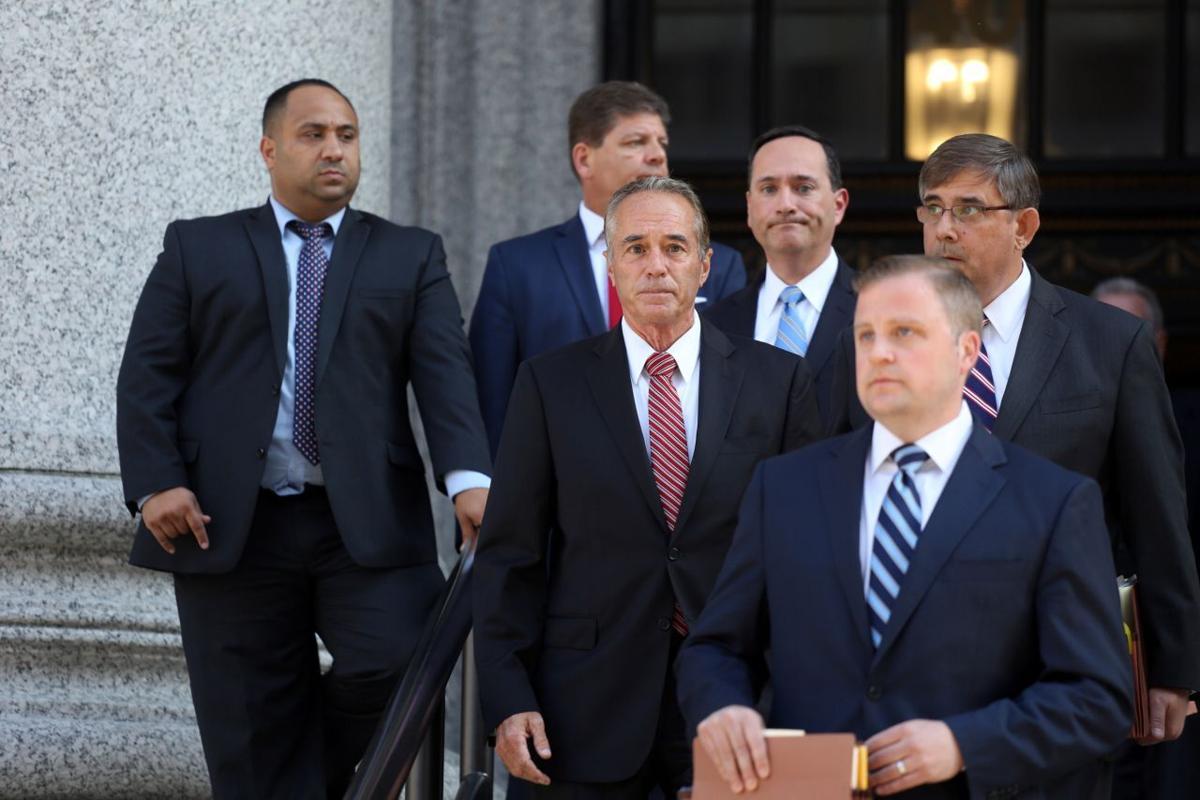
WASHINGTON – Former Rep. Chris Collins is once again asking for a delay in his prison sentence – but new court papers filed late Thursday show that he's been working for months to avoid prison entirely.
In a motion filed in federal court in Manhattan, Collins' legal team asked that his prison sentence on insider trading charges be pushed back a fourth time – from Oct. 13 to Dec. 8.
Once again, Collins' attorneys cited the Covid-19 pandemic, which has repeatedly delayed Collins' confinement in a minimum-security prison camp in Pensacola, Fla.
Collins was originally set to report to prison in mid-April.

This was the former congressman's third request to delay the start of his prison sentence.
Instead of another delay, the Collins legal team also suggested an alternative – "time-served plus a period of supervised release with the special condition of home confinement."
People are also reading…
In other words, instead of the 26 months Collins would spend in prison under the sentence a judge handed down in January, he would do time in his waterfront property in Marco Island, Fla.
When Collins, 69, walked out of the courtroom Jan. 17, it signaled the stunning end of a public life that saw him become a wealthy entrepreneur, the Erie County executive and a member of
Other court papers filed late Thursday show that's exactly what Collins has been seeking outside the courtroom for months. He's been asking the federal Bureau of Prisons, rather than the judge in his case, to commit him to home confinement rather than prison.
The Cares Act, the giant Covid-19 relief package Congress passed in March, includes language giving the Bureau of Prisons greater flexibility in adjusting the sentences of older and ill inmates in light of the pandemic. The court papers show that Collins applied to the Bureau of Prisons for a sentence at home on June 16, but that the warden of the Pensacola facility rejected that request, saying he didn't have the authority to change Collins' sentence because he wasn't incarcerated yet.
When Collins appealed that decision, he never got a reply, prompting him to file a third-level appeal on Aug. 21.
Detailing his initial application, Collins wrote: "My request detailed that in light of my age (70 years), health conditions, which include high blood pressure, asthma, and hyperlipidemia, and my vulnerability to experience severe illness or death should I be exposed to and contract the novel coronavirus (COVID· 19), extraordinary and compelling reasons exist for favorable determination of my application."
In that appeal, Collins also cited a memo by Attorney General William Barr calling on the Bureau of Prisons to consider home confinement for nonviolent felons with health issues who are at a low risk of recidivism.

The final chapter of the story will be written when Collins stands before a judge in Manhattan and learns what his sentence will
The judge will have to consider those issues now, though, in light of Thursday's court filing – and in light of the fact that for the first time, federal prosecutors are objecting to even another delay in Collins' sentence, much less a modification to home confinement.
"The government does not consent to the requested relief," Jonathan New, a Collins attorney, wrote in a court memo. "Rather, the United States Attorney’s Office for the Southern District of New York has advised that it is that Office’s assessment that the (Bureau of Prisons) safety protocols, along with the situation at (Federal Prison Camp) Pensacola in particular, are adequate."
With 13 months remaining before the next congressional election, it’s likely that Gov. Andrew M. Cuomo will call a special election to fill Collins’
A year ago this week, Collins – a Republican who represented a district between Buffalo and Rochester – resigned and pleaded guilty to charges that he gave his son Cameron an inside stock tip that allowed him to shield himself from hundreds of thousands of dollars in losses. Cameron Collins and his prospective father-in-law, Stephen Zarsky, were sentenced to probation in the insider trading case.


