
NEW YORK – Chris Collins, who once bragged about how many millionaires he made in Buffalo, ended up making three felons on a summer night in 2017: two in New Jersey and one, himself, on the White House lawn.
With cameras all around and a smoking gun called a cellphone in hand, Collins – then a candidate for a top job in the Trump White House – made a call that ensnared his son and his son's future father-in-law, Stephen Zarsky, in an insider trading scheme.
U.S. District Court Judge Vernon S. Broderick explained it all succinctly as he sentenced Zarsky on Friday.
"Your involvement in this wouldn't have happened but for Chris Collins feeling the need to tell some nonpublic information," the judge told Zarsky.
People are also reading…
That being the case, Broderick put Zarsky and Cameron Collins on probation while hitting the former Republican congressman from Clarence with a 26-month prison sentence.
Chris Collins' culpability for the crimes of others stood out as a central theme of the three sentencing hearings this month that offered plenty of rich new details about the case.
Those court sessions showed that while Chris Collins' crimes began with that phone call, they didn't end there. Collins talked his son through his stock-dumping and helped concoct a cover-up. Then he lied again and again for months on end to keep up his cover story.
But at his Jan. 17 sentencing hearing, Collins tearfully told the truth.
"It breaks my heart that my 8-year-old granddaughter is having to think Papa Chris is a criminal – not that she does – but she can't understand it," he said.
The crime
June 22, 2017, should have been a day for Chris Collins to celebrate. He was at a celebration, a White House picnic, where he was something of a celebrity.
The first House member to endorse Donald Trump and one of the president’s most outspoken defenders, Collins arrived at the White House as The Washington Post was preparing a story which would run the next day, saying he might be Trump's next chief of staff.
But then Collins checked his email.
The chairman of Innate Immunotherapeutics, an Australian biotech firm where Collins sat on the board, wrote to say the company's only product, a multiple sclerosis drug, had failed in clinical trials. That meant Collins' pet stock, the one he had touted to congressional colleagues and bought for his son when he was only 12, soon would fail, too.
Collins grabbed his phone and called Cameron in New Jersey and, after a game of phone tag, talked to him for six minutes. No one other than Chris Collins and Cameron Collins knows exactly what the congressman said and how he said it, but Cameron Collins made a few things clear in court last Thursday.
"We eventually agreed I should trade some (Innate) shares if I could," he said.
Later that night, Cameron and his girlfriend, Lauren Zarsky, drove to her parents' home in Summit, N.J. His lawyers said he didn't tell the Zarskys exactly what his father had told him – but Cameron made clear they should dump their Innate stock. They started doing so that night.
The next day, Cameron Collins started selling his Innate shares. Then he called his father.
"He seemed relieved that I could trade and seemed relieved that I would do so," Cameron told the judge.
Chris Collins had a reason for his relief. Cameron owned Innate shares worth $2.7 million at the time – all of it, according to Cameron's testimony, rooted in his father's money.
Cameron talked to his father several times over the next few days, and once even dumped some Innate stock while on the phone with his dad.
That being the case, the judge rejected the argument that Chris Collins' crime was nothing but one stupid phone call. Instead, the judge said, Chris Collins made a series of bad decisions for one bad reason.
He "just didn't want anybody to lose any money, didn't want it coming out of his own pocket," Broderick said.
The cover-up
Innate announced on the night of June 26, 2017, that its only product had failed. Within hours, Innate’s stock price sank 92%. Collins, who never dumped any of his own stock, lost at least $5 million.
But by selling some of his stock based on his father's inside tip, Cameron was able to shield $571,000 of his investment.
Then the cover-up began.
The Buffalo News noticed that on June 23, when there was a hold on trading in Innate stock in Australia – where Chris Collins' shares were held – trading of Innate shares spiked in the over-the-counter market in New York. So The News asked Collins if he, his children or chief of staff Michael Hook had dumped any of their Innate stock.
Collins’ office responded with an artfully crafted but misleading statement.
"Neither Chris Collins, Caitlin Collins nor Michael Hook have sold shares prior, during or after Innate's recent stock halt," the statement said. "Cameron Collins has liquidated all his shares after the stock halt was lifted, suffering a substantial financial loss."
The congressman responded more forthrightly in an email to a staffer that prosecutors included in their original indictment.
“We want this to go away,” he said.
It didn’t. In July, The News reported that Collins was heard just off the House floor the preceding week, apparently talking about selling Innate stock with his son, just before Innate announced more bad news.
The congressman then went on the offensive.
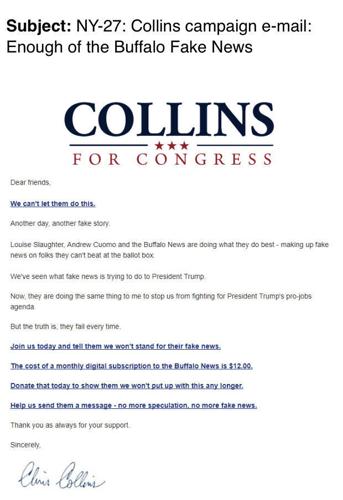
“Enough of the Buffalo Fake News” read the tagline in an August 2017 email in which he suggested that his supporters drop their $12 monthly online Buffalo News subscriptions and send the money to his campaign fund instead. Collins campaign records don’t indicate that anyone ever took him up on that offer.

The Chris Collins fundraising email from August
While the congressman bashed the media in public, in private the Collins cover-up turned criminal.
Sometime between the late June stock sales and the following spring, Collins, his son and Lauren Zarsky all decided to lie if ever questioned by law enforcement about what happened. Prosecutors said they all agreed to say that Cameron dumped his Innate shares because the trading halt in Australia spooked him.
So when FBI agents arrived at Chris Collins’ Washington apartment and the New Jersey condo that Cameron shared with Lauren Zarsky at 6 a.m. on April 25, 2018, and interviewed the three separately, they were ready.
“Christopher Collins, Cameron Collins and Lauren Zarsky told the same lie," the judge noted.
The lies
Lying to the FBI is a federal felony, one of 11 that federal prosecutors charged Chris Collins with on Aug. 8, 2018.
Facing the press over the next 14 months, Collins lied again and again.
“I acted properly and within the law at all times,” he said the night of his arrest.
“I am innocent and I’m going to fight this right to the end in court,” Collins told WIVB a month later. “And I will be exonerated.”
Weeks later, after a failed effort to replace Collins on the ballot, he agreed to run again despite the criminal charges against him.
During the campaign, Collins avoided the media and never proclaimed his innocence, his lawyer, Jonathan New, said in court. Collins campaigned largely through a series of TV ads attacking Democrat Nate McMurray. Most memorably, one ad showed McMurray speaking Korean.
“The advertisements were all focused on his opponent,” New said. “They didn’t talk anything about (Collins’) characteristics or his promises or his goals or anything for the district.”
Still, the judge said the ads implied that voters should trust Collins more than McMurray.
“I’m not saying he was out there professing his innocence, but there certainly were ads that even if they didn’t expressly say ‘trust me,' ” they said, “Don’t trust that guy,’ ” Broderick said.
Collins narrowly defeated McMurray that November and returned to Congress. Barred from committees, Collins spent his time meeting with special interest groups and filling his Twitter page with grip-and-grin photos.
Still he maintained his innocence. Speaking to reporters after a court appearance last Sept. 10, Collins said he was considering running for re-election in 2020, adding: “I look forward to being exonerated.”
Less than three weeks later, on Oct. 1, Collins resigned from Congress and pleaded guilty to conspiracy to commit securities fraud and lying to the FBI. Cameron Collins and Zarsky pleaded guilty to a conspiracy count later that week. Two months later, the three men settled separate civil charges with the Securities and Exchange Commission, with Cameron Collins and Zarsky agreeing to pay back their ill-gotten gains.
The former congressman acknowledged his guilt in an emotionless appearance before the judge Oct. 1, but Collins seemed like a different man by the time of his sentencing on Jan. 17.
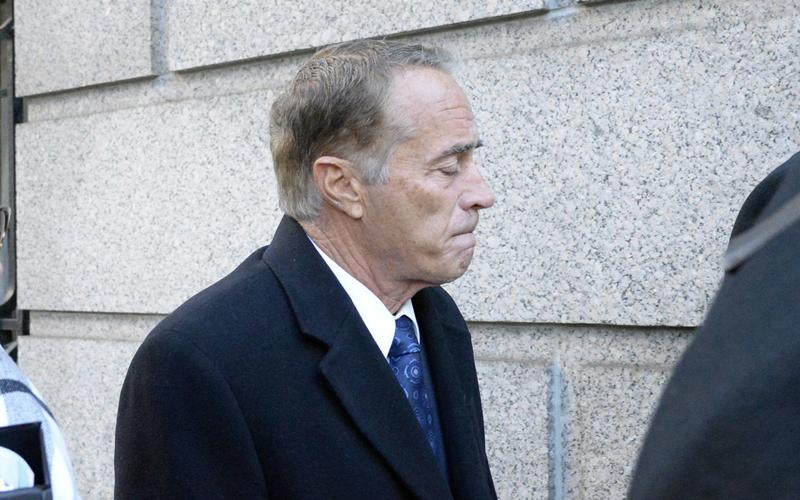
Looking years older than he did at the time of that White House picnic, Collins stood before the judge, sobbing and pleading for mercy – for himself and, he said, even more so for his son.
“The reason he is in this spot is me,” Collins said. “I am the one that made that phone call.”