

It’s been 20 years since Steven M. Gootter succumbed to sudden cardiac death (SCD), but through family and friends, the late husband, father and entrepreneur is changing the fate of those at risk from the condition that kills more than 1,000 Americans every day.
“Steve didn’t die in vain. He passed on so others can live, and our family truly believes that,” said Andrew Messing, Steve’s brother-in-law and President of the Gootter-Jensen Foundation.
Founded in 2005 as the Steven M. Gootter Foundation, the nonprofit was among the first nationwide dedicated to eradicating SCD. It has implemented a multi-pronged plan of increased awareness; education; scientific research; and the distribution of automated external defibrillators (AEDs), which have been proven to improve survival rates in out-of-hospital cardiac arrest.
“We are trying to get the word out about Sudden Cardiac Death, and through research, we are trying to find a cure. Until we find a cure, we are trying to keep people alive with AEDs,” Messing said.
People are also reading…
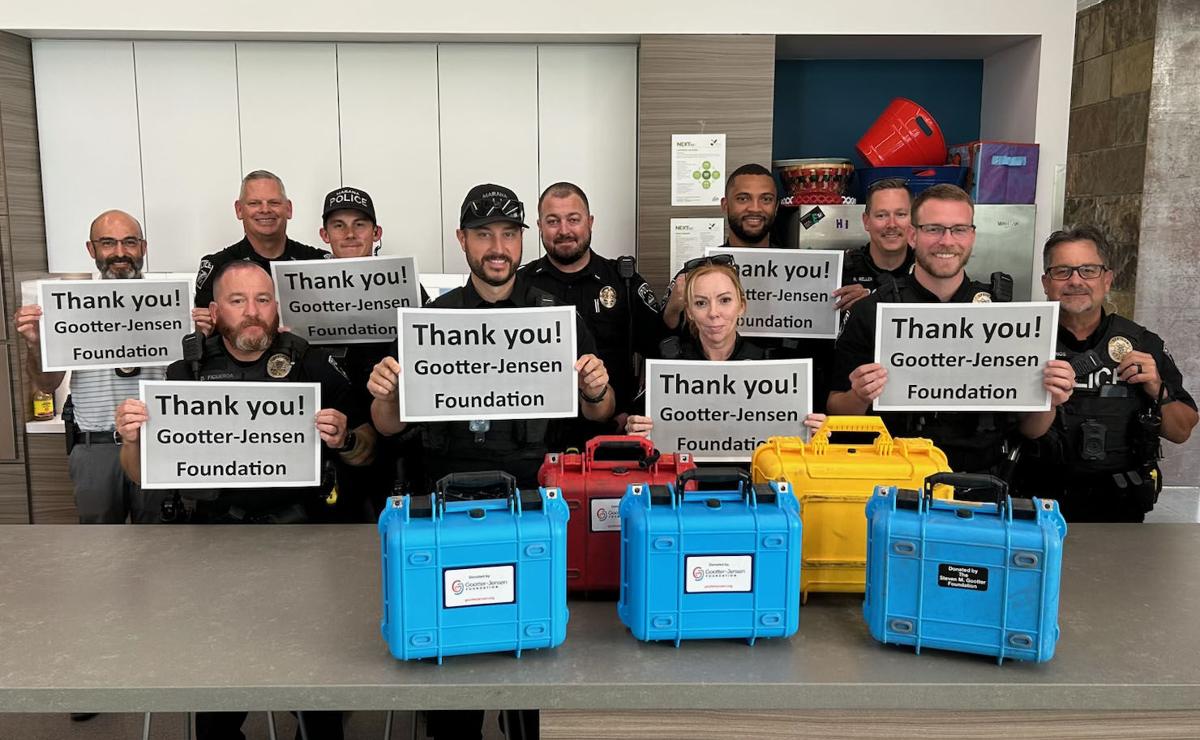
The foundation has distributed more than 500 AEDs in Southern Arizona in spaces where people work, worship and play. Last year, it gifted more than 50 AEDs locally to various non-profit organizations, including the Community Food Bank of Southern Arizona and Youth On Their Own; churches; and the Marana Police Department, where AEDs are placed in the vehicles of first responders. It has also begun distributing AEDs to public tennis centers beyond Tucson.
In 2023, the profile of the foundation — and sudden cardiac death — was raised when former professional tennis player and Grand Slam doubles champion Murphy Jensen joined the organization following his collapse during a tennis exhibition and subsequent revival with an AED.
“The nice thing about joining forces with Murphy is that we feel he lived for a bigger reason,” Messing said. “Unlike Steve, Murphy can tell his story. Murphy experienced sudden cardiac death and was gone, but they used an AED to bring him back to life and now his mission is to make sure the tragedy that our family went through doesn’t happen to others.”
The partnership has extended the reach of the Gootter-Jensen Foundation and highlighted the necessity of placing AEDs in recreational facilities. Currently, only about one-third of public tennis centers nationwide are equipped with AEDs and the foundation is working to change that.
“Murphy was truly blessed that the location where he was playing had an AED .... we are working with the U.S. Tennis Association to help distribute AEDs to make sure that when people play tennis or pickle ball they are in safe environments to do so,” Messing said.
The foundation also continues to prioritize funding of cutting-edge research through partners such as the UA Sarver Heart Center and the Stanford Cardiovascular Institute. It has funneled more than $4.5 million into research, and many studies have received additional funding from the National Institutes of Health and the American Heart Association.
Messing is particularly excited about the latest research.
One study is investigating causes of cardiac arrhythmias (abnormal heart rhythms, which are an identified cause of SCD) on the molecular level and examining links with exposure to microplastics and air pollutants known as PM2.5. The study will also evaluate new therapeutics that can mitigate cardiac toxicity after exposure to these environmental pollutants.
“This study is very topical right now,” Messing said. “When you think of the L.A. fires, there is so much pollution from those ... and there are so many studies about microplastics, which have been shown to cause cardiac stress. These are not going to go away, so it is important to find ways to counteract the cardiac inflammation that these pollutants cause.”
The second study is a clinical trial to test the organic compound, Genistein, which is found in soybeans. The naturally occurring isoflavone has anti-inflammatory, antioxidant and neuroprotective properties and has been proven to substantially reduce vascular inflammation in animal and in-vitro studies.
“We already know that Genistein has been proven to work, so this clinical trial on humans is really important to determine dosages and how it should be used,” Messing said. “There are some people who can’t tolerate medications like statins, so if Genistein, which is totally natural, can do the same trick as some medications, that could be really valuable for our society.”
Messing is also gratified that Gootter Endowed Chair Dr. Jil C. Tardiff was recently named Associate Director of UA Sarver Heart Center. Tardiff will be a speaker at the upcoming 20th Annual Gootter-Jensen Foundation Grand Slam Gala Dinner at 6 p.m. on Friday, May 9, at the Westin La Paloma Resort & Spa, 3800 E. Sunrise Drive.
“Her clinic is the only one like it in the Southwest for people who suffer from hypertrophic cardiomyopathy. People come from all over to her clinic and she is getting really great results. We are really lucky to have her in Tucson and she has said countless times that she appreciates the funding our foundation has given her and many of the studies she has done that have received national attention couldn’t have been done without it,” Messing said.
Ultimately, Gootter’s entire family is honored by the support from generous friends, sponsors and donors who have facilitated the foundation’s work.
“We thank everyone for honoring our son Steve’s life in a way that has saved the lives of many others ... we are humbled by the support of our community that has enabled us to accomplish so many meaningful initiatives since 2005,” said Paulette Gootter. “We have held true to our mission to defeat sudden cardiac death.”


