

Hopi Tribe
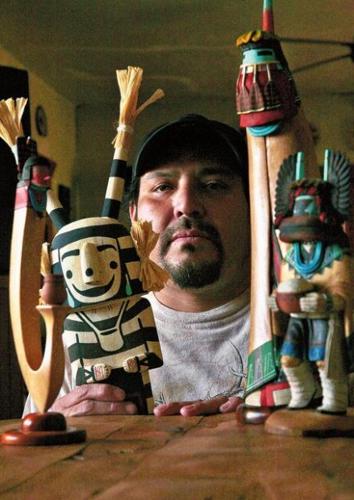
Lawrence LeAllen Acadiz is a self-taught Hopi katsina carver.
For 22 years, Acadiz has been sculpting cottonwood roots into the Hopi mythological figures that teach children about their religion.
Acadiz's roots come from Hopi lands that cover 1.56 million acres in Northeastern Arizona, lands the Hopi have inhabited since the 12th century. The reservation consists of three major mesas — First Mesa, Second Mesa and Third Mesa — that rise up to 7,200 feet.
According to their legends, the Hopi migrated to Arizona from South America, Central America and Mexico. They live by the ethic of peace and good will. They are farmers, potters, carvers, silversmiths and basket weavers.
Katsina
The Hopi believe that a katsina — they prefer this spelling to "kachina" — is a supernatural being who once lived in the spirit of a good person and has returned as a messenger.
People are also reading…
Katsina manifestations can be from an animal to a cloud, and appear on the Hopi mesas on a seasonal basis. There are more than 200 katsinas.
Katsinas are prayed to for a plentiful harvest, rain, good health and a prosperous life.
Every year Acadiz, accompanied by other carvers, goes in search of the cottonwood roots in dry washes. "We find it as driftwood or uprooted trees. I bring back a truckload of the root at least once a year," said Acadiz, who works out of a studio in his home on Tucson's South Side.
The 42-year-old carver describes himself as an "urban Indian" who stays connected to his culture through this art form that takes a lifetime of dedication.
Acadiz is a Cholla High Magnet School graduate who attended the Institute of American Indian Arts in Santa Fe, N.M.
His katsina dolls sell for $40 up to $10,000. They can be found at the Phoenix Heard Museum Indian Fair & Market each spring, and in Tucson at the Kaibab Courtyard Shops, 2837 N. Campbell Ave.; Spirit Mountain Trading, 845 E. University Blvd.; and Grey Dog Trading Co., 2970 N. Swan Road, #138.
Acadiz sculpts traditional, contemporary and old-style katsinas.
A traditional doll can be used in a ceremony. A contemporary doll is an artistic piece to show and admire. An old-style doll is comparable to a museum piece that does not have much detail. It is adorned with feathers, leather and shells.
Family history
Acadiz comes from a direct line of katsina carvers, including his great-grandfather, Fritz Soomah, head of the Mudhead Society. The mudhead is a multifaceted clown. Soomah gave Acadiz his first Hopi name, Chutima, a cottontail jumping — depicting his energy level.
Acadiz's great-uncles, Guy and Alfred Fritz, and uncles Lorenzo and Johnny Martin are also katsina doll carvers. Ella Soomah, his great-grandmother, and grandmother Amelia Martin are potters.
Acadiz remembers spending time as a child at his grandmother's house in Sichomovi, which was founded in 1750 on First Mesa, and seeing Hopi katsina carvers. The seed was planted, and Acadiz believed that he would carve someday.
Inspiration
In time, he observed his uncles and picked up pointers. Acadiz spent time with his uncle Lorenzo and aunt Norma at their home in Hotevilla on Third Mesa. "I felt at home and learned from them about my culture," said Acadiz.
"I am Mexican and Hopi, and carving for me is to show that I am Hopi.
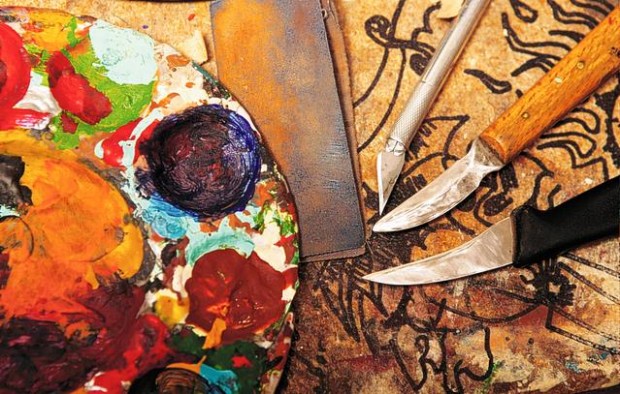
"It is important to me that other Hopis respect my art for what it is. I want my artwork to be credible in their eyes. Their opinion means more to me than that of any of the collectors," said Acadiz, who counts deer, rams, antelope, corn and rain katsinas among his pieces. His tools include pocketknives and a motorized hand tool to grind excess wood.
Respect
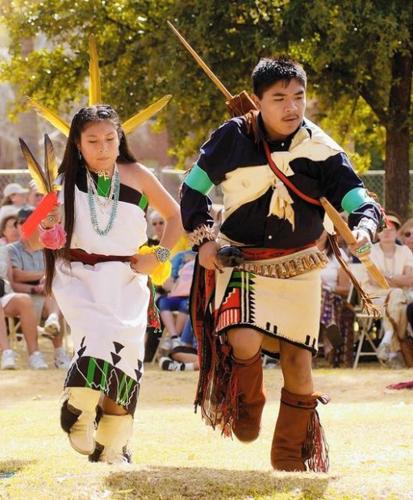
Acadiz said he wants visitors to Hopi lands to be respectful when witnessing ceremonies. "There is no talking or pointing. You are there to observe it for the entire world. The only picture you can take is the one in your mind," said Acadiz.
He said there are some villages and ceremonies that are not open to the public, and it is best to check with the Hopi Cultural Center before making the trip.
According to the Hopi Tribe, the Community Development Office of each village and the tribe's public relations office can also offer information.
In addition to the cultural center, located in Second Mesa with a museum, a motel and a restaurant, other tourist attractions are Honanie Gallery, flea markets and the Hopi Silvercraft Cooperative Guild.


