
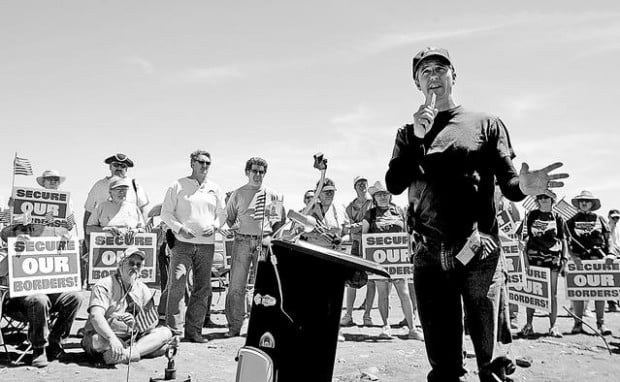
The Minuteman Civil Defense Corps has released its federal income tax filing and an independent financial audit for its 2005 operations in response to critics who once were original Minuteman Project members.
According to the audit by SalmonBeach & Associates of Dallas, the civilian border-watch organization took in about $418,000 in donations and registration fees but spent $449,493 during the year on its operations. The nonprofit group was $31,174 in the red as it entered 2006.
According to the Minutemen's 2005 tax filing with the Internal Revenue Service, which the group released last week along with the auditor's report, the group spent $280,920 on programs supporting its advocacy of border security between its creation in April 2005 and the end of the year. The group spent slightly more than $23,000 on general expenses and $145,000 on fundraising activities.
People are also reading…
That left a loss of $31,174, which Minuteman spokeswoman Connie Hair attributed to a special assessment for January 2006 that needed to be paid for in 2005.
According to Hair, the auditors said, "We were clean, with no derogatories."
The Minuteman Civil Defense Corps is devoted to halting illegal immigration along the nation's borders, and it stages border-watch activities principally on or near the Mexican border.
It trains and deploys volunteers in organized stationary "patrols" to observe illegal entrants and their smugglers, and report sightings to the U.S. Border Patrol.
Chris Simcox, the group's president, said the initial purpose of the audit was "to show due diligence with our fiscal responsibility to the IRS to hopefully expedite our much-delayed nonprofit status."
Simcox said the organization sought IRS nonprofit status more than six months ago but has not received it yet. He said the audit was done to satisfy the IRS but was also helpful in the wake of questions raised over the summer about how the group had spent donations.
"We've shown everything is in tiptop shape; everything has been accounted for," Simcox said. "We have always used proper accounting procedures."
The group is an offshoot of the Minuteman Project, formed in late 2004 and early 2005 by Simcox and retired California accountant Jim Gilchrist to conduct a monthlong patrol along parts of the Arizona border.
Afterward, the two men split and created separate organizations — Gilchrist keeping the Minuteman Project name and Simcox organizing and heading the Minuteman Civil Defense Corps.
Simcox organized another monthlong watch in October 2005, then repeated the efforts in April and October this year, while Gilchrist organized a separate watch effort under his group's auspices.
In a statement accompanying the documents filed by the Nov. 15 federal deadline, the Minuteman Civil Defense Corps referred to "outright malicious lies about the status of MCDC finances."
Gary Cole, once the Minutemen's former national director of operations, told The Washington Times in July, "We can't demand that the government be held accountable for failing to control the border if we can't hold ourselves accountable for the people's money."
Simcox said that all those who spoke critically in the newspaper article but Cole left after the initial Minuteman Project in April 2005 and before the Minuteman Civil Defense Corps was organized.
Cole, who was the Civil Defense Corps' operations director, did not return a call seeking comment on the filing with the IRS or the audit report.
According to the IRS filing, of the Minuteman Civil Defense Corps' total income of approximately $418,000, about $112,500 came from a grant by the Declaration Alliance, a public-policy and issues-advocacy organization headed by Alan Keyes, a one-time presidential and U.S. Senate candidate and a Minuteman supporter.
Hair said the remaining $305,993 in contributions came through individual donations.
Critics have suggested that Keyes' organization was handling and processing the Minuteman-intended donations — and possibly taking a cut.
Simcox said that to date, the organization has raised about $1 million in cash donations, including about $600,000 for fencing projects. That does not include donations of high-tech fencing materials.


 Second wall planned across Arizona as Trump administration doubles down on border